


CHINA J-VALVES Offers Various High-quality I ndustrial Ball Valves
J-VALVES, a distinguished professional ball valve manufacturer rooted in China, takes pride in its extensive product portfolio. Our offerings span a wide range, including trunnion-mounted ball valves, floating ball valves, high-temperature ball valves, high-pressure ball valves, metal-sealed ball valves, ultra-low temperature ball valves, DBB ball valves, Three-way And Four-way Ball Valve, and fully welded ball valves. Each product is a testament to our commitment to precision engineering and reliable performance. Meticulously crafted, they are designed to not only meet but exceed the most stringent industrial demands, ensuring stable operation even under extreme conditions. This enables us to provide our clients with high-value services and makes our valves widely sought-after in industries.
Product Category
Contact Us

-
J-VALVES-Q367F
-
J-VALVES
Overview of the J-VALVES three piece butt welded trunnion mounted ball valve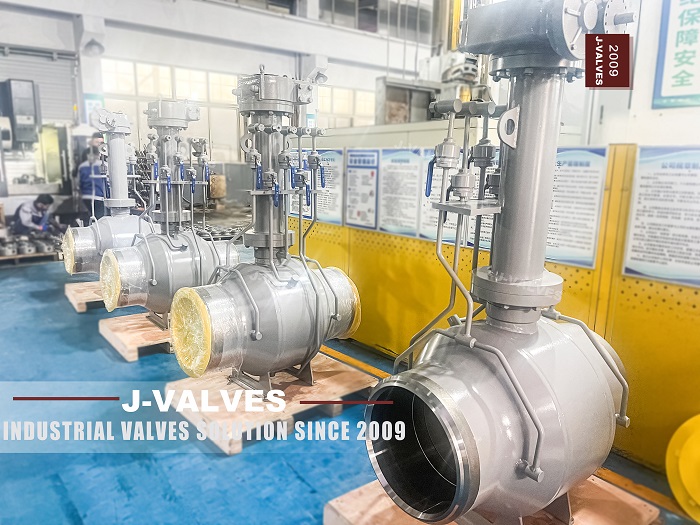
The phrase fully welded gets used loosely on this site. A valve with butt weld ends and a body that opens in the middle is not fully welded, and calling it that hides the one thing a buyer needs to know: the gaskets are still there. This page is about a three piece valve whose ends are welded to the pipe and whose body still comes apart, which makes it a different animal from a sealed shell and a different animal from a flanged valve.
The construction is a centre body carrying the ball, the seats and the trunnions, closed by a left and a right body. The two closing joints are bolted and gasketed. The ends of those side bodies are bevelled and welded to the line. So the pipeline sees two welds it cannot undo, and the valve keeps two joints it can, and every maintenance decision on the valve follows from that arrangement.
What the arrangement buys is worth stating before what it costs. A flanged valve leaks at two flange joints and can be unbolted in an hour. A welded shell has no joints and cannot be opened at all. This valve has no flange joints and can be opened, which is why it turns up on lines where a shutdown is expensive but not impossible, and where the valve has to be inspected without cutting the pipe.
Design and Construction
The centre body is a single casting or forging with a bore through it, a seat pocket at each side, and a trunnion bore at the top and the bottom. The ball runs on those two trunnions in bearings, so the pressure load goes into the body rather than into the seats, and the seats only have to bridge the gap between the pocket and the ball. That is what makes the valve turn with a low torque and what makes a gearbox practical at large sizes.
The side bodies carry the weld ends. Their bore matches the centre body, their faces are machined for the gasket, and their outer ends are bevelled to a profile: either the ASME B16.25 shape with its own root face and included angle, or the EN 12627 shape, which is a different geometry. The two profiles are not interchangeable, and a valve machined to one will not fit a pipe prepared to the other without recutting.
That count is the whole page in one line. Two welds, two gaskets, and between them a valve that can be opened. The photograph also shows how close the body joint sits to the weld end: on a small valve the two are almost touching, which is why the weld heat has to be managed rather than poured in, and why a heat sink on the body is worth asking for on a soft seated valve.
The seats are the other decision. A polymer seat in PTFE, RPTFE, PEEK or nylon is the standard arrangement and gives tight shut off at moderate temperature. A metal seat with a hardfaced ring is the option for high temperature, for abrasive media, or for a fire case where the polymer is expected to burn away. The two are not a grade: a metal seat is harder to make tight, needs more torque, and is chosen for a reason.

The Ends Are Welded, The Body Is Not
A page that says a welded valve eliminates external leakage is making a claim about flanges, and the claim is true as far as it goes. What it does not say is that this valve has two gasketed joints of its own, and that a gasket is exactly the leak path the weld was supposed to remove. The honest statement is narrower: the pipeline joints are welded, so there is no flange to leak at, and the body joints are bolted, so there are two places where a leak can start and two places where it can be stopped.
| Connection | What It Removes | What It Keeps | Who Can Open It |
|---|---|---|---|
| Flanged both ends | Nothing at the pipe | Two flange joints, two gaskets, eight or more bolts each | Any fitter with a spanner |
| Butt weld both ends, one piece body | Every joint between pipe and body | The body itself, which never opens | Nobody |
| Butt weld both ends, three piece body | Every joint between pipe and body | Two body joints, two gaskets | A crew with a shutdown and a torque wrench |
That table is the argument for this valve and the argument against it at the same time. The two body joints are a maintenance feature, not a defect, but they are also two additional leak paths that a sealed shell does not have. On a line where a gasket leak is unacceptable, the sealed body wins. On a line where the valve has to be inspected every few years, this one wins, because the alternative is cutting the pipe.
The second thing the welded end changes is who makes the joint. In the shop, the bevel is machined, the fit is checked against a gauge and the weld is made by a qualified welder under a procedure that has been tested. In the field, the bevel meets a pipe end that was cut on site, the gap is set by the fitter, and the weld is made in whatever weather the schedule allows. The valve is the same; the joint is not, and the inspection plan has to follow the joint.
That is why the two bevel profiles matter more than they look. ASME B16.25 defines a profile with a specific root face and included angle, and EN 12627 defines another. A pipe end prepared to one and a valve end machined to the other will close up with a gap that is either too wide or too tight, and a welder who compensates by filling the gap has made a joint that will not pass a radiograph. The order has to name the profile, and it has to name the pipe wall it will meet.
Technical Specifications
The range below is the factory data with the seat and bearing materials written as material classes rather than trade names, because a trade name in a specification line is a single source that the buyer did not ask for. Where the original page offered a proprietary cobalt alloy or a proprietary nickel alloy, the table says cobalt based hardfacing and nickel alloy, and the certificate names the actual grade.
| Item | Value |
|---|---|
| Size range | 2 inch to 56 inch, DN 50 to DN 1400 |
| Pressure class | Class 150 to Class 2500, PN 20 to PN 420 |
| Temperature | Minus 29 to plus 425 Celsius, carbon steel body |
| Body and ends | ASTM A105, A350 LF2, A182 F304, F316, F51, F53 |
| Body style | Three piece, centre body with two bolted side bodies |
| Ball | Matching the body steel, hard chrome or nitrided |
| Trunnion and bearing | 440C with self-lubricating bearings, or nickel alloy |
| Stem | 17-4PH, A182 F316, or F51 |
| Seat, soft | PTFE, RPTFE, PEEK, nylon as an auxiliary seal |
| Seat, metal | Cobalt based hardfacing on a stainless ring, as the primary seal |
| Packing | Flexible graphite, wire reinforced |
| Body gasket | Spiral wound stainless with graphite, or ring joint |
| End connection | Butt weld to ASME B16.25 or EN 12627, named on the order |
| Face to face | ASME B16.10, measured over the body |
| Operation | Gearbox, pneumatic, electric, hydraulic, electro-hydraulic |
| Design standard | API 6D and ASME B16.34, API 608 within DN 600 and Class 600 |
| Test standard | API 6D and API 598 |
| Coating | Three layer polyethylene, fusion bonded epoxy or paint |
The line worth arguing about is the design standard. This valve is offered to fifty six inches and Class 2500, and API 608 does not reach either end of that: it stops at DN 600 and Class 600. A valve above that ceiling is an API 6D valve, and a data sheet that lists 608 beside a fifty six inch size is a data sheet written by copying a smaller page. It matters because a certificate is written against a standard, and a certificate to a standard the valve is outside of is not evidence of anything.
Standards and Compliance
Six documents shape this valve, and each of them stops at a boundary that the next one picks up. Knowing where each stops is how a buyer reads a data sheet without being misled by a list of numbers. The pattern is that the valve standards describe the valve and the pipe standards describe everything the valve is welded to, and the two only meet at the bevel.
| Document | What It Fixes | Where It Stops |
|---|---|---|
| API 6D | Classes, cavity relief, test, marking | At the weld end, and at DN 600 for 608 |
| ASME B16.34 | Wall and pressure temperature ratings | At the body, not the pipe |
| ASME B16.10 | Face to face for the size and class | At the body joints, which add length |
| ASME B16.25 | The weld end profile | At the pipe end it has to match |
| EN 12627 | The European weld end profile | At a pipe prepared to B16.25 |
| API 598 | Shell and seat test at ambient | At the temperature the line actually runs |
| NACE MR0175 | Material limits for sour service | At the hardness of the weld, which is measured |
The two that get confused are B16.25 and EN 12627, and the confusion is expensive because it is discovered at the trench. A valve machined to one profile cannot be made to fit the other by a fitter with a grinder; the end has to be recut, which on a coated valve means cutting back the coating as well. If the line is being built to a European specification, the order has to say so, and the drawing has to show the profile.
The face to face line is the second trap. ASME B16.10 gives a length for a valve of a given size and class, and that length is measured over the body, not over the weld ends. A three piece valve with long weld ends is longer than the table value, and on a tie-in with a fixed gap that difference has to be known before the pipe is cut, not after.
Manufacturing Process
The centre body and the side bodies are cast or forged, then machined. The seat pockets are cut to take either a soft seat or a metal ring, and the trunnion bores are line bored so that the upper and lower bearings are concentric; a pair of bores that are out of line will make the ball bind at pressure even though it turns freely on the bench. The gasket faces are machined and then checked with a straight edge and a feeler, because a face that is out by a few hundredths will leak at the outer edge of the gasket and nowhere else.
The weld ends are bevelled last, after the body has been assembled and tested, because the bevel is the dimension that has to match the pipe and any handling damage is visible there. On a valve that will be coated, the bevel is masked rather than coated, and the mask extends back far enough for the field weld and the field joint.
Assembly is the step that decides whether the valve can be maintained. The ball goes into the centre body, the seats and their springs go into the pockets, the stem goes down through the top bore and is pinned or keyed to the ball, and the side bodies are drawn up on their gaskets with a controlled torque in a cross pattern. The torque pattern matters because an uneven pull distorts the gasket face and the leak appears on the side that was tightened last.

Quality Control and Testing
Every body is hydrostatically tested before the ends are bevelled, so that a shell defect is found while the valve can still be reworked. The seat test follows assembly and is done in both directions, with the cavity monitored, because a seat that holds from one side and leaks into the cavity will pass a single direction test and fail in service. On a metal seated valve the test is done at both low and high pressure, since a metal seat that seals cold may not seal hot.
The weld ends get their own inspection. The bevel angle and the root face are gauged, the bore is checked for ovality, and the end is checked for the correct wall at the bevel so that the pipe and the valve meet with a matching thickness. A valve with a thick end welded to a thin pipe makes a joint with a step on the inside, which is a corrosion trap and a radiograph reject.
The body joints are checked by pressure, not by torque. After the seat test the body joints are examined for weeping at the gasket line with the cavity pressurised, and on a valve that will go into sour service the bolting is checked for the correct grade and for the correct lubrication, because a dry stud gives a false torque reading and a false sense of security.

Applications and Industry Service
This valve turns up where a line has to be welded and a valve has to be inspectable. Metering stations, compressor station piping, tank farm headers and terminal manifolds all have that shape: the pipe is welded for leak integrity, and the valves are expected to be opened for inspection on a turnaround rather than replaced. A three piece welded end valve does both, which is why the design survives despite the extra joints.
It also turns up on sizes and classes where a sealed shell is impractical. A fifty six inch Class 900 valve with a fully welded body has to be assembled through the ends and cannot be corrected afterwards, and the risk of that is high enough that some operators prefer the bolted body. The three piece design accepts two gaskets in exchange for the ability to open the valve and fix what is inside.
The third case is a line that will be modified. A tie-in that may be re-routed in five years, a manifold that may gain a branch, a station that may be expanded: all of them favour a valve that can be unbolted from its internals even though its ends are welded, because the internals are what wear and the ends are what stay.

Installation, Operation and Maintenance
The installation sequence is short and unforgiving. The pipe ends are prepared to the profile named on the order, the valve is aligned so that the bore matches and the gap is even all round, and the root is tacked before the root pass is run. Heat input on a soft seated valve has to be controlled, because the seat is a few centimetres from the weld and polymer does not tolerate a hot body. A heat sink or a wet wrap on the body, and a temperature check on the shell during the weld, is cheap insurance.
After the weld the joint is inspected to the level the line specification requires, coated, and tested. Then the valve is stroked once, in both directions, with the line at working pressure if the procedure allows it. That stroke is the first real test of the assembly: a valve that was free on the bench and binds in the line has usually been distorted by the weld, and finding that at commissioning is much cheaper than finding it at a shutdown.
Maintenance is the reason to buy this design, and it comes with a bill. Opening the body means isolating the valve, venting both sides, draining the cavity through the drain port, proving the cavity is empty, and then unbolting the side bodies in a cross pattern. Every opening consumes two gaskets and disturbs four sealing faces, and the bolting has a limited number of makeups before it should be replaced. That is the price of being able to look inside, and it belongs in the maintenance budget rather than in the emergency plan.
How to Specify and Order
The order has to settle the bevel, the gaskets, the seat and the standard. Three of those are engineering choices; the fourth is a correction, because a valve above DN 600 or Class 600 cannot carry an API 608 certificate and should be ordered to API 6D. Writing the four lines below is the difference between a valve that fits the line and a valve that has to be recut at the trench.
| Line on the Order | What to Write | Why It Matters |
|---|---|---|
| Weld end profile | ASME B16.25 or EN 12627, and the pipe wall | The two profiles do not interchange |
| Face to face | B16.10 value plus the weld end length | The table length is over the body |
| Body gasket | Spiral wound with graphite, or ring joint | It is the leak path the weld did not remove |
| Seat | Soft polymer, or metal with cobalt based hardfacing | Decides torque, temperature and fire behaviour |
| Bolting | Grade, coating and the torque pattern | A dry stud reads false |
| Design standard | API 6D, with 608 only inside DN 600 and Class 600 | A certificate outside the scope proves nothing |
| Test | Shell, seat both directions, cavity monitored | One direction hides a cavity leak |
| Weld heat input | The limit and how it is checked | The seat is close to the weld |
| Radiography | Extent and acceptance level on the field joint | The joint is made on site, not in the shop |
| Coating and masking | System, and the length masked at the bevel | Coating on a bevel cannot be welded |
FAQ
Q: Is a three piece valve with welded ends a fully welded valve?
A: No. The ends are welded to the pipe, so the pipe joints cannot leak at a flange, but the body still closes on two gasketed joints that can be unbolted. A fully welded valve has a sealed shell with no body joint at all. The two designs remove different leak paths and neither one removes both.
Q: Why buy a valve that keeps two gaskets if a sealed shell has none?
A: Because it can be opened. The ball, the seats and the stem can be replaced with the valve still welded into the line, which a sealed shell does not allow. On a line where a turnaround inspection is planned, that is worth two gaskets; on a line where a gasket leak is unacceptable, the sealed shell is the right answer.
Q: What is the difference between ASME B16.25 and EN 12627 ends?
A: Both define a weld end profile, and the profiles differ in root face and included angle. A valve machined to one will not fit a pipe prepared to the other without recutting the end, which also means cutting back the coating. The order has to name one of them, and the pipe preparation has to follow the same document.
Q: Is the face to face dimension in ASME B16.10 the overall length?
A: No. B16.10 gives a length for the valve size and class, measured over the body. A three piece valve with long weld ends is longer than that value, and the difference has to be known before the pipe is cut, because the tie-in gap is set by the overall length rather than by the table.
Q: Can the metal seat option be fitted to the same body later?
A: The seat pockets are machined for one arrangement or the other, so the decision is made when the body is made. A polymer seat and a hardfaced metal seat also need different springs and give different torque, which changes the gearbox or the actuator. Ordering the seat as an option to be decided later is not possible.


Hot Products


News
A Ball Valve Is A Tuning Fork: Vibration, Fretting And The Joints That Only Hold By Friction
A ball valve holds seat, stem and body joint by preload alone. Vibration turns that preload into micro-motion, and the wear arrives with no cycle at all.
Read More
Urea Plant Ball Valves: The Wetted Path Survives Only While Oxygen Is Being Fed To It
Carbamate at 150 bar and 185 C eats stainless 50 times faster once the passive film starves. The valve cavity is where the oxygen runs out first.
Read More
Stiction: What A Ball Valve Becomes When Nobody Turns It
A valve that stood closed for years has not worn out. The seat has bonded to the ball, and the first stroke is a step, not a ramp. What the trace shows.
Read More
Molten Salt Ball Valves: The Valve Works at 565 C And Dies at 219 C
Salt freezes at 220 C and decomposes at 565 C. Everything a molten salt ball valve does happens in that 345 kelvin gap, and the gap is not generous.
Read More