


CHINA J-VALVES Offers Various High-quality I ndustrial Ball Valves
J-VALVES, a distinguished professional ball valve manufacturer rooted in China, takes pride in its extensive product portfolio. Our offerings span a wide range, including trunnion-mounted ball valves, floating ball valves, high-temperature ball valves, high-pressure ball valves, metal-sealed ball valves, ultra-low temperature ball valves, DBB ball valves, Three-way And Four-way Ball Valve, and fully welded ball valves. Each product is a testament to our commitment to precision engineering and reliable performance. Meticulously crafted, they are designed to not only meet but exceed the most stringent industrial demands, ensuring stable operation even under extreme conditions. This enables us to provide our clients with high-value services and makes our valves widely sought-after in industries.
Product Category
Contact Us

-
J-VALVES-Q9347F
-
J-VALVES
Overview of the J-VALVES DN65 PN420 A105 metal seated trunnion ball valve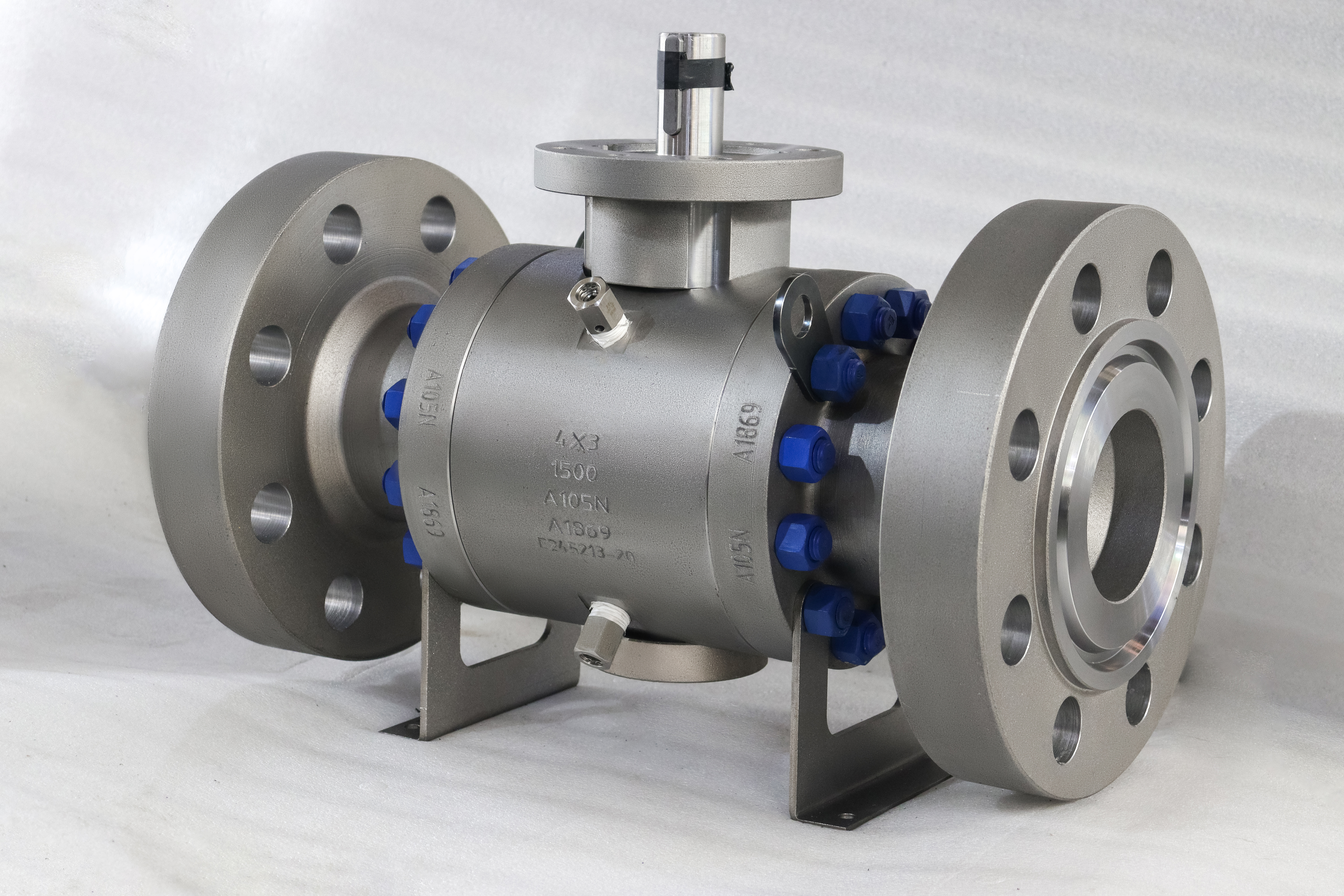
A 2500 class ball valve is not held together by its seats. The pressure acting on a closed ball produces an axial force that has to go somewhere, and on a trunnion valve it goes into two shafts and the bearings around them, which carry the ball and let it turn. The seats only have to seal. Everything the page says about the seat, the hardfacing and the leakage rate sits downstream of that one fact.
So the parts that decide whether this valve opens on the fifth year are the two bearings, and the specification on this page mentions them in a single line: 440C stainless with self lubricating bearings, or a nickel alloy. That line hides a choice between two different bearings with different limits, and the choice is made by temperature and by how long the valve sits still under pressure.
This page reads the valve in the order it actually fails. Bearings first, because a brinelled or galled bearing turns the torque into the stem and the stem is the smallest part in the drive train. Seats second, because a metal seat that is accepted against a rate is not a seat that leaks zero. Body and ends last, because at DN65 the body is not the interesting part.
Design and Construction
The body is three pieces: a left body, a right body and a centre section, bolted together at two joints. The centre section holds the ball and both seats, and that is the reason for the split. Both seat pockets can be bored from the two faces of one centre section in one setting, so the two seats are coaxial by machining rather than by assembly, and each of the three pieces can be forged on its own and inspected before it is bolted to anything.
The ball is carried by an upper and a lower trunnion. Those shafts do not turn the ball; the stem does that. Their job is to hold the ball in place while the pressure tries to push it downstream, and to let it rotate with as little friction as the design can arrange. Because the shafts take the thrust, the seats are relieved of it, which is why a 2500 class trunnion valve can still be turned by a gearbox while a floating valve of the same bore could not be turned by anything a person could apply.
The bearing sits between the trunnion journal and its housing. It is not a pressure boundary part, but it is inside the cavity and it is wetted, so the medium reaches it. Two things follow. The bearing has to resist the process fluid as well as the load, and its clearance sets how far the ball can move inside the cavity. Too much clearance and the ball drifts off the seat centre line, the preload is lost and the ball hammers against the seats each time the valve is cycled.
The stem is a separate part and takes no side load. It passes through packing and a shoulder that keeps it in the body if the gland is removed with the line live. On a 2500 class valve the stem is also the torque bottleneck: if the bearings seize, the gearbox keeps turning and the twist goes into the stem, which is why a torque reading that climbs between services is a bearing symptom rather than a seat symptom.

Material Options
A105 is a forged carbon steel for room and moderate temperature service, and the normalized condition on this page is the one that gives a uniform grain size and predictable toughness. On a 2500 class body, wall thickness comes from the material group table in ASME B16.34, and carbon steel is a heavier group than stainless for the same rating, which is the price of using it. What it buys is strength and cost at ambient temperature, and a body that does not depend on alloy content for its ratings.
| Part | Material on This Build | What It Decides |
|---|---|---|
| Body, centre section, ends | ASTM A105 forged carbon steel, normalized | Wall, weight, and the rating at temperature |
| Ball | A105 with hardfacing, or 17-4PH | The sealing band and its wear life |
| Seat | A105 with hardfacing | The rubbing pair against the ball |
| Stem | 17-4PH or 316 | Torque capacity and packing wear |
| Trunnion journal | Surface hardened, running in the bearing | Ball location and friction |
| Bearings | 440C stainless, or a lined self lubricating type | Load, temperature and service life |
| Packing | Flexible graphite | The stem seal above 200 Celsius |
| Bolting | A193 B7 with A194 2H | Joint preload at 2500 class |
| Ends | Ring joint flange to ASME B16.5 | The metal seal at the pipe joint |
The bearing line is the one that needs splitting. A 440C bearing is a hardened martensitic stainless journal running against a hardened race or a dry film, and it works on hardness and surface finish. A lined bearing is a thin low friction liner in a metal shell, and it works on the liner, which has its own load limit and its own temperature limit. They are not two brands of the same thing, and the page's phrase self lubricating covers both.
The same is true of the hardfacing, which the page names by trade name in two places. A purchase order should carry the alloy designation rather than the brand, because the brand says who made the powder and not what the deposit is. What matters at the seat is the deposit hardness, the finish after lapping and the fact that the ball face and the seat face are not the same alloy, so the pair cannot weld itself together under load.
Technical Specifications
The table below is the build, with the items the page leaves open marked as open. Nothing in it is a conversion: the class is written as the class, and the ends are written as the ends.
| Item | Value |
|---|---|
| Size | DN 65, two and a half inch |
| Class | Class 2500, PN 420 |
| Body | ASTM A105 forged carbon steel, three pieces |
| Ball | A105 hardfaced, or 17-4PH |
| Seat | Metal to metal, A105 hardfaced |
| Bearings | 440C or lined self lubricating, grade to be named |
| Temperature | Minus 29 to plus 425 Celsius |
| Ends | Ring joint flange, ASME B16.5 Class 2500 |
| Face to face | ASME B16.10 |
| Design | ASME B16.34 and API 6D |
| Test | API 598 and API 6D |
| Operation | Gear as standard, actuator on request |
Two lines on the page do not survive being read closely. The first is the pig passage claim in the full bore paragraph: a two and a half inch line is not pigged, and a DN 65 valve with a bore that matches the pipe is full bore in the dimensional sense only. The second is the leakage sentence, which offers zero leakage or a rate class as if they were alternatives. A metal seated valve is accepted against a rate, and that rate belongs on the order.
Standards and Compliance
The design standard named first is ASME B16.34, which fixes the wall and the pressure temperature ratings for the material group. The second is API 6D, which is the document that actually covers a 2500 class valve: it defines the pressure classes, the test requirements, the marking and the cavity relief expectations for a pipeline valve.
| Document | What it fixes | What it does not fix |
|---|---|---|
| ASME B16.34 | Wall, material groups, class ratings | Seat design, leakage rate, bearings |
| API 6D | Pipeline valves, classes to 2500, test and marking | Refinery specific practice |
| API 608 | Steel ball valves, DN 15 to DN 600, Class 150 to Class 600 | Anything above Class 600 |
| ASME B16.5 | Flange dimensions, including ring joint grooves | The internals |
| ASME B16.10 | Face to face for flanged valves | Weld end lengths |
| API 598 | Shell and seat test procedure | Which seat the valve should have |
API 608 appears in the design line and does not belong there. It stops at Class 600, so a 2500 class valve falls outside its scope entirely, and quoting it beside 6D suggests that the valve was designed against a document that does not reach it. That is the kind of line a specification reviewer strikes out, and it costs more attention than it saves.
The ring joint end is the correct choice at this class rather than a preference. Above a certain size, ASME B16.5 does not publish a raised face dimension at 2500, and the joint is made by a metal ring compressed into a groove in both flanges. The ring deforms on first make up and is replaced at every break, which is a line that belongs in the maintenance budget rather than in the spare parts list.
Manufacturing Process
The three body pieces are forged, normalized, and then machined. The centre section is the piece that decides the valve, because it carries both seat pockets and the trunnion housings. Both pockets are bored from the two end faces in one setting where the machine allows, and the trunnion bore is cut square to that same axis. If the pockets are cut in two settings, the seats end up at a small angle to each other and the ball seals on one side only.
The bearings are fitted after the body is cleaned and before the ball goes in. A lined bearing is pressed into its housing with a specified interference, and the liner is easily damaged by a burr on the journal, so the journal is finished and inspected before the bearing is offered to it. A hardened bearing is a clearance fit and depends on the housing bore and the journal finish for its running clearance, which is why the drawing carries both.
Assembly closes the centre section between the two end bodies on ring joint gaskets, torques the studs in a crossing sequence and then checks that the ball turns through its quarter without tight spots. The stem and packing go in from the top afterwards, and the gearbox is fitted on a pad that is machined square to the stem axis. A gearbox bolted to a pad that is out of square will bind before it reaches either end of the travel.

Quality Control and Testing
The shell test is applied to the assembled body at the multiple of the class that the test standard names, with the ball open so that the cavity is pressurised with the body. On a three piece body the two joints are the parts being watched, and a weep at a joint is a gasket, a face or a torque sequence problem rather than a casting problem.
The seat test is run from each side, because the two seats are separate parts and each has to hold on its own. A metal seated valve is accepted against a permitted leakage rate rather than against zero, and the rate is measured, recorded and compared with the number on the order. A valve that is asked for zero and tested to a rate is a commercial argument waiting to happen, and it is cheaper to settle the rate before the test than after.
The torque is checked before the valve leaves, with the ball dry and the packing at its specified compression, and the figure is recorded so that a later reading can be compared with it. That record is the only way to tell a bearing that is failing from a packing that has been over-tightened, and both show up on site as a valve that has become hard to turn.

Applications and Industry Service
High pressure gas and liquid service is the first use, and it is the reason for the ring joint ends and the metal seats. A DN 65 line at 2500 class is usually a small bore injection line, a vent line or a bypass around a larger valve, and those are the places where a valve sits in one position for months and is expected to move when it is asked.
The second family is high temperature service inside the range, where a polymer seat is out of the question and graphite packing is the only sensible stem seal. Above 200 Celsius the packing choice is settled, and the bearing becomes the part that needs a decision, because a lined bearing and a hardened one do not age in the same way at temperature.
Where the valve should not be used is where the medium is abrasive enough to destroy a lapped band in a few thousand cycles, or where the process needs a soft seat to reach the leakage rate the plant demands. A metal seat is the right answer for temperature, pressure and particles, and it is the wrong answer for a specification that says zero leakage without naming a rate.

Installation, Operation and Maintenance
Installation is a ring joint at each end, with new rings, clean grooves and the flange faces parallel before the studs are tightened. The valve is supported so the pipe does not hang from the body, and the gearbox is left with room for the handwheel to turn through its quarter without fouling insulation or a handrail, which is a detail that is easier to arrange before the line is insulated.
Operation is slow at this class, and the gearbox is there to make it possible rather than to make it fast. A quarter turn taken in one movement puts the full breakaway torque into the stem at once; taken steadily, the seat unloads progressively and the peak is lower. On a valve that has sat closed at pressure for a year, the first movement is the one that matters.
Maintenance starts with the torque record and the bleed. Draining the cavity and checking that it holds pressure tells you whether the seats are still barriers, and taking a torque reading tells you whether the bearings are still bearings. Rings are replaced at every break, seats are replaced as a pair, and the bearings are inspected whenever the ball is out, because a bearing that has started to brinell is cheap to change at that moment and expensive after the stem has twisted.
How to Specify and Order
The order lines below are the ones this page leaves open, and the first two are the ones that decide whether the valve is still serviceable in five years.
| Line on the order | What to write | Why it matters |
|---|---|---|
| Bearing | Hardened 440C or lined, with the grade and the temperature limit | The page names both and chooses neither |
| Leakage acceptance | The rate and the standard it is measured to | A metal seat is accepted against a rate, not against zero |
| Hardfacing | Alloy designation and deposit hardness, not the brand | The brand says who made the powder, not what the deposit is |
| Class and design standard | Class 2500 to API 6D, with 608 left off | 608 does not reach this class |
| Ends | Ring joint, with the ring supplied | The groove and the ring are one joint |
| Operation | Gear ratio or actuator, with the torque at temperature | The actuator is chosen against hot torque, not bench torque |
Read as a whole, the page describes a valve whose body is the least interesting part. The forging, the three pieces and the ring joints are all standard practice at this class. What separates a good DN 65 2500 valve from a bad one is a pair of bearings that were chosen for the temperature they will actually see, and a leakage rate that was agreed before the test rather than after it.
FAQ
Q: Where does the pressure load go on a trunnion valve?
A: Into the two trunnion shafts and the bearings around them. The pressure on a closed ball pushes it downstream, and the shafts hold it there while the seats only have to seal. That is why a 2500 class valve of this size can still be turned by a gearbox, and why the bearings decide the torque.
Q: What is the difference between 440C and a lined self lubricating bearing?
A: A 440C bearing is a hardened stainless journal or race that works on hardness, finish and a dry film. A lined bearing is a thin low friction liner in a shell, and it works on the liner, which has its own load and temperature limits. The page names both in one line, and the choice is made by temperature and by how long the valve sits still.
Q: Does this valve seal with zero leakage?
A: No metal seated valve is accepted against zero. The page offers zero leakage or a rate class, and only the rate is measurable: the seat is tested from each side, the leakage is collected and compared with a number. That number belongs on the order before the test, not in a discussion after it.
Q: Why is API 608 on a 2500 class page?
A: It should not be. API 608 covers steel ball valves from DN 15 to DN 600 and Class 150 to Class 600, so a Class 2500 valve is outside its scope entirely. The document that covers this valve is API 6D, and a specification that names 608 at this class will be struck out by a reviewer.
Q: Is a DN 65 full bore valve piggable?
A: Not in any useful sense. The bore matches the pipe, which is what full bore means dimensionally, but a two and a half inch line is not pigged. The claim belongs to the larger sizes of the family and should not be carried down to DN 65.


Hot Products


News
Stiction: What A Ball Valve Becomes When Nobody Turns It
A valve that stood closed for years has not worn out. The seat has bonded to the ball, and the first stroke is a step, not a ramp. What the trace shows.
Read More
Molten Salt Ball Valves: The Valve Works at 565 C And Dies at 219 C
Salt freezes at 220 C and decomposes at 565 C. Everything a molten salt ball valve does happens in that 345 kelvin gap, and the gap is not generous.
Read More
Direct Air Capture Ball Valves The Vacuum Side Runs The Seal Backwards, And Three Hundred Thousand Strokes Decide The Design
A solid sorbent DAC plant moves 1.3 million cubic metres of air per tonne of CO2, then asks a DN50 ball valve to hold 0.9 bar from the wrong side.
Read More
Your Ball Valve Is Not A Test Blind: What A Hydrotest Does To The Seats
A line test puts pressure on the wrong side of the seat logic, above the valve's own seat test, with water that stays in the pocket. What to arrange instead.
Read More