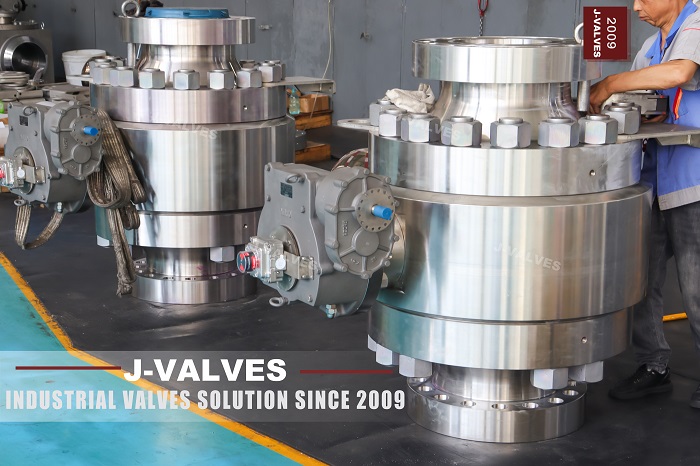
CHINA J-VALVES Offers Various High-quality I ndustrial Ball Valves
J-VALVES, a distinguished professional ball valve manufacturer rooted in China, takes pride in its extensive product portfolio. Our offerings span a wide range, including trunnion-mounted ball valves, floating ball valves, high-temperature ball valves, high-pressure ball valves, metal-sealed ball valves, ultra-low temperature ball valves, DBB ball valves, Three-way And Four-way Ball Valve, and fully welded ball valves. Each product is a testament to our commitment to precision engineering and reliable performance. Meticulously crafted, they are designed to not only meet but exceed the most stringent industrial demands, ensuring stable operation even under extreme conditions. This enables us to provide our clients with high-value services and makes our valves widely sought-after in industries.
Product Category
Contact Us


-
J-VALVES-Q347F
-
J-VALVES
Overview of the J-VALVES cast trunnion mounted ball valves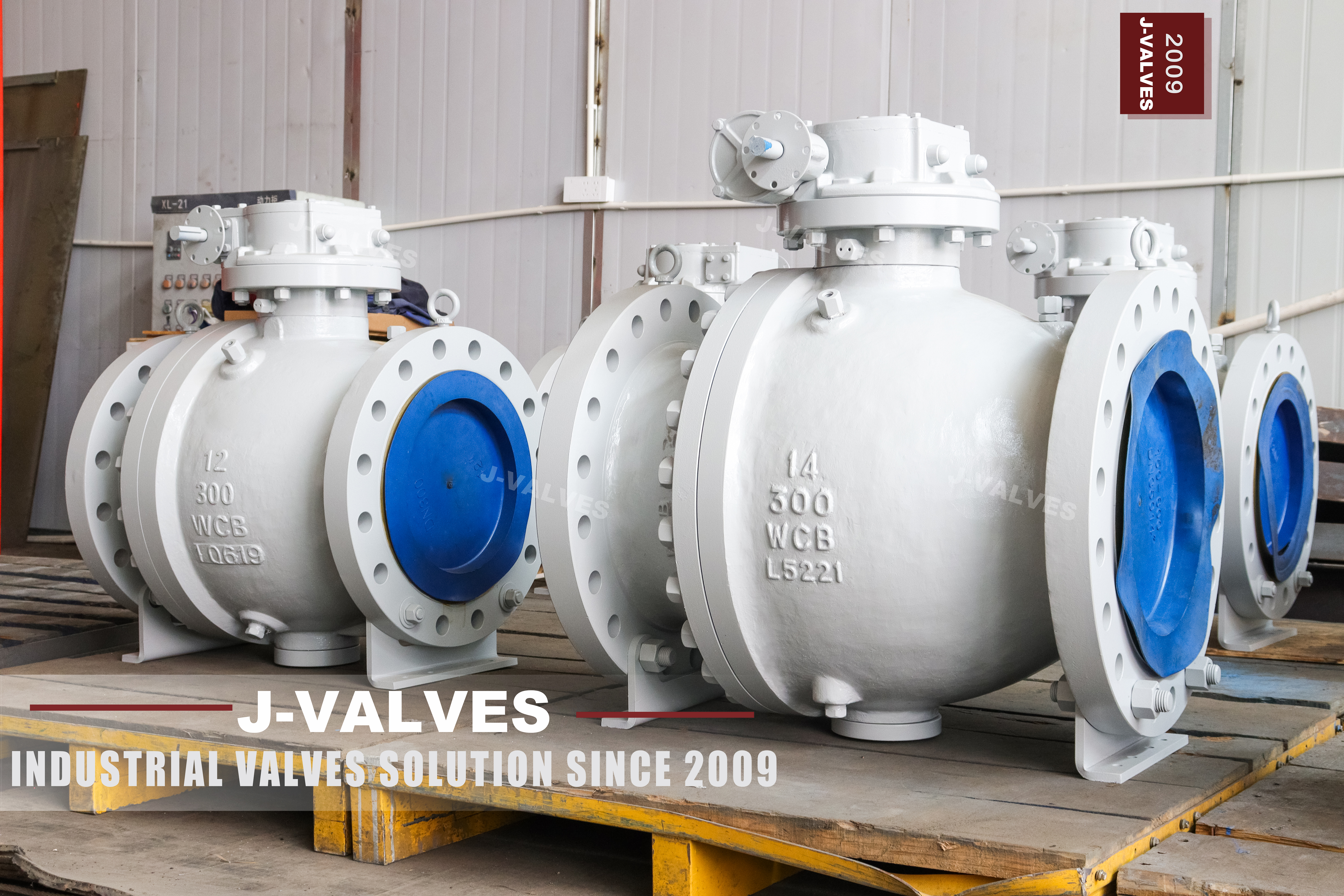
This page is the entry to a family, and a family page has one job that a product page does not: it has to say where the family stops. The cast trunnion series runs from two inch upwards, and the interesting number is not where it starts but where it ends, because that is where a buyer discovers that the valve he has been quoted is not the valve the page describes.
The page carries two figures for the top of the range. The range table says two inch to fifty six inch, and the text describing the body says the works can produce large calibre cast bodies from two inch to forty eight inch. Both sentences are about the same product and only one of them can be the cast limit, and the one that survives a technical reading is forty eight.
The argument of this page is that the top of a cast series is set by the foundry rather than by the valve. Sand boxes, pouring weight, wall uniformity and the reach of a feeder all stop somewhere, and above that point the same family continues in a body that is welded or forged rather than cast. A range table that prints fifty six for a cast body has borrowed the top of the family from a different body route.
Design and Construction
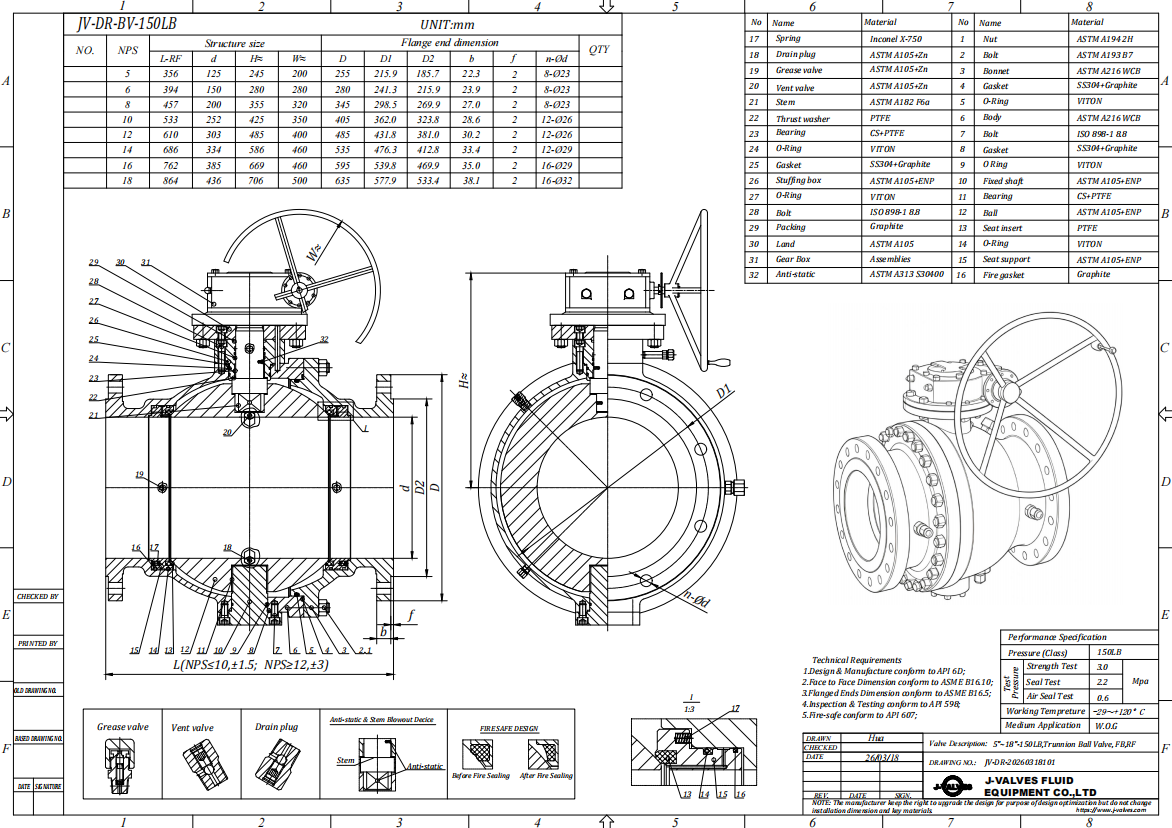
The body is a one piece casting with integral flanges, a spherical shell around the ball and a bore through it. The ball is trunnion mounted, carried on an upper and a lower shaft, with a seat ring on each side. The casting is closed by an end piece at one end on a two piece body, or by two end pieces on a three piece body, and the joint is a spigot and recess with a gasket.
The shape is what a casting buys. A body with integral flanges, a spherical shell, two seat pockets and a mounting foot is a shape that a pattern reproduces for the cost of the pattern, whereas a forging of the same shape needs a press with the capacity for the plan area and a die set for each size. At small sizes the press route wins on cost and at large sizes the pattern route does, and the crossover is a manufacturing fact rather than a pressure one.
The features that appear on the casting are worth reading as a list of what the foundry had to provide. There are feet under the body, which means the pattern carries them and the machine shop drills and faces them. There are tapped holes for eye bolts on the shell, which means the boss for each hole is cast in and the thread is cut afterwards. Neither of those is a machining decision; both are pattern decisions.
The end piece is a separate casting for each size, and on a three piece body the two end pieces are the same casting. That is where a cast family saves money as it grows: one pattern for the end piece serves both ends, and the centre section is the only piece that changes with the bore.
Material Options
The cast family is built in the grades that can be poured: carbon steel, low temperature carbon steel, and the austenitic stainless cast grades that correspond to the wrought 304 and 316 families. The correspondence is where most of the confusion on a cast valve order comes from.
| Cast Grade | Wrought Equivalent | Where It Belongs |
|---|---|---|
| A216 WCB | A105 | General carbon steel service |
| A352 LCB | A350 LF2 | Low temperature carbon steel |
| A351 CF8 | A182 F304 | Mild corrosion, general stainless |
| A351 CF8M | A182 F316 | Chlorides, chemical service |
| A351 CF3M | A182 F316L | Welded bodies, low carbon stainless |
| A995 duplex | A182 F51 | Chloride stress corrosion, seawater |
The correspondence column is the one that causes trouble. CF8M and F316 are the same family and not the same specification: one is a casting grade with its own chemistry limits, heat treatment and examination requirements, and the other is a forging grade. A valve whose body is CF8M and whose trim is F316 has two different material specifications on it, and both of them have to appear on the certificate.
The stainless cast grades also carry a heat treatment requirement that the carbon grades do not. The austenitic castings are solution annealed, and the anneal is what puts the carbon back into solution and gives the corrosion resistance the grade is bought for. A casting that was not annealed will pass a chemistry check and fail in service at the grain boundaries, which is why the certificate for a stainless casting should show the heat treatment as well as the chemistry.
Technical Specifications
| Item | Value |
|---|---|
| Size range, cast | Two inch to forty eight inch, DN 50 to DN 1200 |
| Above the cast range | Welded or forged body, a separate route |
| Pressure class | Class 150 to Class 2500, PN 20 to PN 420 |
| Body | One piece cast, two or three piece assembly |
| Body grades | WCB, LCB, CF8, CF8M, CF3M, duplex |
| Ball | Cast or forged stainless, hard faced where needed |
| Seat | Polymer at the lower classes, metal at the top |
| Ends | Flanged to ASME B16.5 to twenty four inch |
| Face to face | ASME B16.10 where tabulated |
| Casting acceptance | MSS SP-55, level named on the order |
| Design | API 6D, ASME B16.34 |
| Test | API 598 shell and seat |
The cast range row above is the one that settles the contradiction on the family page, and it is deliberately separated from the welded and forged route rather than merged with it. A buyer who needs a fifty two inch body is not buying a larger version of this article; he is buying a different manufacturing route with different examination, different lead time and a different price structure.
The flange row carries a limit that is independent of the size of the casting. ASME B16.5 runs to twenty four inch, so a twenty eight inch or thirty six inch cast body is bolted to a flange from the large flange standard or is supplied with a weld end instead. Both are available and neither is interchangeable with the other, and the difference has to be on the drawing.
Standards and Compliance
| Requirement | Document | What It Means Here |
|---|---|---|
| Product requirements | API 6D | Design, materials, marking, testing |
| Wall and rating | ASME B16.34 | The class, by material group |
| Flanges to 24 inch | ASME B16.5 | Facing and bolt circle |
| Flanges above 24 inch | ASME B16.47 | Series A or B, not interchangeable |
| Casting quality | MSS SP-55 | Visual acceptance, several levels |
| Radiography | To the order | Not a default on every casting |
| Pressure test | API 598 | Shell at 1.5 times, seat at 1.1 times |
Radiography is the row that decides how much a casting can be trusted. It is not a default on a cast valve body, it is a scope on the order, and the acceptance level is a separate decision again. A casting that has been visually inspected to MSS SP-55 and hydrostatically tested has been checked for what can be seen and for whether it holds water, and neither of those finds an internal shrinkage cavity.
ASME B16.47 deserves the warning it gets on every large valve page. It has two series, A and B, and they are not interchangeable: the bolt circles and the bolt counts differ for the same nominal size. A valve drilled to series A cannot be bolted to a series B flange, and the mistake is only found when the valve is on the scaffold.
Manufacturing Process
The pattern is made first, and it carries the external shape, the lettering on the barrel, the feet and the bosses for the eye bolts. The core carries the bore and the seat pockets. A change of bore on the same body size is a change of core, which is why a cast family can offer a reduced bore and a full bore in the same shell.
Pouring is followed by shakeout, cleaning, stress relief and machining. Stress relief before machining is what stops the body moving after the flange faces have been cut, and on a large casting the relief is a separate furnace cycle rather than a step on the way to the machine.
The stainless cast grades are the ones where the foundry work is hardest to see and easiest to get wrong. A CF8M body has to be poured with the chemistry in a narrow band, annealed at the right temperature for the section, and quenched fast enough to keep the carbides in solution. All three of those are furnace and ladle decisions, and none of them can be inspected into a finished body afterwards, which is why the certificate for a stainless casting should carry the heat treatment record and not only the chemistry.
Machining references the flange faces, the seat pockets and the trunnion bores to one centreline, and the joint face to the same reference. On a body that is going to carry a bolted end piece, the joint face is what the end piece registers against, so it is finished before the seat pocket on that side.

Quality Control and Testing
| Step | Check | Acceptance |
|---|---|---|
| 1 Pattern | Dimensions and lettering before first pour | Drawing |
| 2 Chemistry | Ladle analysis against the grade | Certificate |
| 3 Casting | Visual to MSS SP-55 | Level named on the order |
| 4 Radiography | Where the order names it | Acceptance level stated |
| 5 Heat treatment | Stress relief, and anneal for stainless | Recorded by heat |
| 6 Machining | Flange faces, pockets, trunnion bores, joint face | One setting |
| 7 Shell test | Body and joints at 1.5 times | API 598, no leakage |
| 8 Seat test | Each seat at 1.1 times, both directions | API 598 rate |
The heat treatment row is the one that separates a cast stainless body from a cast carbon body in the paperwork. A carbon steel casting is stress relieved, and the record is a furnace chart. A stainless casting is solution annealed, and the record is a chart plus a check that the anneal temperature was reached through the section, because an under annealed CF8M body passes every other test and corrodes at the grain boundaries in service.

Applications and Industry Service
The cast family belongs on large bore block service where the pressure is moderate and the body is big: water and utility headers, product pipelines, tank farm isolation, cooling water, and the large valve positions around a process unit where a forged body would be uneconomic or unavailable.
It also belongs where the shape matters more than the section: a body with a foot, eye bolt bosses and integral flanges is a casting by nature, and reproducing that shape as a forging is a die and press question before it is a cost question. That is why cast bodies dominate at the large end regardless of the pressure involved.
It is the wrong route where the wall has to be examined internally and the buyer is not prepared to pay for radiography, because a casting that has not been radiographed is a casting whose internal quality is an assumption. Above the cast range it is not available at all, and that is a size decision rather than a quality one.

Installation, Operation and Maintenance
The valve is set on its feet before the flange studs are tensioned, so that the body is carried by the structure and the pipe flanges only have to seal. On a large cast body the mass is significant and a valve hanging on two flanges deflects both of them, which shows up later as a leak at a joint that was tight when it was made.
The body joint is broken for a seat or ball replacement, the gasket is renewed, and the studs are tensioned in a cross pattern in at least two passes. The joint faces are cleaned of the old gasket without being scraped, because a scored joint face on a large body is a leak that no amount of stud tension will close.
Operation is quarter turn through the gearbox, and the gearbox stops are set at the works. The maintenance that large cast valves actually need is the packing and the gearbox lubrication, and both are on a schedule rather than on a symptom, because a leaking gland on a large valve is a reportable event on most sites and a lubrication failure is a seized gearbox.
How to Specify and Order
The six entries are size, class, body grade, seat, end connection and operator, and on a family order one more has to be added at the top: the body route. A fifty inch valve is not available as a casting, and an order that specifies cast at that size will either be declined or supplied as something else, and the time to know which is at the enquiry.
The second thing to write is the casting acceptance. MSS SP-55 level, radiography yes or no, and the acceptance level for the radiography if it is yes. Those three lines are what convert a cast body from a shape into an inspected article, and they are also what explains a price difference between two quotations for the same drawing.
Documents to name: the EN 10204 3.1 certificate with the heat number for each casting, the heat treatment record, the MSS SP-55 acceptance level and the inspector, the radiography report where it was ordered, the shell and seat test record, and the general arrangement drawing with the face to face dimension, the foot position and the flange standard, which above twenty four inch has to name the series.
FAQ
Q: Is the cast range two to forty eight or two to fifty six?
A: Forty eight for a cast body, and the page that says fifty six has borrowed the top of the family from a different manufacturing route. Above the cast limit the same family continues in a welded or forged body, and the two routes have different examination, different lead times and different prices.
Q: What sets the cast limit at that size?
A: The foundry rather than the valve. A sand box has a size, a pour has a weight, and a feeder has a reach, and past a certain size the wall stops being uniform and the risk of an internal defect stops being acceptable. None of those limits appears on a valve data sheet, which is why they are argued about after the order.
Q: What does a casting buy that a forging does not?
A: Shape for the cost of a pattern. A body with integral flanges, a spherical shell, feet and tapped bosses needs a die set and a press of the right capacity as a forging, and only a pattern as a casting. At small sizes the press route wins on cost and at large sizes the pattern route does.
Q: Are CF8M and F316 the same material?
A: No, and both belong on the certificate. CF8M is the cast austenitic grade and F316 is the forging grade, with their own chemistry limits, heat treatment and examination requirements. A valve with a CF8M body and an F316 stem carries two material specifications.
Q: Why does radiography matter on a cast body?
A: Because a casting can hold internal shrinkage that a hydrostatic test will not find until it reaches a surface. Visual acceptance to MSS SP-55 and a shell test check what can be seen and whether it holds water, and neither of them looks inside. Radiography is a scope on the order.



Hot Products


News
Remanufactured Ball Valves: Five Checks That Decide Whether A Rebuild Deserves A Certificate
A rebuild at 45 percent of price with half the life is no saving. Five checks that separate a real remanufacture from a repaint with a certificate.
Read More
The Squeeze Is A Residual: How Tolerance Stack-Up Decides Whether A Ball Valve Seals
No dimension sets the seat squeeze. Five tolerances do, in series. Why identical valves feel different, and why a new ball changes the arithmetic.
Read More
Why A Ball Valve Gets Harder To Turn: Five Causes, And The Test That Tells Them Apart
A ball valve that stiffens over months points at one of five parts. Measure torque with the line pressurised and again vented, and the split becomes visible.
Read More
The Ball Valve at Four Thousand Bar: Seat Load, Erosion And Fatigue in Waterjet Circuits
At 4,000 bar a 10 mm bore puts 31 kN on the seat and a 0.1 mm leak cuts steel. What a ball valve must survive in a waterjet or intensifier circuit.
Read More