CHINA J-VALVES Offers Various High-quality I ndustrial Ball Valves
J-VALVES, a distinguished professional ball valve manufacturer rooted in China, takes pride in its extensive product portfolio. Our offerings span a wide range, including trunnion-mounted ball valves, floating ball valves, high-temperature ball valves, high-pressure ball valves, metal-sealed ball valves, ultra-low temperature ball valves, DBB ball valves, Three-way And Four-way Ball Valve, and fully welded ball valves. Each product is a testament to our commitment to precision engineering and reliable performance. Meticulously crafted, they are designed to not only meet but exceed the most stringent industrial demands, ensuring stable operation even under extreme conditions. This enables us to provide our clients with high-value services and makes our valves widely sought-after in industries.
Product Category
Contact Us


-
J-VALVES-Q47F
-
J-VALVES
Overview of the J-VALVES high pressure stainless trunnion valve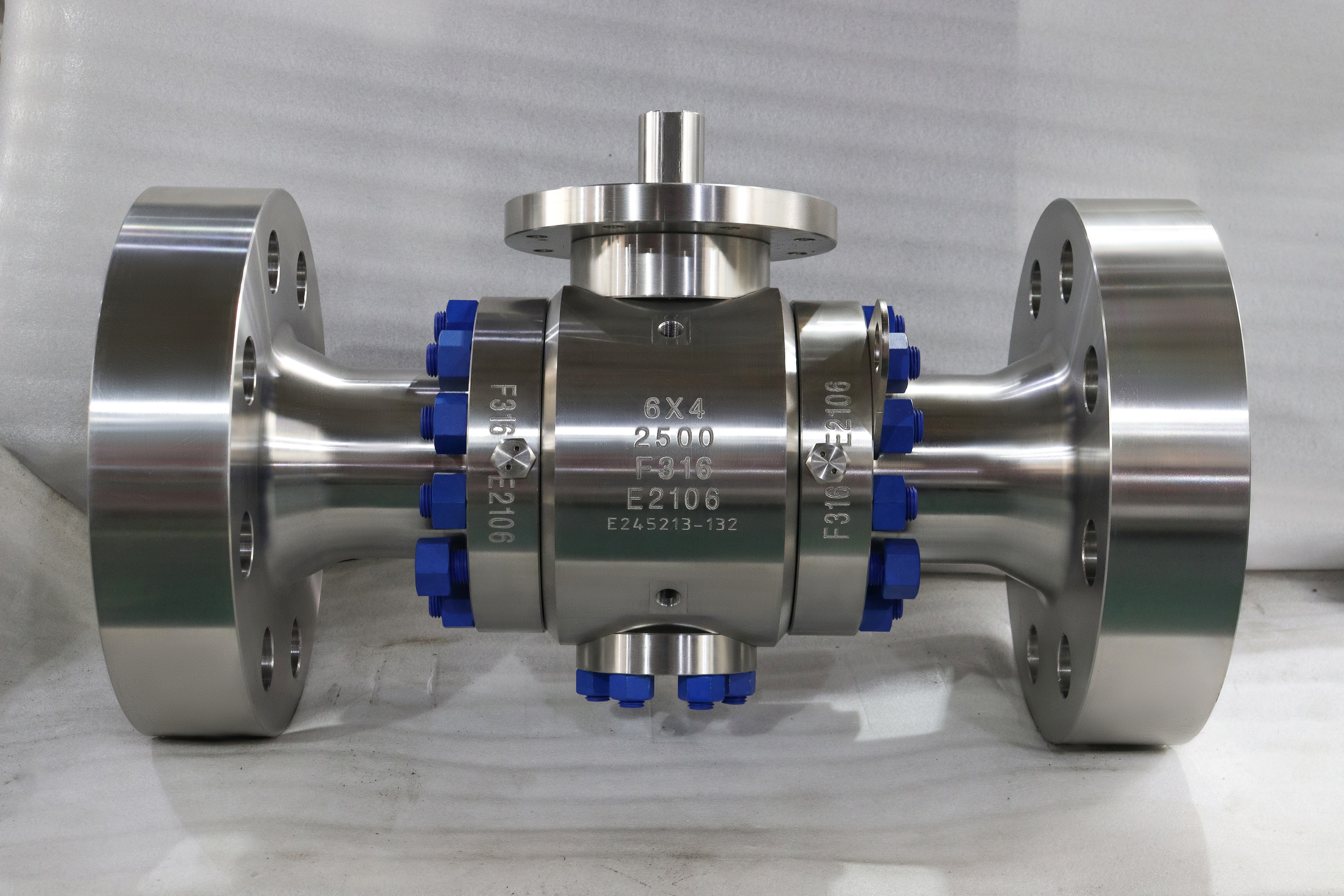
The photograph on this page is a six by four inch Class 2500 body in F316 stainless steel, and the first thing worth looking at is not the steel at all. It is the face of the flange, which carries a machined groove instead of a flat raised face. That groove is the pressure class announcing itself, and it decides how the valve is joined to the pipe before anything about the trim matters.
Class 2500 sits at the top of the ASME B16.34 table, and in the API 6D designation list it is PN 420. At that level the joint between two flanges has to close on metal rather than on a soft sheet, because the bolt load needed to squeeze a compressed fibre gasket to a sealing stress would deform the flange before the gasket sealed. A metal ring sitting in two matching grooves converts the bolt load into a line contact, and a line contact is the only shape that survives this class.
The argument of this page is that the end connection is part of the rating and not a detail below it. A buyer who specifies six by four inch, Class 2500, F316 and stops has described a valve body and left the joint open, because the same body can be built with a raised face, a ring joint or a weld end, and only one of the three will mate with the flange that is already on the pipe.
Design and Construction
The body is a three piece trunnion mounted ball valve body: one centre section carrying the ball and the seats, and two end pieces bolted to it. Each of the two body joints is a spigot and recess closed by a ring of studs with a gasket between the faces, so the valve has two places where it can leak to atmosphere, and both of them are the buyer's to inspect at the works.
The ring joint face is a groove cut into the flange, and the gasket is a solid metal ring that sits in the groove of one flange and in the matching groove of the pipe flange opposite. Pressure acts on the inside of the ring and pushes it outwards against the groove wall, so the seal tightens as the pressure rises rather than being squeezed flat once and left there. The ring is deliberately softer than the groove, so that the ring yields and the groove does not, and the pair that has to be specified together is the groove form, which comes from ASME B16.5, and the ring, which comes from ASME B16.20.
The bore through this valve is four inch inside a six inch body, which is what the stamp 6X4 records. The flange is sized by the pipe and the bore is sized by the flow, and the two are allowed to differ. Reduced bore keeps the ball smaller than the end opening, which shortens the body and lowers the operating torque, and it costs flow area. On a Class 2500 line the pressure drop through a reduced bore is usually accepted because the valve is a block valve and not a control element.
The stem in this view is bare: a machined shaft standing out of a square pad with four stud holes and no lever, handwheel or gearbox on it. The same body is photographed elsewhere with a gearbox bolted to that pad, and the pad is what makes both builds possible, so it is the interface that has to be specified rather than the operator. The pad follows ISO 5211, which fixes the bolt circle and the drive form for a given size, and the actuator is then chosen against those two dimensions plus the torque the valve actually needs.
What the photograph cannot tell you is the grade, and no photograph can. F316 is stamped on the body and on both end pieces beside the heat number E2106, and that stamp is the foundry speaking. The proof that the metal is what the stamp says is the EN 10204 3.1 certificate for that heat, and the two documents have to be read together or neither of them means very much.

Material Options
On this build the pressure retaining parts are all F316, which is the molybdenum bearing austenitic grade, and the trim follows the same family. The part that is almost never discussed is the ring gasket, which is a separate purchase and a separate material decision, because the ring has to be softer than the groove it sits in.
| Part | Material on This Build | Note |
|---|---|---|
| Centre body | A182 F316 forged | Stamped with size, class and grade |
| End pieces | A182 F316 forged | Stamped separately, heat E2106 |
| Ball | F316, polished | Bore four inch inside a six inch body |
| Stem | F316 or 17-4PH | Bare shaft on an ISO 5211 pad |
| Seat | PTFE, reinforced PTFE, or metal | Soft seat limits the temperature |
| Body joint gasket | Spiral wound or metal jacketed | Two joints, two gaskets |
| Ring gasket | Soft iron, low carbon steel, 304, 316, or F5 | Ordered against ASME B16.20 |
| Studs and nuts | B8M class 2 as the stainless pairing | Nickel alloy where the medium asks |
The ring gasket row is the one that turns up missing on purchase orders. The valve arrives with its bores capped and its flanges protected, and the rings that go between the valve and the pipe are a line item that the piping contractor owns. Two rings per valve, in a material that matches the pipe flange rather than the valve body, and softer than the groove on both sides.
The seat material is the limit on temperature, not the body. Austenitic stainless holds its strength well past the point where a polymer seat has extruded, so a valve ordered with a soft seat is a valve whose service temperature is set by the polymer and whose certificate will still say F316. That is not a contradiction, it is two different limits on two different pages of the same document.
Technical Specifications
| Item | Value |
|---|---|
| Size | Six inch by four inch, DN 150 by DN 100 |
| Pressure class | Class 2500, PN 420 in the API 6D table |
| Body and trim | A182 F316, forged |
| Body joints | Two, one at each end piece |
| Bore | Reduced, four inch through a six inch body |
| Ends on this build | Ring joint to ASME B16.5, rings to B16.20 |
| Other ends offered | Raised face flange, butt weld |
| Face to face | ASME B16.10 for six inch Class 2500 |
| Temperature | Minus 46 to plus 200 Celsius, seat dependent |
| Operator | Bare stem on an ISO 5211 pad, or actuator |
| Design | API 6D, ASME B16.34 |
| Test | API 598 shell and seat |
The pairing of Class 2500 with PN 420 is one of the seven that API 6D sets out, and it is worth stating because the same list is where most catalogue errors start. Class 600 is PN 100, Class 900 is PN 150, Class 1500 is PN 250 and Class 2500 is PN 420. A page that prints PN 260 beside Class 1500, or PN 420 beside Class 1500, has converted a pressure into bar and rounded it, and the rounding is the error.
Face to face is tabulated for this size and class in ASME B16.10, which is unusual for a body this thick and worth checking before a replacement is ordered. A valve built to a drawing rather than to the table will fit the space it was made for and nothing else, and on a Class 2500 line the spool piece on either side was cut to the table.
Standards and Compliance
| Requirement | Document | What It Means Here |
|---|---|---|
| Product requirements | API 6D | Design, materials, welding, marking |
| Wall and rating | ASME B16.34 | Class 2500 for the group set by F316 |
| Flange and groove | ASME B16.5 | The groove form at six inch Class 2500 |
| Ring gasket | ASME B16.20 | Ring dimensions and materials |
| Pressure test | API 598 | Shell at 1.5 times, seat at 1.1 times |
| Fire test | API 607 or ISO 10497 | Type test with a stated scope |
| Material certificate | EN 10204 3.1 | One line per pressure part, heat E2106 here |
| Sour service | NACE MR0175 | Only when the order names it |
The ring gasket standard is the one that gets left out of the paperwork. B16.20 defines the ring dimensions, the groove it fits, and the marking on the ring itself, and a ring that is not marked cannot be shown to be the material it was bought as. On a Class 2500 joint, a ring of the wrong hardness is a ring that either does not yield and leaks, or yields too far and is destroyed on first make up.
The fire test row deserves the same caution it gets on any soft seated valve. API 607 is a type test on a representative valve, not a test of the article being shipped, and the certificate that comes with the valve says the design passed it. What the buyer has to hold is the scope of that type test against the size, class and seat arrangement actually ordered.
Manufacturing Process
The end pieces and the centre section are forged, then machined. Forging at this class is not a preference; a casting of this wall section at six inch Class 2500 would carry a porosity risk that no hydrostatic test would find until the porosity reached a surface, and the wall is thick enough that ultrasonic examination of a forging is a practical way to look inside it.
The ring groove is the operation that decides whether the valve bolts up. It is cut on the flange face with the bore as the reference, and the groove diameter, the groove width and the face flatness are three separate checks that all have to pass at once. A groove that is concentric but wide, or narrow but off centre, will hold a ring in the works and leak in the line, because the ring has to sit in two grooves at the same time and both of them belong to different machine shops.
Machining the two seat pockets in the centre section follows, and both pockets are cut from one set up so that they share a centreline. On a three piece body this is the whole argument for the third piece: the centre section can be machined on both faces without the body being turned around, and the two end pieces are identical to each other, so one programme covers both.

Quality Control and Testing
| Step | Check | Acceptance |
|---|---|---|
| 1 Incoming | Heat number against the mill certificate | Chemistry and mechanicals |
| 2 Examination | Ultrasonic or magnetic particle to the order | Acceptance level stated |
| 3 Machining | Groove form, width and concentricity | ASME B16.5 for the size and class |
| 4 Identity | Positive material identification on body and ends | F316 confirmed |
| 5 Shell test | Body and both joints at 1.5 times | API 598, no leakage |
| 6 Seat test | Each seat at 1.1 times | API 598 rate |
| 7 Marking | Size, class, grade, heat on body and ends | Matches the certificate |
| 8 Final | Bores capped, faces protected, crated | Works standard |
The shell test is where the two body joints get their only proof. A three piece body has two gasketed joints and neither of them is visible from outside once the valve is in the line, so the test at the works is the one opportunity to see a joint weep. That is why the test record should name the joints and not only the result, and why a valve that was tested as a body before assembly has not been tested at all.

Applications and Industry Service
Class 2500 stainless belongs where the pressure is at the top of the range and the medium would attack carbon steel: high pressure chemical injection, urea and ammonia service, high pressure water for descaling, and the small bore high pressure runs around a hydrogen or synthesis gas unit where a stainless body is chosen for the medium and the class is chosen for the line.
The ring joint face is what makes the valve usable in those places. A raised face joint at this class depends on a gasket that has to be replaced every time the joint is broken, and on a bolt load that has to be applied evenly enough that the flange does not tilt. A ring joint tolerates the same bolt load with a ring that is a machined part, and the ring is either in place or it is not, which is a simpler thing to check in the field.
It is the wrong valve where the pipe flange is already a raised face, because the two faces do not meet. Adapters exist and they are a leak path added to a joint that was chosen to remove one. The time to decide the facing is when the piping class is written, not when the valve is ordered.

Installation, Operation and Maintenance
The ring is used once. A ring that has been compressed takes a set, and a ring that has taken a set will not seal a second time whatever is done to it, so the joint is assembled with new rings on both sides and the old ones are scrapped rather than inspected. The groove is cleaned, checked for a burr at the edge, and left dry, because a ring joint seals on metal contact and anything between the surfaces is a gap.
The joint is made up with the flanges parallel and the pipe supported, then the studs are tensioned in a cross pattern in at least two passes. On a Class 2500 joint the bolt load is high enough that the sequence matters: a joint closed by working around the circle once will have one side tight and the other side loose, and the leak that follows appears at test pressure rather than at hand tight.
Operation is quarter turn, fully open or fully closed, and the valve is not a throttling device. When an actuator is fitted, the torque it is set to deliver comes from the test record for that valve rather than from a catalogue figure for the size, because the seat friction on a metal seated build is not a constant and the difference between a new seat and a bedded one is enough to change the actuator selection.
How to Specify and Order
The order for this valve has to carry the facing, and that is the line most often missing. Size, class, body grade, seat material, end connection and operator are the six entries that define the article, and on a Class 2500 valve the end connection is not one word: it is the facing, the groove standard, the ring material and whether the rings are in the valve scope or the piping scope.
Two questions belong to the line rather than to the valve. The first is what the pipe flange facing is, because the valve has to match it. The second is who supplies the rings, because a valve delivered with ring joint faces and no rings cannot be installed, and a buyer who assumes the rings are in the box finds out on the day the line is opened.
Documents worth naming: the EN 10204 3.1 certificate for each pressure part with its heat number, the ultrasonic or magnetic particle report at a stated acceptance level, the shell and seat test record naming both body joints and both seats, and the general arrangement drawing with the facing, the groove standard, the face to face dimension and the top pad size.
FAQ
Q: Why is the flange grooved instead of flat?
A: Because at Class 2500 the joint has to close on metal. The groove takes a solid metal ring, the ring sits in the matching groove of the pipe flange, and the seal is a line contact between two machined surfaces. A flat raised face would need a soft gasket squeezed to a sealing stress that deforms the flange first.
Q: Who supplies the ring gaskets?
A: Usually the piping contractor, and that is why they go missing. The rings are a separate line item to ASME B16.20 in a material that matches the pipe flange, and a valve delivered with ring joint faces and no rings cannot be installed on the day the line is opened.
Q: Can a ring be used twice?
A: No. A ring that has been compressed takes a set and will not seal a second time. The joint is assembled with new rings on both sides and the old ones are scrapped rather than inspected, which is a cost that belongs in the maintenance plan.
Q: Is Class 2500 the same as PN 420?
A: Yes, in the API 6D designation list, and that list is the only place the pairing is fixed. Class 600 is PN 100, 900 is PN 150, 1500 is PN 250 and 2500 is PN 420. A page that prints a different PN has converted a pressure in bar and rounded it.
Q: Why is there no operator in the photograph?
A: Because the valve is photographed on its pad before an operator is fitted. The four stud holes above the stem follow ISO 5211, so a gearbox or an actuator can be selected against the pad rather than against the valve model, and the pad is the interface that has to be specified.



Hot Products


News
Remanufactured Ball Valves: Five Checks That Decide Whether A Rebuild Deserves A Certificate
A rebuild at 45 percent of price with half the life is no saving. Five checks that separate a real remanufacture from a repaint with a certificate.
Read More
The Squeeze Is A Residual: How Tolerance Stack-Up Decides Whether A Ball Valve Seals
No dimension sets the seat squeeze. Five tolerances do, in series. Why identical valves feel different, and why a new ball changes the arithmetic.
Read More
Why A Ball Valve Gets Harder To Turn: Five Causes, And The Test That Tells Them Apart
A ball valve that stiffens over months points at one of five parts. Measure torque with the line pressurised and again vented, and the split becomes visible.
Read More
The Ball Valve at Four Thousand Bar: Seat Load, Erosion And Fatigue in Waterjet Circuits
At 4,000 bar a 10 mm bore puts 31 kN on the seat and a 0.1 mm leak cuts steel. What a ball valve must survive in a waterjet or intensifier circuit.
Read More