

Introduction
In modern oil & gas transmission, petrochemical processing, LNG systems, and offshore engineering, pipeline safety and sealing reliability are key engineering priorities. Among all industrial valve types, the trunnion mounted ball valve is widely recognized as one of the most reliable solutions for high-pressure and large-diameter pipeline isolation.
Due to its stable mechanical structure, low operating torque, and excellent sealing performance, the trunnion mounted ball valve has become a core component in critical energy infrastructure worldwide.
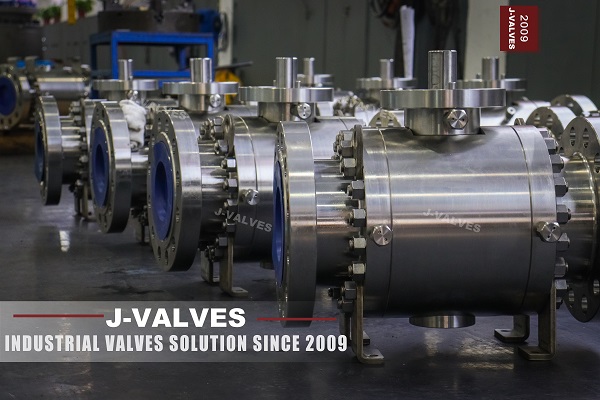
Manufacturers such as J-VALVES provide engineered trunnion ball valve solutions designed in compliance with API 6D and international pipeline standards.
What Is a Trunnion Mounted Ball Valve?
A trunnion mounted ball valve is a quarter-turn valve in which the ball is mechanically supported by upper and lower shafts (trunnions), preventing free-floating movement.
Key structural characteristics:
Fixed ball supported by trunnion system
Seat sealing energized by spring or line pressure
Suitable for high-pressure and large-diameter pipelines
Low torque operation design
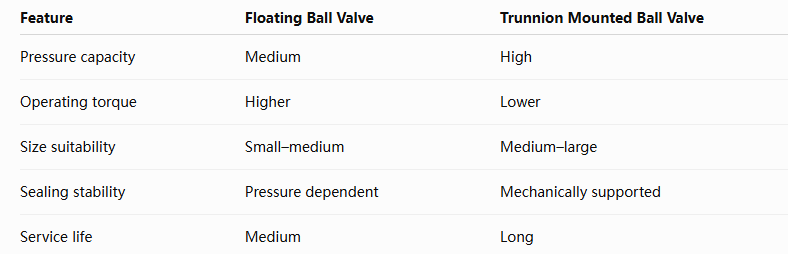
This structure significantly improves stability compared to floating ball valves.
Working Principle
The operation of a trunnion mounted ball valve is based on controlled rotation:
The ball rotates 90° to open or close flow
Trunnion support absorbs hydraulic load
Seats move slightly to maintain sealing contact
Pressure does not force ball displacement
This design ensures consistent sealing performance under varying pressure conditions.
Structural Advantages of Trunnion Mounted Ball Valves
1. Stable Mechanical Support System
The trunnion design prevents ball displacement, ensuring:
Reduced stress on sealing surfaces
Improved structural integrity under high pressure
Stable operation in large diameter pipelines
2. Low Operating Torque
Because the ball is fixed in position:
Torque requirements are significantly reduced
Smaller actuators can be used
Automation efficiency is improved
3. High-Pressure Capability
Trunnion mounted ball valves are suitable for:
Class 150LB to 2500LB applications
High-pressure gas pipelines
Offshore and subsea systems
4. Reliable Sealing Performance
The seat design ensures:
Bubble-tight shutoff capability
Consistent sealing under pressure fluctuations
Reduced leakage risk over long service cycles
How Trunnion Ball Valves Improve Pipeline Safety
1. Double Isolation Capability (DBB/DBB variants)
Advanced configurations can provide:
Upstream and downstream isolation
Safe maintenance conditions
Reduced leakage risk during shutdown
2. Fire-Safe and Anti-Blowout Design
Safety enhancements include:
Fire-safe graphite sealing systems
Anti-blowout stem design
Secondary emergency sealing structures
3. Reduced Wear and Long Service Life
Because the ball does not float:
Seat wear is minimized
Friction is reduced
Maintenance intervals are extended
Engineering and Manufacturing Strength of J-VALVES
J-VALVES applies strict engineering and quality control systems for trunnion mounted ball valves:
Key capabilities:
Precision CNC machining for sealing surfaces
Full forged and cast body production options
API 6D compliant design and testing
NDT inspection (UT, RT, PT, MT)
Hydrostatic and seat leakage testing
Material options:
Carbon steel (A105, WCB)
Low temperature steel (LF2, LCB)
Stainless steel (CF8M, CF8)
Alloy steel for high-pressure service
These ensure stable performance in demanding industrial environments.
Typical Applications
Trunnion mounted ball valves are widely used in:
Natural gas transmission pipelines
Oil refinery systems
LNG storage and transportation
Offshore drilling platforms
Petrochemical process systems
High-pressure metering stations
Advantages Compared to Floating Ball Valves
Conclusion
The trunnion mounted ball valve is a critical component in modern high-pressure pipeline systems due to its stable structure, reliable sealing performance, and long service life. Its engineered design makes it ideal for demanding industrial applications where safety and operational reliability are essential.
With advanced manufacturing technology and strict quality control systems, J-VALVES provides high-performance trunnion mounted ball valves that meet global standards and ensure long-term pipeline safety.


