

Introduction
In cryogenic and low-temperature pipeline systems, material performance and sealing reliability become critical engineering challenges. Liquefied Natural Gas (LNG), liquefied petroleum gas (LPG), and industrial ethylene systems often operate at temperatures as low as -196°C, requiring valve solutions that can maintain toughness, sealing integrity, and mechanical stability under extreme conditions.
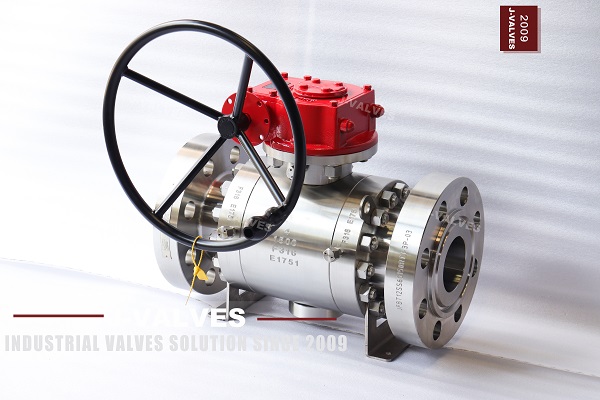
The cryogenic carbon steel trunnion mounted ball valve is specifically engineered for these demanding environments. It combines a trunnion-supported ball structure with low-temperature carbon steel materials (such as LF2 / LCB) to ensure safe and stable operation in cryogenic service.
Manufacturers such as J-VALVES design and produce high-performance cryogenic trunnion ball valves that comply with international standards such as API 6D, BS 6364, and ASME requirements.
What Is a Cryogenic Trunnion Mounted Ball Valve?
A cryogenic trunnion mounted ball valve is a quarter-turn isolation valve designed for extremely low-temperature service, featuring:
Fixed ball supported by upper and lower trunnions
Extended bonnet design for thermal insulation
Low-temperature carbon steel body (LF2 / LCB)
Soft or metal-seated cryogenic sealing system
Anti-blowout stem structure
Its main function is to ensure safe shutoff and flow control in cryogenic pipelines.
Key Material: Low-Temperature Carbon Steel (LF2 / LCB)
1. Excellent Low-Temperature Toughness
LF2 and LCB materials are widely used because they:
Maintain impact resistance at ultra-low temperatures
Prevent brittle fracture in cryogenic environments
Ensure structural stability during thermal cycling
2. High Structural Reliability
Carbon steel for cryogenic service provides:
Strong pressure-bearing capacity
Stable mechanical performance under thermal stress
Compatibility with forging and casting processes
3. Wide Industrial Acceptance
These materials are commonly used in:
LNG terminals
Cryogenic storage tanks
Low-temperature pipeline systems
Structural Features of Cryogenic Trunnion Ball Valves
1. Trunnion Mounted Ball Support System
The trunnion design ensures:
Fixed ball positioning under pressure
Reduced operating torque
Stable sealing contact in extreme conditions
2. Extended Bonnet Design
One of the most important cryogenic features:
Keeps stem packing away from low-temperature fluid
Reduces risk of seal embrittlement
Improves thermal gradient control
3. Low-Temperature Sealing System
Cryogenic sealing includes:
PTFE or reinforced sealing materials
Spring-loaded seat design
Secondary metal sealing backup
This ensures bubble-tight shutoff even under thermal contraction.
4. Anti-Static and Anti-Blowout Stem
Safety features include:
Blowout-proof stem structure
Anti-static grounding system
Fire-safe design options
How Cryogenic Trunnion Ball Valves Improve LNG System Safety
1. Stable Operation Under Extreme Temperature
Cryogenic valves must handle:
Rapid cooling cycles
Thermal contraction of materials
Pressure fluctuations during LNG transfer
Trunnion design ensures structural stability throughout these conditions.
2. Zero-Leakage Isolation Performance
Critical for LNG systems:
Prevents methane leakage
Ensures safe storage and transport
Maintains environmental compliance
3. Low Operating Torque in Cryogenic Conditions
Unlike floating ball valves:
Trunnion design reduces friction
Actuation remains stable at low temperatures
Suitable for automated control systems
4. Reduced Risk of Thermal Stress Failure
Extended bonnet and optimized structure:
Minimize thermal shock
Protect sealing components
Extend valve service life
Engineering and Manufacturing Strength of J-VALVES
J-VALVES produces cryogenic trunnion mounted ball valves with strict engineering and testing processes:
Manufacturing Capabilities:
Precision machining for cryogenic tolerances
Full forged or cast LF2/LCB body production
Extended bonnet cryogenic design optimization
Automated welding and assembly control
Testing Standards:
Cryogenic temperature testing (-196°C)
Shell hydrostatic pressure test
Seat leakage test (bubble-tight requirement)
NDT inspection (UT/RT/PT)
Compliance:
API 6D pipeline valve standard
BS 6364 cryogenic valve standard
ASME B16.34 pressure design requirements
Typical Applications
Cryogenic carbon steel trunnion ball valves are widely used in:
LNG liquefaction plants
LNG storage and transportation systems
LPG and ethylene pipelines
Air separation units (ASU)
Industrial cryogenic process systems
Advantages Compared to Floating Cryogenic Ball Valves

Conclusion
The cryogenic carbon steel trunnion mounted ball valve is a critical component in modern LNG and low-temperature pipeline systems. Its combination of LF2/LCB materials, trunnion-supported structure, and cryogenic sealing technology ensures safe, stable, and long-term operation under extreme conditions.
With advanced engineering design and strict quality control systems, J-VALVES delivers high-performance cryogenic trunnion ball valves that meet global standards for safety, reliability, and efficiency in energy infrastructure.