

Introduction
In high-pressure pipeline systems such as oil & gas transmission, LNG processing, petrochemical plants, and offshore installations, zero leakage performance is one of the most critical engineering requirements for valve systems. Any internal or external leakage can lead to safety risks, environmental hazards, and production losses.
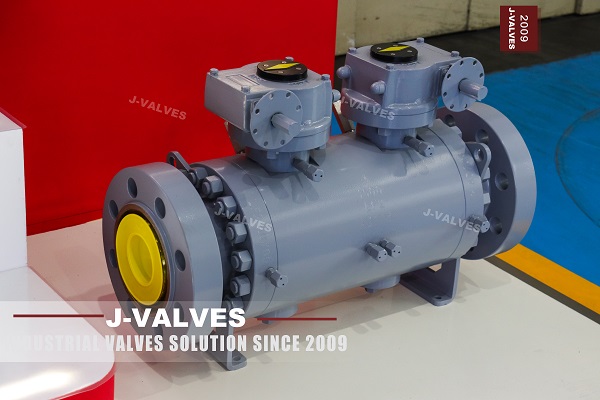
The Double Block and Bleed (DBB) ball valve is specifically engineered to provide reliable isolation and verification of sealing integrity within a single valve body. Through advanced sealing design and precision manufacturing, modern DBB valves achieve near-zero leakage performance under demanding operating conditions.
Manufacturers such as J-VALVES focus on advanced DBB engineering solutions designed to meet API 6D and international pipeline safety standards.
What Is Zero Leakage in DBB Ball Valve Engineering?
“Zero leakage” in DBB ball valve systems refers to the ability of the valve to:
Fully isolate upstream and downstream flow
Prevent internal leakage across sealing surfaces
Maintain sealing integrity under pressure fluctuations
Allow safe venting of cavity pressure through bleed ports
In industrial standards such as API 6D, leakage requirements are often defined as bubble-tight sealing performance for soft seats or extremely low allowable leakage for metal-seated designs.
Core Engineering Principles Behind Zero Leakage Design
1. Dual Isolation Sealing Structure
DBB ball valves achieve zero leakage through two independent sealing barriers:
Primary upstream seat sealing
Secondary downstream seat sealing
This dual barrier ensures that even if one seat experiences minor wear, isolation integrity is still maintained.
2. Cavity Bleed System Verification
The bleed port between two sealing surfaces allows operators to:
Release trapped cavity pressure
Verify sealing integrity of both seats
Confirm isolation before maintenance
If no pressure is detected at the bleed port, the system is confirmed to be fully isolated.
3. Precision Machined Ball and Seat Interface
Zero leakage depends heavily on machining accuracy:
Mirror-finished ball surface
Precision seat alignment
Controlled interference fit between sealing components
J-VALVES uses CNC precision machining and lapping processes to ensure consistent sealing contact.
4. Spring-Loaded or Pressure-Energized Seats
Advanced DBB designs use:
Spring-loaded seats for constant contact force
Pressure-assisted sealing under line pressure
Self-adjusting compensation for thermal expansion
This ensures sealing stability under both low and high pressure conditions.
Material Selection for Zero Leakage Performance
Material compatibility plays a major role in sealing reliability:
PTFE / RPTFE seats: Excellent sealing, low friction
PEEK seats: High temperature and pressure resistance
Metal-to-metal sealing: Suitable for abrasive or high-temperature media
Body materials: A105, LF2, F316, duplex stainless steel
Proper material pairing reduces deformation and improves long-term sealing integrity.
How DBB Ball Valves Achieve Operational Safety
1. Double Isolation Function
DBB valves provide:
Upstream shutoff
Downstream shutoff
Independent verification through bleed system
This ensures complete pipeline isolation during maintenance operations.
2. Reduced External Leakage Risk
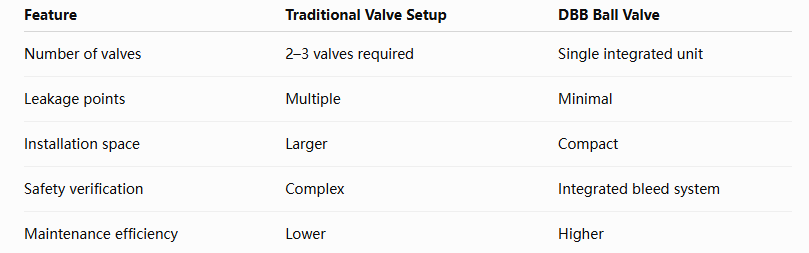
Compared to multi-valve configurations, DBB valves:
Reduce flange connections
Minimize potential leakage points
Improve system compactness and safety
3. High Integrity Pressure Containment
DBB valves are engineered for:
Class 150LB to 2500LB applications
High-pressure gas systems
Offshore and subsea pipelines
4. Thermal and Pressure Stability
Zero leakage performance must remain stable under:
Temperature cycling (including cryogenic conditions)
Pressure surges
Vibration in offshore systems
Manufacturing Excellence of J-VALVES DBB Systems
J-VALVES ensures zero leakage performance through strict manufacturing control:
Key production processes:
Precision forging and casting of valve bodies
CNC machining of sealing components
Automated assembly for alignment accuracy
Surface lapping for sealing optimization
Testing procedures:
Shell hydrostatic pressure test
Seat leakage test (bubble-tight verification)
Cavity bleed performance test
NDT inspection (UT, RT, PT, MT)
Standards compliance:
API 6D pipeline valve standard
ASME B16.34 pressure design
ISO quality management systems
Applications of Zero Leakage DBB Ball Valves
DBB valves are widely used in industries requiring high safety integrity:
Oil and gas transmission pipelines
LNG and LPG systems
Petrochemical processing plants
Offshore platforms
Refinery isolation systems
Metering and sampling systems
DBB Ball Valve vs Traditional Isolation Systems
Conclusion
Zero leakage engineering in DBB ball valves is achieved through a combination of dual isolation design, precision machining, advanced seat technology, and strict manufacturing control. These engineering principles ensure reliable performance in high-pressure and high-risk pipeline systems.
With advanced design capabilities and strict quality assurance systems, J-VALVES delivers high-performance DBB ball valves that provide safe, stable, and near-zero leakage operation across global energy and industrial applications.