


1. What makes offshore duty different from onshore
An onshore pipeline valve spends most of its life in one position, with a predictable pressure envelope and a maintenance team twenty minutes away. An offshore valve has none of those advantages. Five load cases separate offshore service from a typical onshore installation.
Pressure and differential. Wellhead and water-injection lines routinely sit at Class 1500 to Class 2500, and the differential across the closure can approach full line pressure. Any design that converts that force into seat load will see torque and wear climb with pressure.
Dynamic loads. A valve on an FPSO topside is not bolted to bedrock. Hull flexure, sea state, rotating machinery and thermal cycling all feed into the piping. The valve body and its support legs have to absorb that without loosening bolting or cracking at stress raisers.
Corrosion, inside and out. Inside, produced water brings chlorides and often H₂S. Outside, marine atmosphere attacks everything that is not protected. A single valve can face chloride stress corrosion cracking internally and atmospheric corrosion externally at the same time.
Sand and erosion. Sand-producing wells turn a seat into a wear part. A soft insert that works on a clean gas line can erode through in months.
Access and consequence. Subsea, a valve may need to run for decades with no intervention. On a platform, pulling a valve out of a congested module is a shutdown event. Both cases push specification toward "fail-safe and hands-off."
2. Why the ball is trunnion mounted, not floating
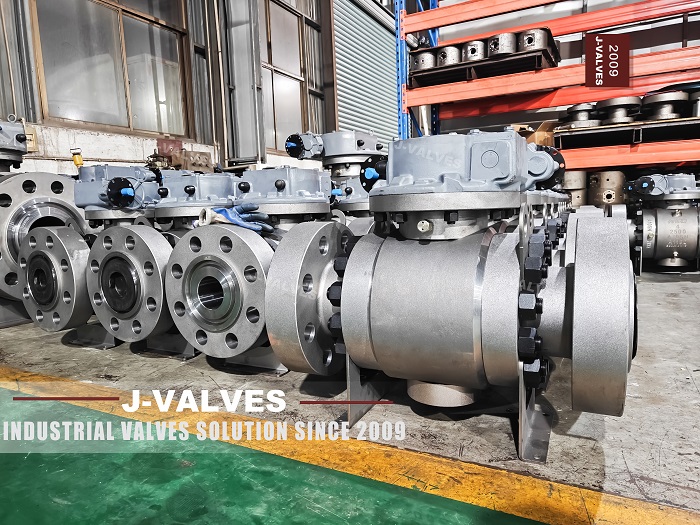
A trunnion mounted ball valve is a quarter-turn isolation valve in which the ball is mechanically anchored by a top and bottom trunnion running in bearings inside the body. Line pressure is not used to seal the ball against the seat; instead, spring-loaded or piston-assisted seats are pushed against the ball. The result is low, stable operating torque and controlled seat loading regardless of line pressure.
A floating ball valve works the opposite way: the ball is free to move downstream and is pressed into the seat by line pressure. That is elegant and cheap, but the seat load is proportional to pressure, so above roughly NPS 6 and Class 600 the torque needed to operate it becomes impractical.
Trunnion mounted | Floating | |
Ball support | Top and bottom bearings | Free-floating, held by seats |
Seat load source | Springs / piston effect | Line pressure |
Operating torque | Low and stable with pressure | Rises sharply with pressure |
Practical range | NPS 2–60, Class 150–2500 | NPS 1–8, lower classes |
Offshore fit | FPSO, subsea, ESD, injection | Utility and small-bore lines |
3. Where trunnion ball valves sit on an offshore facility
FPSO topsides. Crude separation, gas treatment and produced-water modules are dense with trunnion ball valves because they combine high pressure with tight space and the need for in-line maintainability. Top entry designs let the ball, seats and seals be serviced without cutting the valve out of the pipe.
Subsea manifolds and trees. Here API 6DSS governs, adding external sealing and hyperbaric validation requirements on top of API 6D. Valves are typically operated by ROV receptacle, diver handwheel, or pressure-compensated hydraulic actuator with ROV override. One multinational supplier's subsea range is rated for water depths to 500 m with a nominal 25-year design life — a useful reminder that subsea specification is a lifecycle argument, not a purchase-price argument.
Risers and export lines. Large-bore, full-bore trunnion valves keep pigging possible and pressure drop low.
ESD and HIPPS loops. These are safety functions, not process valves. Expect SIL 3 certification to IEC 61508, documented fail-safe behaviour and validated closing times.
Seawater and chemical injection. High chloride content plus frequent cycling makes material selection, not pressure class, the binding constraint.
4. Design features that survive offshore service
Double block and bleed. Independent seats on both sides let the body cavity be vented to prove that neither side is passing. Offshore this supports single-side maintenance without depressurising the whole system, and it is frequently a regulatory expectation. Where the project requires it, DIB-1 (double piston effect) or DIB-2 (dual seat) configurations extend this to positive isolation in both directions.
Double barriers and triple stem seals. Every leak path from process to environment should have a secondary barrier. On subsea valves this is a design requirement rather than an option.
Anti-blowout stem and anti-static device. Both are standard on offshore-grade valves. The stem should be retained by a shoulder, and a verified path should bond ball, stem and body electrically.
Metal-to-metal seats with hardfacing. Where sand is present, HVOF-sprayed tungsten carbide or Stellite hardfacing on ball and seats outlasts soft inserts by a wide margin. Specify hardness in the purchase order rather than leaving it to the supplier's catalogue.
Actuation that matches the safety case. Hydraulic actuators with pressure compensators, ROV override, spring-return fail-safe behaviour — the actuator is as much a part of the offshore valve as the body. Torque calculations should cover break-to-open, running, end-to-open and end-to-close at minimum and maximum supply pressure.
5. Material selection: carbon steel, duplex or higher alloy
Material is usually the decisive cost item, and the decision is driven by chloride content, temperature and H₂S partial pressure rather than by pressure class alone.
Material | Typical UNS | PREN | Offshore fit |
Carbon steel (WCB / LF2 / LCC) | — | — | Non-sour, low-chloride service; low temp grades to −46 °C |
316 / 316L | S31600 / S31603 | ~25 | Clean hydrocarbon, low chloride; limited by pitting and Cl-SCC |
Duplex | S31803 / S32205 | ~35 | Produced water, moderate chloride and H₂S |
Super duplex | S32750 | ~42 | High chloride (seawater-like), higher temperature |
Nickel alloys (Inconel 625, etc.) | N06625 | — | Severe sour service, cladding and overlay |
Two practical anchors. First, NACE MR0175 / ISO 15156 permits duplex stainless steels in sour service up to about 1 bar H₂S partial pressure and 250 °C, subject to hardness limits. Second, critical pitting temperature measured to ASTM G150 gives you the safety margin: 316L becomes the wrong answer when produced-water chloride climbs into the thousands of mg/L and temperature passes roughly 60 °C, because pitting and chloride stress corrosion cracking move from "possible" to "expected."
6. The standards stack you have to get right
Concern | Standard | Offshore implication |
Design, manufacture, test | API Spec 6D, 25th Ed. (Nov 2021; Add. 3, Mar 2025) / ISO 14313:2025 | Baseline for pipeline valves; PHMSA's adoption of the 25th edition took effect 1 January 2026 |
Subsea valves | API 6DSS | Adds external sealing, double barriers, hyperbaric validation |
Pressure–temperature rating | ASME B16.34 | Body wall thickness and rating basis |
Face-to-face / end-to-end | ASME B16.10, API 6D Annex C | Interchangeability without pipe modification |
Weld ends | ASME B16.25 | Wall-thickness matching; heavy-wall transitions at 30°/45° |
Fire safety | API 607, API 6FA, ISO 10497:2022 | Metal secondary seat must still seal after soft parts burn |
Fugitive emissions | ISO 15848-1 (Class AH/BH), API 624 / 641 | Increasingly a tender requirement for methane service |
Sour service | NACE MR0175 / ISO 15156 | Hardness caps and qualified material envelopes |
Functional safety | IEC 61508 (SIL 3) | Required for ESD and HIPPS loops |
Marine coating | ISO 12944 C5-M | External corrosion protection for deck-exposed parts |
Two distinctions buyers get wrong. API 6D does not mandate integral or separate trunnion construction — Clause 6 makes clear that illustrations are for information, not requirements, so a valve is compliant if it meets the performance and testing clauses, not if it matches a drawing. And a fire-test certificate qualifies a design, not each production valve; check that the qualification actually covers your ordered body, ball support, seat and stem-seal configuration.
7. Failure modes and how design counteracts them
Failure mode | Root cause | Design countermeasure |
Seat leakage after a few years | Chloride pitting / Cl-SCC on 316 trim | Duplex or super duplex body and trim; PREN and CPT specification |
Torque rises until the actuator stalls | Seat load rising with differential, or elastomer swell | Trunnion support, self-relieving seats, correct seal compound |
Erosion through seats in months | Produced sand | Metal-to-metal seats, HVOF / Stellite hardfacing, API 6AV1 references |
External leakage subsea | Single barrier at a dynamic seal | Double-barrier sealing, CRA overlay on dynamic seal areas |
Body cavity overpressure | Thermal expansion of trapped fluid | Self-relieving (SR) seat design or cavity relief valve |
Stem leakage or ejection | Inadequate retention, packing degradation | Anti-blowout stem, triple stem barrier, stem injection fitting |
Bolting loosening under vibration | Dynamic load without adequate preload | Controlled preload, retaining features, bolting cap protection |
8. RFQ checklist: twelve items buyers forget
State the API 6D edition basis explicitly (25th edition with Addendum 3, or as the project requires).
State body construction — side entry, top entry, or fully welded — and accept the maintenance consequences.
Give the real H₂S partial pressure, total pressure, temperature, chloride concentration, pH and presence of free water.
Specify body, ball, seat, stem and bolting materials by UNS number, not by trade name.
Define seat type: soft, metal, self-relieving, DPE, DIB-1 or DIB-2.
Require fire-test qualification covering the ordered design, not just a first-page certificate.
Require fugitive-emission test results to ISO 15848-1 with the leakage class stated.
Require PMI and NDE scope, including weld overlay and heat-affected zones.
Require full actuator torque data at minimum and maximum supply pressure and at temperature extremes.
Define the required closing time from hydraulic study — closing a large liquid valve too fast causes surge.
Require a deviation list; an offer with no deviations on a complex valve is a warning sign.
Agree the document package (MTC to EN 10204 3.1/3.2, drawings, IOM, test reports) and its price impact before purchase order.
9. FAQ
Q1. What is the difference between a trunnion ball valve and a floating ball valve?
A trunnion valve anchors the ball on top and bottom bearings, so pressure does not load the seats; a floating ball valve relies on line pressure to press the ball into the downstream seat. Trunnion design keeps torque low and stable at large sizes and high pressure, which is why NPS 6+ and Class 900+ offshore isolation usually specifies trunnion construction.
Q2. Which standard applies to subsea ball valves?
API 6DSS. It builds on API 6D and adds requirements for external sealing, double barriers, and hyperbaric validation testing. Most subsea projects also ask for SIL 3 certification to IEC 61508 and PED 2014/68/EU compliance.
Q3. When should I specify duplex or super duplex instead of carbon steel?
When chlorides and H₂S are present — typically produced water or sour service. Duplex (S31803) has a PREN around 35 and super duplex (S32750) around 42, versus roughly 25 for 316L. In practice, 316L can suffer pitting or chloride stress corrosion cracking when chloride levels exceed a few thousand mg/L at temperatures above about 60 °C.
Q4. What is double block and bleed (DBB) and why does it matter offshore?
DBB means both seats isolate independently, so the body cavity can be vented to prove that neither side is leaking. Offshore, this allows maintenance on one side without depressurising the whole line, and it is often a regulatory expectation for isolation valves.
Q5. How do I handle sand erosion in an offshore ball valve?
Specify metal-to-metal seats with hardfacing (tungsten carbide or Stellite, often applied by HVOF spraying) rather than relying only on soft inserts, and confirm the ball and seat hardness as part of the purchase order. API 6AV1 type testing is a useful reference for sand-service qualification.
Q6. Can a trunnion ball valve be operated by ROV?
Yes. Subsea trunnion ball valves are commonly supplied with a subsea gearbox and ROV receptacle, a diver handwheel, or a pressure-compensated hydraulic actuator with ROV override. Baric (pressure) compensators keep actuator hydraulics balanced at water depth.
10. Conclusion
Offshore valve selection is not a catalogue exercise. The pressure class tells you the flange rating; the chloride content, H₂S partial pressure, sand load and access constraint tell you what the valve actually has to be. A trunnion mounted design answers the torque and seat-loading questions. It does not answer the corrosion, erosion or barrier questions on its own — those come from material selection, sealing architecture and standards coverage.
Start with the failure mode you cannot tolerate, then work back to material, seat type, body construction and test scope. That order produces a specification that survives both the project review and the twenty-five years that follow it.


