


CHINA J-VALVES Offers Various High-quality I ndustrial Ball Valves
J-VALVES, a distinguished professional ball valve manufacturer rooted in China, takes pride in its extensive product portfolio. Our offerings span a wide range, including trunnion-mounted ball valves, floating ball valves, high-temperature ball valves, high-pressure ball valves, metal-sealed ball valves, ultra-low temperature ball valves, DBB ball valves, Three-way And Four-way Ball Valve, and fully welded ball valves. Each product is a testament to our commitment to precision engineering and reliable performance. Meticulously crafted, they are designed to not only meet but exceed the most stringent industrial demands, ensuring stable operation even under extreme conditions. This enables us to provide our clients with high-value services and makes our valves widely sought-after in industries.
Product Category
Contact Us

-
J-VALVES-Q947F
-
J-VALVES
Overview of the J-VALVES stainless steel trunnion flanged ball valve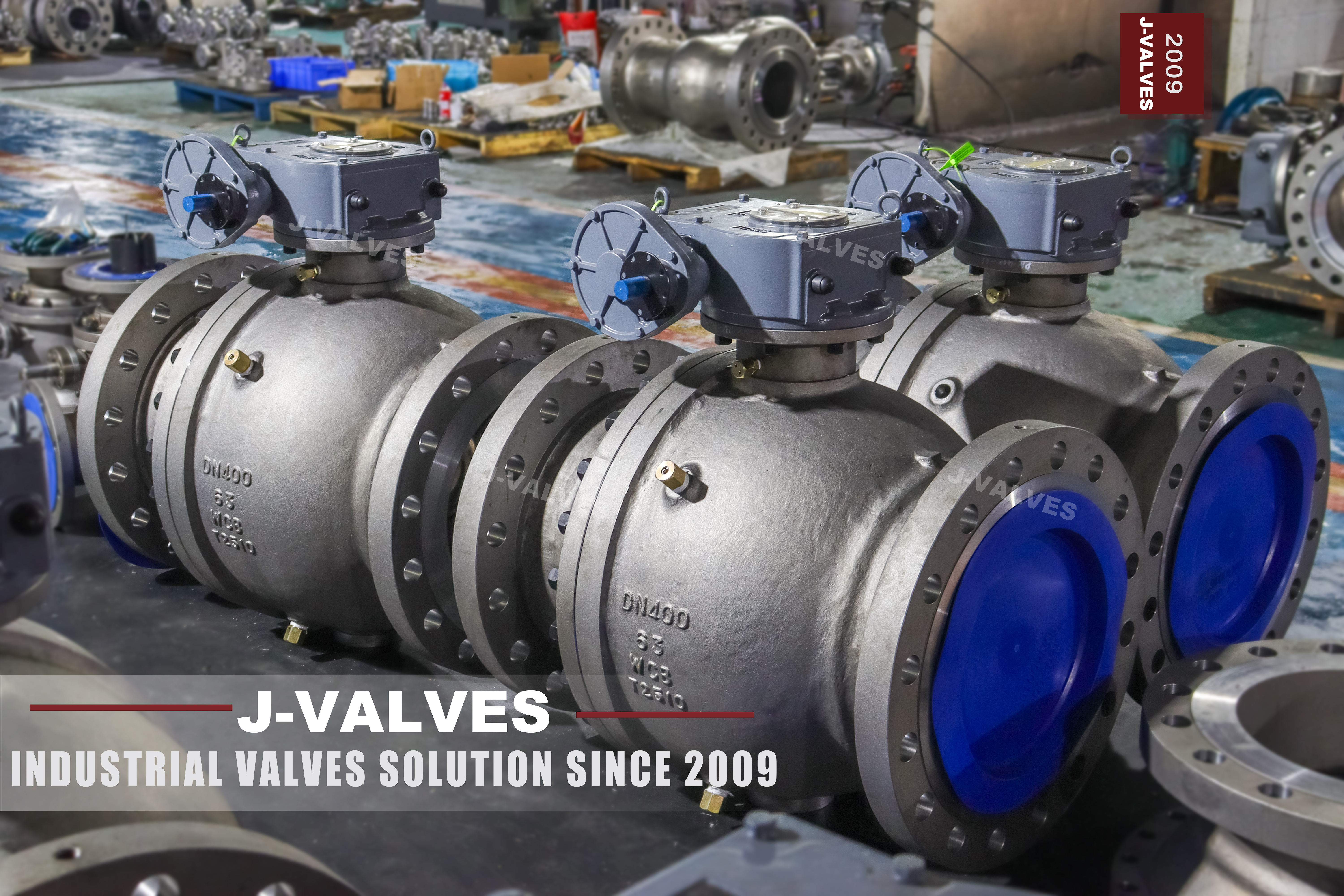
A stainless valve page is usually written around the alloy: corrosion resistance, chloride resistance, the chemical plant it goes into. All of that is true and none of it is checkable from the label. What is checkable is the small block of text that says what each part is made of and which model code the valve carries, and on this page those two lines disagree with the heading above them.
This is a two piece flanged valve from two to fifty six inches, Class 150 to Class 2500, with a CF8M body, a CF8M ball, a CF8M stem, PTFE or RPTFE seats and raised face flanges. The model is given as Q41F, and the valve is described as trunnion mounted.
The disagreement is worth a page of its own, because a buyer who orders from the label gets whatever the label says, and a buyer who orders from the drawing gets something else. The two have to be reconciled before the nameplate is stamped, and this page is about doing it in the right order.
Design and Construction
The body is in two pieces: a main section holding the ball and the seats, and one end cap bolted on with a ring of studs. The flange at the cap end is part of the cap, and the flange at the other end is part of the body, so the two ends of the valve are made differently even though they look the same from the pipe.
The ball is supported from below through a boss on the bottom of the body, and from above through the stem. That boss is the visible difference between a trunnion valve and a floating one, and on the photograph it is the short cylindrical projection under the centre of the body.
So the physical evidence points one way. Two pieces, one body ring, a lower bearing boss, a gear on a pad: that is the outline of a trunnion valve. The label, as published, points another way.
That is why the page is written around the label rather than around the alloy. Corrosion data can be argued about for a week; a model code either matches the body in front of you or it does not.
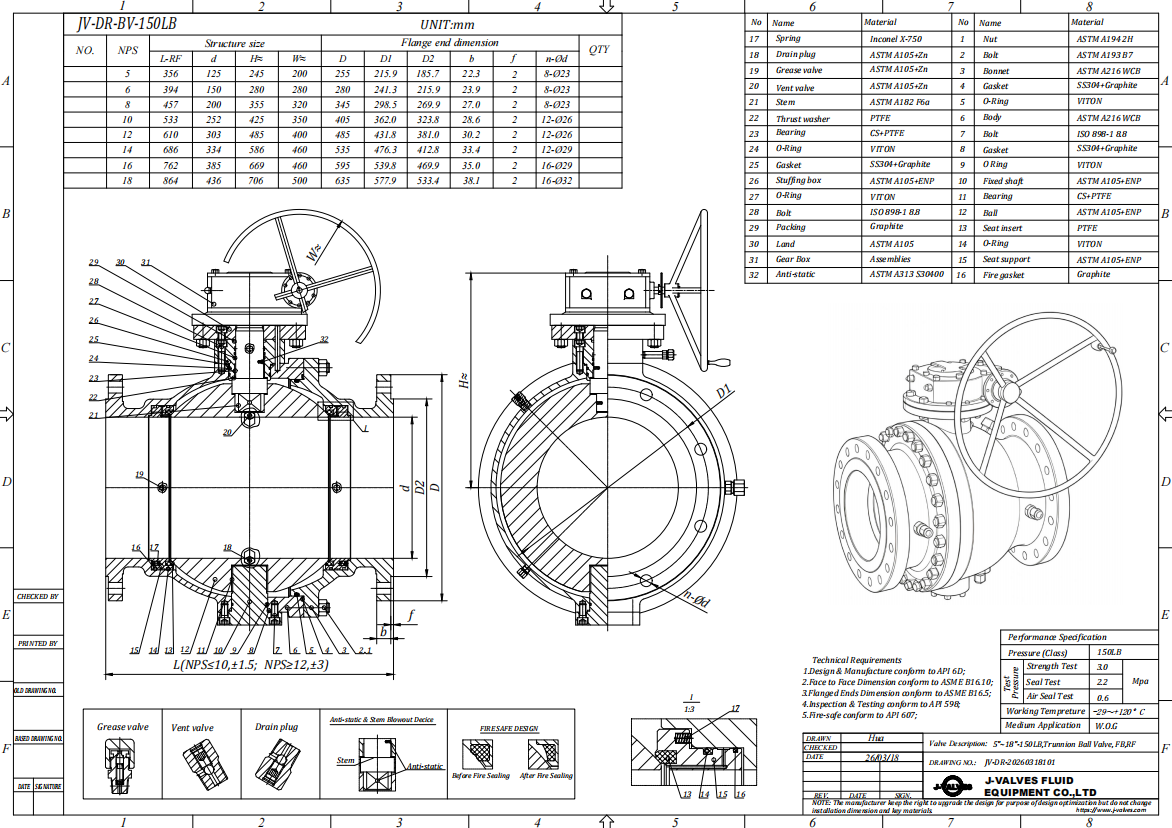
Three Lines Say CF8M, One Letter Says Floating
Take the three material lines first, because they are written identically and they do not mean the same thing. CF8M is a casting grade from ASTM A351. Applied to a body it is normal and correct. Applied to a ball it is possible, and a cast ball has to be machined and ground anyway. Applied to a stem it is unusual, because stems are made from bar or from a forging.
| Line On The Page | What CF8M Implies | What A Trunnion Valve Normally Uses |
|---|---|---|
| Valve body | Cast CF8M, ASTM A351 | Cast CF8M, correct |
| Valve ball | Cast then machined and ground | Cast or forged, then coated or lapped |
| Valve stem | Cast stem | Bar to ASTM A479, or forged to A182 F316 |
| Seats | PTFE or RPTFE | Polymer, or a hardfaced metal ring |
The stem line is the one to ask about. A stem carries the whole operating torque through a square or a keyway, it is the part that must not shear, and it is the part that must not blow out. A cast stem has lower and less predictable mechanical properties than a bar, and on a large trunnion valve the torque at the top of the stem is not small. If the stem really is CF8M cast, the drawing should say so and the torque calculation should be based on it. If it is bar, the line should say bar.
Now the model code. In the GB model system a ball valve is written as a letter and a string of digits, and the digits are read in order: connection, then structure, then the seat material as a letter. In Q41F the Q is the ball valve, the 4 is the flanged connection, the 1 is the straight through floating form and the F is the polymer seat. The trunnion form of the same valve carries a 7 in that position, which makes it Q47F.
Two readings are possible and only one of them is comfortable. Either the valve is a floating valve and the heading is wrong, or the valve is a trunnion valve and the code is wrong. The photograph supports the second, because a floating ball needs no lower bearing boss, and that boss is right there under the body. A buyer with a photograph and no drawing can make that judgement in ten seconds, and it is the cheapest check on the whole page.
The fix is cheap and it is not cosmetic. A code on a nameplate is what a customs officer, a third party inspector and a spare parts catalogue all read, and a code that describes a different valve is a valve that will be ordered again as the wrong thing. If the product is a trunnion valve, the plate carries Q47F. If the plate carries Q41F, the page describes a floating valve and the rest of the copy has to change with it.
There is a quieter version of the same problem in the pressure range. The page offers Class 150 to Class 2500 with PTFE or RPTFE seats and no second seat material. The body class is the body's business; the seat is what sees the temperature and what extrudes under load, and one polymer seat cannot honestly cover the whole range. The quote should carry the class of the body and the window of the seat as two numbers, not one.
Technical Specifications
The table follows the factory data, with the model line and the seat line annotated. The flange and face to face lines are as published.
| Item | Value |
|---|---|
| Size range | 2 inch to 56 inch, DN 50 to DN 1400 |
| Pressure class | Class 150 to Class 2500, PN 20 to PN 420 |
| Temperature | Minus 46 to plus 200 Celsius, material dependent |
| Body | CF8M stainless, ASTM A351, two piece |
| Body ring | One bolted joint, gasketed |
| Ball | CF8M stainless, full bore |
| Stem | CF8M stainless as published, bar or forged preferred |
| Seat | PTFE or RPTFE |
| Ends | Flanged RF per ASME B16.5 |
| Face to face | ASME B16.10 for the size and class |
| Model as printed | Q41F, which is the floating code |
| Model for trunnion | Q47F, if the body has a lower bearing boss |
| Operation | Handwheel, pneumatic, or electric |
| Top flange | Mounting pad for an actuator |
| Design standard | API 6D and ASME B16.34 |
| Test standard | API 598, shell and seat |
| Fire test | API 607 on the design |
| Anti static | Device fitted, continuity checked at assembly |
| Marking | Size, class, grade and model on the plate |
| Lifting | Eyes or slings on the body, not on the gear |
The full bore line and the face to face line have to be read together. A full bore valve has a bore equal to the pipe, and its face to face dimension comes from the same table as every other valve of that size and class. A page that promises full bore and quotes a short pattern dimension is promising a bore that will not fit in the length.
Standards and Compliance
API 6D and ASME B16.34 carry the design, ASME B16.5 carries the flanges and API 598 carries the test. The model code belongs to a different system altogether, which is why it can be wrong on a page that is otherwise correct.
| Document | What It Fixes | What It Does Not Fix |
|---|---|---|
| API 6D | Design, test, marking of the valve | The model code, which is not an API designation |
| ASME B16.34 | Wall and ratings by class | The seat, which is the buyer's choice |
| ASME B16.5 | Flange dimensions and drilling | The face to face length |
| ASME B16.10 | Face to face by size and class | The bore, which the buyer also chooses |
| ASTM A351 | Cast stainless grades, including CF8M | Bar and forgings, which are separate specs |
| ASTM A479 | Stainless bar for the stem | Castings |
| API 598 | Shell and seat test at ambient | The seat behaviour at temperature |
The material specifications are the ones that matter most on a stainless page, because the same three letters appear on three different certificates. A CF8M body is proved by an A351 certificate, a CF8M ball by a casting certificate plus a hardness and coating record, and a stem by a bar certificate with its own mechanical test. One line on a data sheet can hide three supply chains.
The face to face line is the quiet one. It is fixed by the standard for a size and class, and it is the dimension that decides whether the valve fits the gap left in the line. A valve built to a different face to face because the pattern was convenient is a valve that arrives correct in every respect except the one that stops it being installed.
Manufacturing Process
The body and the end cap are cast, then machined. The body gets the ball chamber, the seat pocket and the lower bearing bore in one set up, and the end cap gets its joint face and its flange face machined parallel. The two joint faces are then matched by assembly, not by part number, because a cast joint face has enough variation to need it.
The ball is machined from a casting, then ground and polished, and if it is a soft seated valve it is usually coated. A stainless ball against a polymer seat does not need a coating, and a stainless ball against a metal seat does, because two stainless surfaces in sliding contact will gall.
The stem is turned from bar, or cast and then machined, and this is where the material line on the data sheet becomes a manufacturing decision. A bar stem is turned, threaded and keyed in one sequence, and its grain runs along the axis where the torque goes. A cast stem has no such grain and its mechanical properties come from the casting rather than from the working.

Quality Control and Testing
The shell test is at the class pressure, with the body assembled and the body ring in place. The seat test follows in both directions with the cavity monitored, and on a floating valve the same test is done with the ball free to move, which is a different check from the trunnion case.
The body ring gets a torque check and a record, because a two piece body has one joint that will be opened at some point and it should be closed to a number rather than to a feel. The gasket is a part number and not a material description, and the spare is ordered with the valve.
The material certificates are checked against the three lines that say CF8M. That check is the one that catches a cast stem supplied against a bar specification, and it is cheap to do at the factory and impossible to do after the valve is painted and installed.

Applications and Industry Service
Stainless is chosen for the wetted path in chemical and pharmaceutical service, in water systems where carbon steel would corrode, in food and beverage lines that are cleaned in place, and in coastal installations where the outside of the valve is as exposed as the inside. In all of those the body material is the point of the purchase.
The two piece body suits those services because the valve is expected to be opened for cleaning or for a seat change, and one body ring is easier to reach and to remake than two. It is also lighter and shorter than a three piece body for the same bore, which matters on a skid where the space is fixed.
A trunnion ball in a stainless body is a specific combination: it is chosen where the pressure or the size is beyond what a floating ball can hold, and where the line has to be isolated rather than modulated. Stainless trunnion valves at the larger sizes are usually the isolation valves on a manifold, not the control element.
Stainless is not automatically the safe choice, and the material line is where that gets forgotten. An austenitic grade such as CF8M is chosen for general corrosion resistance, and it is the grade that suffers from chloride stress corrosion cracking when it is warm and concentrated. A page that sells stainless without asking about chlorides and temperature has answered the easy half of the question.

Installation, Operation and Maintenance
The valve is bolted between flanges with the gasket for the facing and the class, and the studs are tightened in a cross pattern. The body ring is checked before installation, because a valve that was opened for inspection at the factory and closed by hand is a valve with one joint at an unknown torque.
The stroke is checked before the line is pressurised: ninety degrees, stops where the drawing says, and no interference between the gear and anything mounted beside it. On a valve with a mounting pad the actuator is fitted afterwards, and the pad and the stem adaptor have to match or the valve will be stroked past its stops.
Maintenance is the packing, the body ring and the seats. The packing is tightened from outside. The body ring is opened with a new gasket. The seats are replaced with the body open, which is the reason to buy a two piece design and the reason to keep the gasket in the store.
How to Specify and Order
An order for this valve has to settle the model code and the stem material, and those two lines are the ones that this page exists to raise. The rest are the usual lines that decide whether the valve fits the line it is going into.
| Line on the Order | What to Write | Why It Matters |
|---|---|---|
| Model code | Q47F for a trunnion body, Q41F only if it is floating | The plate is read by everyone downstream |
| Body material | CF8M to ASTM A351, with the certificate | It is a casting grade, not a generic stainless |
| Stem material | Bar to ASTM A479 or forged to A182, stated | A cast stem has different properties |
| Ball | Cast or forged, with the finish and any coating | It has to match the seat material |
| Seat | Polymer grade and its temperature window | One polymer cannot cover the whole class range |
| Body gasket | Part number, material and a spare set | The ring will be opened at some point |
| Flange facing | RF, and the standard it is drilled to | B16.5 and EN 1092-1 are not interchangeable |
| Bore | Full or reduced, with the dimension | Full bore and short pattern do not coexist |
| Test | Shell and seat both directions, cavity monitored | One direction hides a cavity leak |
| Marking | Size, class, grade, heat number and model | It is the label this page is about |
FAQ
Q: What does Q41F mean?
A: In the GB model system a ball valve is a letter followed by digits read in order: connection, structure, then the seat material as a letter. In Q41F the Q is the ball valve, the 4 is the flanged connection, the 1 is the straight through floating form and the F is a polymer seat. The trunnion form of the same valve carries a 7 in that position.
Q: How can a buyer tell trunnion from floating without opening the valve?
A: Look under the body. A trunnion ball is supported from below as well as from the stem, so the body carries a boss or a cover for the lower bearing. A floating ball is held only by the seats, so the underside of the body is plain. On a large valve that boss is obvious, and it is visible in a photograph.
Q: Is a cast stem a problem on a trunnion valve?
A: It is a question worth asking. A stem carries the whole operating torque through a keyway and it is the part that must not shear or blow out. Bar to ASTM A479 or a forging to A182 has properties that come from working the metal; a casting does not. If the stem is cast, the drawing should say so and the torque should be based on it.
Q: Can one PTFE seat cover Class 150 to Class 2500?
A: Not as a single statement. The body class is the body's business and the seat sees the temperature and the load, so the working window of the seat is narrower than the class range of the body. A quotation should carry both numbers, and the second one is the one that decides whether the valve can be used at the top of the range.
Q: Does a two piece body make the valve harder to repair?
A: It makes it different rather than harder. There is one body ring instead of two, so there is one gasket to replace and one joint to remake, and the end cap comes off to give access to the ball and both seats. The condition is the same as with any bolted body: the gasket has to be a part number and the ring has to be closed to a recorded torque.



Hot Products


News
A Ball Valve Is A Tuning Fork: Vibration, Fretting And The Joints That Only Hold By Friction
A ball valve holds seat, stem and body joint by preload alone. Vibration turns that preload into micro-motion, and the wear arrives with no cycle at all.
Read More
Urea Plant Ball Valves: The Wetted Path Survives Only While Oxygen Is Being Fed To It
Carbamate at 150 bar and 185 C eats stainless 50 times faster once the passive film starves. The valve cavity is where the oxygen runs out first.
Read More
Stiction: What A Ball Valve Becomes When Nobody Turns It
A valve that stood closed for years has not worn out. The seat has bonded to the ball, and the first stroke is a step, not a ramp. What the trace shows.
Read More
Molten Salt Ball Valves: The Valve Works at 565 C And Dies at 219 C
Salt freezes at 220 C and decomposes at 565 C. Everything a molten salt ball valve does happens in that 345 kelvin gap, and the gap is not generous.
Read More