


Introduction
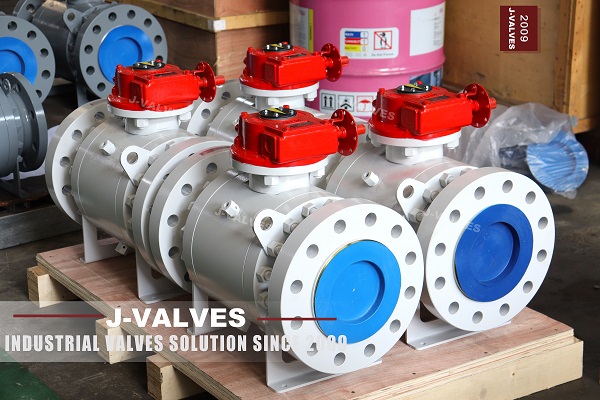
In modern industrial pipeline systems, carbon steel trunnion mounted ball valves are widely recognized as reliable isolation solutions for high-pressure and large-diameter applications. Due to their robust mechanical structure, excellent pressure resistance, and long service life, these valves are extensively used in oil & gas transportation, petrochemical processing, power generation, and energy infrastructure projects.
Compared with floating ball valves, the trunnion mounted ball valve design provides improved stability under high pressure conditions by supporting the ball through upper and lower trunnions. Combined with carbon steel materials such as ASTM A105, WCB, and WCC, these valves deliver excellent performance in demanding pipeline environments.
Manufacturers such as J-VALVES focus on optimizing carbon steel trunnion ball valve designs to achieve high reliability, sealing performance, and compliance with international standards.
1. Structural Design of Carbon Steel Trunnion Ball Valves
A carbon steel trunnion ball valve consists of several critical components:
Carbon steel valve body
Fixed trunnion-supported ball
Stem assembly
Spring-loaded seat system
Anti-blowout stem structure
Double block and bleed option
Fire-safe sealing system
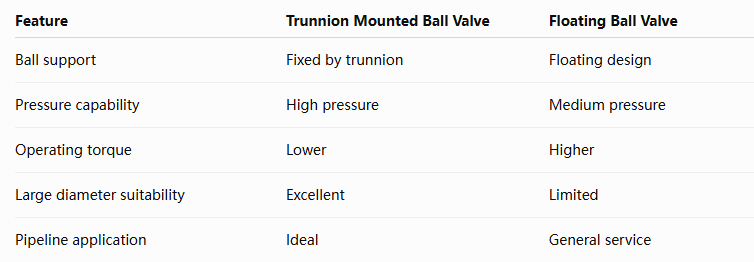
Unlike floating ball valves where the ball moves toward the downstream seat under pressure, the trunnion-mounted structure fixes the ball position and transfers pressure loads through the trunnion system.
This design significantly reduces operating torque and improves stability in high-pressure applications.
2. Performance Advantages of Carbon Steel Material
2.1 High Mechanical Strength
Carbon steel is one of the most commonly selected materials for industrial ball valves because of its:
High tensile strength
Excellent pressure containment capability
Good machinability
Cost-effective performance
Materials such as WCB and A105 are widely applied in:
Oil pipelines
Natural gas systems
Refinery units
Chemical processing plants
2.2 Reliable Performance Under Pressure
Carbon steel trunnion ball valves are designed for pressure classes including:
ANSI Class 150
ANSI Class 300
ANSI Class 600
ANSI Class 900
ANSI Class 1500
ANSI Class 2500
The forged or cast carbon steel body provides excellent resistance against internal pressure and mechanical stress.
3. Trunnion Support System Performance Analysis
3.1 Reduced Operating Torque
One of the biggest advantages of trunnion mounted ball valves is the fixed ball structure.
The trunnion system:
Supports ball weight
Reduces friction between ball and seats
Lowers actuator requirements
Improves operational efficiency
This makes carbon steel trunnion ball valves ideal for large-size pipelines.
3.2 Improved Sealing Stability
The trunnion design works together with pressure-energized seats.
When pipeline pressure increases:
Pressure pushes the seat toward the ball
Sealing force increases automatically
Leakage possibility is reduced
This design provides reliable shutoff performance even under high-pressure conditions.
4. Sealing Performance of Carbon Steel Trunnion Ball Valves
4.1 Double Isolation Capability
Many carbon steel trunnion ball valves incorporate a Double Block and Bleed (DBB) function.
The advantages include:
Independent upstream and downstream sealing
Cavity pressure monitoring
Safer maintenance operations
This is especially important in critical pipeline systems where isolation reliability is essential.
4.2 Fire Safe Design
For oil and gas applications, fire-safe construction is an important requirement.
Typical fire-safe features include:
Metal backup sealing
Anti-static device
Blowout-proof stem
Secondary graphite sealing
These designs improve safety during emergency conditions.
5. Flow Performance Analysis
5.1 Full Bore Design
Many carbon steel trunnion ball valves use a full bore structure.
Benefits include:
Lower pressure loss
Higher flow capacity
Reduced turbulence
Easier pipeline pigging operations
This makes them suitable for long-distance transmission pipelines.
5.2 Flow Efficiency
The spherical ball opening creates a nearly straight flow path.
Compared with traditional globe or gate valves:
Flow resistance is lower
Energy loss is reduced
Pipeline efficiency improves
6. Application Areas of Carbon Steel Trunnion Ball Valves
Carbon steel trunnion ball valves are widely applied in:
Oil & Gas Industry
Crude oil pipelines
Natural gas transmission
Gas processing facilities
LNG Industry
LNG transportation systems
Storage terminals
Process pipelines
Petrochemical Industry
Chemical processing units
Refinery isolation systems
Power Industry
Fuel supply systems
High-pressure process pipelines
7. J-VALVES Advantages in Carbon Steel Trunnion Ball Valve Manufacturing
J-VALVES provides engineered trunnion ball valve solutions with strong manufacturing capabilities and application experience.
7.1 Professional Material Control
J-VALVES applies strict material management including:
Material certificate verification
Chemical composition analysis
Mechanical property testing
Heat treatment control
This ensures carbon steel valve bodies maintain consistent performance.
7.2 Advanced Machining Technology
Precision machining processes include:
CNC machining of ball and seat areas
High-accuracy stem processing
Sealing surface finishing
These processes improve:
Sealing reliability
Torque consistency
Service life
7.3 Complete Testing System
Each valve can be tested according to project requirements:
Hydrostatic shell test
Seat leakage test
Low-pressure gas test
Fire-safe test
NDT inspection
Testing procedures ensure reliable operation before delivery.
8. Carbon Steel Trunnion Ball Valve vs Floating Ball Valve
Conclusion
The carbon steel trunnion mounted ball valve combines strong material properties, advanced sealing technology, and reliable mechanical design to meet the demanding requirements of modern pipeline systems.
Through the use of carbon steel materials, trunnion support structures, pressure-assisted sealing systems, and strict manufacturing controls, these valves provide excellent performance in high-pressure and critical industrial applications.
With professional engineering experience and quality-focused manufacturing processes, J-VALVES delivers dependable carbon steel trunnion ball valve solutions for global oil, gas, LNG, and industrial pipeline projects.


