


Stainless steel trunnion ball valves are critical isolation equipment for long-distance oil & gas pipelines, refineries, offshore platforms and new hydrogen energy projects. Domestic valve manufacturers often face dual standard compliance challenges for global exports: domestic production follows GB/T19672 Chinese national standard for steel pipeline ball valves, while European, American, Middle Eastern and Southeast Asian overseas projects mandate API 6D pipeline ball valve & API 598 valve inspection American standards.
Many procurement engineers and valve manufacturers fail to distinguish core gaps between the two standards in structural design, stainless steel material acceptance, pressure testing, fire & anti-static requirements and certification compliance. Wrong standard selection will lead to failed acceptance by overseas end-users, customs detention and project delays. Drawing on over 15 years of stainless steel trunnion ball valve manufacturing & export experience from J-VALVES, this article fully compares GB/T19672 and core API standards, and provides certification selection solutions for global markets.
1. Scope Definition of Two Core Standards for Stainless Steel Trunnion Ball Valves
1.1 GB/T19672 National Standard of China: Pipeline Valves — Steel Ball Valves
GB/T19672 is a dedicated national standard for domestic pipeline ball valves, applicable to municipal gas, petrochemical and domestic long-distance pipeline projects. It covers flanged & butt-weld trunnion & floating ball valves, compatible with WCB carbon steel, S304/S316L stainless steel, 2205 duplex stainless steel valve bodies.
This standard regulates design, manufacturing and factory test requirements only for domestic industrial projects with pressure classes Class150~Class2500 and operating temperature -29℃~180℃. It is not directly recognized by overseas EPC or end-users, and only serves as a basic domestic production reference.
1.2 Core API Standards Mandatory for Export Ball Valves
Two core American standards for exported trunnion ball valves:
API 6D: Global universal design & manufacturing standard for pipeline ball valves, widely adopted in worldwide oil, gas, petrochemical and offshore industries. It enforces rigid rules for trunnion valve body structure, stem blowout prevention, fire-safe construction, anti-static design and cavity relief ports for bidirectional sealing.
API 598: Unified global standard for factory inspection, hydro/pneumatic testing and NDT of industrial valves, the only testing specification accepted by third-party inspectors for overseas projects.
Supplementary standards: API 607 fire test certification, API 6FA high-temperature fire resistance, ASME B16.34 pressure-temperature rating standard for high-pressure applications.
2. Key Parameter Comparison: GB/T19672 VS API 6D Stainless Steel Trunnion Ball Valves
2.1 Stainless Steel Material Acceptance Rules
GB/T19672: Only defines basic chemical composition limits for stainless steel grades, without mandatory low-temperature impact toughness or intergranular corrosion sampling tests. Domestic S316L valve bodies can pass this standard, with no strict control over performance in low-temperature or marine corrosive environments.
API 6D: Mandates strict low-temperature impact testing (-46℃ impact energy threshold) for 316L, duplex & super duplex stainless steel. Intergranular corrosion tests are compulsory for offshore anti-corrosion service. A182 F316L stainless steel forgings must come with heat traceability material test reports (MTR), enabling full source tracking required by overseas asset owners.
2.2 Sealing & Structural Safety of Trunnion Ball Valves
GB/T19672 only requires basic bidirectional sealing, with no mandatory clauses for stem blowout-proof design, automatic body cavity pressure relief or full fire/anti-static construction. Low-pressure domestic municipal pipelines are exempt from partial safety structures.
API 6D requires all Class 600 & higher high-pressure stainless steel trunnion ball valves to be fully equipped with: stem secondary blowout-proof seals, automatic body cavity relief holes, dual metal & soft fire-safe sealing, and complete anti-static grounding cross-connections. These structures guarantee pipeline safety under extreme pipe rupture and fire conditions, a non-negotiable threshold for global oil & gas projects.
2.3 Hydrostatic & Pneumatic Factory Test Protocols
GB/T19672 specifies shell test pressure at 1.5x nominal pressure and seat sealing test at 1.1x nominal pressure, with short holding time and minor leakage tolerated as qualified.
API 598 (paired with API 6D) requires shell hydrostatic testing at 1.5x rated pressure and gas seat sealing testing at 1.1x rated pressure, with doubled hold time for high-pressure stainless steel valves and a strict zero-leakage acceptance rule. Full 100% volumetric NDT (MT/UT magnetic particle & ultrasonic inspection) for valve body welds is mandatory, while GB/T19672 has no compulsory full NDT regulation.
2.4 Supplementary Fire & Explosion-Proof Certification
GB/T19672 contains no independent fire test chapters with only brief mentions of refractory materials.
API systems require separate API 607 fire certification: valves must maintain zero leakage after 30 minutes of high-temperature flame exposure. This certificate is mandatory for Middle Eastern oilfields and offshore LNG projects; deliveries without this document will be rejected on-site.
3. International Market Certification Selection Guide for Stainless Steel Trunnion Ball Valves
Scenario 1: Domestic Projects + Minor Exports to Southeast Asian Civil Gas
Manufacturing base complies with GB/T19672, supplemented by simple third-party factory inspection reports. Small private Southeast Asian projects accept translated GB/T documents, yet state-owned large oil & gas projects still demand official API 6D certification.
Scenario 2: Oil & Gas Long-Distance Pipelines & Refineries in Europe, America, Middle East & Central Asia (Main Export Scenario)
Valve Body Manufacturing: Design fully compliant with API 6D, adopting A182 F316L/F51 duplex stainless steel forgings;
Factory Inspection: Full set of API 598 pressure tests + 100% valve body non-destructive testing;
Supplementary Certifications: API 607 fire resistance, ISO9001 quality management system, SIL safety certification for high-risk high-pressure equipment;
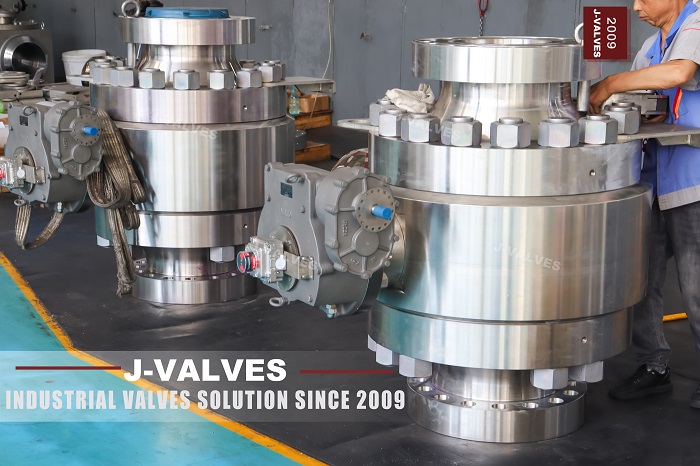
Dual-Standard Production Benchmark: Production lines synchronously meet GB/T19672 domestic inspection and API international tender standards. Large-bore high-pressure stainless steel trunnion ball valves from J-VALVES (as shown in the picture) fully satisfy strict API 6D structural rules including worm gear actuators and cavity relief systems, while passing GB/T19672 type tests for Class1500/2500 high-pressure pipeline applications.
Scenario 3: Offshore Platform & Low-Temperature LNG/Hydrogen Stainless Steel Valves
Beyond API 6D & API 598, additional compliance with ASME B16.34 temperature-pressure rating standards is required, with upgraded low-temperature impact and seawater corrosion testing. GB/T19672 can only act as a secondary reference and cannot cover special marine & cryogenic working conditions.
4. Production Advantages for Manufacturers Complying with Both GB/T19672 & API Standards
Universal Production Lines for Domestic & Export Sales: A single stainless steel trunnion ball valve design satisfies domestic GB/T acceptance and overseas API international bidding simultaneously, cutting repeated mold & inspection costs;
Smooth Customs Clearance & End-User Acceptance: Provide original API 6D certificates & API 598 test reports for export shipments, and GB/T19672 inspection documents for domestic supply, dual-standard paperwork matching all global clients;
Compatibility with Large-Bore High-Pressure Trunnion Valves: Heavy-duty stainless steel trunnion ball valves such as J-VALVES’ high-class pipeline models integrate API-compliant forgings, worm gear operators and overpressure relief structures, and pass national GB/T19672 prototype testing for ultra-high Class1500/2500 pipeline service.
5. Conclusion: Core Recommendations for Stainless Steel Ball Valve Standard Selection
Pure domestic municipal & petrochemical projects: Adopt GB/T19672 national standard for manufacturing & acceptance to lower costs and meet domestic regulatory requirements;
Global exports, foreign EPC contractors and international oil & gas projects: Prioritize API 6D (design) + API 598 (testing) as core standards, with GB/T19672 only as auxiliary production reference;
Valve manufacturers targeting long-term export business: Deploy dual-standard production lines and obtain official API certifications in advance to avoid costly rework, returns and customs detention caused by certification mismatches.


