CHINA J-VALVES Offers Various High-quality I ndustrial Ball Valves
J-VALVES, a distinguished professional ball valve manufacturer rooted in China, takes pride in its extensive product portfolio. Our offerings span a wide range, including trunnion-mounted ball valves, floating ball valves, high-temperature ball valves, high-pressure ball valves, metal-sealed ball valves, ultra-low temperature ball valves, DBB ball valves, Three-way And Four-way Ball Valve, and fully welded ball valves. Each product is a testament to our commitment to precision engineering and reliable performance. Meticulously crafted, they are designed to not only meet but exceed the most stringent industrial demands, ensuring stable operation even under extreme conditions. This enables us to provide our clients with high-value services and makes our valves widely sought-after in industries.
Product Category
Contact Us

-
J-VALVES-Q11F
-
MSNL
Overview of the J-VALVES API two piece flanged floating ball valve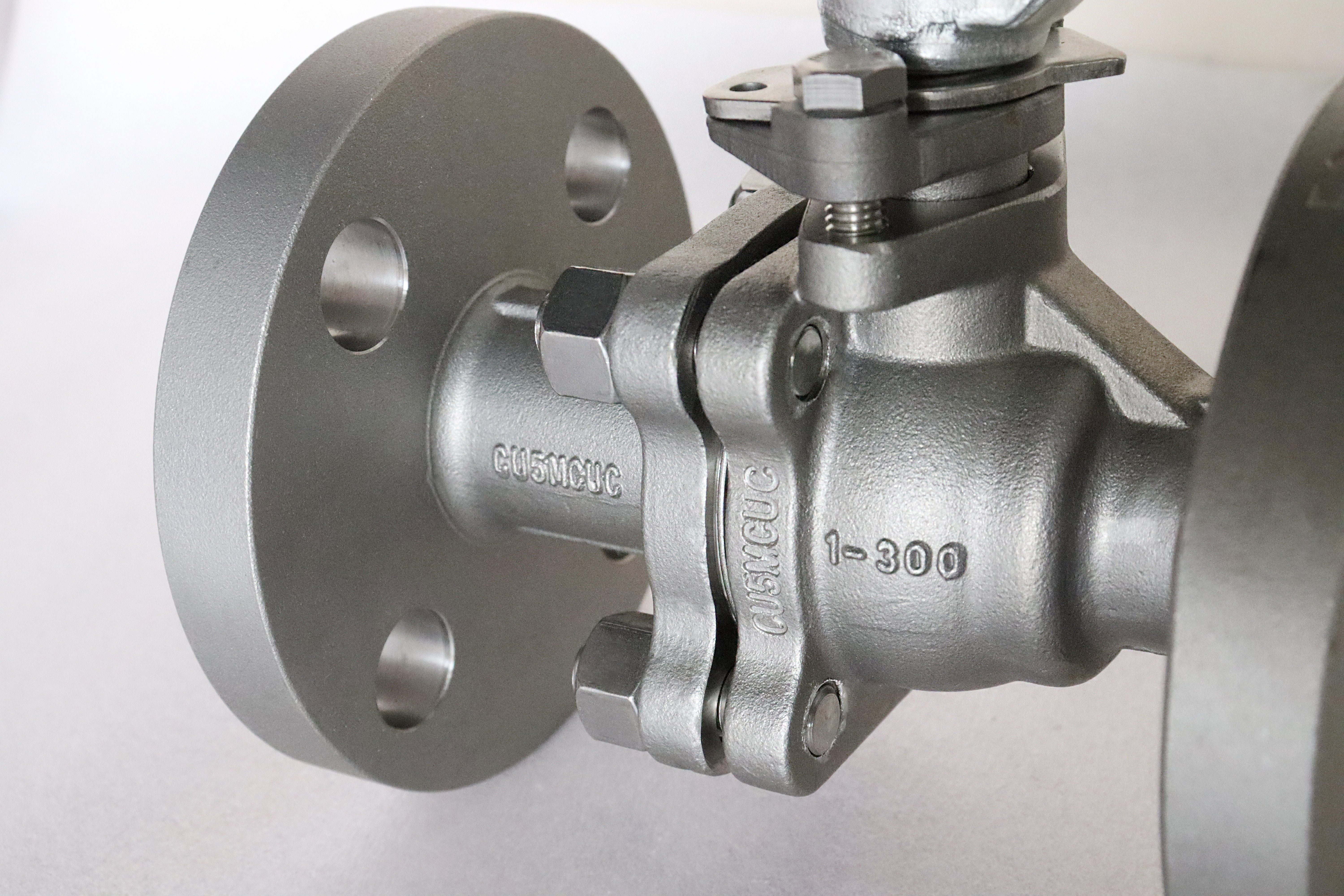
The model code on this valve says Q11F, and Q11F is the code for a valve with a female threaded end. The valve in the photograph has flanges at both ends. That contradiction is not a typing error in a catalogue field; it is the normal way a model code gets copied from a smaller threaded valve onto a larger flanged one, and it is worth taking seriously because the code is the first thing a drafter or a buyer reads.
The valve itself is a two piece 316 stainless body with raised face flanges, a floating ball on two polymer seats, and a range from half inch to eight inch in Class 150 to Class 600. It is the API designated version of the two piece flanged pattern, and its documents are API 608 for the valve and ASME B16.34 for the wall.
The argument here is about labels and their limits. A model code carries four pieces of information and leaves out everything else. A standard carries a scope, and that scope ends at a class. A product name carries a family, not a document number. Reading any one of the three as if it were the specification is how a valve gets ordered that nobody intended to buy.
Design and Construction
The body is split at one joint, closed by studs with a gasket, and the joint doubles as the assembly opening: the ball and both seats go in from that side. The flanges are raised face to ASME B16.5, the face to face length follows ASME B16.10 for the class and size, and the stem carries a blowout proof shoulder with an anti static path to the body.
A model code in the Chinese designation system is built from position, connection, structure and seat material, in that order, and each position has a fixed meaning. The first letter names the valve type, the first digit names the end connection, the second digit names the internal structure, and the letter at the end names the seat or the trim. Once that structure is known, a code can be read as a sentence rather than as an identifier.
Under that structure the first digit 1 means a female threaded end and 4 means a flanged end, so a flanged floating valve of this pattern belongs to the Q41F family. Q11F describes a threaded valve with a floating ball and a PTFE seat, which is a real product and a common one, and it is the valve that this page's code was almost certainly copied from when the page was written.
The code does not describe the size, the class, the body grade, the flange standard or the face to face length, and those are the five things that decide whether the valve fits. That is the honest limitation of any model code: it is a shorthand for the family, and a shorthand that is one digit out points at a different family. The plate, the drawing and the offer should agree on the family before they agree on anything else.

Material Options
The page gives one grade for the body, the ball and the stem, which is simpler than most pages in this range and easier to order. The table keeps the page's entries and adds only the parts that the joint and the seat need.
| Part | Material on This Build | Note |
|---|---|---|
| Body and end piece | 316 stainless, two pieces | One joint, one gasket |
| Ball | 316 stainless, polished | Floating, no trunnion |
| Stem | 316 stainless | Blowout proof shoulder |
| Seats | PTFE or reinforced PTFE | Sets the temperature ceiling |
| Body joint gasket | Spiral wound or PTFE sheet | Compressed by the joint studs |
| Studs and nuts | A4 stainless | Sized by the class |
| Anti static | Spring or conducting washer | Stem to body |
| Fire safe insert | Metal lip behind the seat | To API 607 |
One grade for all three wetted parts is a genuine simplification and it is also a compromise. A 316 ball is softer than a hard faced one, so it is more easily scratched by grit carried in the medium, and a scratched ball leaks past the seat no matter how good the seat is. On clean service the compromise costs nothing; on slurry or on a line with mill scale in it, the ball is the part that fails first.
The seats are polymer and that is what fixes the service envelope, not the body. PTFE and reinforced PTFE run to about 200 Celsius in continuous service, and the reinforced grade resists cold flow better at the top of that band. The page prints a range up to 425 Celsius, which is a body figure; on this build the seat is the limit and the article uses the seat figure throughout.
Technical Specifications
The specification below is the page's own range, with the temperature line corrected to the seat and the two designations kept apart.
| Item | Value |
|---|---|
| Size range | Half inch to eight inch, DN 15 to DN 200 |
| Pressure class | Class 150 to Class 600, PN 20 to PN 100 |
| Body | 316 stainless, two piece, one joint |
| Ball and stem | 316 stainless |
| Seats | PTFE or reinforced PTFE |
| Temperature | Minus 29 to plus 200 Celsius on a polymer seat |
| Ends | Raised face to ASME B16.5 |
| Face to face | ASME B16.10 |
| Design | API 608, ASME B16.34 |
| Test | API 598 shell and seat |
| Fire safe | API 607 |
| Operation | Lever, gear, or pneumatic on an ISO 5211 pad |
The class to PN pairing is one of the few places where the page is exactly right and worth quoting as it stands. Class 150 is PN 20, Class 300 is PN 50 and Class 600 is PN 100, and the three pairs come from the designation table in API 6D. That table is a list of seven pairs and not a conversion, which is why a page that prints PN 16 against Class 150 has done arithmetic instead of reading a document.
The temperature line is the one place where the page and the build disagree, and the disagreement is not academic. A buyer who takes 425 Celsius from the page and puts this valve on a hot oil line will get a valve whose body is inside its range and whose seats are outside theirs. The seats will soften, extrude into the clearance and stop sealing quietly, and the failure will be recorded as a seat problem rather than as a specification problem.
Standards and Compliance
Two standards are named on the page and three more appear in the surrounding lines. The table sets out what each one fixes and where its scope ends, because the ends are where the mistakes happen.
| Document | What it fixes | What it does not fix |
|---|---|---|
| API 608 | Steel ball valves, DN 15 to DN 600, Class 150 to Class 600 | Anything above Class 600 |
| ASME B16.34 | Wall thickness and material groups | The valve's own design details |
| ASME B16.5 | Flange dimensions and drilling | The body, the seats, the stem |
| ASME B16.10 | Face to face for flanged valves | Threaded or welded lengths |
| API 598 | Shell and seat test, allowable leakage | The seat material choice |
API 608 is the reason this valve can be called an API valve at all, and it is also the reason the name should not be read as API 6D. 608 covers steel ball valves from DN 15 to DN 600 in Class 150 to Class 600, which is exactly the range on this page. Above Class 600 the 608 route ends, and a 900 or 1500 class valve has to be built to 6D, which is a different document with different requirements and a different test regime.
The B16.34 line does a different job. It gives the wall thickness for a material group at a class and a temperature, and it is the reason a 316 body can be thinner than a carbon steel one at the same class while still being rated the same. A page that quotes a pressure class without a wall document has quoted half of the pressure boundary.
Manufacturing Process
The two body halves are castings in this size and class, and the flanges are formed in the casting rather than welded on. The first machining operation cuts the flange face and the raised face together, and that face is then the reference for the seat pocket and the bore. Everything downstream of that setting depends on it being square.
The ball is turned, ground and lapped, and the bore through it is machined after the sphere so that the sphere is held by its outside during the last operation. The seat rings are moulded and then faced, and the face is what contacts the ball; a seat ring that is moulded to size and not faced will not hold a line contact on the ball over its whole circumference.
Assembly closes the two halves on a gasket with a controlled stud torque, fits the stem through its shoulder, adds the packing and the lever, and cycles the valve by hand. The plate is struck after the test, not before, because the heat number on the plate has to be the heat number that was tested.

Quality Control and Testing
The shell test is applied with the ball open so that both body halves and the joint see the pressure, at one and a half times the class rating to API 598. The joint is the part that is watched, because a two piece body has exactly one gasketed boundary and it is not visible in service.
The seat test is applied one side at a time at one point one times the rating, with the valve closed. A floating ball loads only the downstream seat, so a single sided test proves one seat and assumes the other. Turning the valve around and repeating the test is the only way to prove both, and the record should show two results rather than one.
The plate is checked against the drawing before dispatch, and the model field is part of that check. On this valve the model field reads Q11F on a flanged body, and a receiving inspector who knows the designation system will stop the delivery on that line alone. Correcting it costs one stamp before dispatch and a returned consignment after, which is the whole argument for reading a code rather than copying it.

Applications and Industry Service
The service this valve is built for is chemical and process isolation in 316, at classes up to 600, in sizes up to eight inch. It suits clean liquids, solvents, dilute acids and the general run of plant utilities where a carbon steel body would corrode and a higher alloy would be wasted. The raised face joint is the standard one for these classes and needs no special gasket.
In pharmaceutical and food grade work the same body is used with a polished bore and a seat chosen for the cleaning regime rather than for the pressure. The straight through bore and the absence of a pocket are the reasons the pattern is accepted there, and the two piece joint is accepted because it can be cleaned and inspected at the split.
Where the valve should not be used is where any polymer seated floating valve should not be used: steam above the seat limit, media that flash across the seat, and anything that needs throttling. A ball valve is an isolator. Half open, it directs the flow across the seat edge and erodes the polymer at a rate that no pressure class anticipates.
Installation, Operation and Maintenance
Installation is a raised face joint at each end with a gasket to suit and studs sized for the class, tightened in a cross pattern. The valve is symmetric in pressure terms and can be fitted either way round, though the preferred direction is normally marked and follows the seat arrangement. The pipe is supported so that the body does not carry the weight of the line.
Operation is a quarter turn against a stop. The valve is not a control device and the lever is not a throttle; a ball left at part open will erode its seat edge and will also trap medium in the body cavity that later drains somewhere unintended. Locking the lever in position is normal practice on a line that must not be moved.
Maintenance reaches the packing from the top without opening the body, and reaches the seats and the ball only through the joint. On a two piece body that means the valve comes off the line for a seat change, which is the practical difference between this pattern and a three piece one. On clean service the interval is long enough that the difference rarely matters.
How to Specify and Order
The order lines below are the ones that a model code cannot carry, and the first line is the one this page exists to make visible.
| Line on the order | What to write | Why it matters |
|---|---|---|
| Model code | Q41F for a flanged body | Q11F names a threaded end |
| Size and class | For example three inch Class 300 | Fixes flange, wall and face to face |
| Body grade | 316 | One grade for body, ball and stem |
| Seat material | PTFE or reinforced PTFE | Sets the 200 Celsius ceiling |
| Ends and operator | Raised face, lever or pad | Pad is an ISO 5211 interface |
Writing the model code correctly costs nothing at the enquiry and saves a return at goods-in. The code, the plate and the drawing should name the same family, and if they do not, the drawing is the one to trust and the code is the one to correct.
Read that way, the valve is a two piece flanged 316 body with one joint, a floating ball on polymer seats, raised face flanges to B16.5, a face to face to B16.10, and documents that run from DN 15 to DN 600 in Class 150 to Class 600 and stop there. The API in the name is a family label; the documents behind it are 608 and B16.34, and the class ladder is where the family ends.
FAQ
Q: What does a Q11F code actually say?
A: Q for a ball valve, the first 1 for a female threaded connection, the second 1 for a floating straight pattern, and F for a PTFE seat. A flanged floating valve of the same pattern belongs to the Q41F family, because the 4 is the code for a flanged end. The page prints Q11F under a body that carries flanges.
Q: Does one wrong digit matter if the drawing is right?
A: It matters at the enquiry, because the code is the first line a drafter or a buyer copies. A code that names a threaded end invites a quotation for the wrong valve, and then the plate, the offer and the drawing disagree three ways. The code is not decoration; it is the shortest description of the valve that exists.
Q: Is this valve built to API 6D?
A: No, and the page does not claim it. It names API 608 and ASME B16.34. API 608 covers steel ball valves from DN 15 to DN 600 in Class 150 to Class 600, which holds the whole range offered here. Above Class 600 the 608 route ends and 6D becomes the only document left.
Q: So what does the API in the product name mean?
A: It means the valve is designed and tested to API documents rather than to a national standard of another system, and on this page those documents are 608 for the valve and B16.34 for the wall. A name is a family label, not a document number, and the two should not be read as the same thing.
Q: Why does the seat matter more than the grade at 600 class?
A: Because the body at 600 class in 316 is inside its rating everywhere the seat can survive, and the seat is what limits the service. PTFE and reinforced PTFE are the only seats offered here, and both are polymer, so the pressure and temperature ceiling of this valve is a polymer ceiling rather than a metal one.
Hot Products


News
Remanufactured Ball Valves: Five Checks That Decide Whether A Rebuild Deserves A Certificate
A rebuild at 45 percent of price with half the life is no saving. Five checks that separate a real remanufacture from a repaint with a certificate.
Read More
The Squeeze Is A Residual: How Tolerance Stack-Up Decides Whether A Ball Valve Seals
No dimension sets the seat squeeze. Five tolerances do, in series. Why identical valves feel different, and why a new ball changes the arithmetic.
Read More
Why A Ball Valve Gets Harder To Turn: Five Causes, And The Test That Tells Them Apart
A ball valve that stiffens over months points at one of five parts. Measure torque with the line pressurised and again vented, and the split becomes visible.
Read More
The Ball Valve at Four Thousand Bar: Seat Load, Erosion And Fatigue in Waterjet Circuits
At 4,000 bar a 10 mm bore puts 31 kN on the seat and a 0.1 mm leak cuts steel. What a ball valve must survive in a waterjet or intensifier circuit.
Read More