


I. Why a "simple" valve is often the right answer
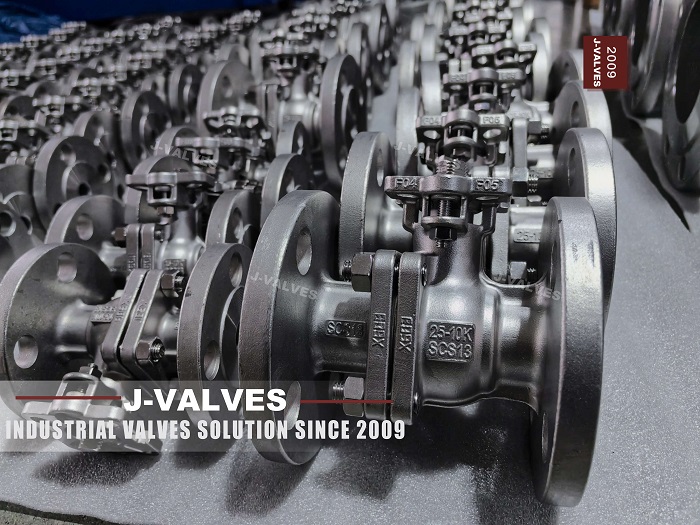
A few years back I sized ball valves for a refinery project — DN200, Class 300, light oil with a bit of entrained solids. The vendor's first offer was a trunnion ball valve, on the familiar logic that "the big plants all use trunnion." But at that size and pressure class, a floating ball valve did the job for roughly a third less in procurement cost, and a full-bore floating design added almost nothing to pressure drop. We ran stainless steel bodies with RPTFE seats. They're still in service without a single seat change.
The point isn't that floating valves are "better." It's that they're misread as a budget option when, in the right envelope, they're the most cost-effective and reliable choice. The trick is knowing how they actually seal, when they fit, and when they don't.
II. How a floating ball valve actually seals
The word "floating" refers to the ball. Unlike a trunnion valve, where the ball is pinned top and bottom, a floating ball hangs off a single stem and sits between the seats with a small amount of axial play.
That play is the whole mechanism:
To close, the ball rotates 90° and blocks the flow path;
Upstream line pressure pushes the ball downstream;
The ball is pressed firmly against the downstream seat, forming the seal.
In other words, a floating ball valve uses line pressure to force the ball onto the seat — the higher the pressure, the tighter the seal (within material and strength limits). That single fact drives both its strengths and its limits:
Strengths — Few parts, simple to maintain; full-bore versions have negligible pressure drop; quarter-turn, fast open/close; lower cost than a trunnion valve of the same size.
Limits — The ball's load is carried by the stem and the downstream seat, so as size and pressure climb, stem torque and seat wear rise quickly. Beyond roughly DN300 / Class 600 the economics flip, and the ball should be pinned top and bottom to share the load — that's a trunnion valve.
One line to remember: small-to-medium bore and low-to-medium pressure — floating; large bore and high pressure — trunnion.
III. Floating vs. trunnion: the real difference
The entire distinction comes down to one thing — is the ball supported or not.
Factor | Floating ball valve | Trunnion ball valve |
Ball support | Stem only, ball floats axially | Pinned top & bottom |
Sealing | Line pressure pushes ball onto downstream seat | Spring/line pressure pushes seat onto ball |
Typical size | Up to ~DN300 (12") | Up to DN1200+ |
Typical class | Class 150–600 | Class 150–2500 |
Operating torque | Rises steeply at high pressure | Lower, more stable |
Cost | Lower | Higher |
The size/class boundary isn't a hard rule. Some manufacturers offer DN350 Class 600 floating designs — whether they work depends on seat material and stem-strength engineering, not the catalog number. When you're sizing, ask one question: "show me the reference list for this exact spec."
IV. Where floating ball valves are used
1. Oil & gas — The largest single market. Wellheads, gathering stations, metering skids, tank farms — floating ball valves in DN50–DN300, Class 150–600 are everywhere. Upstream, sand and wax make seat wear the dominant failure mode, which is why seats are typically RPTFE or PEEK, not plain PTFE.
2. Petrochemical & chemical — Utilities, tank farms, loading arms, and isolation service in chemical plants lean heavily on floating ball valves. In corrosive service, the body material (carbon steel, stainless, duplex, alloy) and trim/seal compatibility with the fluid matter more than the structure itself.
3. Water & municipal — Distribution networks, wastewater plants, and desalination favor floating ball valves for low cost and low pressure drop — common on long transfer lines and pump suction/discharge. In seawater, spec the body and bolting for chloride pitting (316 or duplex stainless).
4. Pharmaceutical & food — Sanitary floating ball valves use 316L bodies, surface finish down to Ra 0.8 μm or better, with no dead zones in the cavity — clamp or weld ends to suit CIP/SIP cleaning.
5. Offshore — On a platform, space is tight and maintenance is expensive, which magnifies the floating valve's few-parts advantage. They're common on process line bypass, vent, and instrument isolation in low-to-medium pressure service. What matters offshore is corrosion resistance (salt spray), firesafe design (API 607 / ISO 10497), and classification-society approval (DNV, ABS, etc.).
V. Four things people get wrong at selection
The seat matters more than the body. On floating ball valves, most failures trace to the seat/seal. Plain PTFE is cheap but creeps and tops out around 150°C continuous; use PEEK for heat, RPTFE or metal seats for solids.
"Full bore" isn't always full bore. Some valves sold as full-bore are actually reduced-bore — one pipe size smaller through the ball. If the line is pigged, the pig will hang up. Confirm the bore matches the pipe ID exactly.
Firesafe and anti-static. For flammable service, spec firesafe design and anti-static stem grounding per code to prevent static buildup and ignition.
Direction and cavity relief. Floating valves are usually bidirectional, but high differential pressure calls for seat pressure-equalizing (SPE) design so the cavity doesn't trap pressure.
VI. FAQ
Q1: Can a floating ball valve be used for steam?
Low-pressure saturated steam — yes, with high-temperature seat material and a confirmed T/P rating. Avoid soft-seated valves on superheated steam.
Q2: What's the largest floating ball valve?
Commonly up to DN300 (12"). Larger exists, but torque and seat loading climb fast and economics fade — switch to trunnion.
Q3: Are floating ball valves bidirectional?
Most designs are bidirectional, but "bidirectional" doesn't mean both directions meet the same leakage class. Verify against manufacturer test data at high differential pressure.
Q4: How do I choose floating vs. trunnion?
Start with class and size: Class ≤600 and DN ≤300 — floating first. Above that, or with heavy solids and frequent cycling, consider trunnion. Settle it with the manufacturer's reference list.
VII. Bottom line
A floating ball valve's value isn't in an impressive data sheet — it's in fit. In the low-to-medium pressure, small-to-medium bore envelope, it closes tight, opens fast, and adds next to no pressure drop, with fewer parts and lower cost. The real selection skill is understanding your fluid's temperament, your pressure-temperature envelope, and the seat-material tradeoffs. Get those right, and the floating ball valve is usually the choice that's both easy to live with and easy on the budget.


