


Why an ordinary ball valve fails at LNG temperature
At -196°C the ball, the stem and the body all shrink, but they do not shrink equally. Austenitic stainless contracts about 0.3 percent between ambient and liquid nitrogen temperature, while PTFE packing contracts close to 2.5 percent. A packing set that was preloaded at 20°C therefore lifts off the stem somewhere around -120°C, and a valve that passed its ambient seat test weeps gas the first time the line cools down. The second problem is the bonnet. On a standard short bonnet the packing box sits close enough to the cold body that the gland drops below the temperature at which the packing still has elasticity, and no amount of gland tightening recovers it. Everything else in a cryogenic ball valve design, from the extended bonnet to the disc springs and the PCTFE seats, exists to answer those two facts.
Extended bonnet: what the length is actually for
The extension is a thermal break, not a spanner clearance feature. BS 6364 and ISO 28921 both work to the same principle: the packing has to stay in a temperature range where it can still seal, and normal practice keeps the packing box above -29°C at rated cryogenic conditions, with -46°C accepted for some cold box layouts. Length follows from that principle and from how much of the bonnet sits inside the insulation. Typical extensions run 250 mm for DN50 to DN100, 300 mm for DN150 to DN200, 350 mm for DN250 to DN300 and 400 mm for DN350 and above, measured from the body centreline to the bottom of the packing box. Those are starting values, not a specification. A valve buried in a cold box needs a longer neck than one standing in ambient air, and the drawing has to be checked against the real insulation thickness before the pattern is cut.
Orientation matters as much as length. The stem should point up, or within 45 degrees of vertical, so that any ice that forms runs away from the gland instead of into it. On a horizontal stem the packing box collects frost, the gland studs seize, and the first attempt to adjust the packing in service usually cracks the gland follower. Where a cold box forces a horizontal stem, the bonnet length should be reviewed rather than copied from the vertical case.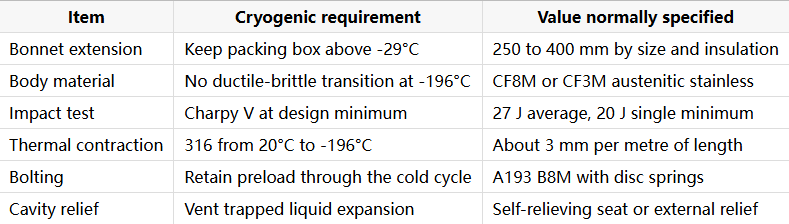
Materials: impact energy, not just the grade name
CF8M and CF3M are the default body materials for LNG because an austenitic structure does not show the ductile to brittle transition that carbon steel shows. Carbon steel is not an option at -196°C. A216 WCB stops at about -29°C, and even the low temperature grades A352 LCC and A350 LF2 are qualified only to -46°C. The distinction matters in practice, because a specification that asks for low temperature carbon steel on an LNG line has asked for a valve that will fail its impact test at the design temperature.
Grade alone does not close the requirement. Project specifications normally call for Charpy V-notch impact tests on the body, the bonnet and the closure at the design minimum temperature, with 27 J average and no single value below 20 J as a common acceptance line, taken from coupons that have received the same heat treatment as the casting and tested to ASTM A370. On welded bodies the test is repeated on the weld metal and the heat affected zone. Where boil-off gas compression, expander outlets or helium recovery push below -196°C, the material conversation moves to 316L forgings, Inconel 625 or 9 percent nickel steel, and the valve stops being a catalogue item.
Seats and seals: where cryogenic leakage actually starts
Soft seats in cryogenic ball valves are usually PCTFE, not PTFE. PCTFE keeps useful stiffness and a lower expansion coefficient down to -196°C, and it holds a bubble-tight seat against liquid nitrogen when it is properly confined. The cost is torque. PCTFE is harder than PTFE, and a DN200 Class 300 cryogenic ball valve needs noticeably more operator torque than the same valve in ambient service, which is why gear operators appear at smaller sizes on LNG duty than they would on a water line. PTFE and TFM seats are used to about -100°C in some designs, and below that the extrusion gap and the differential contraction become difficult to control. Metal seated cryogenic valves exist for high cycle and abrasive duty, but they are specified to a leakage class rather than to zero leakage.
Three sealing details carry most of the field reliability. The seat insert needs mechanical anti-extrusion support, because at -196°C the polymer cannot flow back into a gap the way it does when warm. Every elastic element has to be a disc spring or a metal seal rather than an elastomer O-ring, since elastomers pass their glass transition well above LNG temperature and simply stop sealing. And the fire-safe secondary seal still has to be graphite, positioned where cryogenic contraction does not open a path around it. A valve that is cryogenic but not fire-safe is a specification gap that shows up at the first API 607 review.
Cavity pressure and boil-off
Liquid trapped in the body cavity between the seats is the most common cause of a split cryogenic valve body, and it has nothing to do with the material choice. LNG expands roughly 600 times when it vaporises at ambient temperature, so a few hundred millilitres of liquid in a DN200 cavity becomes a substantial gas volume as the valve warms during a shutdown. The seat design has to relieve that pressure in a controlled direction: a self-relieving seat venting to the upstream side, a cavity relief port piped to a safe location, or a double piston effect seat arrangement with an external relief valve on the cavity. On LNG duty the relief path normally goes to the flare header rather than to atmosphere, and the cavity connection has to remain accessible after the valve is insulated, which is a layout decision rather than a valve decision.
The same physics applies to the extension. In cold box installations the bonnet extension is purged with dry nitrogen, which keeps moisture out and stops ice forming on the stem. A wet extension frosts up, the frost melts on warm-up, and the water runs down into the packing box.
The cold test that proves the design
Ambient hydrostatic testing tells you very little about cryogenic performance, which is why BS 6364 and ISO 28921-1 define a separate procedure. The valve is shell tested at ambient first, then cooled with liquid nitrogen until thermocouples on the body, bonnet and seat confirm that the whole assembly has reached test temperature, which for a large valve means a soak of one to two hours rather than a few minutes. The seat test follows at 1.1 times rated pressure in both directions. Many specifications add a cycling sequence, five open-close cycles at cryogenic temperature followed by a repeat seat test, because the seal that holds on the first closure and fails on the fifth is the failure mode that reaches site.
Acceptance is normally ISO 5208 Rate A for soft seated valves, held at cryogenic temperature and re-checked after warm-up back to ambient. The warm-up re-test is not a formality. A seat that passes cold and fails warm usually has an extrusion or a preload problem; a seat that passes warm and fails cold usually has a contraction problem. Neither is visible unless the test runs in both states.
Installation rules the valve cannot fix
Three site decisions decide whether a correct valve stays correct. The bonnet extension must not be insulated, because wrapping it in the same foam or PIR as the body defeats the thermal break and pushes the packing back down towards cryogenic temperature. The stem must be vertical or near vertical, and where a cold box forces a horizontal stem the design should be reviewed rather than accepted. And the valve must be supported independently of the pipe: a DN300 cryogenic valve with a long bonnet is a lever, and the flange bolts are not a support.
What to write into the purchase order
Six lines close the requirement: design minimum temperature and fluid; bonnet extension length and stem orientation; body material with the impact test temperature and acceptance energy; seat material and leakage class at cryogenic temperature; fire-safe requirement; and cavity relief arrangement with its destination. J-VALVES builds cryogenic ball valves from 1/2 to 56 inch (DN15 to DN1400) in CF8M and CF3M, with extended bonnets sized to the cold box drawing, PCTFE or metal seats, and liquid nitrogen testing at -196°C witnessed to BS 6364 or ISO 28921-1, supported by PMI, impact test reports and EN 10204 3.1 certificates.
Frequently Asked Questions
What is the lowest temperature a cryogenic ball valve can handle? Standard LNG service is -196°C, which covers liquid nitrogen testing and the full LNG chain. Below that the material set changes completely: liquid hydrogen at -253°C and liquid helium at -269°C need austenitic or nickel alloy bodies with qualified impact data and a different seat concept, and those valves are engineered rather than selected.
Why does a cryogenic ball valve need an extended bonnet? The extension keeps the packing box far enough from the cold body that the packing stays above about -29°C and keeps its elasticity. Without it the packing contracts away from the stem, the gland cannot be adjusted in service, and ice forms directly on the sealing area.
Can PTFE seats be used at -196°C? They can be used to roughly -100°C in some designs, but PCTFE is the normal choice for LNG because it stays stiffer and contracts less. Above all, the seat needs anti-extrusion support and the valve needs a cavity relief path, because the seat alone cannot control the pressure of trapped liquid boiling off.


