


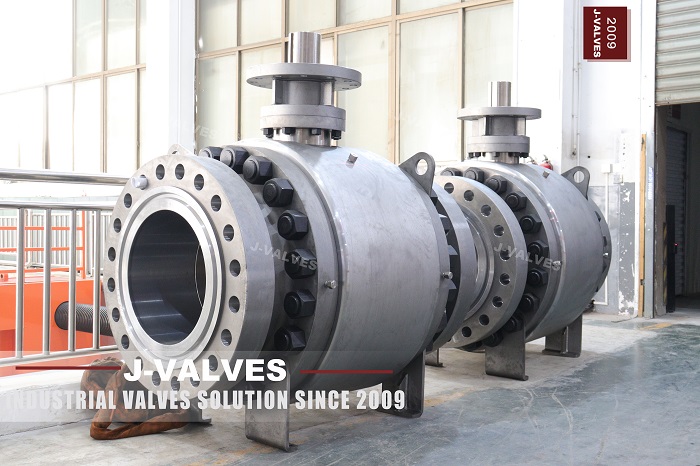
A Class 150 ball valve is not a 150 psi valve, and it is not a 19 bar valve either, except at one temperature. The class number is a designation tied to a table, and the table is the specification. Most arguments about whether a valve is suitable for a line come from reading the designation and skipping the table, so this article works through what the table actually contains, where the number stops being true, and how to write the requirement so the valve that arrives is the valve the line needs.
1. The class number is a reference point, not a working pressure
The 150, 300, 600, 900, 1500 and 2500 designations descend from a nominal pressure in pounds per square inch at a reference condition, but the number no longer carries a unit and must never be read as one. In the current ASME system a carbon steel Class 150 valve is rated 19.6 bar (285 psi) at 38 degrees C, and about 7.6 bar (110 psi) at 371 degrees C. Both statements describe the same valve. The difference between them is the whole subject.
The practical consequence is a single sentence that resolves a large share of field disputes: pressure without temperature is not a requirement. A line designed for 16 bar at 40 degrees C sits comfortably inside Class 150 carbon steel. The same 16 bar at 350 degrees C does not, and the correct response is Class 300 rather than a thicker body, because the rating is an allowable stress calculation, not a wall thickness preference.
2. What ASME B16.34 actually tabulates
Table 2 of ASME B16.34 lists pressure ratings in bar and psi against temperature for material groups rather than for individual grades. Wrought and cast carbon steels such as A105 and A216 WCB share group 1.1. Low temperature carbon steel such as LCB sits in its own group. Austenitic stainless steels are grouped as 304 in one family and 316 in another, and the high alloys and nickel alloys occupy further groups. Two valves in the same group read from the same column even when their tensile strengths differ, because the table is built on allowable stress with a margin wide enough to cover the group.
The table is a set of discrete points, at 38 degrees C, 50, 100, 150, 200 and upwards in fixed bands, and the standard permits interpolation between listed temperatures while forbidding extrapolation beyond the highest listed temperature for the material. That one rule closes the question of whether a valve may be used a little above its stated limit. It may not, and the prohibition is written into the standard rather than left to judgement.
It is worth being explicit about scope as well. The rating describes the pressure boundary of the valve body. It says nothing about the seat, the packing, the body joint gasket or the bolting, each of which has its own limit and may be far lower, and nothing at all about transients, vacuum or external pressure.
3. The six classes at their reference temperature
All six classes are defined at 38 degrees C, and the steps between them are not linear. Class 300 is roughly 2.6 times Class 150, Class 600 is roughly twice Class 300, and the increments flatten as the class rises because the wall thickness required by the design equations grows faster than the pressure does.
Class | Rating at 38 degrees C (psi) | Rating at 38 degrees C (bar) | Typical largest size | Where it is normally found | What usually limits it first |
150 | 285 | 19.6 | DN1400 (56 inch) | Water, cooling, HVAC, low pressure utilities | Temperature derating above 200 degrees C |
300 | 740 | 51.1 | DN1200 | Process lines, medium pressure steam, gas distribution | Flange gasket and bolting at temperature |
600 | 1480 | 102.1 | DN900 | Gas transmission, high pressure process, hydrogen | Soft seat extrusion above DN150 |
900 | 2220 | 153.2 | DN600 | Wells, high pressure gas, LNG send-out | Seat and stem torque, actuator size |
1500 | 3705 | 255.3 | DN400 | High pressure process, offshore topsides | Body joint and bolting relaxation |
2500 | 6170 | 425.5 | DN300 | Extreme pressure, small bore injection | Seat material, cycling, availability |
4. Derating: what the same valve holds once it is hot
Carbon steel loses its rating faster than most buyers expect. The Class 150 figure falls from 19.6 bar at 38 degrees C to 15.9 bar at 149 degrees C, 11.7 bar at 260 degrees C and 7.6 bar at 371 degrees C. In round terms it retains about 60 percent at 260 degrees C and 39 percent at 371 degrees C, which means a valve chosen for a cold hydro test can be marginal in steam service without anything about the valve changing.
Austenitic stainless starts slightly lower at the reference temperature, around 19 bar for 316 in Class 150 against 19.6 for carbon steel, but it retains a larger fraction of that figure as temperature rises. This is the real reason 316 is specified on hot lines where carbon steel would be cheaper, stronger and easier to weld at ambient: the crossover happens somewhere above 300 degrees C, and by 400 degrees C the stainless valve has a rating the carbon steel one no longer has.
Temperature | Class 150 carbon steel (bar) | Class 150 carbon steel (psi) | Fraction of 38 degrees C rating | What this means in practice |
38 degrees C | 19.6 | 285 | 100 percent | Reference condition, the number on the datasheet |
149 degrees C | 15.9 | 230 | 81 percent | Saturated steam at 5 bar still fits, at 12 bar it does not |
260 degrees C | 11.7 | 170 | 60 percent | Most of the Class 150 margin is gone, Class 300 territory |
371 degrees C | 7.6 | 110 | 39 percent | Below the pressure of many utility headers |
European PN ratings are a separate system and are not interchangeable with ASME classes. PN16 is 16 bar at 20 degrees C and derates on its own curve, and a PN16 flange does not mate with a Class 150 flange: the bolt circle, the bolt count and the flange thickness all differ. The assumption that PN16 and Class 150 are the same flange has probably caused more field machining, adapter spools and leaking joints than any other units error in piping.
5. The body rating is not the valve rating
A Class 600 body holds 102 bar at 38 degrees C. A DN200 valve with PTFE seats in that same body will not hold 102 bar across the seat, and in most designs it will not hold a third of it. The mechanism is extrusion: under differential pressure the PTFE cold flows into the clearance between seat ring and ball, the clearance grows, the seal is lost and the seat is permanently deformed. The limit depends on the seat design, the clearance, the support ring, the temperature and the diameter, and it falls as the diameter rises.
This is why a project can buy a correctly rated body and still have a valve that fails its seat test at the pressure the process actually runs. The datasheet says Class 600; the seat says 25 bar.
Seat material | Temperature rang | Typical maximum differential, DN100 to DN200 | Failure mode at the limit | Notes |
PTFE | -29 to 200 degrees C | 20 to 40 bar, falling with size | Cold flow and extrusion into the clearance | Bubble tight, lowest torque, never for steam above 200 degrees C |
Reinforced PTFE | -29 to 230 degrees C | 25 to 45 bar | Extrusion, slower than unfilled | Glass or carbon filled, better creep resistance, slightly higher torque |
PEEK | -29 to 260 degrees C, some grades to 300 | 40 to 100 bar | Brittle cracking under thermal shock | Needs higher preload, tighter ball finish, higher torque |
PCTFE | -196 to 120 degrees C | 40 to 60 bar | Cold flow at ambient, brittle at cryogenic | The cryogenic soft seat, used with spring energised designs |
Metal, Stellite faced | -196 to 650 degrees C | Limited by class, not by seat | Leakage rate rises, never bubble tight | Rate D or E to ISO 5208, requires high seating force and hard facing |
6. The weakest link is usually not the shell
Six components carry the pressure and each has its own limit: shell, body joint, stem, packing, bolting and seat. The shell is normally the strongest, because B16.34 sets a minimum wall for each class and size and most manufacturers exceed it. The body joint gasket is often the first to give at temperature, and it is common to find a spiral wound gasket rated to 400 degrees C inside a valve whose graphite packing is good to 650, or the reverse, so the assembly rating is set by whichever is lower rather than by the class.
The stem deserves separate attention. B16.34 specifies a minimum stem diameter for each class and size, which exists to keep torsional stress within limits at the rated pressure. A manufacturer who reduces stem diameter to save material produces a valve that passes its shell test and fails in torsion after a few years of operation, and the failure is at the packing, not at the ball, so it looks like a gland problem. Anti-blowout retention and anti-static bonding belong to the same conversation, because both are stem features that a cost reduction can quietly remove.
Bolting is the third. B7 studs relax at 400 degrees C, and the preload chosen at assembly determines whether the joint stays tight through a thermal cycle. A change of bolt grade alters the joint more than a change of class does, and it is invisible on the datasheet unless the specification asks for it.
7. What the class rating does not cover
Vacuum. A pressure rating says nothing about external pressure. A Class 150 valve is not automatically vacuum rated, and the seat assist acts in the wrong direction.
Fire. API 607 and ISO 10497 qualify a design after a burn, not a class. A Class 300 valve without fire-safe qualification is still not fire safe.
Surge. A transient above the rating is outside the rating. Closing a large ball valve quickly in a long liquid line can add tens of bar upstream of the seat.
Fatigue. Thermal and pressure cycling consume life in a way a single rating number cannot express.
Hydrogen. ASME B31.12 applies a material performance factor, so the same pressure in hydrogen may require a higher class or a different material for the same wall.
Erosion and corrosion allowance. A rating assumes the wall is still there. Slurry service and internal corrosion remove the margin the class was giving.
External load. Piping weight, settlement, flange misalignment and insulation loads are not in the table.
8. Why over-specifying costs more than it protects
Moving one class up is never just a heavier body. A DN300 Class 600 valve is roughly two to three times the mass of the Class 150 equivalent, and the price follows the mass, the machining time and the test pressure. Face to face dimensions change under B16.10, so the piping layout, the support spacing and sometimes the structural steel change with it. Flanges take more and larger bolts, which means longer studs, higher bolt loads, a bigger torque wrench and a different gasket.
Then comes the actuator. Breakaway torque scales with differential pressure and seat load, so a higher class usually brings a larger cylinder, higher air consumption, a larger solenoid and a bigger compressor duty. A designer who specifies Class 600 for a 12 bar line has bought a valve, a spool piece, a support modification and an air system to solve a problem that did not exist.
The fair comparison is not the price difference between the two valves. It is the price difference against the cost of the wrong flange drilling, the adapter spool, the re-engineered support, the oversized actuator and the schedule slip that follows. Under-specifying is a safety and warranty problem. Over-specifying is a budget and interface problem. Both are avoidable with one table and one conversation.
9. How to specify pressure so the quotation comes back right
Six numbers will get a correct answer: design pressure, design temperature, maximum differential across the seat, fluid and phase, test standard, and any special condition such as vacuum, fire exposure, hydrogen or heavy cycling. The class is an output of those numbers, not an input. An enquiry that states only the class leaves the supplier to assume the temperature, and the assumption will be 38 degrees C because that is where the rating is highest.
State the test as well, because it is not implied by the class. API 598 and API 6D shell tests run at 1.5 times the 38 degrees C rating, and seat tests at 1.1 times the pressure differential, and a buyer who also wants the low pressure air seat test has to ask for it: a valve that passes on water can fail on air, because water surface tension closes leak paths that gas will pass.
Finally, ask for two documents rather than one. The pressure temperature table for the exact material group, and the seat differential limit as a separate figure. With both in hand the valve can be checked against the line in a minute, and the conversation about whether the valve is suitable becomes arithmetic instead of opinion.
10. Field checklist before the valve is accepted
Read the class and the material group together; a class with no material is half a specification.
Check the design temperature against the table, not against the nameplate pressure.
Confirm the seat differential limit separately from the body rating.
Confirm the shell test pressure was 1.5 times the reference rating, and the seat test 1.1 times the differential.
Check that the flange standard, drilling and facing match the mating flange, PN or ASME.
Confirm fire-safe, anti-static and anti-blowout qualification in writing if the duty needs them.
11. A pressure clause you can paste into a specification
Ball valves shall be rated for the design pressure at the design temperature in accordance with ASME B16.34 for the body material group supplied, and the manufacturer shall submit the pressure temperature rating table for the actual material group with the quotation. The seat shall be capable of tight shut-off at the maximum differential pressure stated in the data sheet, and the seat differential limit shall be stated separately from the body rating where the two differ. Shell testing shall be at 1.5 times the 38 degrees C rating and seat testing at 1.1 times the specified differential in accordance with API 598 or API 6D as stated, with a low pressure air seat test also required for gas, hydrogen and vacuum duty. Body, bonnet and stem materials shall be stated by grade, and where the service involves hydrogen, fire exposure, vacuum or heavy cycling, the applicable additional qualification shall be named in the data sheet rather than left to the supplier. J-VALVES supplies ball valves from 1/2 to 56 inch (DN15 to DN1400) in ASME Class 150 to 2500, full bore and reduced port, with soft and metal seats, in carbon steel, stainless, duplex and high alloy bodies, for service from minus 196 to 650 degrees C, tested to API 598 and API 6D with 1.5 times shell and 1.1 times seat pressure, and returns quotations within three working hours including the rating table for the material group offered.
12. Frequently Asked Questions
Is ASME Class 150 the same as PN16?
No. Class 150 is rated 19.6 bar at 38 degrees C and PN16 is rated 16 bar at 20 degrees C, and more importantly the flanges are not interchangeable: different bolt circle, different bolt count, different thickness and different facing details. They can be joined with an adapter spool or a transition gasket set, but never bolted face to face without checking the drilling.
Can I install a Class 300 valve in a Class 150 line?
The pressure rating is not the obstacle, the interface is. Class 300 flanges have more and larger bolts on a different bolt circle, and the face to face length differs under B16.10, so the spool pieces and supports usually change. If the line pressure is low and the only reason for the higher class is temperature, the cheaper answer is often a higher alloy in Class 150 rather than a higher class in carbon steel.
Why is my Class 600 valve limited to about 25 bar?
Because the body is not the limiting component. A soft seated valve is limited by the differential pressure at which the seat material extrudes into the clearance between seat and ball, and for PTFE at DN200 that figure is typically between 20 and 40 bar regardless of whether the body is Class 600 or Class 1500. The body rating and the seat rating must be read as two separate numbers.
What test pressure applies to a Class 300 valve?
Under API 598 and API 6D the shell test is 1.5 times the 38 degrees C rating, so about 77 bar for Class 300 carbon steel, and the seat test is 1.1 times the specified differential, capped at the rating. The test is performed on the assembled valve with the ball in the closed position for the seat test and in the open position for the shell test, and the acceptance criteria come from the leak rate class in the purchase specification.
Does a higher class always mean a heavier and more expensive valve?
Almost always, because the minimum wall thickness in B16.34 rises with class and the test pressure rises with it. The penalty is not only the valve: flange size, bolt size, face to face length, actuator torque and air consumption all move in the same direction, so a one class step at DN300 typically changes the installed cost by more than the price difference between the two valves.


