CHINA J-VALVES Offers Various High-quality I ndustrial Ball Valves
J-VALVES, a distinguished professional ball valve manufacturer rooted in China, takes pride in its extensive product portfolio. Our offerings span a wide range, including trunnion-mounted ball valves, floating ball valves, high-temperature ball valves, high-pressure ball valves, metal-sealed ball valves, ultra-low temperature ball valves, DBB ball valves, Three-way And Four-way Ball Valve, and fully welded ball valves. Each product is a testament to our commitment to precision engineering and reliable performance. Meticulously crafted, they are designed to not only meet but exceed the most stringent industrial demands, ensuring stable operation even under extreme conditions. This enables us to provide our clients with high-value services and makes our valves widely sought-after in industries.
Product Category
Contact Us


Pressure Class: Class 300 (PN50), 51.1 bar at 38°C
Body Material: ASTM A105N forged, or A216 WCB cast
Ball: CF8 / CF8M, or A105N with ENP / hard chrome
Seat: PTFE, RPTFE, PPL, or A105N with Stellite hardfacing
Stem: 316 stainless or 17-4PH, anti-blowout
Bolting: A193 B7 studs with A194 2H nuts
Body Joint: Single gasketed joint; spiral wound or RTJ
Top Flange: ISO 5211 mounting pad, standard
End Connection: Flanged RF / RTJ to ASME B16.5
Temperature Range:-29°C to +425°C, seat dependent
Design Standard: ASME B16.34, API 6D, API 608
Test Standard: API 598, API 6D
-
Q447F
-
J-VALVES

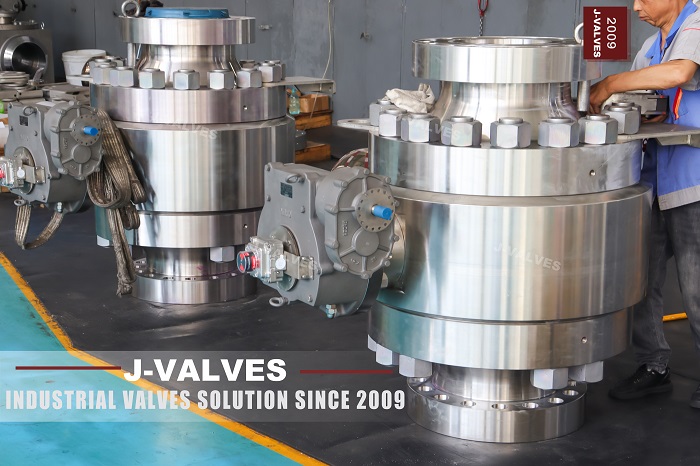
A two piece trunnion ball valve is a split body valve in which the main body carries the ball and one end cap closes it, with a single bolted gasket joint between them. The ball is supported on upper and lower trunnions, so line pressure is carried by bearings rather than by the seat, and the valve can be built in sizes where a floating ball would need an impractical stem. This 8 inch Class 300 pattern in A105N or WCB is the standard workhorse for gas and oil service at moderate pressure.
The phrase "top flange" causes more confusion than any other term in this product family, and it is worth settling first. It does not mean top entry. A top flange, or top pad, is the machined flange on the bonnet to which the actuator is bolted. A top entry valve is a different product whose whole closure is removed through the bonnet. This valve is side entry with a two piece body, and the top flange is an automation interface.
Parameter | This valve |
|---|---|
Size | 8 inch (DN200); 2 to 24 inch in the family |
Pressure class | Class 300 (PN50), 51.1 bar at 38°C |
Body | ASTM A105N forged, or A216 WCB cast |
Ball | CF8 / CF8M, or A105N with ENP or hard chrome |
Seat | PTFE, RPTFE, PPL, or A105N with Stellite hardfacing |
Stem | 316 stainless or 17-4PH, anti-blowout |
Bolting | A193 B7 studs with A194 2H nuts |
Ends | Flanged RF or RTJ to ASME B16.5 |
Top flange | ISO 5211 pad, standard; gear or actuator mounted |
Temperature | -29°C to +425°C, seat dependent |
Standard | ASME B16.34, API 6D, API 608; test API 598 |

Two Piece, Three Piece or Top Entry
The three constructions do the same job and differ in where the joint is and what it costs to open.
Construction | Joints in pressure boundary | In-line repair | Best for | Weakness |
|---|---|---|---|---|
Two piece | 1 body gasket | End cap off, ball and seats accessible | General service, lower cost, common sizes | Line spread needed to remove the cap |
Three piece | 2 body gaskets | Centre section drops out without pipe movement | Frequent maintenance, small bore, manifolds | Two leak paths, more bolts |
Top entry | 1 bonnet gasket | Full trim removed from above, line stays welded | Pipelines, buried or welded lines, large sizes | Higher cost, larger bonnet, needs clearance above |
The two piece valve is the cheapest of the three per unit of pressure containment because it has one gasket plane instead of two and fewer bolts to torque. It is also the most common, which matters for spares and for the availability of a replacement in a hurry. Its limitation is that removing the end cap requires the pipe to be spread by roughly the gasket and cap thickness, so it is not the right choice on a welded spool that cannot move.
The Body Joint Is the Whole Design
On a two piece valve there is exactly one place where the pressure boundary is not solid metal, and everything about the design is arranged around it.
The joint is a bolted assembly of a machined body face, a gasket, and a machined end cap face, held by B7 studs. B7 is a chrome-molybdenum steel with 725 MPa minimum tensile at room temperature and good behaviour to about 450°C; 2H nuts are the matching grade. The studs are torqued in a cross pattern in stages, and the target preload is set so that the gasket stays in compression when the internal pressure tries to separate the faces.
The gasket choice follows the duty. A spiral wound 316L graphite filled gasket covers most hydrocarbon service and tolerates the pressure and temperature cycling of a process plant. An RTJ ring joint is used at high pressure, high temperature or where a spiral wound gasket would be attacked; it seals on metal-to-metal line contact and is far less forgiving of a damaged groove. A PTFE faced gasket is acceptable on water and low temperature but is not a hydrocarbon gasket.
Three field failures trace back to this joint and not to the seat. Under-torquing leaves the gasket below its seating stress and the joint weeps at pressure. Over-torquing yields the stud, and a yielded stud loses preload as soon as the joint is heated. Reusing studs that have been torqued and thermally cycled several times produces a joint that holds cold and leaks hot. The maintenance manual should give the torque value and say that the studs are single use on a hydrocarbon joint.
What the Top Flange Is For
The top flange, also called the mounting pad, is the machined face on the bonnet with a bolt circle and a spigot register, made to ISO 5211. Its purpose is to allow a gear operator, a pneumatic actuator or an electric actuator to be bolted on without modifying the valve.
This matters more than it appears at the order stage. A valve bought with a lever and no top pad cannot be automated later without replacing the bonnet or the whole valve. A valve bought with a standard ISO 5211 pad can be automated at any point in its life, by any actuator supplier, because the interface is defined: flange size, bolt circle, spigot diameter, drive flat or key dimensions, and the stem height above the pad.
Two details decide whether a retrofit actually fits. The stem drive must match the actuator output drive — a double-D or a keyed square — and the stem height must leave room for the actuator's drive bushing. And the pad size must be adequate for the torque: ISO 5211 sizes are rated by the torque they can transmit, and an 8 inch Class 300 valve with a high breakaway torque needs a pad sized for that torque, not for the valve's nominal size.
On the 8 inch size a worm gear is normal rather than a lever, because the handwheel force to break the seat open at full differential is beyond what an operator should apply to a lever of practical length. The gear ratio is chosen so that the rim pull stays under about 350 N, which for this size typically means a ratio in the range of 40:1 to 60:1.
A105N Forged or WCB Cast
Both are carbon steels with 250 MPa minimum yield and 485 MPa minimum tensile, and both are Group 1.1 in ASME B16.34 with the same pressure ratings. The difference is how they are made and what that means for the buyer.
A105N is forged and normalized. Forging closes porosity and produces a directional grain structure, and the normalized condition gives uniform properties. It is the default for smaller sizes and for bodies where the wall is thick relative to the bore. A216 WCB is cast, is cheaper in large sizes, and is entirely adequate when the casting is sound and the wall is verified. Casting defects — shrinkage porosity, inclusions, gas holes — are found by radiography, and a WCB body should be radiographed at the seat pocket and the flange neck, not only at the barrel.
The practical rule is that A105N is chosen where the buyer wants a forging certificate and no casting risk, and WCB is chosen where the size makes forging uneconomic. For an 8 inch Class 300 body both are offered, and the price difference is modest. In low temperature service neither is right below -29°C, and A350 LF2 is the answer.
Seats, Piston Effect and Double Block and Bleed
The seat is where a trunnion valve earns its place. Two independent seat rings seal against the ball, one on each side, and each is pushed toward the ball by a ring of coil springs. The springs give a seal at low or zero line pressure; as pressure rises, the pressure acting on the seat ring adds to the spring force and the sealing stress increases.
Single piston effect seats let cavity pressure escape into the line on the low pressure side, which makes the valve self-relieving. Double piston effect seats seal in both directions, which means the cavity must be relieved externally but either seat alone can hold the full differential. Combination seats use one of each, in a defined flow direction.
Seat type | Seals both directions | Cavity self-relieving | Typical use |
|---|---|---|---|
SPE (single piston) | One direction per seat | Yes | Standard process isolation |
DPE (double piston) | Yes | No, needs relief | Critical isolation, DIB-1 |
Combination | Yes | One side | Where flow direction is fixed, DIB-2 |
Double block and bleed follows from the seat arrangement rather than being a separate feature. With the ball closed and a vent in the body cavity, the upstream seat and the downstream seat form two barriers with a bleedable space between them. That is what allows a technician to prove the seats are holding without interrupting the line, and it is the reason a DBB claim should always be accompanied by a statement of which seat type delivers it.
Rating at Temperature, and the Class 300 Traps
Class 300 in carbon steel is rated 51.1 bar at 38°C, about 45 bar at 200°C, 38 bar at 300°C and 28 bar at 400°C. The valve is usually ordered for a line running far below that, and the class is chosen for flange compatibility and for margin. Two traps are worth naming.
The first is that the seat, not the body, sets the temperature limit. A PTFE seat is limited to about 200°C in continuous service and 230°C for short excursions; PPL reaches about 260°C; a Stellite faced metal seat is what allows the 425°C marking. A valve sold as 425°C with a PTFE seat is a valve that will fail at 300°C.
The second is that Class 300 and PN50 are equivalent in rating and not in flange dimensions. A PN50 flange will not bolt to a Class 300 flange, and a project that mixes the two needs adapters or a change of specification. Face-to-face dimensions follow ASME B16.10, and the 8 inch Class 300 figure is not the same as the Class 150 figure, so a replacement valve may not fit an existing spool.

Testing and the Documents That Matter
The shell test is at 1.5 times the 38°C rating and the seat test at 1.1 times, to API 598, with the leakage judged against ISO 5208 rate A or B as specified. The body joint is checked for weep during the shell test, which is the only time it is pressurised without the line attached.
What separates a good package from a thin one is traceability. Material certificates to EN 10204 3.1 should carry heat numbers that match the body, the end cap, the ball and the stem. The bolt grade should be certified, not assumed. A dimensional report should cover face-to-face, flange facing, bore and the top flange interface. And the test report should give the actual torques, not only a pass stamp, because that record is the baseline for every later maintenance decision.

Maintenance That Can Be Done in Line
A two piece valve can be partially maintained without removing it from the line, provided the line can be isolated and depressurised and the pipe can be spread. The end cap comes off, the seats and the ball can be reached, and the stem packing can be replaced from the top without touching the body joint.
What cannot be done in line: replacing the body itself, machining a damaged seat pocket, or correcting a distorted bore. Those require the valve out. And the packing replacement has a precondition that is often skipped — the body cavity must be vented and confirmed at zero pressure, because the packing sits above the cavity and a pressurised cavity will push product out through the gland the moment the gland nut is slackened.

Two Piece Trunnion Ball Valve FAQ
Is a top flange the same as top entry?
No. A top flange is the ISO 5211 mounting pad on the bonnet where the actuator bolts on. Top entry is a body construction where the ball, seats and stem are all removed through the bonnet. A valve can have a top flange and still be side entry with a split body, which is the case for this product.
What is the advantage of two piece over three piece?
One gasket plane instead of two, fewer bolts to torque, lower cost and less to go wrong. A three piece valve is easier to service because the centre section can be removed without spreading the pipe, which is why three piece is preferred in small bore manifolds and instrument service.
Can the valve be automated later?
Yes, if it was ordered with an ISO 5211 top pad. The pad size, bolt circle, spool diameter and stem drive are standardised, so any actuator supplier can mount a unit. A valve without a top pad needs a new bonnet or a new valve to be automated.
Why use a gear operator instead of a lever at 8 inch?
Because the breakaway torque at full differential is too high for a lever of practical length. A gear reduces the rim pull to a level an operator can apply with one hand and holds the valve in position without a detent.
Which seat gives double block and bleed?
Any of the three seat arrangements can, provided the body cavity has a bleed point and the seats seal in the required directions. DPE seats give two independent barriers; SPE seats give one self-relieving barrier per side. The datasheet should state the seat type and the DBB function together.
A105N or WCB for an 8 inch Class 300 body?
Either. The pressure ratings are identical. A105N is a forging with no casting porosity and is the default where a forging certificate is required. WCB is a casting and is economical in this size, provided the casting is radiographed at the seat pocket and flange necks.
Ordering This Valve
Provide size, class, design temperature and fluid, bore, body material and whether a forging certificate is required, seat material and piston effect, flange facing, whether the valve needs to be automated now or later, top pad size if an actuator is planned, and the test and certification package. State whether the line can be spread for maintenance, because that is what decides whether a two piece or a top entry valve is the right answer.
Standard delivery is 4 to 6 weeks. Drawings showing the top pad interface, the face-to-face and the bore are issued for approval before machining, and a change of actuator at that stage costs nothing; a change after assembly costs an adapter and a week.
Hot Products


News
Ball Valve Condition Monitoring: Which Signals Actually Predict A Failure
Torque signatures, acoustic emission, differential pressure and digital twin residuals: which measurements find a failing ball valve early.
Read More
Ball Valves in SWRO Desalination: The High Pressure Section Where Ordinary Seawater Valves Fail
Why SWRO high pressure valves fail early: recovery arithmetic, crevice temperature, ERD ripple, scale, letdown cavitation and surge.
Read More
Air Test And Water Test For Ball Valves: What Each Medium Can Prove
A ball valve can pass a hydrostatic seat test and still leak gas. Why air and water prove different things, and how to read a bubble, decay or helium test.
Read More
Ball Valve Flange Bolting: Preload, Relaxation And The Fasteners That Decide Leakage
A weeping flange is rarely the gasket. Preload, torque scatter, hardness limits and thermal relaxation decide whether the joint holds at 100 bar and 400 C.
Read More