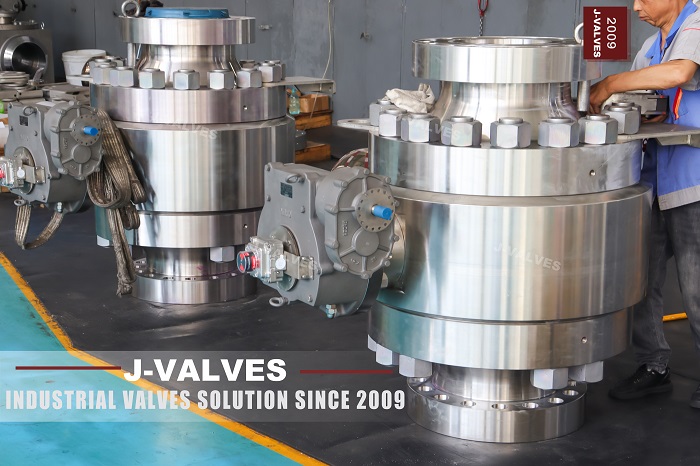
CHINA J-VALVES Offers Various High-quality I ndustrial Ball Valves
J-VALVES, a distinguished professional ball valve manufacturer rooted in China, takes pride in its extensive product portfolio. Our offerings span a wide range, including trunnion-mounted ball valves, floating ball valves, high-temperature ball valves, high-pressure ball valves, metal-sealed ball valves, ultra-low temperature ball valves, DBB ball valves, Three-way And Four-way Ball Valve, and fully welded ball valves. Each product is a testament to our commitment to precision engineering and reliable performance. Meticulously crafted, they are designed to not only meet but exceed the most stringent industrial demands, ensuring stable operation even under extreme conditions. This enables us to provide our clients with high-value services and makes our valves widely sought-after in industries.
Product Category
Contact Us

Pressure Class: ASME Class 300 (PN50), 51.1 bar at 38°C
Body Material: ASTM A105 forged carbon steel, welded closure
Ball: A105 with ENP or hard chrome; F304 / F316 option
Seat: A105 with Stellite or nickel-based hardfacing; PTFE / RPTFE option
Stem: F316 or 17-4PH, anti-blowout, extended for burial
Seat Effect: Double piston effect (DPE) standard for welded body
End Connection: Butt weld to ASME B16.25
Temperature Range: -29°C to +425°C
Design Standard: API 6D, ASME B16.34
Test Standard: API 598 shell and seat, API 6FA fire safe
Body Weld NDT: 100% RT or UT on the welded closure
Operation: Worm gear standard; pneumatic, electric, gas-hydraulic
-
Q367F
-
J-VALVES

A fully welded trunnion ball valve is a quarter-turn isolation valve with no bolted body joint. The closure is welded to the main body at the works and the finished valve joins the pipeline by two butt welds, so the two joints that leak most often on a conventional valve — the body gasket and the flange gasket — do not exist. J-VALVES builds this 12 inch Class 300 A105 pattern in Wenzhou, Zhejiang, for gas gathering lines, product pipelines and city gas mains that are buried without a valve chamber.
This page is written for the engineer who has to defend the choice in a design review. It covers what the welded body changes, where A105 stops being the right material, how the field weld is controlled, and why a sealed body needs a different seat logic from a valve that can be opened on site.
Parameter | This valve |
|---|---|
Size | 12 inch (DN300), full or reduced bore |
Pressure class | ASME Class 300 (PN50), 51.1 bar at 38°C |
Body and closure | ASTM A105 forged carbon steel, welded |
Ball | A105 with ENP or hard chrome, or F304 / F316 |
Seat | A105 with Stellite or nickel-based hardfacing; PTFE / RPTFE option |
Stem | F316 or 17-4PH, anti-blowout, extended for burial |
Ends | Butt weld to ASME B16.25 |
Temperature | -29°C to +425°C |
Design / test | API 6D, ASME B16.34 / API 598, API 6FA |
Operation | Worm gear standard; pneumatic, electric, gas-hydraulic |

What "Fully Welded" Actually Means
The phrase is used loosely in the market, and three different products are sold under it. A valve with welded ends but a bolted body is a weld-end valve, not a fully welded one. A valve with a welded body but flanged ends still has two gaskets in the line. Only the third combination — welded body plus welded ends — removes every elastomer and every gasket from the pressure boundary except the stem seal.
Construction | Body joints | Line joints | Leak paths to atmosphere | Access for repair |
|---|---|---|---|---|
3-piece flanged | 2 gasketed | 2 flange gaskets | 5 | Full, in line |
2-piece flanged | 1 gasketed | 2 flange gaskets | 4 | Partial, in line |
Welded ends, bolted body | 1 gasketed | 2 welds | 2 | Body opens, line must be cut |
Fully welded | 0 | 2 welds | 1 (stem) | None; seat injection only |
That last row is the whole argument. A buried valve is judged on the leaks it does not have over twenty years, not on the torque it had at the factory. Removing four of five atmospheric leak paths is a bigger reliability gain than any trim improvement, which is why pipeline operators specify welded bodies for road crossings, river crossings, urban mains and any location where a chamber is impractical.
Why Buried Service Drives the Design
A valve in a chamber is inspected. A valve under two metres of soil is not, and every decision on this product follows from that.
Soil load comes first. At 2 m cover the vertical earth pressure on a 12 inch body is modest, perhaps 30 to 40 kPa for a dense granular backfill, but the load is uneven and it is applied for decades. A body with a gasketed joint deflects slightly under that load, the gasket relaxes, and the joint weeps into the backfill where nobody sees it until the smell reaches the surface. A welded body has no such compliance.
Corrosion follows. A buried valve sits inside the pipeline's cathodic protection system, and the coating is the primary barrier. The body is coated to the same specification as the line pipe, with the same surface preparation, and the weld area is coated after the field joint is completed. A flanged valve cannot be coated across the gasket, so it becomes a coating holiday at the exact point where two dissimilar surfaces meet.
Third is access for operation. A buried valve is operated from the surface through an extension stem inside a protective tube, and the stem seal therefore sits above ground where it can be maintained. This is why the extended stem on a fully welded valve is not an accessory: the stem packing is the only remaining dynamic seal, so it is deliberately brought to a place where a fitter can reach it with a wrench.
Fourth is thrust. A buried valve does not need anchors, because the soil and the welded line carry the longitudinal load. A flanged valve in the same location needs thrust blocks or restrained joints, and those blocks are another thing that can settle.
A105 Forging and the Wall Thickness Question
ASTM A105 is a forged carbon steel for ambient and moderate temperature service: 0.35 percent maximum carbon, 0.60 to 1.05 percent manganese, 250 MPa minimum yield and 485 MPa minimum tensile in the normalized condition. It is not a casting, and that matters here. A forged body has no shrinkage porosity, and on a welded body the region around the weld bevel has to be sound because it will be heated to melting and then cooled under restraint.
A105 is a Group 1.1 material in ASME B16.34. Its rating at 38°C is 51.1 bar at Class 300, and the rating falls with temperature: roughly 45 bar at 200°C, 38 bar at 300°C and 28 bar at 400°C. The valve is marked 425°C, but a 12 inch Class 300 line running at 400°C is not a carbon steel application in most specifications, and the enquiry should say so rather than discover it in the rating table.
Minimum wall thickness is set by ASME B16.34 and not by the pressure alone. The standard explains a thickness that satisfies hoop stress with a corrosion allowance built into the dimensional rules, and for a welded body the wall also has to survive the weld heat input without unacceptable distortion of the seat pocket. J-VALVES checks the wall at the seat pocket and at the weld bevel, not only at the body barrel, because those are the two places where a thin wall turns into a leak.
Below about -29°C, A105 is the wrong choice and the answer is A350 LF2, which is impact tested at -46°C. The two grades look similar on a certificate and behave differently in a Charpy machine.
The Welded Joint Itself
The body weld and the field weld are different problems and are treated differently.
The body weld is made in the shop, under a qualified procedure, and inspected in full. The closure is welded into the body with a full-penetration weld, and the finished joint is examined by radiographic testing or ultrasonic testing, or both, depending on the specification. The weld is not a place to save time: on a 12 inch Class 300 body the weld carries the same hoop load as the barrel.
The field weld is made by the pipeline contractor and is the joint that fails in service. Three things decide whether it will hold. The bevel must match ASME B16.25 and the pipe end must be matched to it; a bevel that is close is not a bevel that is correct, and a mismatch shows up as a root defect. The valve must be welded with the body protected: heat from a 12 inch girth weld travels, and the seat and packing are a few hundred millimetres away. Welders who do not use a heat sink or a wet wrap around the body regularly destroy a seat and then blame the valve. And the weld must be made with the valve fully open, so that spatter cannot land on a sealing surface and so that the bore is not distorted by a closed ball.
Transition pieces, or pups, solve a problem that catches buyers late. When the valve body is A105 and the line pipe is API 5L X65, the strength mismatch and the wall thickness step can exceed the limits in the welding procedure, and the valve cannot be welded directly to the pipe. A pup piece of intermediate grade and thickness moves the transition away from the valve and lets the field weld be made on like-to-like material. If the contractor supplies the pups, they must be strong enough to take the 1.5 times shell test without deforming.
Hardness is the last control. A weld that is sound but hard is a weld that cracks in sour service, and NACE MR0175 puts a 250 HV limit on the weld and heat affected zone. That is a procedure qualification issue, not an inspection issue, and it has to be raised at enquiry.
Seat Logic in a Body You Cannot Open
On a valve with a bolted body, a seat that leaks can be reached. On this valve it cannot, so the seat system has to be built to be repaired from outside.
Double piston effect seats are the norm here, for a reason that is often stated backwards. A single piston effect seat relieves trapped cavity pressure into the line automatically, which sounds safer. But a welded body has no way to install a relief valve, and a DPE seat blocks the cavity in both directions — the cavity pressure then has to be managed deliberately, by a vent or a relief device, instead of being dumped into the upstream line. The advantage of DPE is that both seats seal against pressure from either side, so a damaged upstream seat does not become a leak path.
Seat and stem injection are therefore standard rather than optional. A grease fitting at each seat ring and at the stem lets a technician inject sealant into the sealing gap and stop a weep without excavation. This is a temporary repair and should be described as one: it buys time to plan a shutdown, it does not restore the valve.
The cavity also needs a vent. On the 12 inch size the body cavity holds a meaningful volume, and on a liquid line that volume expands when the line warms. A 1/2 inch NPT needle valve in the body, capped and accessible from the surface, is the normal answer, and it doubles as the bleed point for a double block and bleed check.
Seat arrangement | Bidirectional sealing | Cavity self-relief | Used on welded body |
|---|---|---|---|
Single piston effect (SPE) | Yes, one direction per seat | Yes, automatic | Rarely |
Double piston effect (DPE) | Yes, both directions | No, needs external relief | Standard |
Combination SPE / DPE | Yes | One side only | Where a preferred flow direction exists |
Bore, Pigging and the 12 Inch Full Bore Claim
A full bore valve has a bore equal to the pipe inside diameter, and on a transmission line that is a functional requirement rather than a flow coefficient argument. Intelligent pigs, gauge plates and gel slugs have to pass, and a reduced bore valve is a permanent obstruction that has to be bridged by a pig with a bypass or avoided by a dual-diameter tool.
The bore tolerance is where cheap valves fail. API 6D sets the bore and the roundness, and a pig will find 2 mm of mismatch at a weld or a step at the ball. The check is not the catalogue bore but the measured bore at the ball, at both ends, and the alignment of the two weld bevels to the bore. A 12 inch full bore valve should be delivered with a bore and concentricity record if it is going into a pigged line.
Pressure, Temperature and the Rating Table
A Class 300 body is frequently ordered for a line that runs at 20 bar, and that is correct: the class is chosen for flange compatibility and for margin, not for the operating pressure. What matters is that the rating is read at the design temperature and not at 38°C.
Temperature | Class 300 rating, A105 | Comment |
|---|---|---|
-29°C to 38°C | 51.1 bar | Full rating; impact test at -29°C for the grade |
100°C | about 50 bar | No practical restriction |
200°C | about 45 bar | Packing and seat material become the limit |
300°C | about 38 bar | PTFE seats out; metal or PEEK only |
400°C | about 28 bar | Confirm creep and oxidation allowance |
Class to PN equivalence is quoted as 300 to PN50. That is an equivalence of rating, not of flange dimensions, and a PN50 flange will not bolt to a Class 300 flange.

Testing, Records and What Arrives on Site
Every valve gets a shell test at 1.5 times the 38°C rating and a seat test at 1.1 times, to API 598, with the results recorded by serial number. The body weld is radiographed or ultrasonically examined in full. The gear operator is function tested and the torque recorded, because the recorded torque is the baseline against which a rising torque in service is judged.
The documentation package is where a pipeline operator actually evaluates a supplier: EN 10204 3.1 material certificates with the heat numbers traceable to the body and the closure, impact test results for the heats used, weld procedure and qualification records, NDT reports, a dimensional report including the weld bevel and the bore, and a coating report with dry film thickness and holiday test. If a supplier cannot produce a dimensional report on the bevel, the field weld is a gamble.
Marking follows API 6D: size, class, body material, heat number, serial number, and the maximum and minimum design temperature. On a buried valve the marking plate is brought up to the surface plate, because a nameplate two metres underground is decoration.

When a Fully Welded Valve Is the Wrong Answer
A welded body is not universally better, and saying so is part of the specification. It is the wrong choice when the valve is expected to be opened for seat replacement, when the line cannot be shut down and cut for a body replacement, when the duty is heavily abrasive and seat life is short, or when the valve is in a location where a chamber is cheap and access is valuable — a pump station, a metering skid, a terminal manifold.
The honest comparison is lifecycle cost. A flanged valve costs less to buy and more to own if it leaks in a place you cannot reach. A welded valve costs more to buy and cannot be repaired in place, so its economics depend on a seat life that outlasts the interval between planned shutdowns. For clean gas and refined product that is a good bet. For produced water with sand, it is not.

Fully Welded Trunnion Ball Valve FAQ
Can a fully welded ball valve be repaired?
Not by opening the body, because there is no body joint. It can be repaired from outside in two ways: sealant injection at the seat rings and the stem, which stops a weep temporarily, and replacement of the stem packing, which is accessible because the extended stem brings the gland above ground. A failed seat or a damaged ball requires the valve to be cut out of the line.
Why is a double piston effect seat used on welded body valves?
Because the cavity cannot be fitted with a relief valve in most buried installations. A DPE seat seals against pressure from both sides, so neither seat depends on the other to hold, and a damaged upstream seat does not become an atmospheric leak path. The trade is that cavity pressure must be managed by a vent or an external relief device rather than being self-relieving.
How is the field weld protected during installation?
The valve must be fully open, the body wrapped or heat-sunk so that welding heat does not reach the seat and packing, the bevel matched to ASME B16.25, and the root made with a procedure qualified for the pipe grade. After welding, the joint is coated and holiday tested as part of the pipeline coating system.
Does A105 work at -46°C?
No. A105 is rated to about -29°C. For -46°C the body should be ASTM A350 LF2, which is impact tested at that temperature as a condition of the grade. The two materials have similar strength and are not interchangeable at low temperature.
What is the difference between a fully welded valve and a butt weld valve?
A butt weld valve has welded ends but a bolted body, so the body gasket remains a potential leak path. A fully welded valve has both a welded body and welded ends. If the datasheet says "BW ends" it is describing the connection, not the body construction, and the two should be confirmed separately.
How long is the stem extension for a buried valve?
It is set by the burial depth plus the operating assembly, typically from 0.5 m to 2 m from body centre to the gear input. The extension is quoted as a dimension on the drawing, not chosen from a table, because the surface box, the road loading and the operator height all change it.
Ordering This Valve
To quote, send size, class, design temperature and fluid, full or reduced bore, body and trim material, whether the line will be pigged, burial depth and whether the stem extension needs a surface box, the field weld pipe grade and wall thickness so pups can be assessed, actuation, and the documentation package. Sour service, fire certification and NACE MR0175 should be stated at enquiry rather than after the order.
Typical lead time is 5 to 8 weeks for a 12 inch Class 300 A105 valve with a standard gear operator, longer where a special bore, a non-standard extension or a third-party witness test is required. Drawings are released for approval before the body weld is made, because after that weld the geometry is fixed.
Hot Products


News
Ball Valve Condition Monitoring: Which Signals Actually Predict A Failure
Torque signatures, acoustic emission, differential pressure and digital twin residuals: which measurements find a failing ball valve early.
Read More
Ball Valves in SWRO Desalination: The High Pressure Section Where Ordinary Seawater Valves Fail
Why SWRO high pressure valves fail early: recovery arithmetic, crevice temperature, ERD ripple, scale, letdown cavitation and surge.
Read More
Air Test And Water Test For Ball Valves: What Each Medium Can Prove
A ball valve can pass a hydrostatic seat test and still leak gas. Why air and water prove different things, and how to read a bubble, decay or helium test.
Read More
Ball Valve Flange Bolting: Preload, Relaxation And The Fasteners That Decide Leakage
A weeping flange is rarely the gasket. Preload, torque scatter, hardness limits and thermal relaxation decide whether the joint holds at 100 bar and 400 C.
Read More