CHINA J-VALVES Offers Various High-quality I ndustrial Ball Valves
J-VALVES, a distinguished professional ball valve manufacturer rooted in China, takes pride in its extensive product portfolio. Our offerings span a wide range, including trunnion-mounted ball valves, floating ball valves, high-temperature ball valves, high-pressure ball valves, metal-sealed ball valves, ultra-low temperature ball valves, DBB ball valves, Three-way And Four-way Ball Valve, and fully welded ball valves. Each product is a testament to our commitment to precision engineering and reliable performance. Meticulously crafted, they are designed to not only meet but exceed the most stringent industrial demands, ensuring stable operation even under extreme conditions. This enables us to provide our clients with high-value services and makes our valves widely sought-after in industries.
Product Category
Contact Us

-
J-VALVES-Q11F
-
MSNL
Overview of the J-VALVES pneumatic two piece full port female ball valve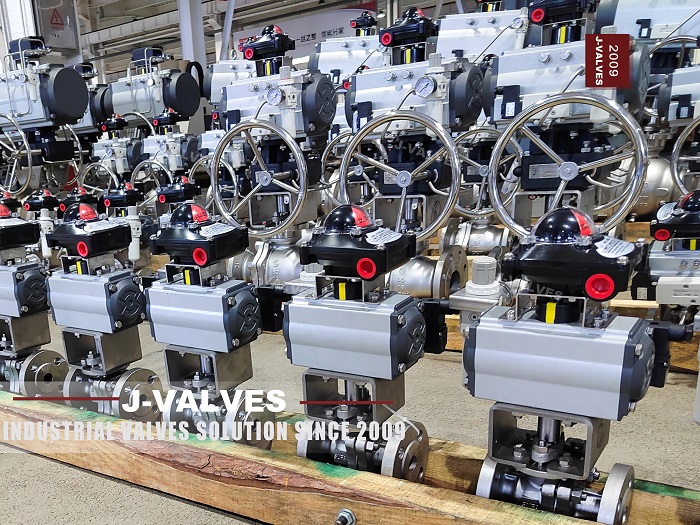
WOG is three letters for three media: water, oil and gas. It is not a class, it is not a pressure, and it is not a synonym for the number printed in front of it. A valve marked 1000 WOG is being described as suitable for those three media at ambient temperature in non shock service, and everything about steam, hot water and a medium that flashes is outside the description.
The valve under the marking is a two piece 316 stainless body with female threaded ends, a full port floating ball, polymer seats and a pneumatic quarter turn actuator on an ISO 5211 pad, offered from a quarter inch to two inch. It is the small bore automatic isolation valve that fills water treatment skids, dosing packages and utility headers, and it is usually bought on a WOG figure and a size.
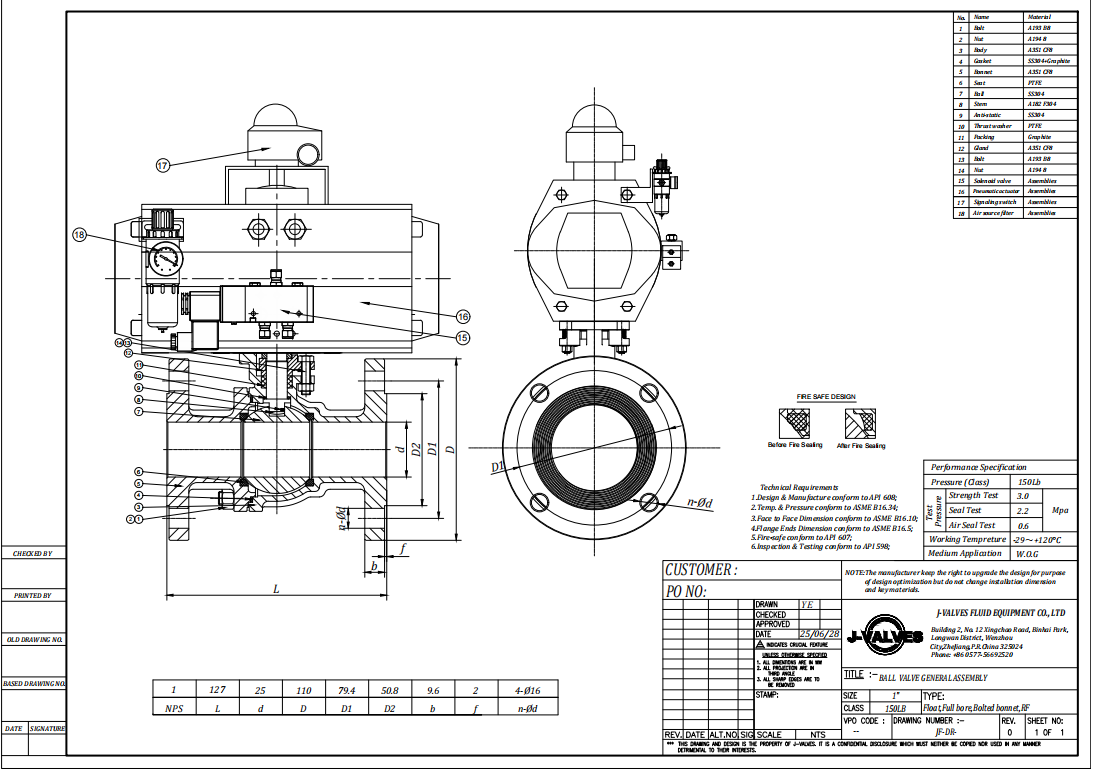
The argument here is about what that figure covers and what the pad decides. The rating names three media and one temperature condition, and the actuator is selected against four stud holes and a drive rather than against the valve size. Both of those are visible in the drawing before any money is spent, and both are routinely left to the supplier.
Design and Construction
The body is two pieces with a single gasketed joint, closed by a ring of studs. The ball and both seats go in through the joint face, which is why the joint exists at all: a two piece body has one opening large enough to pass the ball, and the end piece that closes it also carries one of the two female threads.
Full port means the bore through the ball equals the bore of the pipe, so the valve adds no restriction and no pocket. The cost is a ball larger than the pipe bore, a body longer than a reduced port body of the same size, and more torque at the stem because the seat is being loaded over a larger area. On a quarter inch line none of that matters; on two inch it decides the actuator.
The pad above the stem is the interface, and it is worth reading as one. Four threaded holes on a stated bolt circle, and a drive in the centre in a stated form, square or star, at a stated size. ISO 5211 numbers those combinations, so a bracket is selected against a pad designation rather than against the valve model, and a coupler is selected against the stem flats. Get either wrong and the assembly will stroke on the bench and slip under load.
The seat arrangement is the ordinary floating one, with the medium pushing the ball into the downstream seat and the upstream seat held by preload. That is why a full port floating valve tightens its shut off as pressure rises and why its torque rises with it, and it is also why the actuator has to be selected on the torque at the pressure the line actually runs at rather than at the maker's rating.
Material Options
The page gives 316 for the body, the ball and the stem, and the parts that need a decision are the seat, the thread standard and the actuator seals. The table keeps the page's entries and adds the ones that decide whether the valve can be fitted.
| Part | Material on This Build | Note |
|---|---|---|
| Body and end piece | 316 stainless, two pieces | One joint, one gasket |
| Ball | 316 stainless, full port | Bore equals the pipe bore |
| Stem | 316 stainless | Blowout proof shoulder |
| Seats | PTFE or reinforced PTFE | Sets the 120 Celsius ceiling |
| Body joint gasket | Spiral wound or PTFE sheet | One joint |
| Studs and nuts | A4 stainless | Sized by the body |
| Thread seal | PTFE tape or anaerobic sealant | Chosen for the medium |
| Actuator seals | Nitrile as standard | Compound chosen for the air |
A 316 body on a 1000 WOG valve is a deliberate mismatch of capability and rating, and it is the right one. The body could carry far more than the rating asks, and the reason it is bought in 316 is the medium rather than the pressure: water treatment, dilute chemical dosing and food grade service all want a stainless wetted path at modest pressure. Paying for 316 to carry 1000 psi would be paying for the wrong thing.
The thread standard is a material decision in practice, because it decides what the valve will seal against. NPT, BSPP and BSPT are three different joints, and the page lists all three along with the two German standards that describe the British forms. A valve bought with the wrong one is not repairable on site; it is a wrong part, and it will be discovered when the fitter tries to make it up.
Technical Specifications
The specification below is the page's own, with the rating language set out so that the media limit travels with the number.
| Item | Value |
|---|---|
| Size range | Quarter inch to two inch, DN 6 to DN 50 |
| Pressure rating | 1000 WOG, cold and non shock |
| Bore | Full port, ball bore equal to the pipe bore |
| Body | 316 stainless, two pieces, one joint |
| Ball and stem | 316 stainless |
| Seats | PTFE or reinforced PTFE |
| Temperature | Minus 29 to plus 120 Celsius |
| Ends | Female NPT, BSPP or BSPT |
| Design | API 608, ASME B16.34 |
| Test | API 598 |
| Actuator | Pneumatic, double acting or spring return |
| Interface | ISO 5211 pad, bracket and coupler |
The 120 Celsius ceiling on this page is more honest than the 425 printed on its sister pages, and it is worth keeping because it matches what a PTFE seat can do in continuous service with a margin. A buyer who needs 180 Celsius on a two inch line cannot get there with this seat, and no amount of reading the pressure figure will change that. Temperature and pressure are one limit on a polymer seat, not two.
The class comparison belongs beside the WOG figure rather than in place of it. Class 600 for a 316 body is 102.1 bar at 38 Celsius, from the material group table, and that is a pressure with a temperature attached and a wall behind it. 1000 WOG is about 69 bar of nominal cold capability with three named media and no wall statement. They are different kinds of number and a datasheet that puts them on one line is hiding that.
Standards and Compliance
The page cites API 608 next to a WOG rating, and the two do not speak the same language. The table sets out what each document fixes and what it leaves open, which is where most of the confusion about WOG starts.
| Document | What it fixes | What it does not fix |
|---|---|---|
| API 608 | Steel ball valves, Class 150 to Class 600 | A 1000 psi or WOG rating |
| ASME B16.34 | Wall thickness and material groups | Media lists or ambient ratings |
| ASME B1.20.1 | NPT thread form, taper and gauging | Pressure rating of a threaded joint |
| DIN 259 | BSPP parallel thread form | Which medium the valve may carry |
| API 598 | Shell and seat test procedure | The media the rating covers |
WOG is a manufacturer's notation and it has no standard behind it in the way that a class does. What it does have is a convention: the number is a cold working pressure for water, oil and gas, in non shock service, and the three media are named because those are the three the convention was written around. Nothing in the notation covers steam, and nothing in it covers a medium at a temperature where the seat is the limiting part.
That is why a WOG valve on a steam line is a specification error rather than a valve failure. Steam at any useful pressure brings heat to the seat, the seat reaches its limit long before the body does, and the failure appears as a leaking valve that was never rated for the service it was put on. The 120 Celsius line on this page is the honest boundary, and it should be read as the boundary of the whole valve.
Manufacturing Process
The body halves are castings, and the thread is cut after the gasket face is machined so that the thread axis is square to the face. A thread cut before the face, or on a piece that has been turned over, pulls the joint into a bind when it is made up to a pipe, and the leak that follows is always blamed on the tape.
The ball is turned, ground and lapped, and the bore is machined after the sphere so that the sphere is held by its outside for the last operation. On a full port ball the bore is large relative to the ball, which leaves a thin wall at the port and makes the lapping of the sealing band the operation that decides the valve. A full port ball that is out of round leaks at the band, not at the bore.
Assembly fits the seats and the ball into the body, closes the joint on its gasket, fits the stem and packing, then mounts the bracket and the quarter turn unit and cycles the assembly. The cycle is done with the unit fitted because the bracket and coupler are in the torque path, and a coupler that is not square shows up as a stroke that will not complete.

Quality Control and Testing
The shell test is applied with the ball open at one and a half times the class rating, and the threaded ends are plugged rather than flanged, which is a different rig from a flanged valve and a different set of plugs. The joint is watched during the shell test because it is the one boundary that cannot be seen once the valve is insulated or boxed in.
The seat test follows at one point one times, one side at a time, because a floating ball loads only its downstream seat. On a full port valve the test is the same procedure as on a reduced port one and the acceptance is the same; what differs is the volume behind the seat and therefore the time it takes for a leak to show.
The pad is checked before dispatch, and it is checked as an interface rather than as a feature. Bolt circle, thread size, drive form and drive size are compared with the bracket drawing, and the actuator is stroked on the assembled valve. An assembly that arrives with a pad that does not match its bracket is a valve that will be returned, and the check costs a few minutes at the works.

Applications and Industry Service
Water treatment is the largest single use, because a two inch stainless full port valve with a pneumatic head is the standard isolation point on a filtration skid, a dosing line or a transfer pump discharge. The medium is water, the temperature is ambient, the pressure is modest, and the WOG rating describes the duty almost exactly.
Oil and gas at ambient, in the sense of lube oil, fuel oil and instrument gas, is the second family, and there the 316 body is chosen for the medium rather than for the pressure. Food and beverage work uses the same valve with a polished bore and a seat chosen for the cleaning regime, and the full port bore is the reason the pattern is accepted: there is no pocket for product to sit in.
Where the valve should not be used is on steam, on hot water above the seat limit, and on any line that needs throttling. A ball valve at part open puts the flow across the seat edge and erodes the polymer, and a pneumatic head does not change that. The rating says water, oil and gas at ambient, and the three media are a description rather than a starting point for negotiation.
Installation, Operation and Maintenance
Installation is a threaded joint at each end, made up to the correct standard with a sealant suited to the medium, and the body is supported so that the pipe does not hang from the threads. On a parallel thread the seal is made at a face or a washer, on a taper thread it is made in the thread itself, and mixing the two produces a joint that either will not seal or will not come apart.
Operation is a quarter turn with a definable failure position, and the air supply should be filtered and dry at the pressure the actuator was selected for. A flow regulator on the exhaust is the usual way to slow the stroke, and slowing the stroke is often what stops a small valve from hammering its seat on every cycle.
Maintenance reaches the packing from the top and the seats through the joint, and the actuator comes off with four bolts and a coupler. On a skid with a dozen of these valves the practical policy is to keep one spare assembly and swap it, because the cost of a rebuild is mostly the labour of taking the valve out of a tight package.
How to Specify and Order
The order lines below are the ones the WOG figure does not carry, and the first two decide whether the valve can be installed at all.
| Line on the order | What to write | Why it matters |
|---|---|---|
| Medium and temperature | Water, oil or gas, with the running temperature | WOG covers three media at ambient only |
| Thread standard | NPT, BSPP or BSPT, and the size | The three do not interchange |
| Size and bore | For example one inch full port | Full port changes body length and torque |
| Actuator | Spring return or double acting, and the air pressure | Sets the failure position |
| Accessories | Solenoid, switch box, regulator | They mount on the same pad |
The medium line comes first because it is the line the rating is written around. A valve ordered as 1000 WOG for a hot water line at 150 Celsius has been ordered outside the only statement the figure makes, and the fact that the number looked large is not a defence.
Written that way, the valve is a known object: a two piece 316 body with one joint, a full port ball on polymer seats, female threads to a named standard, a 120 Celsius ceiling that belongs to the seat, and a quarter turn unit chosen against a pad and a failure position. The WOG figure stays where it belongs, on the three media it names at the temperature it assumes.
FAQ
Q: What does WOG actually stand for?
A: Water, oil and gas. It is a cold, non shock rating, so the number applies to those three media at ambient temperature. It says nothing about steam, about hot water above the seat limit, or about a medium that flashes as it passes the seat.
Q: Can I put this valve on steam because the number looks high?
A: No. Steam at any useful pressure brings heat to the seat, and this page tops out at 120 Celsius. Above that the polymer is the limit rather than the body, and a valve sold on a WOG figure alone will be asked to do something the seat was never rated for.
Q: Why is 1000 WOG not the same as Class 600?
A: Because a class carries a pressure in bar at a stated temperature, and WOG is a maker notation for three media at ambient. They can appear on the same datasheet and still be different statements. Class 600 for a 316 body is 102.1 bar at 38 Celsius, and the figure comes from the material group table, not from a media list.
Q: What does full port buy on a valve this small?
A: A bore equal to the pipe, so the valve adds no restriction and no pocket for solids to sit in. The cost is a larger ball, a longer body between the threads, and more torque at the actuator. On a quarter inch line the difference is small; on two inch it decides the actuator size.
Q: Will an NPT valve seal into a BSPP socket?
A: No. At half inch both threads run fourteen to the inch, which is why they appear to start, but the flank angle is different, so the joint binds after a turn or two and neither the thread nor a face washer can seal it. Match the thread standard before matching the size.
Hot Products


News
Remanufactured Ball Valves: Five Checks That Decide Whether A Rebuild Deserves A Certificate
A rebuild at 45 percent of price with half the life is no saving. Five checks that separate a real remanufacture from a repaint with a certificate.
Read More
The Squeeze Is A Residual: How Tolerance Stack-Up Decides Whether A Ball Valve Seals
No dimension sets the seat squeeze. Five tolerances do, in series. Why identical valves feel different, and why a new ball changes the arithmetic.
Read More
Why A Ball Valve Gets Harder To Turn: Five Causes, And The Test That Tells Them Apart
A ball valve that stiffens over months points at one of five parts. Measure torque with the line pressurised and again vented, and the split becomes visible.
Read More
The Ball Valve at Four Thousand Bar: Seat Load, Erosion And Fatigue in Waterjet Circuits
At 4,000 bar a 10 mm bore puts 31 kN on the seat and a 0.1 mm leak cuts steel. What a ball valve must survive in a waterjet or intensifier circuit.
Read More