


CHINA J-VALVES Offers Various High-quality I ndustrial Ball Valves
J-VALVES, a distinguished professional ball valve manufacturer rooted in China, takes pride in its extensive product portfolio. Our offerings span a wide range, including trunnion-mounted ball valves, floating ball valves, high-temperature ball valves, high-pressure ball valves, metal-sealed ball valves, ultra-low temperature ball valves, DBB ball valves, Three-way And Four-way Ball Valve, and fully welded ball valves. Each product is a testament to our commitment to precision engineering and reliable performance. Meticulously crafted, they are designed to not only meet but exceed the most stringent industrial demands, ensuring stable operation even under extreme conditions. This enables us to provide our clients with high-value services and makes our valves widely sought-after in industries.
Product Category
Contact Us

-
J-VALVES-Q347F
-
J-VALVES
Overview of the J-VALVES three piece cryogenic flange trunnion valve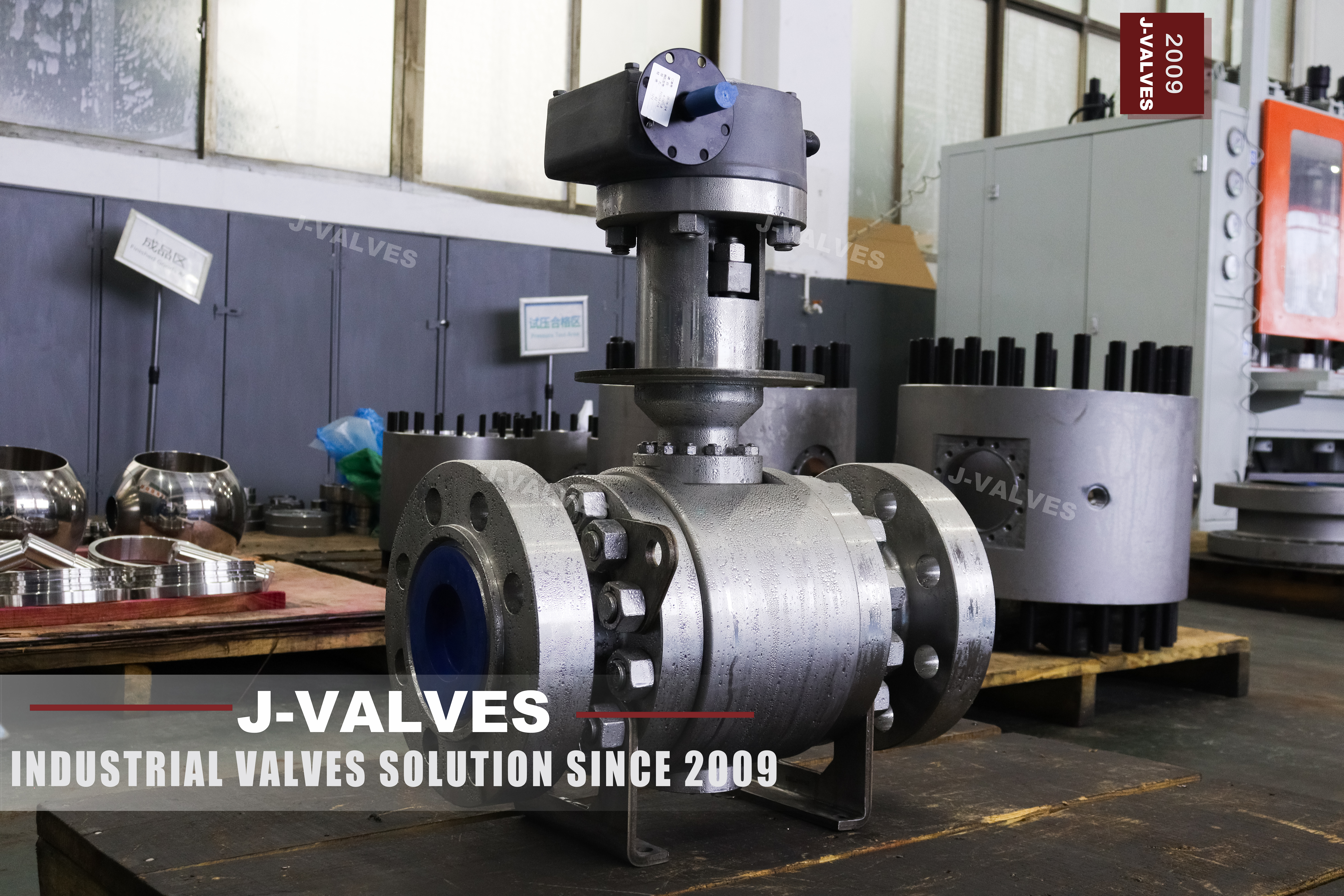
Three body pieces, bolted, with a long neck between the body and the operator. That is what the photograph shows, and it settles a question the earlier version of this page left open, because that version also claimed a top entry design. A three piece body and a top entry body are two different castings, and one valve cannot be both. The picture shows the bolted joints at each end of the centre section and no opening on top large enough to pass a ball.
The build is a flanged trunnion valve for cold service: half inch to thirty six inch, Class 150 to Class 600, minus 196 to plus 100 Celsius. Ends are raised face or ring joint to ASME B16.5 inside twenty four inch, and to ASME B16.47 above it, which is a separate point and is dealt with in the standards section.
The argument here is that a cryogenic valve is decided in two places and neither of them is the body wall. It is decided at the seat, which has to stay elastic at minus 196, and at the bonnet, which has to keep the packing warm enough to seal and the stem free of ice. Everything else on the page follows from those two.
Design and Construction
The body is a centre section carrying the ball, the seats and the stem, with an end piece bolted to each side. Both joints carry line pressure and both are gasketed, so the valve has two more pressure boundaries than a single piece body. That is the price of the construction, and it is better said first than discovered later.
What the construction buys is access to the trim. With the line isolated, the joints are opened and the centre section comes out with the ball, the seats and the stem in it, while the end pieces stay on the pipe. Opening a joint requires axial room, so on a flanged line the joint at one end is broken and the pipe is spread, and on a rigid welded run there is no such room and the valve comes out. Entry style and end type are one decision, not two.
The neck is the part that makes this a cryogenic valve rather than a cold looking one. A standard bonnet puts the gland a short distance above the body, which at minus 196 means the gland is cold, the packing is cold, and the stem is iced exactly where it has to turn. The extended neck moves the gland up the temperature gradient until the packing sits at a temperature it is rated for.
The ball is carried on an upper and a lower trunnion in bearings, so its centre stays fixed while the body contracts around it. That matters more in cold service than at ambient. Seat preload is set at assembly temperature, and a floating ball would follow the differential contraction between an austenitic body and its trim instead of holding still.
The seat is a ring that is pressed onto the ball by a spring and by line pressure, and in cold service it is also pressed by the contraction of the body. That third force is the one that is easy to forget. A seat spring that holds the right preload at ambient can be over compressed at minus 196 if the pocket and the ring contract at different rates, which is why the pocket dimensions belong on the drawing and not in a catalogue.
Material Options
The body list splits at minus 46, and the split is a property of the crystal structure rather than a preference. Carbon and low alloy steels are body centred cubic, they have a ductile to brittle transition, and below that transition the toughness falls away quickly. LCC is the low temperature carbon steel casting, and minus 46 is its floor.
| Grade | Family | Where It Belongs |
|---|---|---|
| LCC | Low temperature carbon steel casting | Down to minus 46, the cold end of ordinary carbon service |
| CF8 | Austenitic stainless casting, 304 type | Down to minus 196, mild corrosion |
| CF8M | Austenitic stainless casting, 316 type | Down to minus 196, chlorides and process gas |
| F304 | Austenitic stainless forging | Down to minus 196, forged body route |
| F316 | Austenitic stainless forging, Mo bearing | Down to minus 196, forged body in corrosive duty |
| 17-4PH | Martensitic precipitation hardening | Stems, where hardness is wanted |
The austenitic grades are face centred cubic and have no such transition. CF8 and CF8M castings and F304 and F316 forgings keep their toughness at minus 196, which is why they are the grades named for the cold end of this range. The change from LCC to CF8M at minus 46 is the whole of the material story on a cryogenic valve.
The seat list is where this page parts company with the earlier one. PCTFE is the polymer that earns the minus 196 line: it stays dimensionally stable and it does not shatter at liquid nitrogen temperature. Modified and reinforced PTFE are used in the same service, but their fitness is a test result rather than a grade, and the seat test at temperature is where it is proved rather than asserted.
UHMWPE also appears on the original seat list and does not belong there. Below its glass transition it is glassy and brittle, and a brittle ring does not seal, it cracks. A seat material list is not a menu of polymers that happen to be white; it is a list of materials that still have recovery at the service temperature.
Technical Specifications
The temperature column is the one that changes what the class means. A Class 600 cryogenic valve and a Class 600 general service valve carry the same class number and are not the same article: one is limited to a hundred Celsius by its seat and packing, the other runs to four hundred and twenty five. A buyer who orders by class alone has ordered the pressure and left the temperature to the works.
| Item | Value |
|---|---|
| Size range | Half inch to thirty six inch, DN 15 to DN 900 |
| Pressure class | Class 150 to Class 600, PN 20 to PN 100 |
| Temperature | Minus 196 to plus 100 Celsius |
| Body | LCC to minus 46; CF8, CF8M, F304, F316 to minus 196 |
| Ball | Austenitic stainless, polished or coated |
| Stem | F304, F316 or 17-4PH, impact tested |
| Seat | PCTFE, modified or reinforced PTFE, or metal |
| Bonnet | Extended, length to BS 6364 or MSS SP-134 |
| Ends | Raised face or ring joint, B16.5 to 24 inch, B16.47 above |
| Face to face | ASME B16.10 where tabulated |
| Packing | Graphite, or a low temperature PTFE stack |
| Insulation | Vacuum jacket or foam on request |
| Operator | Chainwheel, gearbox, or actuator |
| Design | ASME B16.34, API 608, API 6D |
| Test | API 598, plus a low temperature test |
The pressure itself is not the weak point at the cold end. Austenitic stainless gains yield strength as it gets colder, so the body has margin at minus 196 that it does not have at ambient. What loses capability is the seat and the packing, which is why the temperature ceiling on a cryogenic ball valve is a seat figure and not a body figure.
The class number needs the same care at the top of the range. Class 600 sits at PN 100 in the API 6D table of class designations, and PN 100 is a bar designation rather than a class. Printing the two together is correct; treating them as interchangeable with a figure calculated from one to the other is where the wrong numbers get onto drawings.
Standards and Compliance
| Requirement | Document | What It Means Here |
|---|---|---|
| Wall and rating | ASME B16.34 | The class sets the pressure, the group sets the wall |
| Cryogenic design | BS 6364, MSS SP-134 | Bonnet length, cleaning, low temperature test |
| Product requirements | API 6D | Design, materials, marking |
| Product requirements | API 608 | Ball valves DN 15 to DN 600, Class 150 to 600 |
| Pressure test | API 598 | Shell and seat, acceptance by size |
| Fire test | API 607 or ISO 10497 | Type test with a stated scope |
| Material certificate | EN 10204 3.1 | Heat number per pressure part |
| Flanges above 24 inch | ASME B16.47 | Series A and B, not interchangeable |
ASME B16.34 gives the wall and the rating. BS 6364 and MSS SP-134 give the cryogenic requirements, which are mainly about the neck length, the cleaning and the test at temperature. API 598 gives the shell and seat test. None of them chooses the seat material, which is why the seat has to be written on the order rather than looked up in a standard.
The scope line is worth reading twice. API 608 runs from DN 15 to DN 600 in Class 150 to Class 600, so a thirty six inch valve is outside it at any class, and this range reaches thirty six inch. Above DN 600 the article is an API 6D valve, and a quotation that cites 608 for a thirty six inch valve has cited a standard that does not cover the size.
The flange row is the one that catches large cryogenic valves at the drawing stage. ASME B16.5 stops at twenty four inch, and above that the flange is an ASME B16.47 item in series A or series B. The two series have different bolt circles and different bolt counts for the same size and class, so a valve drilled to one will not bolt to a pipe flanged to the other, and the neck length and the face to face both change with the series.
Manufacturing Process
The cryogenic part of the process is cleaning and drying rather than shaping. A body that has been pressure tested and left wet, or a cavity that holds a trace of test water, becomes an ice plug in service and a leak at the seat. The works sequence is degrease, dry, cap, and keep capped until the flanges are fitted.
The extended neck is machined with its flange in one operation, and its length is measured from the body centreline to the gland face against the figure on the drawing. That dimension is the one the standard governs. A neck that is short by a little puts the packing back into the cold zone, and the whole design fails quietly at the gland rather than loudly at the seat.
Welding on the austenitic grades is done to a qualified procedure with the intergranular corrosion test on the procedure qualification, because the heat affected zone is where chromium carbide precipitation starts. That is a works question and a certificate question at the same time, and only the second one can be checked at the receiving dock.

Quality Control and Testing
The test that separates a cryogenic valve from a valve that merely looks cold is the seat test at temperature. A room temperature test proves the geometry; it does not prove that the seat material still has recovery at minus 196 or that the stem still turns with cold packing. BS 6364 and MSS SP-134 set out the test and the acceptance, and the report should carry the temperature at which it was done.
| Step | Check | Acceptance |
|---|---|---|
| 1 Incoming | Heat number against the mill certificate | Chemistry and mechanicals |
| 2 Impact | Charpy at the design temperature | Acceptance figure stated on the order |
| 3 Cleaning | Degrease, dry, cap | No residue, no moisture |
| 4 Shell test | Body and joints at 1.5 times | API 598, no leakage |
| 5 Seat test | Each seat at 1.1 times | API 598 rate |
| 6 Cold test | Seat and stem at the service temperature | BS 6364 or MSS SP-134 |
| 7 Neck | Gland face to body centreline | Drawing figure, not a nominal |
| 8 Marking | Size, class, grade, standard | API 6D marking |
Dimensional checks matter more here than on a standard valve because the neck length, the face to face and the flange drilling are all fixed by the drawing and none of them can be corrected on site. A short neck, a face to face that is long by a few millimetres, and a ring joint groove of the wrong profile are all found at installation, which is the most expensive place to find them.
The impact row needs one sentence of explanation. An acceptance figure is a number agreed for a grade and a temperature, and it is not the property that qualifies an austenitic body for minus 196, because an austenitic steel has no transition to fall through. It is a check that the heat is what the certificate says it is.

Applications and Industry Service
The duty is liquefied gas: receiving and send out terminals, air separation, liquid oxygen and nitrogen storage, ethylene and propylene, and the cold boxes in a petrochemical complex. In all of them the valve is either fully open or fully closed, and the reason it is a trunnion valve is that the ball has to hold its position while a large differential pressure sits across it.
The second duty is the one that gets forgotten, which is cold service on a line that also has to be isolated for maintenance. That is where the three piece body earns its place, because the trim is reachable without disturbing the end connections where the line allows it, and where the neck has to be long enough that nobody is standing next to a frosted gland to turn the valve.
It is the wrong valve where the line runs hot for part of its life. The seat and the packing on a minus 196 build are chosen for the cold end, and at plus two hundred the same polymer ring is at or beyond its limit. A valve that has to work at both ends of the temperature axis is two specifications, and buying one valve for both is how a seat fails in the second season.

Installation, Operation and Maintenance
Support the body and bring the mating flanges up parallel before tensioning. On a cold line the piping moves when it cools, and a valve that has been pulled into alignment by its flange bolts carries that movement into the body joints. The feet on the photograph are there to take the mass of the valve, not to correct a misalignment in the pipe.
Insulation is part of the installation and not a finishing touch. The body and the flanges are insulated and the neck is normally left partly bare so that the gland stays in the warm. A contractor who insulates the neck up to the gland has removed the temperature gradient the design depends on and put the packing back into the cold, and the first symptom is a stem that will not turn.
For maintenance the line is isolated, warmed and drained, both body joints are opened, and the centre section is lifted out. The seat rings are replaced as a pair, the body gaskets are renewed, and the cavity is dried before the valve goes back. On a cryogenic valve the drying is a step in the procedure rather than a courtesy.
Operate fully open or fully closed. A ball valve held part open on a cold line has a jet across the seat that will erode a polymer ring quickly, and nothing about the valve will say so until the next seat test fails.
How to Specify and Order
The order is settled by six entries: size, class, body grade, seat material, end connection and operator. On this valve three of those need a second line. The body grade needs the impact requirement and the temperature at which it applies. The seat needs the polymer named and the temperature it has to pass. And the end connection needs the flange series above twenty four inch, because B16.5 stops there and the two B16.47 series do not interchange.
The neck belongs on the order as a dimension and not as a word. Extended bonnet means a length, the length comes from BS 6364 or from the drawing, and an order that says extended bonnet and nothing else has asked for a shape rather than for a valve that works.
Documents to name in the order: the EN 10204 3.1 certificate with a heat number for each pressure part, the impact report at the design temperature, the intergranular corrosion test on the welding procedure qualification, the low temperature seat and stem test report with its temperature recorded, and the general arrangement drawing carrying the neck length, the face to face and the flange drilling.
FAQ
Q: Can a three piece body be top entry?
A: No. Top entry means the ball leaves through an opening in the top of the body, which requires a single body with a large bonnet flange. A three piece body has two axial joints instead, and the trim is reached by opening those. The photograph shows the two joints and a top opening sized for a stem, so the page cannot be both.
Q: Does every material on the seat list work at minus 196?
A: No. PCTFE is the polymer that earns that temperature. Modified and reinforced PTFE are used in the same service but their fitness is a test result rather than a grade. The UHMWPE on the original list does not belong: below its glass transition it is glassy and brittle, and a brittle ring cracks rather than seals.
Q: What does the extended bonnet actually do?
A: It moves the packing gland up the temperature gradient so that the packing sits at a temperature it is rated for and the stem does not ice where it has to turn. The length is a dimension set by BS 6364 or MSS SP-134, so extended bonnet on an order should be a figure rather than a word.
Q: Why does the body grade change at minus 46?
A: Because carbon and low alloy steels have a ductile to brittle transition and the austenitic grades do not. LCC is the low temperature carbon steel casting and its floor is minus 46. CF8, CF8M, F304 and F316 are face centred cubic and keep their toughness down to minus 196.
Q: Is a class 600 cryogenic valve the same as a class 600 valve?
A: No. Both carry the class number, which sets the pressure, and one is limited to a hundred Celsius by its seat and packing while the other runs to four hundred and twenty five. A valve ordered by class alone has had its pressure specified and its temperature left to the works.


Hot Products


News
Why A Ball Valve Gets Harder To Turn: Five Causes, And The Test That Tells Them Apart
A ball valve that stiffens over months points at one of five parts. Measure torque with the line pressurised and again vented, and the split becomes visible.
Read More
The Ball Valve at Four Thousand Bar: Seat Load, Erosion And Fatigue in Waterjet Circuits
At 4,000 bar a 10 mm bore puts 31 kN on the seat and a 0.1 mm leak cuts steel. What a ball valve must survive in a waterjet or intensifier circuit.
Read More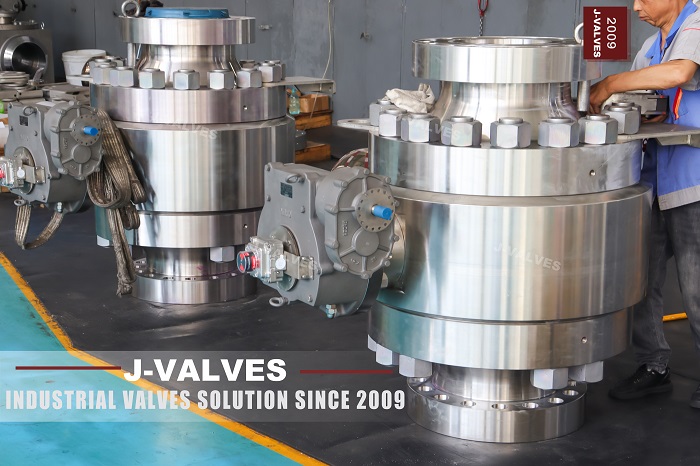
Large Diameter Ball Valves: Four Limits That Change The Design
Above a certain size a ball valve stops being a scaled one. Ball weight, operator torque, body split and the test bench each set a limit at a different size.
Read More
Cast Or Forged Ball Valve Body, And What A Radiography Acceptance Level Actually Buys You
Casting or forging is only half the decision. What RT, UT, MT and a proof test each find in a ball valve body, and where the geometry defeats all of them.
Read More