


CHINA J-VALVES Offers Various High-quality I ndustrial Ball Valves
J-VALVES, a distinguished professional ball valve manufacturer rooted in China, takes pride in its extensive product portfolio. Our offerings span a wide range, including trunnion-mounted ball valves, floating ball valves, high-temperature ball valves, high-pressure ball valves, metal-sealed ball valves, ultra-low temperature ball valves, DBB ball valves, Three-way And Four-way Ball Valve, and fully welded ball valves. Each product is a testament to our commitment to precision engineering and reliable performance. Meticulously crafted, they are designed to not only meet but exceed the most stringent industrial demands, ensuring stable operation even under extreme conditions. This enables us to provide our clients with high-value services and makes our valves widely sought-after in industries.
Product Category
Contact Us


-
J-VALVES-Q347F
-
J-VALVES
Overview of the J-VALVES API 6D forged trunnion valve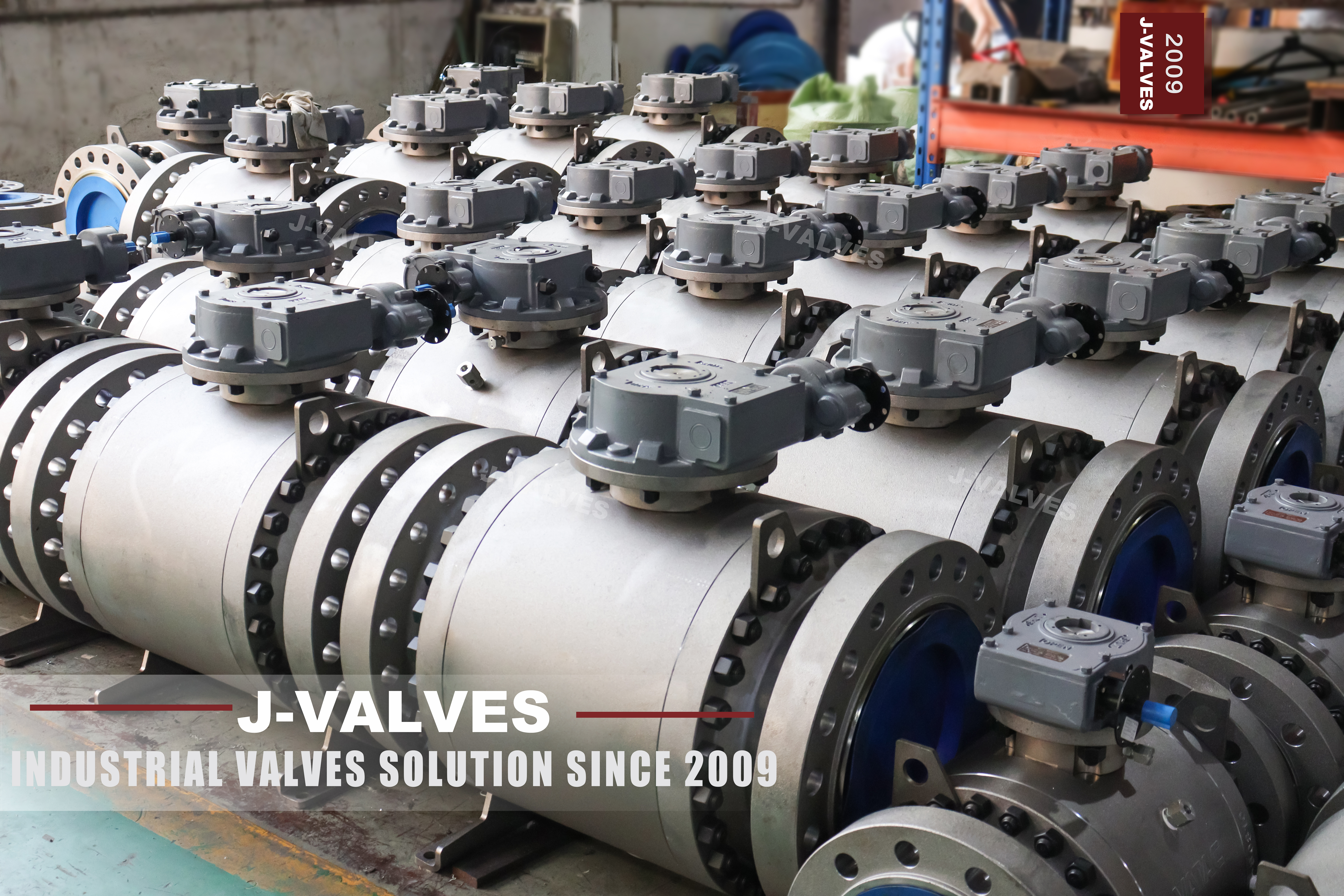
Forged is a manufacturing process. It describes how a billet was shaped into a body, and it says nothing about the pressure the body can hold. A forged body and a cast body of the same grade, the same wall and the same class have the same pressure capability, because both are governed by the wall thickness method and the material group in ASME B16.34.
The family runs from two inch to fifty six inch, Class 150 to Class 2500, with the body available in forged carbon steel, stainless, alloy steel or duplex, the seat in PTFE, reinforced PTFE or metal, and the ends flanged or butt welded. The photograph on this page is a Class 600 flanged build, and the file name behind that photograph is worth a paragraph of its own later on, because it lists three body grades against one picture.
The argument here is that forged is a word that has been promoted beyond its rank. It is a real advantage in three specific ways, and it is not a pressure class, not a corrosion grade and not a guarantee of anything on its own. An order that says forged and stops there has specified a process and left the article undefined.
Design and Construction
The body is a trunnion mounted ball valve body, forged or cast depending on size and grade, with the ball carried on an upper and a lower trunnion and a spring loaded seat on each side. On a three piece build there are two end pieces and one centre piece, and on a two piece build there is one end piece; in both cases the trim is reached by opening a gasketed body joint.
The trunnion mounting is what allows the valve to be built at the top of the class range without a seat load that a polymer insert could not survive. The end thrust goes into bearings at the top and bottom of the ball, and the seats only have to seal against the pressure that reaches them. That is the same on a forged body and on a cast body, and it is the reason the pressure capability question is about the wall rather than about the process.
What forging does change is the internal quality of the material. A forging has a continuous grain flow that follows the shape of the die, no shrinkage porosity, and a uniform density through the section. A casting has a grain structure that depends on how the metal solidified and on where the feeders were, and it can carry porosity that a hydrostatic test will not find until the porosity reaches a surface.
The three advantages that forged is usually claimed to have are worth naming precisely, because the word is used loosely and each of them has a condition attached. Higher integrity is true when the section is examined by ultrasonic or magnetic particle testing and false when no examination was ordered. Better toughness is true when the grade and the heat treatment give it and false when the grade is the same one the casting would have used. A higher pressure rating is never true on its own, because the class sets the rating and the process does not enter into it. Lower cost at small size is true inside the range of the press and false outside it. No porosity risk is true when the billet was sound to begin with.
The lower cost claim is where the economics sit. Below roughly four to six inch a forging is the cheaper route for a trunnion body, because the die cost and the machining are low and the presses are available. Above that the forging becomes a large item on a large press, and at some size the casting wins on cost and the forging stops being offered. That break point is a manufacturing fact rather than a pressure fact, and it moves with the shape of the body and the capacity of the works.
The examination claim is the one that matters most on a purchase order. A forging is only more reliable than a casting if somebody looked inside it. Ultrasonic examination for internal discontinuities and magnetic particle examination for surface indications are the two examinations that convert the material advantage into evidence, and both are a scope on the order rather than a default. A forging that has been proof tested and painted has been pressure checked, not examined.

Material Options
The body grades on this valve run across four families, and the same photograph serves all of them. That is the practical problem with a page like this: the picture shows a shape, and the shape is common to every grade in the list.
| Grade | Family | Where It Belongs |
|---|---|---|
| A105 | Carbon steel forging | General service, ambient to moderate |
| A105N | A105 normalised | Same duty, tougher, recorded heat treatment |
| F304 | Austenitic stainless | Mild corrosion, food and water |
| F316 | Austenitic stainless, Mo bearing | Chlorides, chemical service |
| Duplex | Ferritic austenitic | Chloride stress corrosion, seawater |
| Alloy steel | Chrome moly | Temperature, refinery duty |
The A105N line is the one that gets abbreviated most often. A105 is the grade and the N records that the forging was normalised after forging, which changes the grain structure and the toughness. An order that says A105N without a heat treatment record has asked for a condition and left the evidence of that condition to chance.
The stainless lines are where a photograph is actively misleading. An F304 body and an F316 body are indistinguishable in a picture, weigh almost the same and differ only in molybdenum content, and the difference decides whether the valve survives a chloride bearing medium. That is why positive material identification on the body is not a formality on these builds, and why the certificate has to match the grade on the order rather than the grade on the drawing.
Technical Specifications
| Item | Value |
|---|---|
| Size range | Two inch to fifty six inch, DN 50 to DN 1400 |
| Pressure class | Class 150 to Class 2500, PN 20 to PN 420 |
| Build shown | Class 600 flanged, PN 100 equivalent |
| Body process | Forged or cast, by size and grade |
| Body grades | A105, A105N, F304, F316, duplex, alloy steel |
| Seat | PTFE, reinforced PTFE, or metal |
| Ends | Raised face flange or butt weld |
| Face to face | ASME B16.10 where tabulated |
| Temperature | Minus 46 to plus 200 Celsius, seat dependent |
| Operator | Gearbox, actuator, or handwheel at small sizes |
| Test | API 598 shell and seat |
The PN 100 and Class 600 that appear together on this build are a correct pairing, and it is worth saying so because the pairing is often wrong on catalogue pages. API 6D sets out seven class designations and their PN equivalents, and Class 600 with PN 100 is one of them. A page that prints a PN figure that is not in that table has converted a pressure in bar and rounded it, and the rounding is where the errors live.
Standards and Compliance
| Requirement | Document | What It Means Here |
|---|---|---|
| Product requirements | API 6D | Design, materials, welding, marking |
| Wall and rating | ASME B16.34 | The rating comes from here, not from the process |
| Pressure test | API 598 | Shell at 1.5 times, seat at 1.1 times |
| Fire test | API 607 or ISO 10497 | Type test with a stated scope |
| Material certificate | EN 10204 3.1 | Heat number per pressure part |
| Examination | UT and MT to the order | Not a default |
| Heat treatment | Normalising recorded for A105N | Condition, not grade |
The wall and rating row is the sentence that answers the title of this page. ASME B16.34 sets out a wall thickness for each size and class and a rating for each material group, and neither of those depends on whether the body was forged or cast. A forged body that is under wall for its class is a body that is under wall, and the process will not save it.
Manufacturing Process
The billet is cut, heated, upset and punched, then the body is machined. Upsetting closes internal voids and orients the grain flow along the shape, which is the mechanism behind the integrity claim. The heat treatment after forging, normalising for A105N, refines the grain and is recorded per heat.
Machining is done with the flange face, the joint face, the bolt circle and the seat pockets referenced to one centreline, and the seat pockets are checked against each other for coaxiality. On a forged body the machining allowance is smaller than on a casting, because the forging is closer to the finished shape, which is part of why the route is economic at small sizes.
Examination is the step that differs most between a well ordered forging and a cheap one. Ultrasonic examination is done on the billet or on the rough machined body, and magnetic particle examination is done after machining on the surfaces that will be exposed to pressure. Both leave a report, and the report is the only evidence that the inside of the body is what the process promises.

Quality Control and Testing
| Step | Check | Acceptance |
|---|---|---|
| 1 Incoming | Heat number against the mill certificate | Chemistry and mechanicals |
| 2 Examination | Ultrasonic and magnetic particle to the order | Acceptance level stated |
| 3 Heat treatment | Normalising record for A105N | By grade, recorded |
| 4 Identity | Positive material identification on body and trim | Grade match |
| 5 Shell test | Body and joints at 1.5 times | API 598, no leakage |
| 6 Seat test | Each seat at 1.1 times | API 598 rate |
| 7 Marking | Class, size, grade, standard on the nameplate | API 6D marking |
| 8 Final | Drained, faces protected, marked, crated | Works standard |
The marking row is where the three grades on the photograph finally resolve. A nameplate carries the size, the class, the body material and the standard, and it is the only place on the valve where the grade is stated. A valve whose nameplate says the class but not the grade is a valve whose material cannot be confirmed at the receiving dock without a test.

Applications and Industry Service
The forged trunnion valve belongs where the pressure is high and the bore is moderate, and where the consequences of an internal defect are not acceptable: wellhead and test lines, high pressure gas letdown, hydraulic power units, chemical injection skids and the small bore high pressure runs in a process unit.
It also belongs where the grade has to be stainless for the medium and the size is small enough that a forging is the natural route. In that combination the forged stainless body is both the corrosion answer and the economic one, and the process and the grade are doing two different jobs that happen to point the same way.
It is the wrong valve where the size is large enough that the forging route has been left behind, because a forged body at the top of the size range is expensive without being better. It is also the wrong valve where forged has been used as a substitute for a grade, because a valve that is forged and otherwise unspecified is a valve with no defined material at all.
The cost of that substitution is paid at the receiving dock. A valve that arrives with a nameplate carrying a class and a size but no grade cannot be accepted against the order without a test, and a test that identifies A105 rather than F316 will not tell the buyer whether a mistake was made in the works or in the enquiry. Getting the grade onto the order is the cheapest quality control measure available on a valve of this kind.

Installation, Operation and Maintenance
Support the body and bring the mating flanges up parallel before tensioning, and check the nameplate against the order before the valve is lifted into place. On a forged body the weight is lower than on a casting of the same size, and the difference is enough that a rigging plan written for one is not automatically right for the other.
Operate the valve fully open or fully closed, and record the torque at commissioning so that a change later can be recognised as a change. On a high pressure valve the torque is the cheapest indicator of seat condition, and a baseline taken on day one is worth more than any later measurement.
For maintenance the line is isolated, vented and drained, the body joint is broken, and the ball and its seats come out together. The body bore is inspected for erosion and for any sign of a surface defect that the original examination did not find, the seat band is checked for width, and the trunnion bearings are examined for play. The seats are replaced as a pair, the gasket is renewed, and the studs are brought to the drawing figure in a cross pattern.
How to Specify and Order
Six lines fix the valve: size, class, body grade, seat type, end connection and operator. On this valve the second word of the first line, forged, is not one of the six. It belongs alongside the grade, written as body forged to A105N or body to A182 F316 forged, so that the process, the grade and the specification are all on the order at once.
Three questions belong to the line rather than to the valve: what the medium is, what the design temperature is, and whether the body will be examined. The first two choose the grade and the class, and the third chooses whether the forging advantage is being bought with evidence or is being taken on trust.
Documents to name in the order: the EN 10204 3.1 certificate with the heat number, the normalising record for A105N, the ultrasonic and magnetic particle reports with their acceptance levels, the positive material identification report, the shell and seat test record with a result per seat, and the general arrangement drawing with the face to face dimension and the nameplate data.
FAQ
Q: Does a forged body hold more pressure than a cast body?
A: No. The pressure capability comes from the wall thickness and the material group in ASME B16.34, and both are the same for a forging and a casting of the same grade and class. Forging buys internal soundness and the ability to examine the section, not a higher rating.
Q: What does forged actually buy?
A: Three things, each with a condition. Higher integrity when the section is examined, better toughness when the grade and heat treatment give it, and lower cost at small sizes where the press range covers the shape. None of them is automatic, and none of them is a pressure class.
Q: Why does one photo list three body grades?
A: Because the photo shows a shape, and the shape is common to every grade in the list. A105, F304 and F316 bodies are indistinguishable in a picture and differ only in chemistry, which is why the grade has to come from the order and the certificate rather than from the image.
Q: What does PN 100 next to Class 600 mean?
A: It is a correct pairing from the API 6D class designation table, where Class 600 is PN 100. The trap is one step up: Class 900 is PN 150, and reading PN 150 as one hundred and fifty is a factor of six error in the wrong direction.
Q: Why ask for ultrasonic examination?
A: Because it is the only evidence that the inside of the forging is what the process promises. A body that has been hydrostatically tested and painted has been pressure checked, not examined, and porosity that has not yet reached a surface will pass the test.



Hot Products


News
Why A Ball Valve Gets Harder To Turn: Five Causes, And The Test That Tells Them Apart
A ball valve that stiffens over months points at one of five parts. Measure torque with the line pressurised and again vented, and the split becomes visible.
Read More
The Ball Valve at Four Thousand Bar: Seat Load, Erosion And Fatigue in Waterjet Circuits
At 4,000 bar a 10 mm bore puts 31 kN on the seat and a 0.1 mm leak cuts steel. What a ball valve must survive in a waterjet or intensifier circuit.
Read More
Large Diameter Ball Valves: Four Limits That Change The Design
Above a certain size a ball valve stops being a scaled one. Ball weight, operator torque, body split and the test bench each set a limit at a different size.
Read More
Cast Or Forged Ball Valve Body, And What A Radiography Acceptance Level Actually Buys You
Casting or forging is only half the decision. What RT, UT, MT and a proof test each find in a ball valve body, and where the geometry defeats all of them.
Read More