


CHINA J-VALVES Offers Various High-quality I ndustrial Ball Valves
J-VALVES, a distinguished professional ball valve manufacturer rooted in China, takes pride in its extensive product portfolio. Our offerings span a wide range, including trunnion-mounted ball valves, floating ball valves, high-temperature ball valves, high-pressure ball valves, metal-sealed ball valves, ultra-low temperature ball valves, DBB ball valves, Three-way And Four-way Ball Valve, and fully welded ball valves. Each product is a testament to our commitment to precision engineering and reliable performance. Meticulously crafted, they are designed to not only meet but exceed the most stringent industrial demands, ensuring stable operation even under extreme conditions. This enables us to provide our clients with high-value services and makes our valves widely sought-after in industries.
Product Category
Contact Us


-
J-VALVES-Q47F
-
J-VALVES
Overview of the J-VALVES stainless steel full bore trunnion valve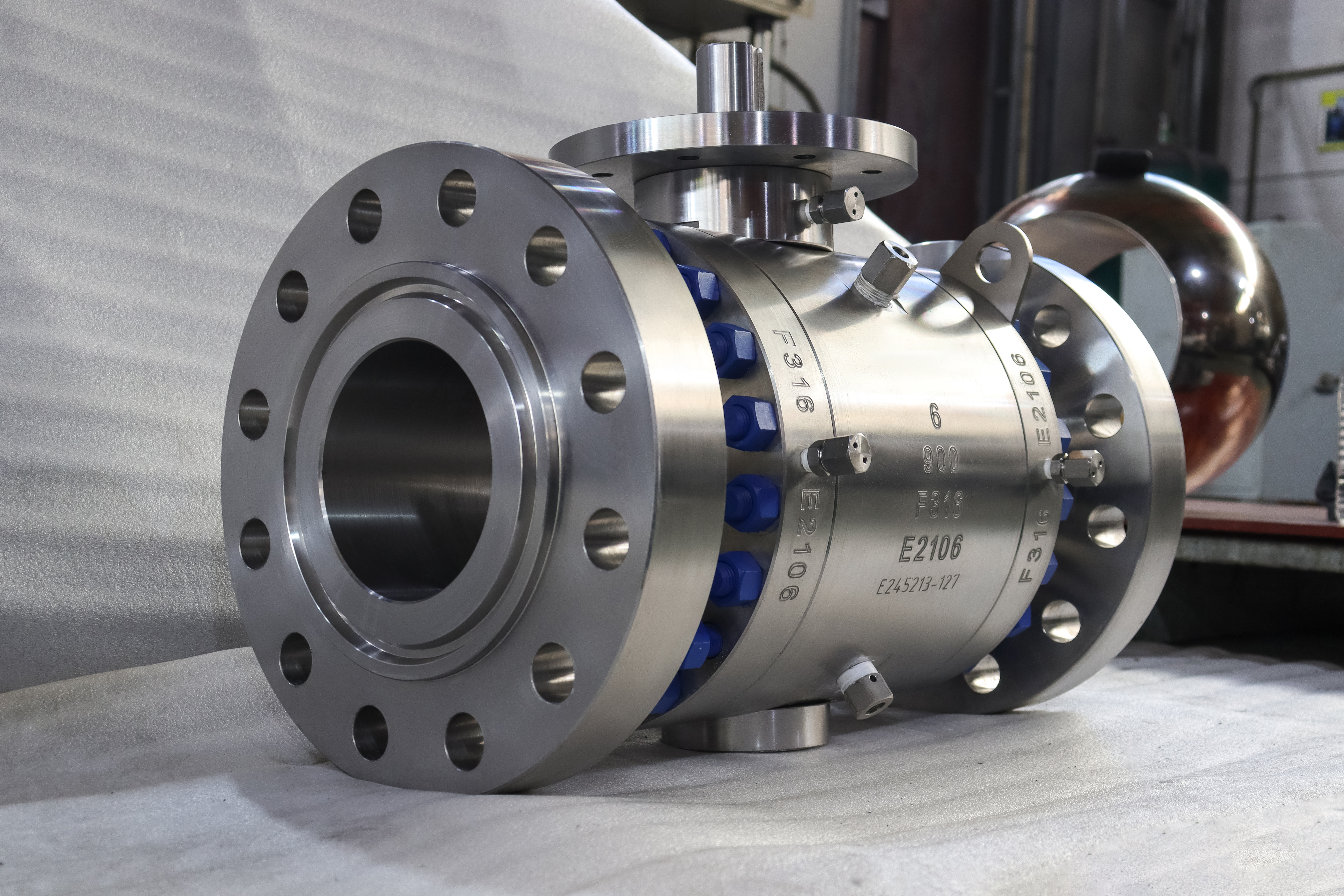
Full bore is a claim about geometry, and geometry can be measured. A full bore valve has a passage through the ball that is at least as large as the bore at the ends, so that the ball is not a restriction in the line. A catalogue can print the words on every page; only the drawing shows whether the claim is true for the size and the class being ordered.
The family runs from two inch to fifty six inch, Class 150 to Class 2500, in 316 stainless for the body, the ball and the stem, with the seat in PTFE, reinforced PTFE or metal and the ends available flanged or butt welded. The photograph on this page is the six inch Class 900 build, which is the size where the difference between full bore and reduced bore starts to be worth money.
The argument is that a buyer should ask for three numbers rather than an adjective: the bore through the ball, the bore at each end, and the pressure class that fixes both. With those three, full bore is either true or false and the answer does not depend on which catalogue the valve came from.
Design and Construction
The body is a three piece trunnion design, with the ball carried on an upper and a lower trunnion and the seats spring loaded on either side. On a full bore build the ball is large, because the bore through it has to match the ends, and a large ball brings a large seat ring, a longer body and a higher operating torque than the reduced bore equivalent.
The bore at the ends is machined to the inside diameter that the class and the wall thickness call for, which means the same nominal size can have different end bores on different builds. A valve made for a heavier wall has a smaller end bore, and its ball is correspondingly smaller, and it is still a full bore valve because the passage through it is not smaller than the ends.
That is the point at which the phrase full bore stops being a synonym for large and becomes a comparison. The comparison is inside the valve, not between the valve and the nominal size. A six inch valve with a five inch bore at the ends and a five inch bore through the ball is full bore. A six inch valve with a six inch bore at the ends and a four inch bore through the ball is reduced, and it will stop a pig.
The trunnion mounting is what keeps a large ball workable. The ball does not float under pressure; the end thrust goes into bearings at the top and bottom, and the seats only have to seal. On a full bore valve at Class 900 the ball and the seat rings are heavy enough that the bearings are a design item rather than a detail, and the bearing material decides the operating torque as much as the seat does.

Material Options
The standard build is 316 throughout: body, ball and stem. One grade means one welding procedure, one passivation process and one corrosion limit, and on a full bore valve it also means that the ball and the body expand at the same rate when the line heats up, which keeps the seat clearance predictable.
The seat is where the build stops being uniform. A reinforced PTFE insert gives tight shut off to about two hundred Celsius, and above that the choice is a PEEK insert or a metal seat. On a full bore valve the seat circumference is long, so the difference in friction between a polymer and a metal face is a large part of the torque, and the operator has to be sized for the seat that was actually fitted.
The packing and the gasket follow the temperature in the same way. A PTFE packing is normal at moderate temperature and becomes graphite above it, and the body gasket changes from a filled spiral wound to a graphite filled one at the same point. Both changes are invisible from outside the valve and both are decided when the valve is ordered.
Technical Specifications
| Item | Value |
|---|---|
| Size range | Two inch to fifty six inch, DN 50 to DN 1400 |
| Build shown | Six inch, Class 900, F316 |
| Pressure class | Class 150 to Class 2500, PN 20 to PN 420 |
| Bore | Full bore, matched to the end bore |
| Body, ball, stem | 316 stainless as standard |
| Seat | PTFE, reinforced PTFE, or metal |
| Ends | Raised face flange or butt weld |
| Face to face | ASME B16.10 where tabulated |
| Temperature | Minus 46 to plus 200 Celsius, seat dependent |
| Operator | Handwheel, gearbox, or actuator |
| Test | API 598 shell and seat |
The three numbers that settle the full bore question belong on the drawing and on the order, and each of them is read by a different person for a different reason.
| Figure | Read From | What It Decides |
|---|---|---|
| Inlet end bore | Flange standard and wall | What the pipe has to match |
| Outlet end bore | Flange standard and wall | Whether both ends are the same schedule |
| Ball bore | The ball drawing | Whether the valve is full bore at all |
| The smallest of the three | Comparison | The true passage offered to the line |
Where the two end bores differ, which happens on a valve built with different flange schedules at each end, the smaller of the two is the figure the ball bore has to meet. A valve with a ball bore equal to the larger end is still full bore at the smaller end and is over bored at the larger one, which is unusual but not wrong, provided the drawing says so.
Standards and Compliance
| Requirement | Document | What It Means Here |
|---|---|---|
| Product requirements | API 6D | Design, materials, marking, testing |
| Wall and rating | ASME B16.34 | Group 2.2 for 316 |
| Class designation | API 6D, PN equivalents | Class 900 is PN 150 |
| Pressure test | API 598 | Shell at 1.5 times, seat at 1.1 times |
| Fire test | API 607 or ISO 10497 | Type test with a stated scope |
| Material certificate | EN 10204 3.1 | Heat number per pressure part |
The class designation row is where a reader can lose a factor of six. Class 900 is written as PN 150 in the API 6D conversion, and PN 150 looks like it might mean one hundred and fifty. It does not. PN is a European pressure designation in bar, Class is the ASME designation, and the conversion is a table rather than a calculation. A valve ordered as PN 150 because the line was described as 150 will arrive as a Class 900 valve, or a Class 150 valve will be supplied against a PN 150 requirement, and both are expensive in different ways.
The same trap exists one step down, where Class 600 is PN 100 and Class 300 is PN 50. The pattern only holds because the two systems were aligned by a table, and outside that table the two numbers are not interchangeable. On a page that offers both, the only safe habit is to quote the class and let the PN be derived.
API 608 does not reach Class 900. That standard covers ball valves to Class 600 and DN 600, so every 900, 1500 and 2500 valve on this page is an API 6D article, and a quotation that cites 608 for a Class 900 valve is citing a document outside its scope. The two standards overlap at the bottom of the range and separate above it.
Manufacturing Process
The stainless body is forged or cast, machined, pickled and passivated. On a full bore body the bore is large, which means more material has to come out and the machining time is longer than for the reduced bore equivalent; that is part of why full bore costs more before any trim is fitted.
The ball is ground and then lapped, and on a metal seated build it is lapped against its own seat ring so that the two surfaces match. The lapping is what produces the contact band, and the band is what the seat test is really measuring. A ball with a good surface finish and a narrow band will leak; a ball with a band that is even and wide will hold even if the finish is not perfect.
The seat pockets and the bore are machined from one setup where the size allows, so that the bore and both seat faces share a centreline. On a large full bore body the setup is transferred and the centreline is re-established, which is why the drawing carries a coaxiality requirement across the whole bore rather than only diameters.

Quality Control and Testing
| Step | Check | Acceptance |
|---|---|---|
| 1 Incoming | Heat number against the mill certificate | Chemistry and mechanicals |
| 2 Identity | Positive material identification on body and trim | 316 confirmed |
| 3 Bore | Through ball bore against both end bores | Not smaller than the ends |
| 4 Seat band | Lapped band width and position | Drawing tolerance |
| 5 Shell test | Body and joints at 1.5 times | API 598, no leakage |
| 6 Seat test | Each seat at 1.1 times | API 598 rate |
| 7 Torque | Operating torque with the operator fitted | Works limit |
| 8 Final | Drained, dried, ends capped, marked | Works standard |
The bore check is the one that decides whether the adjective on the page is true. It is a measurement rather than a test, it takes a few minutes, and it is the only evidence a buyer will ever have that the valve is what it says. It belongs on the inspection record with the three figures written down, not with a tick in a box.
The seat band check is the other one that predicts field behaviour better than the bench test. A band that is narrow means the seat is only touching over a small area, which will pass a test at ambient and leak when the body grows at temperature. A band that is wide and even means the two surfaces have mated across their full width, which is what a lapped pair is for.

Applications and Industry Service
Full bore stainless belongs where the line is swept, where the pressure drop matters, or where the product must not sit in a cavity that a reduced bore would create. Pigged product lines, chemical transfer lines that are cleaned in place, catalyst and slurry lines where a shoulder would collect solids, and the suction side of pumps where any restriction costs net positive suction head are the four standard cases.
It also belongs where the line will be inspected with a tool rather than by eye. A full bore valve is the only ball valve that a camera or a gauge pig can pass, and on a line that is inspected on a schedule the valve is either full bore or it is a permanent obstruction in the inspection route.
It is the wrong valve where the pressure drop does not matter and the size does. A full bore valve is larger, heavier, more expensive and harder to operate than the reduced bore equivalent, and on an isolation duty in a line that is never swept, the extra money buys a feature that will never be used.
The same argument runs the other way on a line that is swept once a year. One pigging operation on a line that has been built with a shoulder will cost more in lost production and in the recovery of a stuck tool than the difference between a full bore and a reduced bore valve across the whole line, and that comparison is worth doing on the drawing rather than after the first pig is launched.

Installation, Operation and Maintenance
Support the valve and bring the mating flanges up parallel before tensioning. A six inch Class 900 valve is heavy enough that a flange pulled into place by its studs will load one side of the body joint and leave the other with a gap that no gasket will fill.
Operate the valve fully open or fully closed. A full bore ball valve part open is a throttling device with the whole pressure drop across a narrow opening, and the seat downstream is the part that suffers. If the duty needs regulation, that is a control valve's job.
For maintenance the line is isolated, vented and drained, the body joint is opened, and the ball and seats come out as a set. The bore is inspected for erosion and for deposits, the seat band is checked for width, and the trunnion bearings are examined for play. Both seat inserts are replaced as a pair, the gasket is renewed, and the body is closed with the studs brought up in a cross pattern in stages.
How to Specify and Order
Six figures settle the article: size, class, body grade, the seat, the ends and the operator. On a full bore valve there is a seventh that should be written rather than assumed, which is the bore. Writing full bore is a claim; writing the three bore figures is an instruction.
Three questions belong to the line rather than to the valve: will it be pigged, what is the design temperature, and what pressure drop can the line afford. The first decides between full and reduced bore, the second decides whether the seat can stay polymeric, and the third decides whether the extra cost of a full bore body is buying anything.
Documents to name in the order: the EN 10204 3.1 certificate for each pressure part with its heat number, the positive material identification report, the passivation record, the shell and seat test record with a result per seat, the bore measurement record for both ends and through the ball, and the general arrangement drawing carrying the face to face dimension.
FAQ
Q: How do you prove a valve is full bore?
A: By measuring three figures and comparing them: the bore at the inlet end, the bore at the outlet end and the bore through the ball. The valve is full bore when the passage through the ball is not smaller than the ends. It is a measurement rather than a test, and it belongs on the inspection record with the numbers written down.
Q: Is full bore the same as the nominal size?
A: No. The nominal size describes the end connection, and the bore at the end depends on the wall thickness the valve was built for. So a six inch valve can have a five inch end bore and still be full bore, because the passage through the ball matches the end rather than the nominal figure.
Q: Why does full bore cost more at the same class?
A: Because the ball is sized by the bore, and a larger ball brings a larger seat ring, a longer body, more material, a higher torque and a larger operator. The cost is in the ball and the seats rather than in the casting, which is why the difference grows with the class.
Q: What does PN 150 mean on a Class 900 valve?
A: It is the European designation in the API 6D conversion table, and it does not mean one hundred and fifty. PN is a bar designation and Class is the ASME designation, and the conversion is a table rather than a calculation. Reading PN 150 as 150 is a factor of six error in the wrong direction.
Q: Does API 608 cover a Class 900 valve?
A: No. API 608 covers ball valves from DN 15 to DN 600 in Class 150 to Class 600, so Class 900, 1500 and 2500 valves are API 6D articles. The two standards overlap at the bottom of the range and separate above Class 600.



Hot Products


News
Why A Ball Valve Gets Harder To Turn: Five Causes, And The Test That Tells Them Apart
A ball valve that stiffens over months points at one of five parts. Measure torque with the line pressurised and again vented, and the split becomes visible.
Read More
The Ball Valve at Four Thousand Bar: Seat Load, Erosion And Fatigue in Waterjet Circuits
At 4,000 bar a 10 mm bore puts 31 kN on the seat and a 0.1 mm leak cuts steel. What a ball valve must survive in a waterjet or intensifier circuit.
Read More
Large Diameter Ball Valves: Four Limits That Change The Design
Above a certain size a ball valve stops being a scaled one. Ball weight, operator torque, body split and the test bench each set a limit at a different size.
Read More
Cast Or Forged Ball Valve Body, And What A Radiography Acceptance Level Actually Buys You
Casting or forging is only half the decision. What RT, UT, MT and a proof test each find in a ball valve body, and where the geometry defeats all of them.
Read More