


CHINA J-VALVES Offers Various High-quality I ndustrial Ball Valves
J-VALVES, a distinguished professional ball valve manufacturer rooted in China, takes pride in its extensive product portfolio. Our offerings span a wide range, including trunnion-mounted ball valves, floating ball valves, high-temperature ball valves, high-pressure ball valves, metal-sealed ball valves, ultra-low temperature ball valves, DBB ball valves, Three-way And Four-way Ball Valve, and fully welded ball valves. Each product is a testament to our commitment to precision engineering and reliable performance. Meticulously crafted, they are designed to not only meet but exceed the most stringent industrial demands, ensuring stable operation even under extreme conditions. This enables us to provide our clients with high-value services and makes our valves widely sought-after in industries.
Product Category
Contact Us


-
J-VALVES-Q47F
-
J-VALVES
Overview of the J-VALVES two piece flanged cast trunnion valve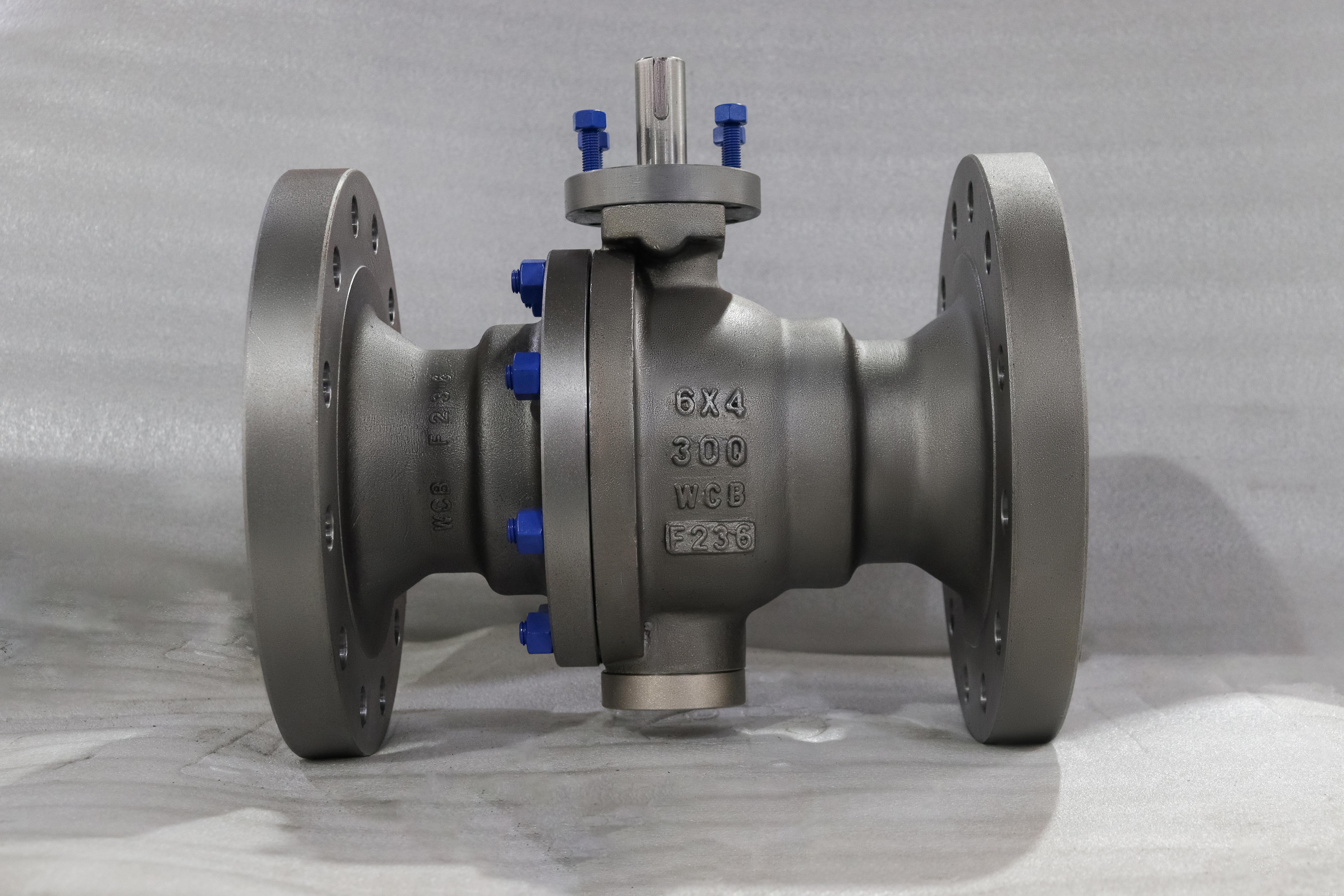
The photograph behind this page is a twelve by ten inch Class 300 cast carbon steel valve, and the two numbers in that description are the whole subject. Twelve is the end size and ten is the bore through the ball, and a valve described that way is a reduced bore valve sitting in a twelve inch line.
The family runs from two inch to fifty six inch, Class 150 to Class 2500, in cast carbon steel, stainless or alloy steel, with a temperature range of minus 46 to plus 200 Celsius that is set by the seat. The body is two pieces on this designation: a main body that carries the ball, the seats and the stem, and an end piece that closes on it with one gasketed joint.
The argument here is about the two claims a two piece body usually attracts. It is said to be easier to maintain and stronger than a three piece body. The first is half true and the second is false. One joint means one access route, and a joint is a pressure boundary rather than a reinforcement, so a two piece body is a body with fewer places to leak and fewer places to reach.
Design and Construction
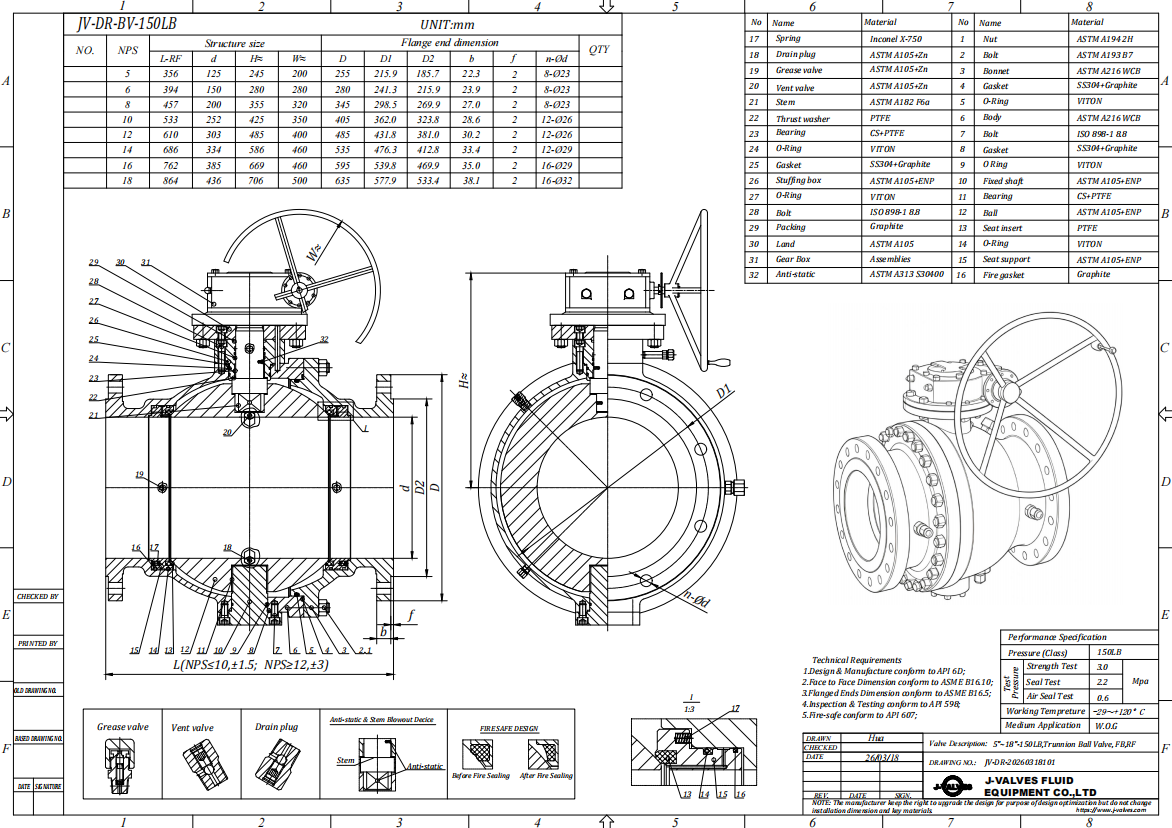
The main body carries the ball on its trunnions, holds both seats in their pockets and takes the stem through a gland at the top. The end piece is a ring that carries one flange and closes on the main body around the bore, so the valve has a single joint at full line pressure.
That single joint is the reason the maintenance claim needs qualifying. To reach the seats, the end piece comes off and the ball is withdrawn through the opening. Everything is accessible from one side, and that side is the side the piping has to be opened from. The valve cannot be serviced from both ends the way a three piece body can, and on a large valve in a congested pipe rack the difference between one accessible side and two is the difference between a repair and a shutdown.
The structural claim is the one that should be dropped from the catalogue. A two piece body has one gasketed joint and a ring of studs through a flange that is part of the casting; a three piece body has two. Neither is stronger than the other as a casting, and the joint is not a reinforcement. What a two piece body actually offers is fewer joints, fewer gaskets, fewer studs, shorter assembly time and one less place to leak, which are real advantages of a different kind.
The casting itself is the reason this size exists in cast form. Above a certain size a forging stops being practical, and the twelve inch Class 300 body on this page is comfortably in the range where a casting is the normal route. The wall thickness comes from the class and the material group rather than from the casting method, which is why a well made casting and a forging of the same class have the same pressure capability.
Twelve by ten is a notation with three separate meanings, and all three have to be right for the valve to fit the line.
| Reading | What It Fixes | Where It Appears |
|---|---|---|
| End size | Flange drilling, face to face, shell test | The line drawing and the flange standard |
| Bore size | Pressure drop, pig passage, flow area | The process datasheet |
| The pair | The valve as an article | The purchase order and the nameplate |
The end size governs everything the piping engineer cares about. A twelve inch Class 300 flange has a defined bolt circle and a defined face to face dimension, and those come from the end size rather than from the bore. A valve ordered as ten inch because the bore is ten inch will arrive with ten inch flanges and will not bolt to the line.
The bore size governs everything the process engineer cares about. A ten inch bore in a twelve inch line is a permanent contraction, and the loss across it is paid for by the pump for the life of the plant. On a Class 300 line at moderate velocity that loss is small; on a short line with several valves it can be the difference between a pump that has margin and one that does not.
The pair is what the valve actually is, and it belongs on the nameplate and on the order in that form. Writing twelve by ten, or twelve inch reduced to ten, or DN 300 by DN 250, all mean the same article. Writing either number alone means a different article, and a supplier who receives one number will build what that number says.
Material Options
Cast carbon steel in the WCB grade covers the general duties on this valve: water, steam, gas and the ordinary hydrocarbon services where the temperature is inside the carbon range. The stainless grades cover corrosion, and the alloy grades cover temperature. On a large cast body the grade also decides the welding and the heat treatment, because a cast carbon steel body that needs a weld repair has to be heat treated afterwards and the record of that treatment belongs with the valve.
The seat decides the shut off. A reinforced PTFE seat gives tight shut off at moderate temperature on this size, and a metal seat gives temperature capability at a leakage rate that is a rate. On a twelve inch valve the seat is a large ring, and the difference between a soft insert and a metal face is a large part of the price difference between two otherwise identical builds.
The stem, the gland and the trunnion bearings are the parts that decide the operating effort. On a twelve inch reduced bore valve the ball is a ten inch ball, which is smaller and lighter than a twelve inch full bore ball, and the torque that follows is lower. That is the practical chain that makes a reduced bore large valve attractive: smaller ball, lower torque, smaller gearbox, shorter lever, less money.
Technical Specifications
| Item | Value |
|---|---|
| Size range | Two inch to fifty six inch, DN 50 to DN 1400 |
| Build shown | Twelve by ten inch, Class 300, WCB |
| Pressure class | Class 150 to Class 2500, PN 20 to PN 420 |
| Construction | Two piece cast body, trunnion mounted ball |
| Body grades | WCB, stainless, alloy steel by order |
| Seat | PTFE, reinforced PTFE, or metal |
| Ends | Raised face flange or butt weld |
| Face to face | The end size dimension, per ASME B16.10 |
| Temperature | Minus 46 to plus 200 Celsius, seat dependent |
| Operator | Handwheel or gearbox, actuator on request |
| Test | API 598 shell and seat |
The class and the size together set the rating, and the rating at temperature is not the same as the rating at ambient. Class 300 in carbon steel sits in material group 1.1 of ASME B16.34, where the cold rating is a stated figure in the standard and falls with temperature at a rate set by the group. A valve selected on the ambient rating alone can be over its allowable pressure at the operating temperature, which is a common and quiet way to buy the wrong class.
Standards and Compliance
| Requirement | Document | What It Means Here |
|---|---|---|
| Product requirements | API 6D | Design, materials, marking, testing |
| Wall and rating | ASME B16.34 | Group 1.1 for carbon steel |
| Casting quality | MSS SP-55 | Visual and dimensional acceptance |
| Pressure test | API 598 | Shell at 1.5 times, seat at 1.1 times |
| Fire test | API 607 or ISO 10497 | Type test with a stated scope |
| Material certificate | EN 10204 3.1 | Heat number per casting |
| Heat treatment | Stress relief after weld repair | Recorded, part of the file |
| Flanges | ASME B16.5 to 24 inch | Standard changes above |
MSS SP-55 is the document that turns a visual inspection of a casting into an acceptance decision. It defines the visual imperfections and the severity levels, and a buyer who specifies a level is buying a casting that has been judged against a published scale rather than against the inspector's mood. On a large cast body that line is worth more than it looks, because the surface area being judged is large and the consequences of a missed defect are not.
Manufacturing Process
A pattern is made and the two castings are poured, cleaned and heat treated before machining. On a two piece body both castings are large, and the match between the end piece and the main body is decided by the machining rather than by the pattern, which is why the joint faces are machined after the castings have been stress relieved.
Machining is done with the flange face, the joint face, the bolt circle and the seat pockets referenced to one centreline. On this design the two seat pockets are in the same casting, which removes the cross joint coaxiality problem that a three piece body has and replaces it with a joint face flatness problem, because the end piece has to seat on a large ring face without a gap.
The ball is ground and the seats are lapped to it, the trunnion bearings are fitted, and the stem is assembled with its packing and gland. The valve is then cycled with the end piece fitted and the torque recorded, because a large two piece body that has been machined slightly out of square will close with a tight spot that no adjustment will remove.

Quality Control and Testing
| Step | Check | Acceptance |
|---|---|---|
| 1 Incoming | Heat number against the mill certificate | Chemistry and mechanicals |
| 2 Casting | Visual and dimensional to MSS SP-55 | Level on the order |
| 3 Identity | Positive material identification | Grade match |
| 4 Machining | Joint face flatness and seat pocket position | Drawing tolerance |
| 5 Shell test | Body and the single joint at 1.5 times | API 598, no leakage |
| 6 Seat test | Each seat at 1.1 times | API 598 rate |
| 7 Function | Cycles and torque with the end piece fitted | Works limit |
| 8 Final | Drained, joint faces protected, marked | Works standard |
The single joint is both an advantage and a risk in testing. It is one joint to prove rather than two, so a shell test on a two piece body is a simpler and more conclusive test than the equivalent on a three piece body. It is also the only joint there is, so a joint that weeps at test is not a partial failure of the design, it is the whole of the pressure boundary at that end.

Applications and Industry Service
The twelve by ten Class 300 build belongs to the large bore side of a plant where the pipe is big and the duty is ordinary: cooling water headers, fire water ring mains, crude and product rundown, tank farm manifolds, and the isolation points on large pumps. In those duties the valve is either open or closed, the pressure drop across a reduced bore is not a design constraint, and the reduced bore saves weight and money on every unit.
Cast carbon steel is the right body for those duties until the water becomes aggressive or the temperature leaves the carbon range. Above that the same body is poured in a stainless or an alloy grade, and the two piece construction carries over unchanged.
It is the wrong valve where the line has to be pigged, because a twelve by ten body has a shoulder that a pig will not pass. It is also the wrong valve where maintenance access is only available from the far side of the pipe, because the single joint means the work has to happen from the end piece side and there is no second route in.

Installation, Operation and Maintenance
Install the valve with the end piece facing the side that has access, and decide that before the pipe is cut rather than after. Support the body on its own feet or on a saddle, and bring the mating flanges up parallel before tensioning, because a large body that is being pulled into alignment will close its joint on one side and open it on the other.
Operate the valve through its full travel. On a reduced bore large valve the flow through a part open ball is a high velocity jet through a smaller throat, and the seat downstream of that jet is the part that will be cut.
For maintenance the line is isolated, vented and drained, the end piece studs are released in a pattern, and the end piece comes away with its gasket. The ball is withdrawn through the opening, the seats are replaced as a pair, and the joint face is inspected for corrosion and for the marks of a previous uneven closure. The gasket is renewed, the studs go back dry or with the specified lubricant, and the joint is tensioned in a cross pattern in stages.
How to Specify and Order
Six lines fix the valve: the size pair, class, body grade, seat type, the ends and the operator. The first line has to carry both numbers, and on a replacement it also has to carry the face to face dimension and the flange drilling, because the pair alone will not tell a supplier which build the line was designed around.
Three questions belong to the line rather than to the valve: will it be pigged, what pressure drop can the line afford, and which side has access. The first rules out a reduced bore where a pig has to pass, the second decides whether the saving on the ball is real, and the third decides which way round the valve goes in.
Documents to name in the order: the EN 10204 3.1 certificate for each casting with its heat number, the heat treatment record including any weld repair, the MSS SP-55 acceptance level, the shell and seat test record with a result per seat, the torque record for the operator fitted, and the general arrangement drawing carrying both the end size and the bore.
FAQ
Q: Is a two piece body stronger than a three piece body?
A: No. Both are castings or forgings of the same grade and wall, and the joint between the pieces is a pressure boundary rather than a reinforcement. What a two piece body actually offers is fewer joints, fewer gaskets and fewer studs, which is a real advantage of a different kind and does not need the strength claim.
Q: What does twelve by ten mean?
A: A twelve inch end connection and a ten inch bore through the ball. The valve is flanged, dimensioned and tested as a twelve inch valve and only the passage is ten inch. Ordering it as a ten inch valve produces a body with ten inch flanges that will not bolt to a twelve inch line.
Q: Does one joint mean it is easier to maintain?
A: It means there is one access route. The end piece comes off and the ball is withdrawn through that opening, so everything is reachable from one side and that side has to be opened. A three piece body can be worked from both ends, and on a large valve in a congested rack the difference between one accessible side and two is a shutdown decision.
Q: Why is a large valve usually reduced bore?
A: Because the ball is the expensive part. A ten inch ball in a twelve inch body is smaller, lighter, lower in torque and cheaper than a twelve inch ball, and on a Class 300 line at moderate velocity the pressure drop across the step matters much less than the saving on the valve and the operator.
Q: What is MSS SP-55?
A: The standard that turns a visual inspection of a casting into an acceptance decision. It defines the visual imperfections and their severity levels, so a buyer who specifies a level is buying a casting judged against a published scale rather than against an inspector judgement. On a large cast body that line is worth more than it looks.



Hot Products


News
Why A Ball Valve Gets Harder To Turn: Five Causes, And The Test That Tells Them Apart
A ball valve that stiffens over months points at one of five parts. Measure torque with the line pressurised and again vented, and the split becomes visible.
Read More
The Ball Valve at Four Thousand Bar: Seat Load, Erosion And Fatigue in Waterjet Circuits
At 4,000 bar a 10 mm bore puts 31 kN on the seat and a 0.1 mm leak cuts steel. What a ball valve must survive in a waterjet or intensifier circuit.
Read More
Large Diameter Ball Valves: Four Limits That Change The Design
Above a certain size a ball valve stops being a scaled one. Ball weight, operator torque, body split and the test bench each set a limit at a different size.
Read More
Cast Or Forged Ball Valve Body, And What A Radiography Acceptance Level Actually Buys You
Casting or forging is only half the decision. What RT, UT, MT and a proof test each find in a ball valve body, and where the geometry defeats all of them.
Read More