


CHINA J-VALVES Offers Various High-quality I ndustrial Ball Valves
J-VALVES, a distinguished professional ball valve manufacturer rooted in China, takes pride in its extensive product portfolio. Our offerings span a wide range, including trunnion-mounted ball valves, floating ball valves, high-temperature ball valves, high-pressure ball valves, metal-sealed ball valves, ultra-low temperature ball valves, DBB ball valves, Three-way And Four-way Ball Valve, and fully welded ball valves. Each product is a testament to our commitment to precision engineering and reliable performance. Meticulously crafted, they are designed to not only meet but exceed the most stringent industrial demands, ensuring stable operation even under extreme conditions. This enables us to provide our clients with high-value services and makes our valves widely sought-after in industries.
Product Category
Contact Us


-
J-VALVES-Q47F
-
J-VALVES
Overview of the J-VALVES stainless steel line trunnion valve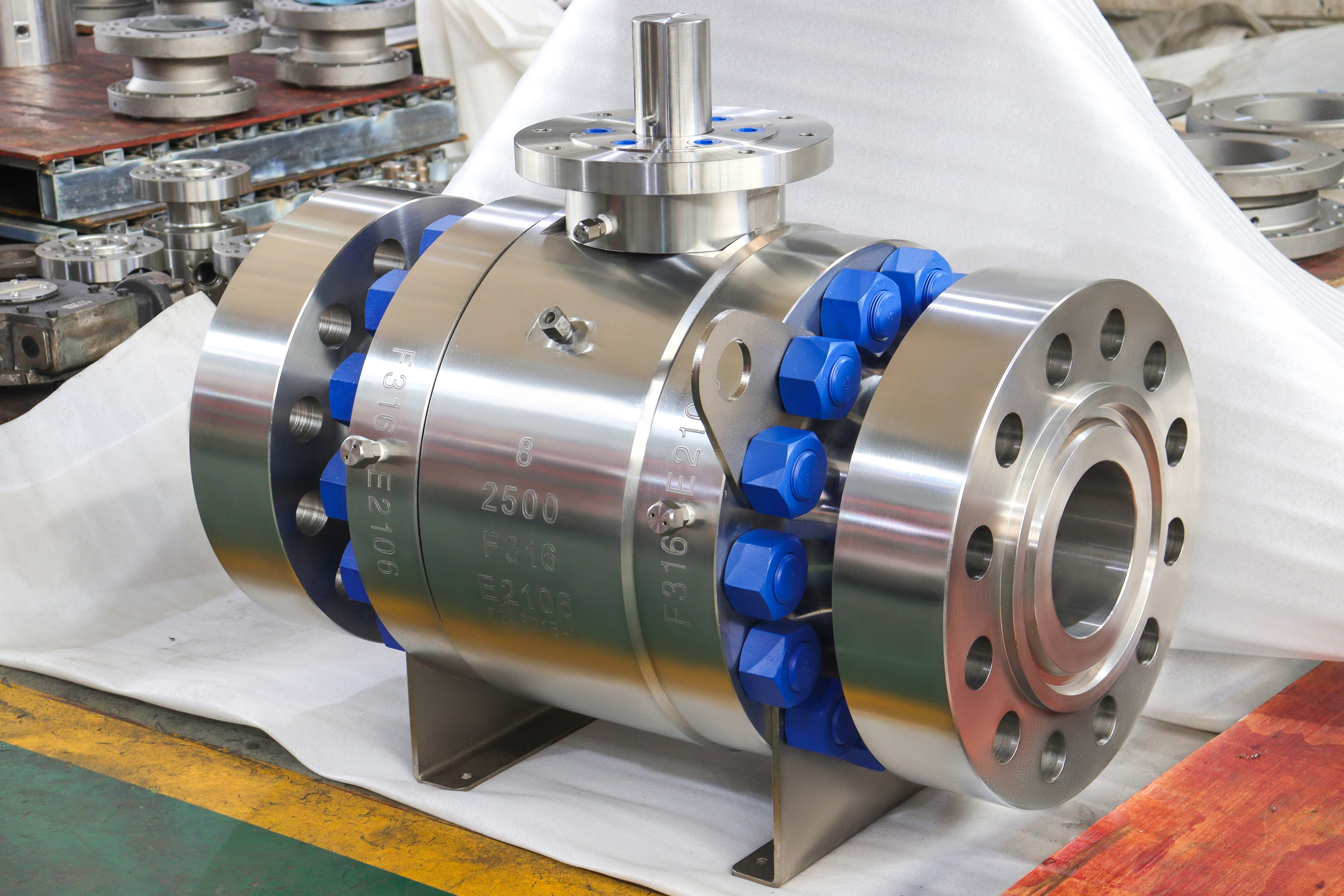
A line valve is not a type of valve. It is a statement about where the valve sits and what the line asks of it, and in pipeline service that comes down to three properties: the bore has to pass a pig, the ends have to weld into the pipe without a flange in between, and the length has to match the dimension the line was built to. A valve that has all three is a line valve. A valve that has two of them is a valve with an ambitious title.
The family runs from two inch to fifty six inch, Class 150 to Class 2500, in 316 stainless as the standard build with the ends available as raised face or butt weld. The temperature range on the source page reads minus 46 to plus 200 Celsius, and that figure belongs to the seat rather than to the body, which is the first thing this page has to untangle.
The argument here is that a page titled line valve should be able to answer three interface questions: what the bore is, what the bevel is, and what the length is. Catalogues tend to answer the first with an adjective and leave the other two to the drawing. This page puts the three in one place, because a buyer who cannot answer them is buying a valve that will not fit the line it was bought for.
Design and Construction
The body is a three piece trunnion design on the flanged and welded builds, with the ball carried on an upper and a lower trunnion and the seats spring loaded on either side. That arrangement is what allows a stainless body to hold Class 2500 without a seat load that would destroy a soft insert, and it is the reason the same body can be offered from two inch to fifty six inch.
The bore through the ball is the first of the three interface properties, and it is decided before the body is drawn. A full bore valve has a bore through the ball that matches the inside diameter of the pipe, so a pig or a sphere can pass without meeting a shoulder. A reduced bore valve has a smaller ball, which shortens the body, lowers the torque and saves money, and which puts a permanent step in a line that was designed to be swept.
The ends are the second. A butt weld end is not a flange with the flange cut off; it is a machined bevel that has to match the wall thickness and the bevel detail of the pipe it is welded to, and the standard that defines it is separate from the valve standard. A valve ordered with butt weld ends and no bevel detail on the drawing is a valve that will be dressed on site by whoever is welding it, which is not a controlled operation.
The third property is the length. The face to face or end to end dimension for a given size and class is tabulated for a long list of combinations, and above the tabulated sizes it comes from the drawing. A line valve that is dimensionally short has to be made up with a spool, and a spool in a high pressure stainless line is a new weld, a new NDE scope and a new place for a leak.
The three properties are worth setting out as a check, because each of them is answered by a different document and a quotation that answers only one of them is incomplete.
| Property | What It Means | Where It Is Answered |
|---|---|---|
| Full bore | Bore through the ball matches the pipe bore | The drawing, not an adjective |
| Weld ends | Bevel matches the pipe wall and detail | ASME B16.25 on the drawing |
| Length | End to end for the size and class | ASME B16.10 where tabulated |
| Pressure class | Class and its PN equivalent | API 6D designation table |
| Bending | The valve is not a pipe support | Installation detail, not the valve |
| Pigging | No shoulder, no cavity trap in the bore | Full bore plus a drainable cavity |
The last row is the one that is left out of most catalogues and it matters on a line that is pigged. A full bore valve still has a cavity between the seats, and that cavity is a place where debris collects. Whether the cavity can be drained and whether the drain is on the low side of the installed valve is an installation question, but it is decided by whether the valve has a cavity connection at all.

Material Options
The standard build on this page is 316 stainless for the body, the ball and the stem, and that uniformity is a real advantage: one material means one heat treatment family, one passivation process and one welding procedure. It also means one corrosion limit, and the limit applies to the weakest of the three, which is usually the seat and the packing rather than the metal.
The seat is where the temperature range is actually set. A reinforced PTFE insert takes the valve to about two hundred Celsius and no further, and the minus 46 figure at the other end is the low temperature limit of that insert rather than of the body. A 316 body at Class 1500 will hold pressure far outside that window, and a buyer who reads minus 46 to plus 200 as the valve's capability will under-use it or, worse, order a metal seated version for a duty that needed a soft seat and tighter shut off.
The ends change the material story as well. A butt weld end means the valve is welded into the line, and the weld is a heat input next to a gasket and a seat. The welding procedure has to keep the heat away from the seat pocket, and on a stainless valve it also has to protect the inside from oxidation, which is why a purge is specified rather than assumed.
Technical Specifications
| Item | Value |
|---|---|
| Size range | Two inch to fifty six inch, DN 50 to DN 1400 |
| Pressure class | Class 150 to Class 2500, PN 20 to PN 420 |
| Body, ball, stem | 316 stainless as standard |
| Seat | PTFE, reinforced PTFE, or metal |
| Ends | Raised face flange, or butt weld |
| Face to face | ASME B16.10 where tabulated |
| Temperature | Minus 46 to plus 200 Celsius, seat dependent |
| Operator | Handwheel, pneumatic, electric |
| Design | API 6D, ASME B16.34 |
| Test | API 598 shell and seat |
The class range is the one place where a line valve page usually overstates itself. Class 2500 in 316 stainless sits in material group 2.2 of ASME B16.34, and the cold rating for that group at 2500 is a stated figure in the standard rather than a multiple of the class number. The rating falls with temperature at a rate set by the group, so the same valve at two hundred Celsius has a lower allowable pressure than at ambient, and the nameplate only tells the reader where the table starts.
Standards and Compliance
| Requirement | Document | What It Means Here |
|---|---|---|
| Product requirements | API 6D | Design, materials, marking, testing |
| Wall and rating | ASME B16.34 | Group 2.2 for 316, rating falls with temperature |
| Weld ends | ASME B16.25 | The bevel is a specified geometry |
| Length | ASME B16.10 | Tabulated, drawing above the tables |
| Flanges | ASME B16.5 to 24 inch | Larger sizes change standard |
| Pressure test | API 598 | Shell at 1.5 times, seat at 1.1 times |
| Fire test | API 607 or ISO 10497 | Type test with a stated scope |
| Material certificate | EN 10204 3.1 | Heat number per pressure part |
The two interface standards are the ones that make the difference between a valve that is a line valve and a valve that is described as one. ASME B16.25 sets out the bevel geometry for butt welding ends, and ASME B16.10 sets out the face to face and end to end dimensions. Neither appears in API 6D, and a quotation that cites only API 6D has answered the product question and left the interface question open.
The temperature rating deserves one more line. The rating tables in B16.34 are for the body, and the seat and the packing have their own limits that are lower and that are not in that standard at all. A valve that is rated to the class at a temperature above the seat's limit is a valve that will hold pressure and leak at the seat, which is a different failure from a burst and a much more common one.
Manufacturing Process
The stainless body is forged or cast, machined, cleaned, pickled and passivated, and the passivation step is what separates a valve that looks like stainless from a valve that behaves like it. Machining leaves embedded iron and a disturbed surface layer, and both of them are sites where pitting starts. A passivated valve has its chromium oxide layer restored across the whole wetted surface.
The seat pockets and the bore are machined on one setup where the size allows it, so that the bore and both seat faces share a centreline. On a large body the setup is transferred and the centreline is re-established, which is why the drawing carries a coaxiality requirement rather than only individual dimensions.
Welding the ends on a welded body is a qualified operation with a procedure, a qualified welder and a record. The heat input is controlled so that the seat pocket does not distort, and the inside of the weld is purged so that the root does not oxidise. A weld that has been made without a purge looks acceptable from outside and has a black oxide scale on the inside that will be the first place to corrode.

Quality Control and Testing
| Step | Check | Acceptance |
|---|---|---|
| 1 Incoming | Heat number against the mill certificate | Chemistry and mechanicals |
| 2 Identity | Positive material identification on body and trim | 316 confirmed |
| 3 Bore | Bore diameter against the pipe schedule | Drawing figure |
| 4 Bevel | Angle and land against B16.25 | Drawing detail |
| 5 Shell test | Body and joints at 1.5 times | API 598, no leakage |
| 6 Seat test | Each seat at 1.1 times, cavity vented | API 598 rate |
| 7 Length | End to end against B16.10 or drawing | Drawing tolerance |
| 8 Final | Drained, dried, ends capped, marked | Works standard |
The bore and bevel checks are the two that a valve can pass every pressure test and still fail. A valve with the wrong bevel cannot be welded to the pipe, and a valve with a bore smaller than the schedule assumes is a valve that will not pass the pig. Neither shows up in a hydrostatic test, and both are decided at the drawing stage rather than at final inspection.

Applications and Industry Service
The stainless line valve belongs to pipelines that carry something aggressive enough to need 316 and clean enough to be pigged: chemical transfer lines, product pipelines in food and pharmaceutical plants, water injection lines offshore where the water is oxygen scavenged and the alloy is there for the chlorides, and the high pressure stainless runs in a process unit that are cleaned in place.
It is also used where the line is welded rather than flanged for a reason. A flanged joint is a leak path and a maintenance point; a welded valve removes both, at the cost of making the valve itself the only replaceable element. That trade is worth it in a line that runs continuously and is never opened, and it is a poor trade in a line that is opened for cleaning every month.
It is the wrong valve where the line is pigged with a tool that needs a true bore and the valve has been ordered reduced bore, because the pig will stop at the shoulder and the recovery operation will cost more than the valve. It is also the wrong valve where the medium carries solids that will pack the cavity, unless the cavity has a drain that is actually used.

Installation, Operation and Maintenance
For a welded valve the installation sequence is the whole of the maintenance plan. The line is cut to length, the bevels are prepared, the valve is aligned and tacked, and the root is purged before the first pass. The valve is left in the fully open position during welding so that heat does not concentrate on a seat, and the body is shielded or wrapped so that spatter does not land on the machined faces.
Support the valve independently during welding. A welded body that is holding the pipe in alignment while the weld cools will carry a bending load for the rest of its life, and the first symptom is a body joint that weeps rather than a weld that cracks.
For maintenance on a welded valve there is no maintenance: the valve is cut out. That is the honest consequence of the welded end, and it belongs in the decision rather than in a footnote. A flanged build with the same trim can be opened in place, and a line that expects to change seats should be built with flanges even though the welded version is cheaper and tighter.
How to Specify and Order
The valve is fixed by six lines: size, class, the body grade, the seat, the end detail and the operator. On a pipeline article there are two more that decide whether it will fit: the bore, stated as full or reduced and confirmed against the pipe schedule, and the end detail, stated as the bevel standard and the wall thickness it has to match.
Three questions belong to the line rather than to the valve: will it be pigged, what is the design temperature, and how will the valve be removed when it fails. The first decides the bore, the second decides whether the seat can stay polymeric, and the third decides between flanged and welded ends better than any price comparison.
Documents to name in the order: the EN 10204 3.1 certificate for each pressure part, the passivation record, the shell and seat test record with a result per seat, the weld procedure and welder qualification where the ends are welded, the general arrangement drawing carrying the bore, the bevel detail and the end to end dimension, and the fire test certificate with its scope where fire safe performance is required.
FAQ
Q: What makes a ball valve a line valve?
A: Three properties, all of them geometric. A bore through the ball that will pass a pig, weld ends whose bevel matches the pipe, and a length that matches the dimension the line was built to. A valve with two of the three is a valve with an ambitious title, and no adjective on a catalogue page substitutes for the three figures.
Q: Is the minus 46 to plus 200 range the valve range?
A: It is the seat range. A reinforced PTFE insert sets both ends of that window, and the 316 body at Class 1500 will hold pressure well outside it. Reading the figure as the valve capability leads either to under using the body or to ordering a metal seat for a duty that needed a soft seat and tight shut off.
Q: Why does the bevel standard matter?
A: Because a butt weld end is a machined geometry rather than a flange with the flange cut off. ASME B16.25 defines the bevel, and it has to match the wall thickness and the detail of the pipe it welds to. A valve ordered with weld ends and no bevel detail is dressed on site by whoever is welding it, which is not a controlled operation.
Q: Can a welded valve be serviced?
A: Not in place. The valve is cut out, which is the honest consequence of a weld end and belongs in the decision rather than in a footnote. A flanged build with the same trim can be opened where it sits, so a line that expects seat changes should be built with flanges even though the welded version is cheaper and has fewer leak paths.
Q: What is the PN equivalent of Class 2500?
A: PN 420, in the API 6D class designation table. The same table gives PN 100 for Class 600, PN 150 for Class 900 and PN 250 for Class 1500. A page that prints a PN figure outside that table has converted a pressure in bar and rounded it, and the rounding is where catalogue errors live.



Hot Products


News
Why A Ball Valve Gets Harder To Turn: Five Causes, And The Test That Tells Them Apart
A ball valve that stiffens over months points at one of five parts. Measure torque with the line pressurised and again vented, and the split becomes visible.
Read More
The Ball Valve at Four Thousand Bar: Seat Load, Erosion And Fatigue in Waterjet Circuits
At 4,000 bar a 10 mm bore puts 31 kN on the seat and a 0.1 mm leak cuts steel. What a ball valve must survive in a waterjet or intensifier circuit.
Read More
Large Diameter Ball Valves: Four Limits That Change The Design
Above a certain size a ball valve stops being a scaled one. Ball weight, operator torque, body split and the test bench each set a limit at a different size.
Read More
Cast Or Forged Ball Valve Body, And What A Radiography Acceptance Level Actually Buys You
Casting or forging is only half the decision. What RT, UT, MT and a proof test each find in a ball valve body, and where the geometry defeats all of them.
Read More