


CHINA J-VALVES Offers Various High-quality I ndustrial Ball Valves
J-VALVES, a distinguished professional ball valve manufacturer rooted in China, takes pride in its extensive product portfolio. Our offerings span a wide range, including trunnion-mounted ball valves, floating ball valves, high-temperature ball valves, high-pressure ball valves, metal-sealed ball valves, ultra-low temperature ball valves, DBB ball valves, Three-way And Four-way Ball Valve, and fully welded ball valves. Each product is a testament to our commitment to precision engineering and reliable performance. Meticulously crafted, they are designed to not only meet but exceed the most stringent industrial demands, ensuring stable operation even under extreme conditions. This enables us to provide our clients with high-value services and makes our valves widely sought-after in industries.
Product Category
Contact Us

A three piece forged trunnion valve from Class 150 to 2500 whose real limit is not the forging but the four long bolts that close both body joints.
-
J-VALVES-Q347F
-
J-VALVES
Overview of the J-VALVES three piece forged steel high pressure trunnion valve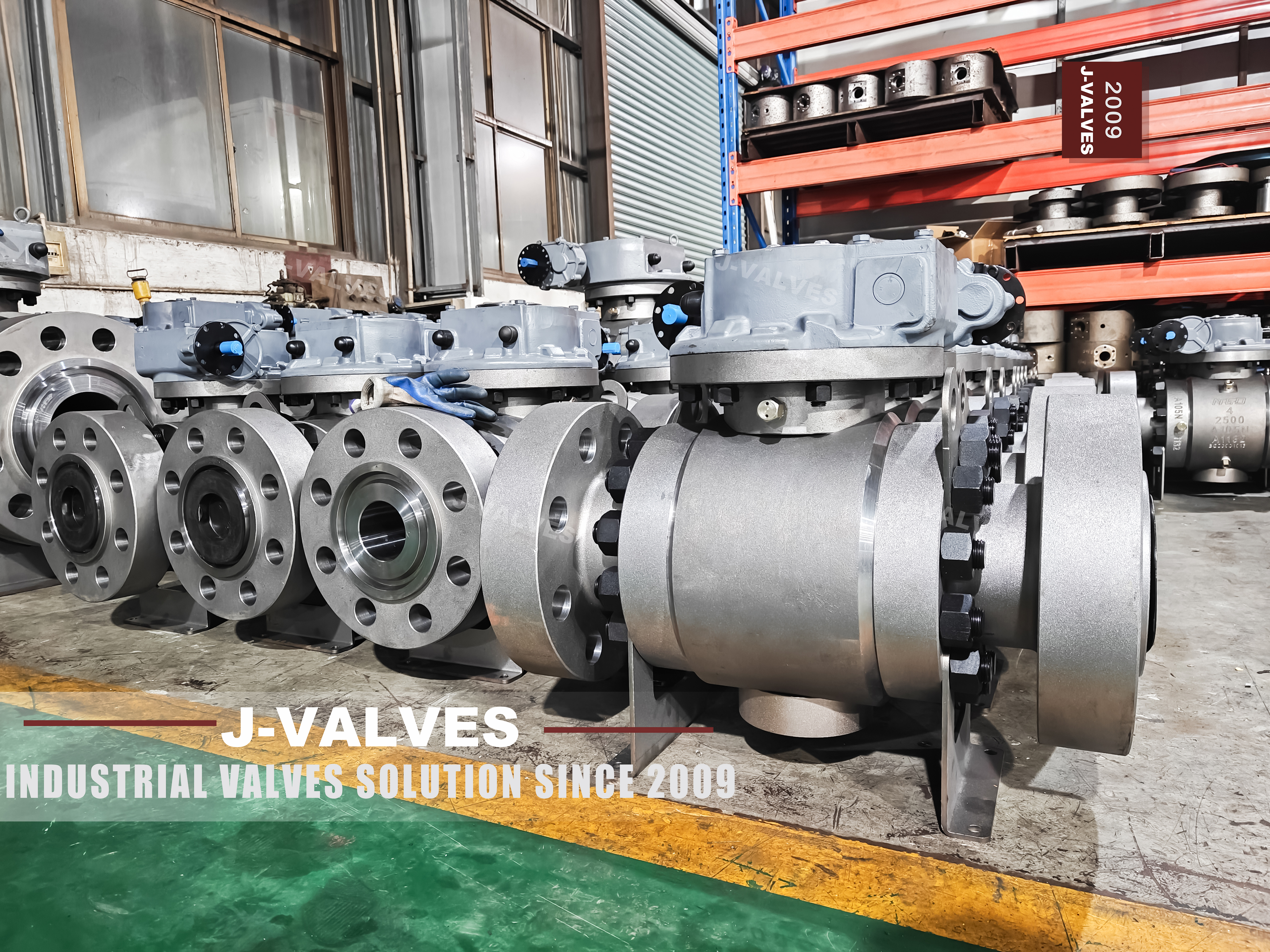
A three piece body is two end pieces and a centre piece, pulled together by four long bolts that run the full length of the valve. Those four bolts are the part of the design that gets the least attention in a catalogue and the most attention in a repair shop, because they are the only thing holding a gasketed joint closed against the end thrust of the line pressure.
The family is offered from two inch to forty eight inch, Class 150 to Class 2500, with a temperature range of minus 29 to plus 425 Celsius as a general figure. The body list runs from carbon steel through the low temperature grades to the austenitic and the chrome moly forging grades, and the ends can be flanged, butt welded, socket welded or threaded. Those are range statements, and the page treats them as the frame rather than as the description of one valve.
The judgment this page argues is that the limit of a three piece high pressure valve is not the forging. Forging a body is a solved problem at the sizes where a press can reach. The limit is the number of body joints multiplied by the length of the bolts that close them, because each of those joints has to compress a gasket and carry the end thrust at the same time, and the longer the bolt, the less certain the preload becomes.
Design and Construction
The centre piece holds the ball on its upper and lower trunnions, carries the stem and the gland, and provides the seat pockets. The two end pieces carry the flanges or the weld ends, and each closes on the centre piece with its own gasket and its own ring of bolts. On this construction the four long bolts pass through the end pieces and through the centre piece, so one set of bolts closes both joints at once.
That arrangement is efficient and it is also unforgiving. One set of bolts means the two joints are not independent: tensioning the bolts compresses both gaskets in series, and a gasket that is thicker on one side than the other will load the bolts unevenly and cock the centre piece. A two piece body has one joint and one gasket and does not have this problem, which is why three piece designs are more common at the small and medium sizes than at the large ones.
The ball is carried on trunnions rather than floating, and the trunnion bearings take the thrust that a floating ball would put into the seats. That is what allows this valve to be built at Class 2500 without a seat load that would crush a soft insert, and it is also why the operating torque stays manageable at the sizes where a gearbox is not yet needed.
The seats are spring loaded and can be single or double piston effect, with a soft insert for tight shut off or a hardfaced face for temperature and abrasion. A spring loaded seat keeps a light contact pressure on the ball when the line is depressurised, which matters on a valve that will be hydrotested, drained and left closed for months before it is commissioned.

Material Options
The body grades divide by temperature rather than by price. Carbon steel covers ambient and moderate service. The low temperature forging grades cover cold duty, and the difference between them is the impact test temperature rather than the chemistry alone. The austenitic grades cover corrosion. The chrome moly grades cover temperature, and the three of them on this page are the ones that carry a process requirement rather than a purchasing preference.
| Body Grade | What It Is | Where It Belongs |
|---|---|---|
| A105 | Carbon steel forging | General service, ambient to moderate |
| A350 LF2, LF3, LF6 | Low temperature carbon and alloy forgings | Cold duty, impact tested |
| A182 F304, F316, F316L | Austenitic stainless forgings | Corrosion, chemical service |
| A182 F321, F347 | Stabilised austenitic | Elevated temperature, grain growth |
| A182 F11 | 1.25Cr-0.5Mo | High temperature, refinery |
| A182 F22 | 2.25Cr-1Mo | Higher temperature, hydrogen service |
| A182 F91 | 9Cr-1Mo-V | The top of the chrome range |
The chrome moly grades are the ones where the heat treatment record is part of the product. F11 and F22 are normalised and tempered, F91 is normalised and tempered to a much tighter window, and a forging that has been through the wrong cycle will pass a hardness check and fail its creep life. That is a documentation question as much as a metallurgical one, and it is answered by the certificate and the heat treatment sheet rather than by a portable analyser.
The bolting and the gasket are on the same list and are usually left off the order. Bolting for this valve runs from B7 through the hardness limited B7M and L7M for sour service to B8 and B8M for stainless bodies, with B16 for the higher temperatures. The gasket is spiral wound, ring joint, or a lens ring on the ultra high pressure builds. Each of those three is a different joint geometry and none of them can be substituted for another after the body has been machined.
Technical Specifications
| Item | Value |
|---|---|
| Size range | Two inch to forty eight inch, DN 50 to DN 1200 |
| Pressure class | Class 150 to Class 2500, PN 20 to PN 420 |
| Construction | Three piece forged body, four long body bolts |
| Body joints | Two, each with its own gasket |
| Ball | Trunnion mounted, solid or with a coated face |
| Seat | Soft insert or hardfaced, single or double piston effect |
| Ends | Flanged, butt weld, socket weld, threaded |
| Face to face | ASME B16.10 where tabulated |
| Temperature | Minus 29 to plus 425 Celsius, grade dependent |
| Bolting | B7, B7M, L7M, B16, B8, B8M by service |
| Gasket | Spiral wound, ring joint, or lens ring |
| Test | API 598 shell and seat, API 6D documentation |
The bolting row is not a detail. On a Class 2500 valve the end thrust that the bolts have to hold is a large force that grows with the square of the bore, and the bolts are also the springs that keep the gasket compressed when the temperature cycles. A valve with the right body grade and the wrong bolting grade is a valve that will leak at the joint rather than in the seat, and a joint leak at pressure is a more serious event than a seat that weeps.
The face to face row is deliberately vague above the sizes that are tabulated. ASME B16.10 covers a long list of sizes and classes and it does not cover everything, and above its tables the dimension comes from the general arrangement drawing. A buyer who needs a replacement to fit an existing gap should send the gap dimension with the enquiry rather than assume the standard covers it.
Standards and Compliance
| Requirement | Document | What It Means Here |
|---|---|---|
| Product requirements | API 6D | Design, materials, welding, marking |
| Wall and rating | ASME B16.34 | Rating at temperature by material group |
| Product requirements | API 608 to Class 600 | Applies at the bottom of this range only |
| Pressure test | API 598 | Shell at 1.5 times, seat at 1.1 times |
| Fire test | API 607 or ISO 10497 | Type test, scope stated on the certificate |
| Material certificate | EN 10204 3.1 | Heat number per pressure part |
| Sour service | NACE MR0175, ISO 15156 | Hardness limits on bolting and trim |
The API 608 line matters at the bottom of the range only, because that standard stops at Class 600 and DN 600. Every 900, 1500 and 2500 valve on this page is an API 6D article, and a quotation that cites 608 for a Class 2500 valve is citing a document outside its scope. The two standards sit alongside each other rather than one replacing the other, and a valve can be built to satisfy both at the sizes where both apply.
Sour service is the other line that changes the hardware rather than the paperwork. Carbon steel bolting in sour service is limited by hardness, which is why B7M and L7M exist and why the letter after the grade is the whole point of the specification. A valve ordered for sour service with plain B7 bolting will be refused at the buyer's incoming inspection even though the body grade is correct.
Manufacturing Process
Forging a body of this shape means upsetting and punching a billet into a block with a bore, then machining the seat pockets, the joint faces and the bolt holes. The grain flow that results follows the shape of the forging rather than being random, and the density is uniform in a way that a casting of the same wall cannot promise.
Machining is done on a horizontal boring mill with the two joint faces and the two seat pockets referenced to one centreline. On a three piece body the two end pieces are separate parts and are machined to the same reference as the centre piece, which is why the joint faces of the end pieces are checked against a flatness and a parallelism figure rather than only a dimension.
The four long bolt holes are drilled and reamed as a set, and the bolts are matched to the holes rather than picked from a bin. A bolt that is a loose fit in its hole will not deliver the preload that the torque figure assumes, and on a long bolt the loss is larger than on a short one because the same clearance allows more bending.
Assembly is where the design either works or does not. The gaskets go in dry or with the specified lubricant, the end pieces are brought up square, and the bolts are tensioned in a cross pattern in stages rather than in one pass. On the high pressure sizes the final stage is usually controlled by torque and angle rather than by torque alone, because the scatter in thread friction at these bolt lengths is wide enough to matter.

Quality Control and Testing
| Step | Check | Acceptance |
|---|---|---|
| 1 Incoming | Heat number against the mill certificate | Chemistry and mechanicals |
| 2 Identity | Positive material identification on body and bolting | Grade match on both |
| 3 Heat treatment | Normalising and tempering record | By grade, recorded |
| 4 Machining | Joint face flatness and parallelism | Drawing tolerance |
| 5 Body test | Shell at 1.5 times with both joints assembled | API 598, no leakage |
| 6 Seat test | Each seat at 1.1 times, direction by direction | API 598 rate |
| 7 Bolting | Grade stamp checked against the order | B7, B7M, B16, B8M as specified |
| 8 Final | Joints dry, ends masked, marked, crated | Works standard |
The bolting check is the one that is most often reduced to a glance at a box label. Bolts carry a grade stamp on the head and on the end, and a B7M bolt can be identified on the bench in a few seconds. On a valve that is going into sour or high temperature service, that check belongs on the test record rather than in the fitter's memory.
The body test is performed with both joints assembled, which is the only configuration that tests the design as it will be used. A shell test on the centre piece alone, before the end pieces go on, proves the forging and proves nothing about the joints that are the actual risk on a three piece body.

Applications and Industry Service
This valve is bought where the pressure is high and the bore is moderate: wellheads and test lines, high pressure gas letdown, hydrogen and hydroprocessing circuits at the chrome moly end, and chemical injection packages at the stainless end. In each of those the three piece body is chosen because the trim can be reached from both ends without cutting the line.
The chrome moly grades put the same valve into refinery and petrochemical service at temperature. F11 and F22 bodies with the matching trim and the right bolting are the standard answer for hot hydrocarbon, and the difference between them shows up at the top of the temperature range rather than at ambient, where the two look identical on a test bench.
It is the wrong valve where the medium is a slurry with hard particles, because a lapped metal seat will be cut by the solids and a soft seat will be extruded. It is also the wrong valve at the very large sizes at the top of the range, where a three piece forged body stops being economic against a two piece casting or a fully welded body, and where the two body joints and four long bolts become a maintenance liability rather than an advantage.

Installation, Operation and Maintenance
Support the valve so that the pipe is not carrying it, and check that both body joints are accessible before the insulation goes on. A three piece valve that has been buried in lagging is a valve whose joints cannot be checked for a leak without stripping the insulation, and joint leaks are the failure mode this construction is most exposed to.
Bring the mating flanges up parallel and tension the body bolts before the pipe flanges are finally tightened, not after. If the body is tensioned while it is being pulled by the pipe, the two joints will end up with different loads and the one with less load will be the one that weeps at test pressure.
For maintenance the line is isolated, vented and drained, the body bolts are released in a cross pattern in stages, and the end pieces come away with their gaskets. The ball and its seats come out from either end. New gaskets go in every time, the bolts are checked for stretch and for thread damage, and the assembly is tensioned in the same staged pattern it was built with. A joint that is re-tensioned by feel after a repair is a joint that will be back.
How to Specify and Order
Six entries fix the article: size, class, body grade, the seat, the ends and the operator. On this construction there are two more that belong on the order and are the ones most often missing: the bolting grade and the gasket type. Both are decided by the service, both change the joint, and neither can be corrected after the body has been machined.
Three questions belong to the line rather than to the valve. What is the design temperature, and does it put the body into the chrome moly range or leave it in carbon steel. Is the service sour, because that decides between B7 and B7M and changes the trim hardness limits. And will the valve be maintained in place or removed, because a three piece body is a poor choice where the joints cannot be reached.
Documents to name in the order: the EN 10204 3.1 certificate for each pressure part with its heat number, the heat treatment record for the chrome moly grades, the bolting certificates with grade stamps, the shell and seat test record with a result per seat, the fire test certificate with its scope, and the general arrangement drawing carrying the face to face dimension and the joint details.
FAQ
Q: Why are the bolts so important on a three piece body?
A: Because one set of bolts closes both joints at once. The tension that compresses the upstream gasket also loads the downstream one, so the two joints are not independent. A bolt that loses preload, or a gasket that is thicker on one side, cocks the centre piece and loads one joint more than the other.
Q: Does a longer bolt need more torque?
A: It needs more elongation for the same preload, and the scatter in thread friction becomes wider as the bolt gets longer. That is why the high pressure sizes are tensioned by torque and angle rather than by torque alone, and why the bolt holes are reamed and the bolts matched to them rather than picked from a bin.
Q: Is a forged body rated higher than a cast body?
A: No. The rating comes from the wall thickness and the material group in ASME B16.34, and both are the same for a forging and a casting of the same grade. Forging buys internal soundness and the ability to examine the section, not a higher class.
Q: Why is this range offered to Class 2500 but not to fifty six inch?
A: Because the two body joints and the long bolts become the limit rather than the forging. At the very large sizes a three piece forged body stops being economic against a two piece casting or a fully welded body, and the joints that were an advantage at six inch become a maintenance liability at thirty.
Q: Which bolting grade goes with a stainless body?
A: Not necessarily stainless. B8M studs are the obvious match and they are also the grade most exposed to chloride stress corrosion cracking in a wet or insulated environment. B7 with a suitable coating, or a nickel alloy where the atmosphere is severe, is often the better answer and is a decision to record on the order.


Hot Products


News
Why A Ball Valve Gets Harder To Turn: Five Causes, And The Test That Tells Them Apart
A ball valve that stiffens over months points at one of five parts. Measure torque with the line pressurised and again vented, and the split becomes visible.
Read More
The Ball Valve at Four Thousand Bar: Seat Load, Erosion And Fatigue in Waterjet Circuits
At 4,000 bar a 10 mm bore puts 31 kN on the seat and a 0.1 mm leak cuts steel. What a ball valve must survive in a waterjet or intensifier circuit.
Read More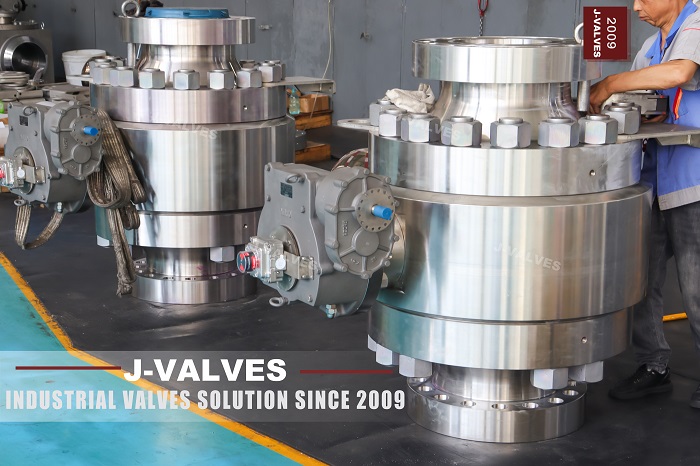
Large Diameter Ball Valves: Four Limits That Change The Design
Above a certain size a ball valve stops being a scaled one. Ball weight, operator torque, body split and the test bench each set a limit at a different size.
Read More
Cast Or Forged Ball Valve Body, And What A Radiography Acceptance Level Actually Buys You
Casting or forging is only half the decision. What RT, UT, MT and a proof test each find in a ball valve body, and where the geometry defeats all of them.
Read More