


CHINA J-VALVES Offers Various High-quality I ndustrial Ball Valves
J-VALVES, a distinguished professional ball valve manufacturer rooted in China, takes pride in its extensive product portfolio. Our offerings span a wide range, including trunnion-mounted ball valves, floating ball valves, high-temperature ball valves, high-pressure ball valves, metal-sealed ball valves, ultra-low temperature ball valves, DBB ball valves, Three-way And Four-way Ball Valve, and fully welded ball valves. Each product is a testament to our commitment to precision engineering and reliable performance. Meticulously crafted, they are designed to not only meet but exceed the most stringent industrial demands, ensuring stable operation even under extreme conditions. This enables us to provide our clients with high-value services and makes our valves widely sought-after in industries.
Product Category
Contact Us


-
J-VALVES-Q47F
-
J-VALVES
Overview of the J-VALVES metal sealed stainless steel trunnion mounted ball valve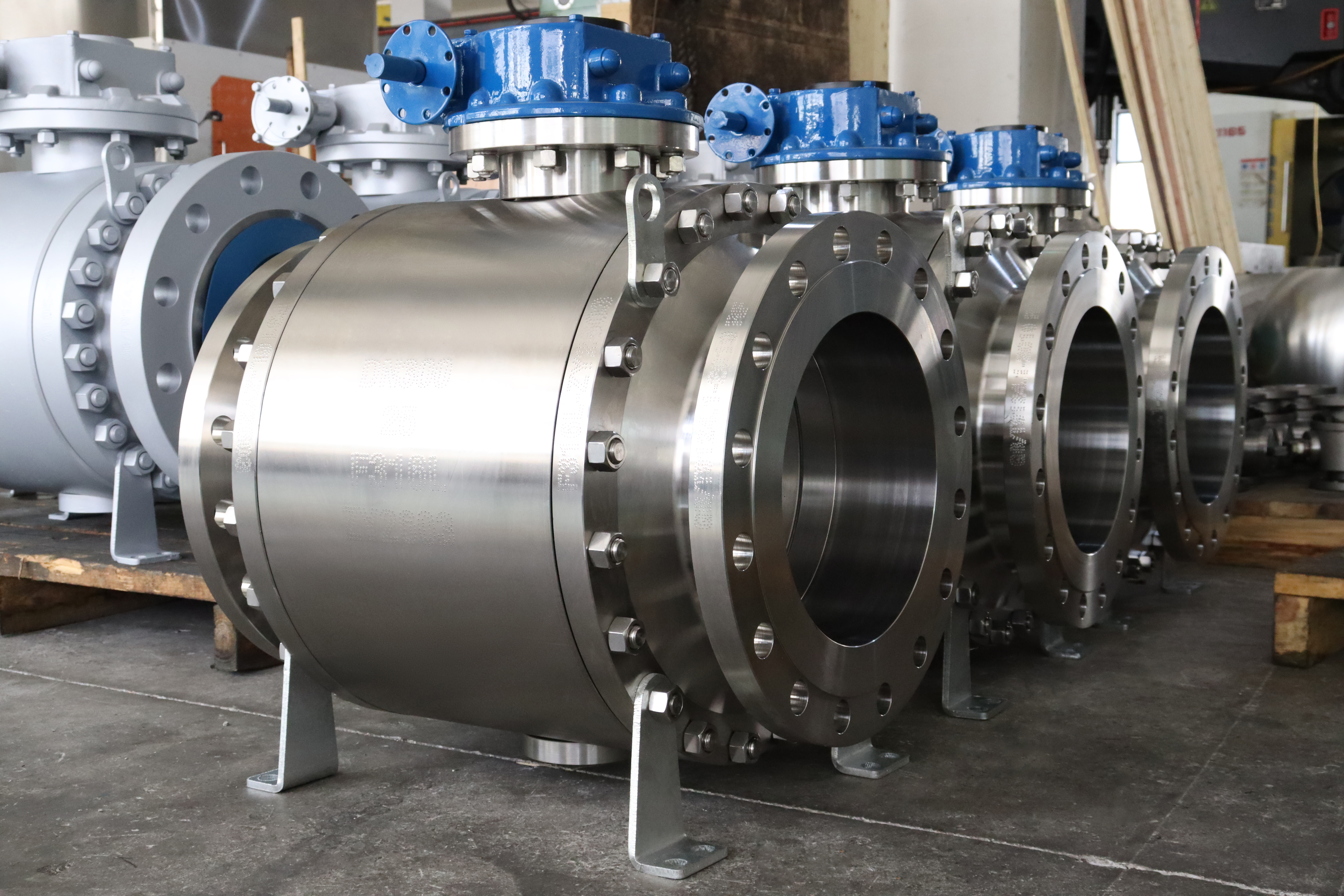
Three numbers on this page decide more about the valve than the body grade does, and they are all hardness figures. A cobalt based overlay comes in around 40 on the Rockwell C scale, a tungsten carbide coating around 58, and a ceramic coating around 72. Everything else in the material list is a choice about corrosion, and those three are the choice about what happens at the sealing surface when the medium is moving.
That distinction is worth making because hardness is usually sold as if it were tightness. It is not. Hardness decides how long the seat and ball survive erosion and galling, and tightness comes from geometry and from lapping, which are separate operations with separate acceptance. A very hard seat that has not been lapped will leak, and a softer seat that has been lapped properly will hold.
The valve is a trunnion mounted metal seated ball valve in stainless steel and nickel alloys, from two inch to forty eight inch, Class 150 to Class 2500. It is the article that gets bought when a soft seat cannot survive the temperature or the medium, and the choices on the page are about which hard surface and which corrosion resistant body, not about whether a metal seat is needed.
Design and Construction
The ball is trunnion mounted, held on an upper and a lower shaft in bearings, so the pressure load goes into the body and the seats only have to seal. That is what makes a metal seat practical at all, because a metal seat has no resilience to absorb the movement a floating ball would put into it.
The seats are rings with a hardfaced face and a spring behind them, and they are either spring loaded or pressure energized depending on the pattern. On a metal seated valve the spring has more work to do than on a soft seated one, because there is no polymer to take up the difference between the ball and the seat when the valve is cold and the body has not yet grown.
The sealing is a band of contact between two hard surfaces, held together by the spring and by pressure. Its width is set by the lapping, its shape by the sphericity of the ball, and its life by the hardness of the two surfaces. A band that is too wide leaks because the unit load is too low; a band that is too narrow wears quickly because the load is concentrated.
The source page describes the geometry as a tri-offset design, and that description belongs to a different product. A triple offset is a butterfly valve arrangement in which the seat cone is offset from the shaft in three ways so that the disc lifts off before it rotates. A ball valve has no disc and no seat cone: it seals on a sphere that is concentric with the bore, and the ball rotates through the seat rather than lifting off it first.

Material Options
The body grades split into austenitic stainless, duplex and nickel alloys, and the split is about chloride and about temperature rather than about strength. The hardfacing split is about erosion, and the two choices are independent of one another.
| Option | What It Is | Hardness | Where It Is Used |
|---|---|---|---|
| Cobalt based overlay | Welded hardfacing, finished and lapped | Around 40 HRC | General high temperature and light abrasion |
| Tungsten carbide | Sprayed coating, ground | Around 58 HRC | Abrasive media, catalyst, slurry |
| Ceramic coating | Plasma sprayed oxide | Around 72 HRC | Severe erosion, non impact duty |
| F316 body | Austenitic stainless | Not applicable | General corrosive service |
| F321 and F347 | Stabilized austenitic | Not applicable | Elevated temperature, weld duty |
| F51 and F53 | Duplex and super duplex | Not applicable | Chloride service under pressure |
| Nickel alloy body | Nickel based | Not applicable | Severe acid and chloride |
The stabilized grades are the ones that are least understood. F321 is stabilized with titanium and F347 with niobium, and both are there to stop chromium carbide forming at the grain boundaries during welding or at temperature. In a cast or forged valve body that will not be welded in service the benefit is small, and where the valve will be welded into a spool it is the difference between a sound heat affected zone and one that corrodes.
The hardness numbers are not a ranking of quality either. A ceramic at 72 is the most wear resistant of the three and the least forgiving of impact and of thermal shock, so a valve that will be slammed shut on a line with solids may last longer with a cobalt overlay than with a ceramic. The hardest surface is the right answer only where the wear mechanism is abrasion without impact.
Technical Specifications
The range is two inch to forty eight inch across Class 150 to Class 2500, and the classes most often built are the middle of the ladder. That is a fact about where metal seats are needed rather than a limit: a metal seat at Class 150 is unusual because a soft seat would do, and at Class 2500 it is common because the temperature and the pressure arrive together.
| Item | Value |
|---|---|
| Size range | Two inch to forty eight inch, DN 50 to DN 1200 |
| Pressure class | Class 150 to Class 2500, PN 20 to PN 420 |
| Body materials | F316, F316L, F321, F347, F51, F53, nickel alloys |
| Seat | Metal to metal, hardfaced, spring loaded |
| Hardfacing | Cobalt based, tungsten carbide or ceramic |
| Ball | F316 with hardfacing, or a coated stainless ball |
| Ends | Raised face, ring joint or butt weld |
| Face to face | ASME B16.10 for the size and class, confirmed on the drawing |
| Temperature | Minus 29 to plus 425 C as a general figure, grade dependent |
| Bonnet | Extended neck for high or low temperature on request |
| Test | API 598 shell and seat, seat accepted at the metal seat rate |
| Leakage | Rate per API 598, not a control valve class |
The leakage line in that table is the one to argue about, and the source page invites the argument by claiming Class VI sealing. Class VI is a leakage class from the control valve standards, and it is written around a soft seated control valve with a defined seat diameter. A metal seated ball valve is accepted by API 598 at a rate that scales with the nominal size, and quoting a control valve class against it is borrowing a scale that was never written for the article.
Standards and Compliance
The documents are the same as on any trunnion valve, and the difference is in which material group the body sits in and therefore what the rating does with temperature. A duplex body and an austenitic body at the same class do not have the same rating at the top of the range, and the group in ASME B16.34 is what decides.
| Requirement | Document | What It Means Here |
|---|---|---|
| Wall and rating | ASME B16.34, group by grade | Rating falls with temperature at a grade specific rate |
| Product requirements | API 6D across the range | Design, marking, documentation |
| Product requirements | API 608 up to Class 600 | Applies only at the lower end |
| Pressure test | API 598 | Shell 1.5 times, seat 1.1 times |
| Seat acceptance | API 598 rate for a metal seat | Scales with size, not a fixed class |
| Hardness | Coating specification and drawing | Measured on the finished surface |
| Fire test | API 607 or ISO 10497 | Type test, scope to be read |
| Material certificate | EN 10204 3.1 | Heat number matched to each part |
The fire test is a different proposition on a metal seated valve and it is worth saying why. There is no soft seat to burn, so the seat survives by definition; what burns is the packing and the body gasket, and what the test proves is that the valve still seals after they have been destroyed. That is why the certificate is still relevant on a metal seated valve even though the headline claim, that the seat does not rely on a polymer, is already true before the test starts.
The hardness figure has to be measured on the finished surface rather than on the coating as deposited, because the finishing operation removes some of it and a sprayed coating that has been ground back can be softer at the surface than the certificate says. That is the reason the hardness is written on the drawing as a finished condition requirement rather than as a coating property.
Manufacturing Process
A sprayed coating is applied to a prepared surface with a roughness the spray can key into, and the preparation is as important as the spray. A tungsten carbide coating applied to a surface that was not properly blasted will pass a hardness test on the bench and will flake in service, because the bond is mechanical rather than metallurgical.
After coating, the ball is ground on its sphere and the seat is ground on its face, and the two are then lapped together. That lapping is the operation that produces the contact band, and it is done as a pair so that the band is a band rather than a set of high spots. A replacement seat supplied without a ball is a part that has to be lapped again before it will hold.
The roundness and finish figures on the source page are the ones that make the lapping possible: a ball that is round to within a few thousandths of a millimetre and finished to a fraction of a micrometre will take a contact band across its whole circumference. A ball outside those figures will produce a band that touches on part of the circle and misses on the rest.

Quality Control and Testing
Hardness is checked on the finished surface at several points rather than at one, because a sprayed coating can vary across a curved surface and a single reading will find the best place rather than the worst. The reading is recorded against the drawing figure for the coating that was ordered, not against a generic minimum.
| Step | Check | Acceptance |
|---|---|---|
| 1 Incoming | Heat number against the mill certificate | Grade chemistry as ordered |
| 2 Identity | Positive material identification on body, ball, seat | Grade match, molybdenum where required |
| 3 Coating | Surface preparation before spraying | Roughness and cleanliness per procedure |
| 4 Hardness | Finished surface, several points per part | Drawing figure for the coating |
| 5 Geometry | Ball roundness and surface finish | Drawing figures |
| 6 Lapping | Contact band between seat and ball | Full ring, width per works standard |
| 7 Shell test | Body and joints at 1.5 times | API 598, no leakage |
| 8 Seat test | Each seat at 1.1 times, cavity vented | API 598 metal seat rate |
The seat test is a rate and the rate scales with size, so a record that gives one number without the size beside it cannot be assessed. That is the practical difference between a metal seat and a soft one at the witness test: the soft seat has a binary acceptance and the metal seat has a number that has to be read against a table.

Applications and Industry Service
Metal seated stainless valves are bought where a soft seat would be destroyed, and the destruction comes in three forms. Temperature above what the polymer will hold, abrasion from solids in the stream, and a specification that forbids soft seats in the wetted path for fire or for oxygen cleanliness.
Catalyst handling, slurry service, coker bottoms, ash handling and high temperature steam are the classic abrasive and thermal duties. In those the seat is a wear part and the maintenance plan is built around changing it, which is why the body construction is chosen for access as much as for strength.
The duplex and nickel alloy bodies appear where the medium is chloride bearing and the pressure is high, which is the combination that rules out the austenitic grades. Duplex is not a universal answer either, because it has a temperature limit above which it loses toughness, and a high temperature chloride duty can end up with a nickel alloy body and a metal seat as the only combination that survives both.

Installation, Operation and Maintenance
A metal seated valve is installed like any trunnion valve and operated rather differently. It should be cycled through a full quarter turn rather than stopped part way, because a ball parked at an intermediate position holds the seat open against the flow and erodes the band that was lapped.
Where an extended bonnet has been fitted for temperature, the extension is there to keep the packing and the operator away from the heat, and it should not be insulated over. Insulating an extended neck defeats the purpose, which is to dissipate heat along the neck rather than to keep it in.
For maintenance the line is isolated, drained and vented, the body is opened, and the seat and ball are removed as a pair. They go back as a pair, either both new and lapped together or the existing ball relapped against a new seat. The gaskets are replaced, and the hardness of the new parts is checked against the certificate before they go in, because a seat that was finished after coating and a seat that was coated after finishing are not the same part.
How to Specify and Order
Six lines fix the valve: size, class, body grade, hardfacing, seat pattern and operator. Two more belong on the order at this level of duty: the leakage acceptance, and whether the contact band is to be inspected and recorded. The second is the only way to know that the lapping was done rather than claimed.
Four questions belong to the line rather than to the valve: the medium and what it carries, the design temperature, the design pressure, and whether the seat will see impact as well as abrasion. The first decides the hardfacing and the body grade, the second decides whether duplex is possible, the third confirms the class, and the fourth decides between a hard coating and the hardest one.
Documents to name in the order: the EN 10204 3.1 certificate for the body, ball and seat, the coating specification and the hardness record, the roundness and finish record, the shell and seat test record with a rate per seat and the size beside it, and the general arrangement drawing.
FAQ
Q: Is a harder seat a tighter seat?
A: No. Hardness is a wear property and tightness comes from the geometry of the contact band and from the lapping that produced it. A ceramic at 72 HRC that has not been lapped will pass, and a cobalt overlay at 40 HRC that has been lapped will hold. The two figures are bought for different reasons and should not be read as a ranking.
Q: Why does the seat have to be lapped?
A: Because a ground surface has a direction and a lapped surface does not. Grinding leaves a pattern of fine scratches that a fluid can follow, and two ground surfaces brought together touch only at the high points. Lapping produces a random matte finish and a band that conforms over its full width, so the unit load is even and there is no path across the band.
Q: Can this valve be quoted to Class VI?
A: Not honestly. Class VI is a leakage class from the control valve standards, written around a soft seated control valve of a defined seat diameter. A metal seated ball valve is accepted by API 598 at a rate that scales with the nominal size, and quoting a control valve class against it borrows a scale that was never written for the article. Ask for the API 598 rate instead.
Q: Does a metal seat give double block and bleed?
A: Only where the seats are double piston effect. A spring loaded single piston effect seat relieves cavity pressure to the upstream side and is a barrier in one direction, so both seats are not barriers and the cavity cannot be bled as a block. Double piston effect seats are the arrangement that makes both seats independent barriers, and that is the version to specify for DBB duty.
Q: What is the tri-offset claim on the source page?
A: It belongs to a butterfly valve. A triple offset valve has a seat cone offset from the shaft in three ways so that the sealing face lifts clear before it turns, and a ball valve has no disc and no seat cone. A ball seals on a sphere that is concentric with the bore and rotates through the seat rather than lifting off it. The geometry described on that page is not this product.


Hot Products


News
Why A Ball Valve Gets Harder To Turn: Five Causes, And The Test That Tells Them Apart
A ball valve that stiffens over months points at one of five parts. Measure torque with the line pressurised and again vented, and the split becomes visible.
Read More
The Ball Valve at Four Thousand Bar: Seat Load, Erosion And Fatigue in Waterjet Circuits
At 4,000 bar a 10 mm bore puts 31 kN on the seat and a 0.1 mm leak cuts steel. What a ball valve must survive in a waterjet or intensifier circuit.
Read More
Large Diameter Ball Valves: Four Limits That Change The Design
Above a certain size a ball valve stops being a scaled one. Ball weight, operator torque, body split and the test bench each set a limit at a different size.
Read More
Cast Or Forged Ball Valve Body, And What A Radiography Acceptance Level Actually Buys You
Casting or forging is only half the decision. What RT, UT, MT and a proof test each find in a ball valve body, and where the geometry defeats all of them.
Read More