


CHINA J-VALVES Offers Various High-quality I ndustrial Ball Valves
J-VALVES, a distinguished professional ball valve manufacturer rooted in China, takes pride in its extensive product portfolio. Our offerings span a wide range, including trunnion-mounted ball valves, floating ball valves, high-temperature ball valves, high-pressure ball valves, metal-sealed ball valves, ultra-low temperature ball valves, DBB ball valves, Three-way And Four-way Ball Valve, and fully welded ball valves. Each product is a testament to our commitment to precision engineering and reliable performance. Meticulously crafted, they are designed to not only meet but exceed the most stringent industrial demands, ensuring stable operation even under extreme conditions. This enables us to provide our clients with high-value services and makes our valves widely sought-after in industries.
Product Category
Contact Us


-
J-VALVES-Q347F
-
J-VALVES
Overview of the J-VALVES 3 piece cast trunnion mounted ball valve, 2 to 56 inch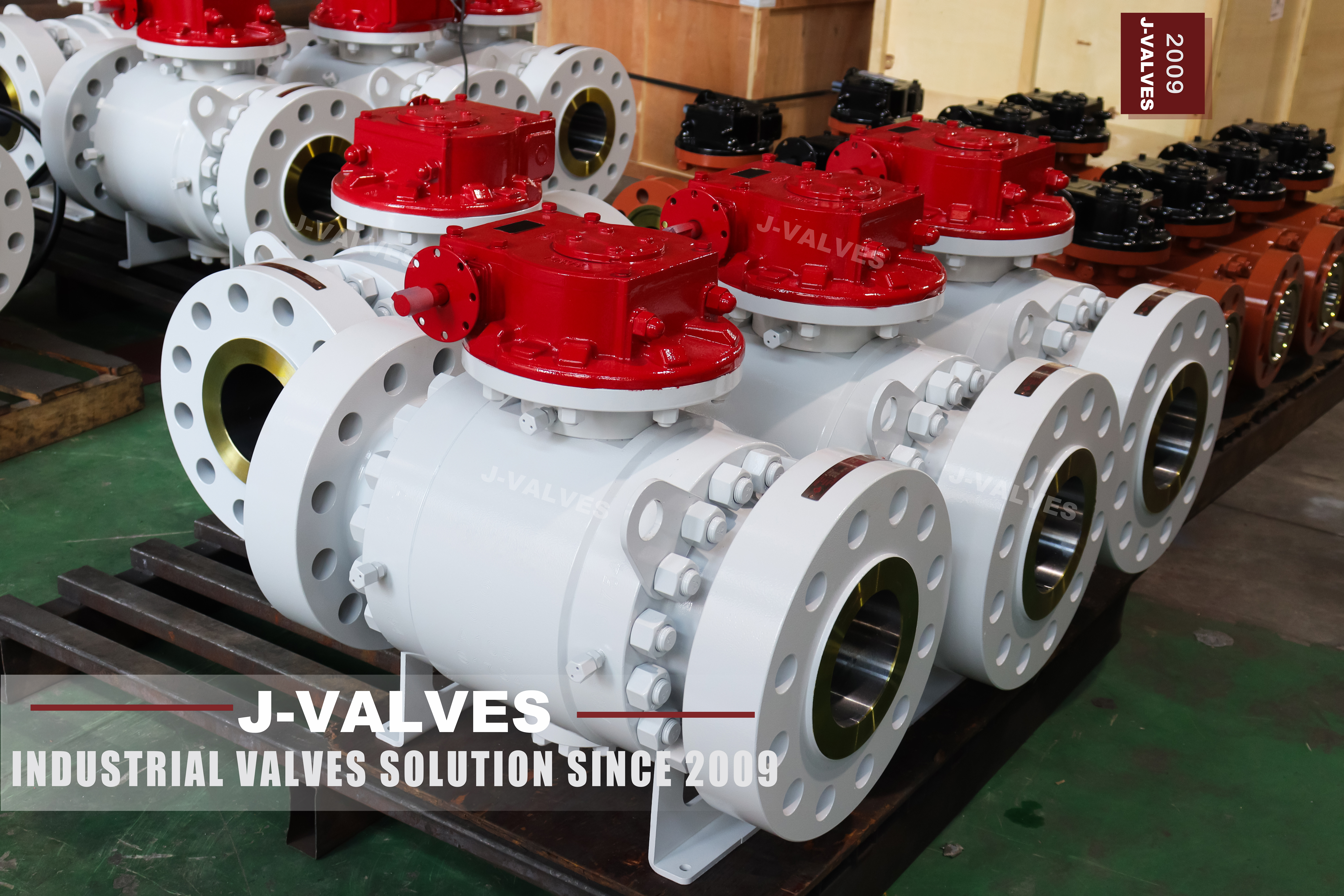
There is a size above which a ball valve body cannot be forged, and once a works is past that size it casts. That is the plain reason this valve exists as a three piece casting rather than as a forging: a twenty four inch body, let alone a fifty six inch one, is not something a press will produce at a sensible price, and the three piece construction is how a very large body is broken into pieces a foundry can actually pour.
The interesting part of the page is not the construction, which is familiar. It is the row of grades. WCB, WCC, WC6, WC9, C5, C12, LCC, CF8, CF8M, CF3 and CF3M are not a list of alternatives thrown at a catalogue. They are two families, carbon and chrome moly plus stainless, and the chrome moly half of the list is the cast counterpart of the forged grades that appear on high temperature valves.
WC6 is the cast version of F11. WC9 is the cast version of F22. C5 is the cast F5, and C12 is the cast F9. Once that mapping is in mind, a page that looked like a parts list becomes a statement about temperature, and the three piece construction becomes a way of pouring each of the three pieces in the grade it needs.
Design and Construction
The body is three castings: a centre piece that carries the ball, the trunnion bearings and the stem, and two end pieces that carry the flanges. The two end pieces are mirror images of one another, which means one pattern serves both, and on a large valve a single pattern is a significant part of the cost of the casting.
Each end piece closes on its own ring of studs with its own gasket, so the valve has two pressure joints. That is the price of the construction and it is worth naming, because a two piece body would have one. What is bought for that price is access: both end pieces come off and the entire trim, including both seats and both trunnion bearings, is in front of the maintenance crew.
The ball runs on an upper and a lower shaft in bearings, and at these sizes the bearings are a design item rather than an accessory. The load on a fifty six inch ball is large enough that the bearing material and its lubrication decide the operating torque, and a bearing that has been chosen for price will show up as a gearbox that has to be oversized to compensate.
The seats are spring loaded rings with a hardfaced or soft face depending on the grade ordered, and they can be supplied as single piston effect or double piston effect. The DPE option is what turns the valve into a double block and bleed article, because both seats become barriers and the cavity between them can be bled. A buyer who needs DBB on a large valve should write DPE on the order rather than assume it.
The valve also carries sealant injection points at the seat and at the stem on most builds. These are not a substitute for a correct seat; they are an emergency measure for a valve that has begun to pass and cannot be taken out of a line that is running. On a large valve in a continuous plant that is a real provision rather than a catalogue line.

Material Options
The grade list divides into three groups and the division is by what the steel is for rather than by price. Carbon steel for the ordinary duties, chrome moly for temperature, and stainless for corrosion. The three piece construction is what allows the groups to be mixed in one valve, because each piece is poured separately.
| Grade | What It Is | Cast Equivalent Of | Where It Is Used |
|---|---|---|---|
| WCB | Carbon steel casting | A105 forging | Water, steam, gas, general service |
| WCC | Carbon steel, higher strength | A105 with higher tensile | Heavier sections, higher load |
| WC6 | 1.25Cr-0.5Mo cast | F11 forging | High temperature, refinery |
| WC9 | 2.25Cr-1Mo cast | F22 forging | Higher temperature than WC6 |
| C5 | 5Cr-0.5Mo cast | F5 forging | Hot hydrogen, severe service |
| C12 | 9Cr-1Mo cast | F9 forging | The top of the chrome range |
| LCC | Low temperature carbon cast | LF2 forging | Cold service |
| CF8 and CF8M | Cast 304 and 316 | F304 and F316 | Corrosive media |
The chrome moly grades are the ones that carry a process requirement rather than a purchasing preference. WC6 and WC9 are bought when the design temperature is above what carbon steel will hold, and the difference between them is the chromium content and therefore the temperature at which the creep strength falls away. A valve ordered in WC6 for a WC9 duty will pass every test on the bench and will have a shorter life in the line.
The stainless grades are the ones that get mixed within a valve. A CF8M body with a CF8 ball is a common enough arrangement and it is a mistake, because the ball sees the same medium as the body and a 304 ball in a 316 body will pit first. The grade of each wetted part belongs on the order as a separate line.
Technical Specifications
The range on this page is two inch to fifty six inch, Class 150 to Class 2500, which is the widest span in the catalogue. It is a family page rather than a description of one valve, and the numbers that matter are the ones that hold across the family: the construction, the joints, the seat arrangement and the operator.
| Item | Value |
|---|---|
| Size range | Two inch to fifty six inch, DN 50 to DN 1400 |
| Pressure class | Class 150 to Class 2500, PN 20 to PN 420 |
| Body style | Three piece cast body, trunnion mounted ball |
| Body grades | WCB, WCC, WC6, WC9, C5, C12, LCC, CF8, CF8M, CF3, CF3M |
| Seat | Soft or metal, single or double piston effect |
| Ends | Flanged raised face or ring joint, butt weld |
| Face to face | ASME B16.10 where tabulated, the drawing above those sizes |
| Operator | Gearbox as standard, actuator per order |
| Sealant | Injection points at the seat and the stem on most builds |
| Temperature | Minus 29 to plus 425 C as a general figure, grade dependent |
| Test | API 598 shell and seat, a result per seat |
The temperature line is the one that has to be read with the grade rather than on its own. The figure is a general one for the family, and a WC9 valve and a CF8 valve do not share a limit just because they share a page. The rating table for each grade in ASME B16.34 is the document that decides, and the class on the nameplate only sets the starting point.
Standards and Compliance
The standards do not change with the grade, but the material group in ASME B16.34 does, and that changes the rating at temperature. A WC6 body and a WCB body at the same class have the same cold rating and different ratings at the top of the range, which is the entire reason for buying one instead of the other.
| Requirement | Document | What It Means Here |
|---|---|---|
| Wall and rating | ASME B16.34, group by grade | Rating falls with temperature at a grade specific rate |
| Product requirements | API 6D across the range | Design, marking, documentation |
| Product requirements | API 608 up to Class 600 | Applies only at the lower end |
| Pressure test | API 598 | Shell 1.5 times, seat 1.1 times |
| Casting quality | MSS SP-55 | Visual and dimensional acceptance |
| Heat treatment | By grade, recorded | Stress relief after welding on chrome moly |
| Fire test | API 607 or ISO 10497 | Type test, scope to be read |
| Material certificate | EN 10204 3.1 | Heat number matched to each casting |
The heat treatment line is the one that differs most between grades and is least visible on a certificate that has been summarised. Chrome moly castings are stress relieved after pouring and after any weld repair, and the record of that treatment is part of the material documentation rather than a works secret. A WC6 body without its stress relief record is a body with an unfinished heat treatment as far as a project file is concerned.
Manufacturing Process
A pattern is made, and on a valve of this size the pattern is the expensive item rather than the metal. The pattern is what puts the risers where the shrinkage will be, and the difference between a foundry that has made the pattern properly and one that has not is a body that passes radiography and a body that does not.
The casting is poured, cleaned, heat treated to the grade and then inspected before machining starts. On the chrome moly grades the heat treatment is a normalizing and tempering cycle and the result is recorded per heat, because two castings from the same pour can end up with different properties if they were treated separately.
Machining is done with the flange face, the bolt circle, the joint face and the seat pocket referenced to one centreline per part, and on a large valve that reference is checked with a laser or a portable measuring arm rather than with a height gauge. The seat pockets in the two end pieces are then checked against each other, because two pockets that are each within tolerance but not coaxial will give a crescent contact band.

Quality Control and Testing
The heat number is cast into the body and repeated on the certificate, and on a chrome moly valve the identity check is a real check rather than a formality. A portable analyser will separate WC6 from WC9 on chromium in a few seconds, and it will not tell you whether the casting was stress relieved, which is why the certificate and the heat treatment record are read together.
| Step | Check | Acceptance |
|---|---|---|
| 1 Incoming | Heat number against the mill certificate | Grade chemistry and tensile |
| 2 Identity | Positive material identification on each casting | Chrome moly grade match |
| 3 Heat treatment | Stress relief record after pouring and repair | By grade, recorded |
| 4 Radiography | Where specified on the order | Acceptance level on the order |
| 5 Machining | Seat pocket coaxiality across both joints | Drawing tolerance |
| 6 Shell test | Body and both joints at 1.5 times | API 598, no leakage |
| 7 Seat test | Each seat at 1.1 times, cavity vented | API 598 rate |
| 8 Final | Cavity drained, faces masked, marked, crated | Works standard |
The radiography line is where a buyer gets what they pay for. Radiography is not a default on a cast valve body, and a large casting that has not been examined will still pass a hydrostatic test with internal porosity that has not yet found a path to the surface. Asking for it on the order is the only way it happens.

Applications and Industry Service
Large cast trunnion valves belong to the parts of a plant where the pipe is big: water transmission, cooling water, crude and product rundown, flare and vent headers, and the suction and discharge of large pumps. In those duties the valve is as much a piece of plant furniture as a control element, and it is bought for a life measured in decades.
The chrome moly grades appear where the temperature is the problem, which on a large valve usually means steam or hot hydrocarbon. A WC6 body at twenty four inch is a different proposition from a WCB body at the same size, and the difference is entirely in the material rather than in the drawing.
It is the wrong valve where the medium is abrasive enough to cut a soft seat in a few months, because the seat change on a valve this size is a planned shutdown rather than a workshop job. It is also the wrong valve where the line has to be pigged and a reduced port has been ordered, because a large reduced port body is a permanent obstruction in a line that was designed to be swept.

Installation, Operation and Maintenance
A valve of this size is lifted on its own lugs, not on the gearbox and not on the flange studs, and it is supported on its own feet or on a saddle rather than hanging from the pipe. The three piece body means there are two joints that have to be brought up true, and a body that is distorted by its own weight will not close those joints evenly.
Bring the mating flanges up parallel and check that the body is not carrying pipe load before the joints are tensioned. On a large valve the pipe load is measured in tonnes and a body that is being used as a pipe support will show it as a joint that weeps on one side only.
For maintenance the line is isolated, vented and drained, both end piece stud rings are released in a pattern, and the end pieces come away with their seats. The ball is then free on its trunnions and can be lifted with the works' own lifting arrangement. The gaskets are replaced, the seats go back against a ball that has been checked for roundness, and the studs are brought to the drawing figure in a cross pattern.
How to Specify and Order
Six lines fix the valve: size, class, grade for each wetted part, seat type, end connection and operator. On a three piece body there is a seventh that is easy to leave off, which is the grade of the end pieces separately from the centre piece, because a valve with a WC9 centre and WCB ends is a valve that will fail at the ends rather than in the middle.
Four questions belong to the line rather than to the valve: the design temperature, the medium, whether the valve has to block twice, and how it will be maintained. The temperature decides the grade, the medium decides whether stainless is needed, the double block question decides between single and double piston effect seats, and the maintenance plan decides whether the sealant injection points are worth having.
Documents to name in the order: the EN 10204 3.1 certificate for each casting with its heat number, the heat treatment record, the radiography report where specified, the shell and seat test record with a result per seat, and the general arrangement drawing carrying the face to face dimension and the lifting arrangement.
FAQ
Q: What is the difference between WC6 and F11?
A: They are the same alloy in two product forms. F11 is the forging specification and WC6 is the casting specification, both 1.25Cr-0.5Mo. The mapping continues up the range: WC9 is the cast F22, C5 the cast F5, and C12 the cast F9.
Q: Why cast rather than forge a large valve body?
A: Because above roughly twenty four inch there is no sensible forging route. A body that size is broken into three castings, each of which a foundry can pour and heat treat, and the two end pieces are mirror images so one pattern serves both.
Q: Can the three pieces be different grades?
A: They can, and that is the point of the construction. Each piece is poured and heat treated separately, so a valve can carry a chrome moly centre and carbon steel ends, or the reverse. It matters for cost and it matters for where the valve will fail, which is at the end that was under specified.
Q: Does a cast body need radiography?
A: Not by default. Radiography is a purchaser option and it has to be written on the order. A large casting that has not been examined can pass a hydrostatic test with internal porosity that has not yet found a path to the surface, which is why the option exists.
Q: What does DPE change on this valve?
A: It turns it into a double block and bleed article. With double piston effect both seats are barriers and the cavity between them can be bled, so the valve blocks twice. With single piston effect the cavity relieves but only one seat is a barrier in each direction.


Hot Products


News
Why A Ball Valve Gets Harder To Turn: Five Causes, And The Test That Tells Them Apart
A ball valve that stiffens over months points at one of five parts. Measure torque with the line pressurised and again vented, and the split becomes visible.
Read More
The Ball Valve at Four Thousand Bar: Seat Load, Erosion And Fatigue in Waterjet Circuits
At 4,000 bar a 10 mm bore puts 31 kN on the seat and a 0.1 mm leak cuts steel. What a ball valve must survive in a waterjet or intensifier circuit.
Read More
Large Diameter Ball Valves: Four Limits That Change The Design
Above a certain size a ball valve stops being a scaled one. Ball weight, operator torque, body split and the test bench each set a limit at a different size.
Read More
Cast Or Forged Ball Valve Body, And What A Radiography Acceptance Level Actually Buys You
Casting or forging is only half the decision. What RT, UT, MT and a proof test each find in a ball valve body, and where the geometry defeats all of them.
Read More