


CHINA J-VALVES Offers Various High-quality I ndustrial Ball Valves
J-VALVES, a distinguished professional ball valve manufacturer rooted in China, takes pride in its extensive product portfolio. Our offerings span a wide range, including trunnion-mounted ball valves, floating ball valves, high-temperature ball valves, high-pressure ball valves, metal-sealed ball valves, ultra-low temperature ball valves, DBB ball valves, Three-way And Four-way Ball Valve, and fully welded ball valves. Each product is a testament to our commitment to precision engineering and reliable performance. Meticulously crafted, they are designed to not only meet but exceed the most stringent industrial demands, ensuring stable operation even under extreme conditions. This enables us to provide our clients with high-value services and makes our valves widely sought-after in industries.
Product Category
Contact Us


-
J-VALVES-Q47F
-
J-VALVES
Overview of the J-VALVES ANSI Class 300 two piece carbon steel trunnion ball valve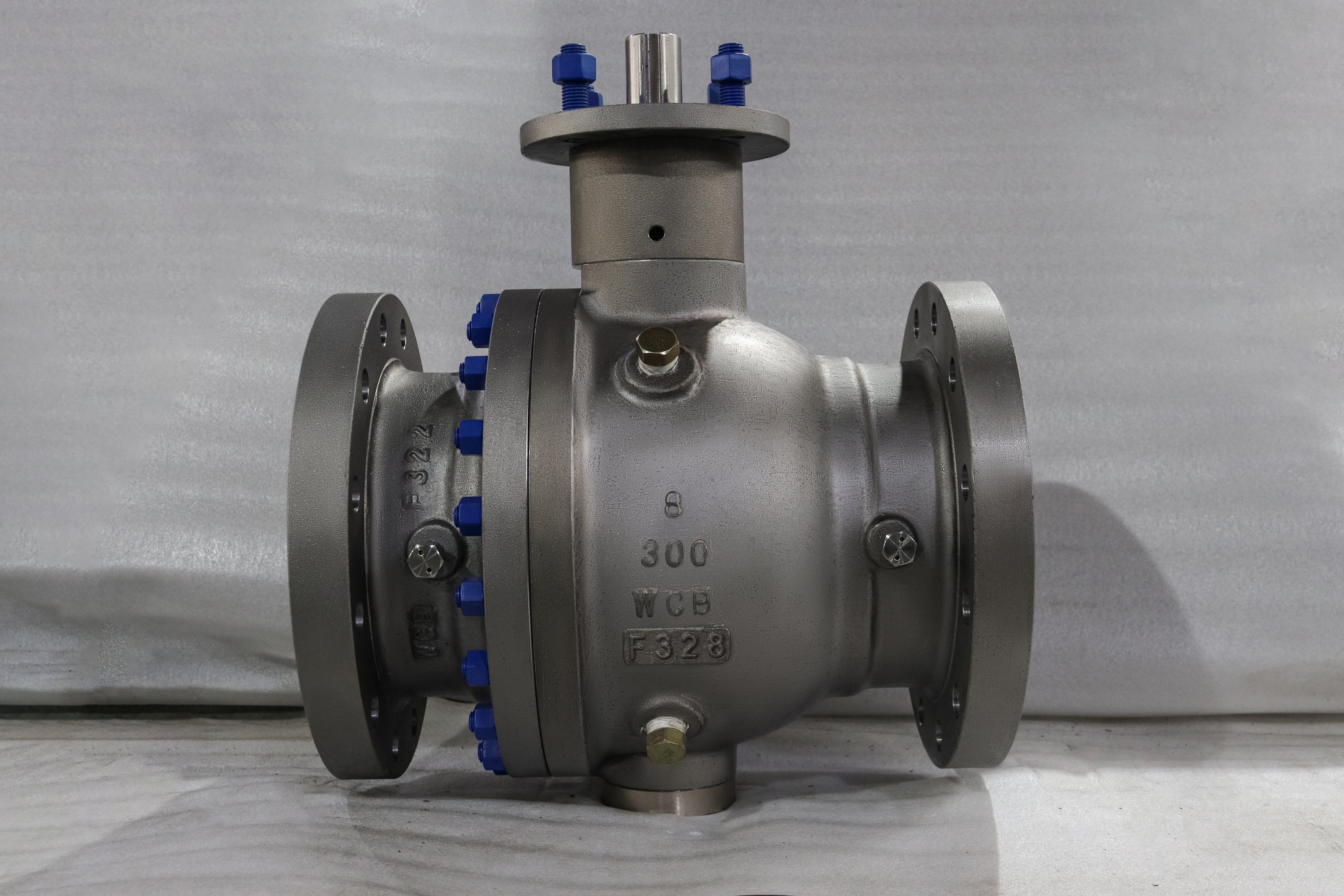
There are three names for one pressure rating and they are used interchangeably in conversation and nowhere near interchangeably on a drawing. ANSI 300 is the name on the enquiry, Class 300 is the name in the standard, and PN 50 is the designation that API 6D assigns to the same class in its own table. All three describe the valve on this page.
The trouble starts at the fourth name, which is PN 40. It is not another name for Class 300, it is a different flange. The two are close enough in pressure terms that they get treated as equivalents, and they are not interchangeable on a joint, because the bolt circle, the bolt size, the number of bolts and the gasket are all different. A valve drilled to one will not pull up on the other.
So this page is about the flange rather than the ball. The valve is eight inch, cast WCB, two piece, trunnion mounted, Class 300, and everything about it that a buyer can get wrong starts with which of those four names was written on the order.
Design and Construction
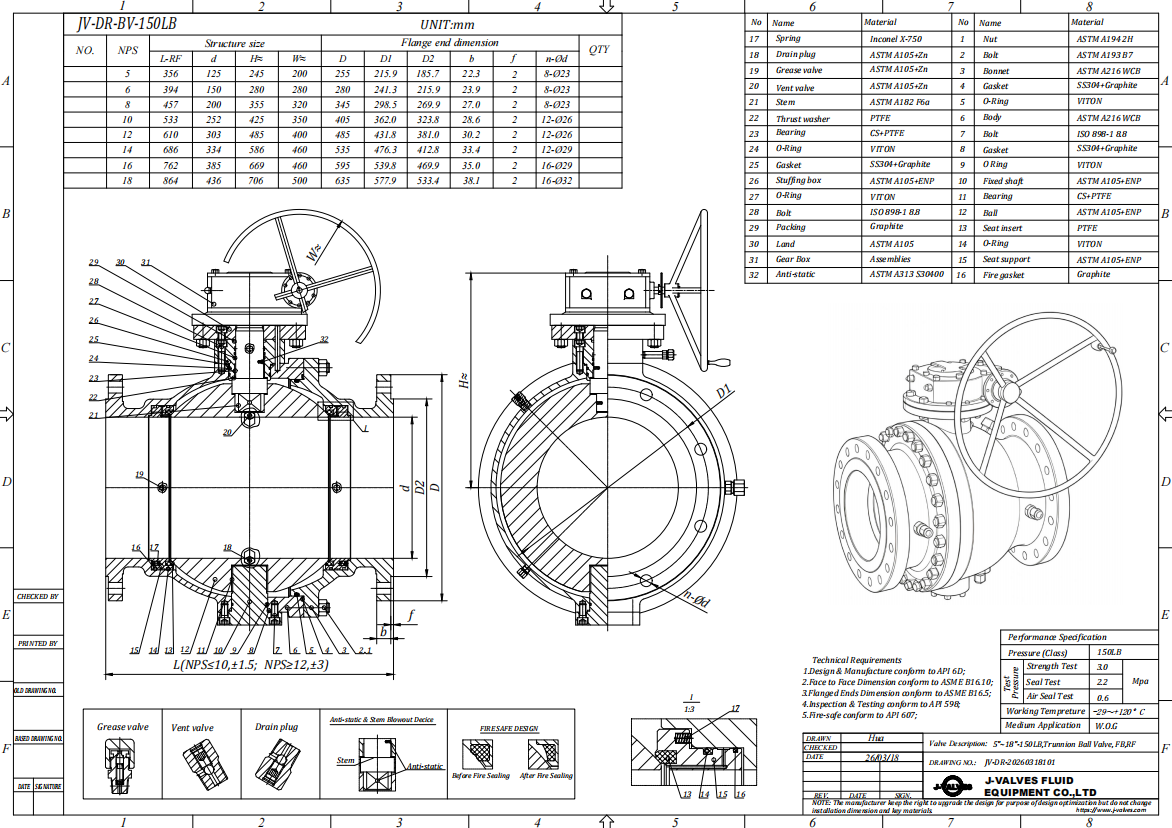
The body is a main body and one end cap, cast in ASTM A216 WCB, closed on a single ring of studs with a spiral wound gasket. At eight inch this is the standard arrangement for a large bore carbon steel valve, and the body is shaped around the trunnion pockets and seat bores rather than machined out of a solid block.
The ball is trunnion mounted on an upper and a lower shaft in bearings, and the pressure load goes into the body rather than into the seats. That is what allows a DN 200 valve to be turned by a gear rather than by a bar, and it is also what keeps the seats from being crushed by the load on a ball of that size.
The ends can be raised face or ring joint, and on a Class 300 valve at this size the raised face is the normal choice. The ring joint is bought when the line is cyclic or when the specification forbids a soft gasket, and it changes both the flange facing and the gasket, which means it changes the joint rather than the valve.
The stem is retained from inside the body, the packing sits under a bolted gland, and the top flange is machined square to the stem bore so that an actuator can be fitted later. That flange is the part that makes a manual valve convertible, and its pattern is worth confirming at the order rather than at the point where someone arrives with a actuator that will not fit.
Material Options
WCB is the cast carbon steel that most large valve bodies are made of, and the grade is defined by chemistry and by tensile rather than by how it was poured. It is a fine grain practice steel with a specified minimum tensile and yield, and it is weldable with the right procedure, which matters when a body needs a repair or a boss added.
| Component | Standard Build | Options | What It Decides |
|---|---|---|---|
| Body and cap | ASTM A216 WCB | WCC, or CF8M for corrosive service | Containment and corrosion |
| Ball | WCB with nickel plating | F304 or F316 stainless | Whether the seat stays clean |
| Seat | Reinforced PTFE | PPL for temperature, metal for abrasion | The temperature ceiling of the valve |
| Stem | F6a | F304, F316, 17-4PH | Stem strength and corrosion |
| Packing | PTFE chevrons | Flexible graphite, low emission packing | Stem seal and emission limit |
| Body gasket | Spiral wound, graphite filled | Ring joint at the higher classes | The single joint at line pressure |
| Bolting | A193 B7 with A194 2H | B8M with 8M for stainless bodies | Thermal match with the body |
| Flange facing | Raised face, ASME B16.5 | Ring joint to ASME B16.20 | Which gasket the joint takes |
WCC is the other carbon steel casting grade on the list and it is often asked for without a reason. It has a higher minimum tensile than WCB and it is used where a section is heavily loaded or where a lighter wall is wanted, and on a Class 300 body of this size neither applies. Ordering WCC where WCB was designed is not an upgrade, it is a substitution that changes the welding procedure and the certificate for no gain in service.
The gasket is the item that follows the facing and is often ordered separately by the pipe contractor, which is where a raised face valve ends up with a ring joint gasket on site. The two do not fit, and the discovery is made when the joint will not pull up rather than when the valve is unpacked.
Technical Specifications
Class 300 is 740 psi at 38 C in group 1.1 of ASME B16.34, which is a little over twice what the number in the name suggests. The gap between 300 and 740 is the single most common misreading of a class designation, and it is worth having the figure on the page for anyone who is converting from a bar rating.
| Item | Value |
|---|---|
| Size | Eight inch, DN 200 |
| Pressure class | Class 300, PN 50 in API 6D clause 7.2 |
| Rating | 740 psi at 38 C in group 1.1 |
| Body style | Two piece cast body, trunnion mounted ball |
| Body material | ASTM A216 WCB, ASME B16.34 group 1.1 |
| Flange | ASME B16.5 Class 300, raised face or ring joint |
| Flange note | Not interchangeable with EN 1092-1 PN 40 |
| Face to face | ASME B16.10 for NPS 8 Class 300, confirmed on the drawing |
| Seat | Reinforced PTFE, PPL or metal, spring loaded |
| Temperature | Minus 29 to plus 425 C as a body figure, insert limited |
| Operator | Gear as standard, actuator per order |
| Test | API 598 shell and seat, a result per seat |
The flange note is doing real work in that table. A Class 300 flange to ASME B16.5 and a PN 40 flange to EN 1092-1 are both about the right size, both have a raised face and both are used at similar pressures, and they will not bolt to each other. The bolt circle differs, the bolt size differs and the number of bolts differs, and at DN 200 the difference is visible without a tape measure.
Standards and Compliance
ANSI is not a standard that a valve is made to. It is the initials of an institute that published B16.5 for a large part of the last century, and the standard is now an ASME document with the same number. So ANSI Class 300 is a habit of speech that means ASME B16.5 Class 300, and the document that governs the joint is B16.5.
| Requirement | Document | What It Means Here |
|---|---|---|
| Wall and rating | ASME B16.34 group 1.1 | 740 psi at 38 C |
| Flange dimensions | ASME B16.5 Class 300 | Bolt circle, facing, gasket envelope |
| Product requirements | API 608 and API 6D | Both apply at this size and class |
| Pressure test | API 598 | Shell 1.5 times, seat 1.1 times |
| Casting quality | MSS SP-55 | Visual and dimensional acceptance |
| Ring joint gasket | ASME B16.20 | Where ring joint facing is ordered |
| Fire test | API 607 or ISO 10497 | Type test, scope to be read |
| Material certificate | EN 10204 3.1 | Heat number matched to the plate |
The class ladder itself is worth a sentence, because it explains why 300 does not mean 300 psi. The classes double as they go up from 150 to 300 to 600, and the cold rating doubles with them, so 300 is exactly twice 150 in pressure terms. The number in the name is an index rather than a pressure, and the index happens to coincide with nothing in particular.
The designation table in API 6D is worth finding once and keeping, because it is the only place where the two conventions are put side by side by somebody with authority. It sets Class 300 at PN 50, which is not a PN that appears in the European flange standard at all, and that absence is the clearest evidence that the two systems are parallel rather than convertible.
Manufacturing Process
The casting is poured, normalized and tempered, shot blasted and inspected before machining, and the inspection is visual and dimensional to MSS SP-55 unless radiography has been ordered. A casting that has been poured without proper feeding will have shrinkage in the thick sections, and the thick sections on a valve body are exactly where the flanges and the seat pockets are.
The machining is done with the flange face, the bolt circle, the joint face and the seat pocket referenced to one centreline per part. That reference is what makes the two halves close with the seat pockets coaxial, and if the two pockets are not coaxial the seats will sit at an angle to the ball and the contact band will be a crescent rather than a ring.
The ball is machined and ground, coated if a coating was ordered, and checked for sphericity. On a DN 200 ball the grinding is a centre-held operation and the result is a sphere the insert can conform to, which is not the same as a surface that has been polished until it looks right.

Quality Control and Testing
The heat number is cast into the body and repeated on the certificate, and the identity check is as much about excluding a mixed grade as about confirming WCB. A WCC body in a WCB order will work, and it will not match the certificate the project has already approved.
| Step | Check | Acceptance |
|---|---|---|
| 1 Incoming | Heat number against the mill certificate | A216 WCB chemistry and tensile |
| 2 Casting | Visual and dimensional to MSS SP-55 | No unacceptable discontinuity |
| 3 Machining | Seat pocket coaxiality across the joint | Drawing tolerance |
| 4 Flange | Facing, bolt circle and drilling against B16.5 | Gauge and drawing |
| 5 Shell test | Body and cap joint at 1.5 times | API 598, no leakage |
| 6 Seat test | Each seat at 1.1 times, cavity vented | API 598, a result per seat |
| 7 Torque | Gear input torque at rated pressure | Drawing figure |
| 8 Final | Cavity drained, faces masked, marked, crated | Works standard |
The seat test record is worth insisting on as two results rather than one. Each seat is proved on its own with the cavity open, so the document should show which seat was tested against which pressure, and a record that reports a single pass for both is a record that cannot tell a valve with one good seat from a valve with two.
Step four is where a flange that is dimensionally close but not B16.5 gets caught. A drilling that has been laid out from a European drawing will be a few millimetres out on the bolt circle, and it will bolt to nothing on the site it was delivered to.

Applications and Industry Service
Eight inch Class 300 carbon steel is the utility workhorse of a process plant: cooling water, plant air, nitrogen, steam distribution, fire water and fuel gas. In those duties the requirement is a tight shutoff that can be restored with a seat change, and a body that will outlast the piping around it.
It also appears in hydrocarbon service where the line is large and the pressure modest, such as tank farm rundown, flare headers and vent lines. In those duties the class is chosen by the piping standard rather than by the process, because the flange is what fixes the valve.
The valve is wrong in three situations that are discovered late. A line that will be pigged needs a full port and this page does not decide that for you. A medium that attacks carbon steel needs a different body grade. A duty with a high cycle count turns the seat insert into a wear part and the maintenance interval into the design constraint.

Installation, Operation and Maintenance
The valve should be supported on the body rather than hung from the pipe, particularly on a vertical run where the flange bolts would otherwise carry its weight. Leave the support adjustable so the two flange faces can be brought parallel before anything is tensioned.
On a retrofit the flange is the first thing to measure and the last thing to assume. Take the bolt circle, count the bolts, measure the bolt size and check the gasket envelope before the valve is ordered, because a plant built to a European standard and extended with an American valve will have one joint in it that nothing fits. Measuring takes ten minutes and it is the difference between a valve and a spacer.
Check the facing before the gasket goes in, and check the gasket against the facing rather than against the valve description. A raised face valve takes a flat gasket with the right inside and outside diameter; a ring joint valve takes a metal ring and has no gasket at all. Getting this wrong is the most common cause of a joint that will not seal on a retrofit.
For maintenance the line is isolated and drained, the cap studs come out in a pattern, and the cap leaves with one seat on it. Both seats go back as a pair, the gasket goes back new, and the studs are brought to the drawing figure in a cross pattern.
How to Specify and Order
Six entries settle the order: bore, class, body grade, port, insert, operator. Two more belong on the order and are frequently left to the works: the flange facing, and the flange standard. The second one matters when the enquiry says ANSI and the piping is European, because those two facts in one sentence are a contradiction.
The piping raises the questions the valve cannot answer: which standard, how hot, what medium flows, and whether the line is ever pigged. The piping standard decides the flange and therefore the valve; the temperature decides the seat insert; the medium decides the body and ball grade; the pigging question decides the port.
Documents to name in the order: the EN 10204 3.1 certificate with the heat number matched to the plate, the casting inspection record, the flange dimensional record against B16.5, the shell and seat test record with a result per seat, and the general arrangement drawing carrying the face to face dimension.
FAQ
Q: Is ANSI 300 the same as Class 300?
A: Yes. ANSI is the institute that published B16.5 for much of the last century and the standard is now an ASME document with the same number. ANSI 300 is a habit of speech that means ASME B16.5 Class 300, and the document that governs the joint is B16.5.
Q: Is Class 300 the same as PN 40?
A: No. PN 40 is a European flange to EN 1092-1 and Class 300 is an American flange to ASME B16.5. They are close in pressure terms and they are not interchangeable on a joint: the bolt circle, the bolt size, the number of bolts and the gasket envelope all differ.
Q: Where does PN 50 come from if Europe uses PN 40?
A: From the designation table in API 6D clause 7.2, which puts the two conventions side by side and sets Class 300 at PN 50. PN 50 is not a flange size in the European standard at all, which is the clearest evidence that the two systems are parallel rather than convertible.
Q: Why does 300 not mean 300 psi?
A: Because the number is an index rather than a pressure. The classes double as they go up from 150 to 300 to 600 and the cold rating doubles with them, so 300 is twice 150. The actual figure is 740 psi at 38 C in group 1.1, and it falls as the temperature rises.
Q: What should I measure before ordering a replacement?
A: The bolt circle, the number of bolts, the bolt diameter and the gasket envelope. On a plant built to one standard and extended with a valve from the other, the joint is where the mismatch appears, and measuring it takes ten minutes against a shutdown to correct.


Hot Products


News
Why A Ball Valve Gets Harder To Turn: Five Causes, And The Test That Tells Them Apart
A ball valve that stiffens over months points at one of five parts. Measure torque with the line pressurised and again vented, and the split becomes visible.
Read More
The Ball Valve at Four Thousand Bar: Seat Load, Erosion And Fatigue in Waterjet Circuits
At 4,000 bar a 10 mm bore puts 31 kN on the seat and a 0.1 mm leak cuts steel. What a ball valve must survive in a waterjet or intensifier circuit.
Read More
Large Diameter Ball Valves: Four Limits That Change The Design
Above a certain size a ball valve stops being a scaled one. Ball weight, operator torque, body split and the test bench each set a limit at a different size.
Read More
Cast Or Forged Ball Valve Body, And What A Radiography Acceptance Level Actually Buys You
Casting or forging is only half the decision. What RT, UT, MT and a proof test each find in a ball valve body, and where the geometry defeats all of them.
Read More