


CHINA J-VALVES Offers Various High-quality I ndustrial Ball Valves
J-VALVES, a distinguished professional ball valve manufacturer rooted in China, takes pride in its extensive product portfolio. Our offerings span a wide range, including trunnion-mounted ball valves, floating ball valves, high-temperature ball valves, high-pressure ball valves, metal-sealed ball valves, ultra-low temperature ball valves, DBB ball valves, Three-way And Four-way Ball Valve, and fully welded ball valves. Each product is a testament to our commitment to precision engineering and reliable performance. Meticulously crafted, they are designed to not only meet but exceed the most stringent industrial demands, ensuring stable operation even under extreme conditions. This enables us to provide our clients with high-value services and makes our valves widely sought-after in industries.
Product Category
Contact Us

-
J-VALVES-Q347F
-
J-VALVES
Overview of the J-VALVES high pressure stainless steel trunnion valve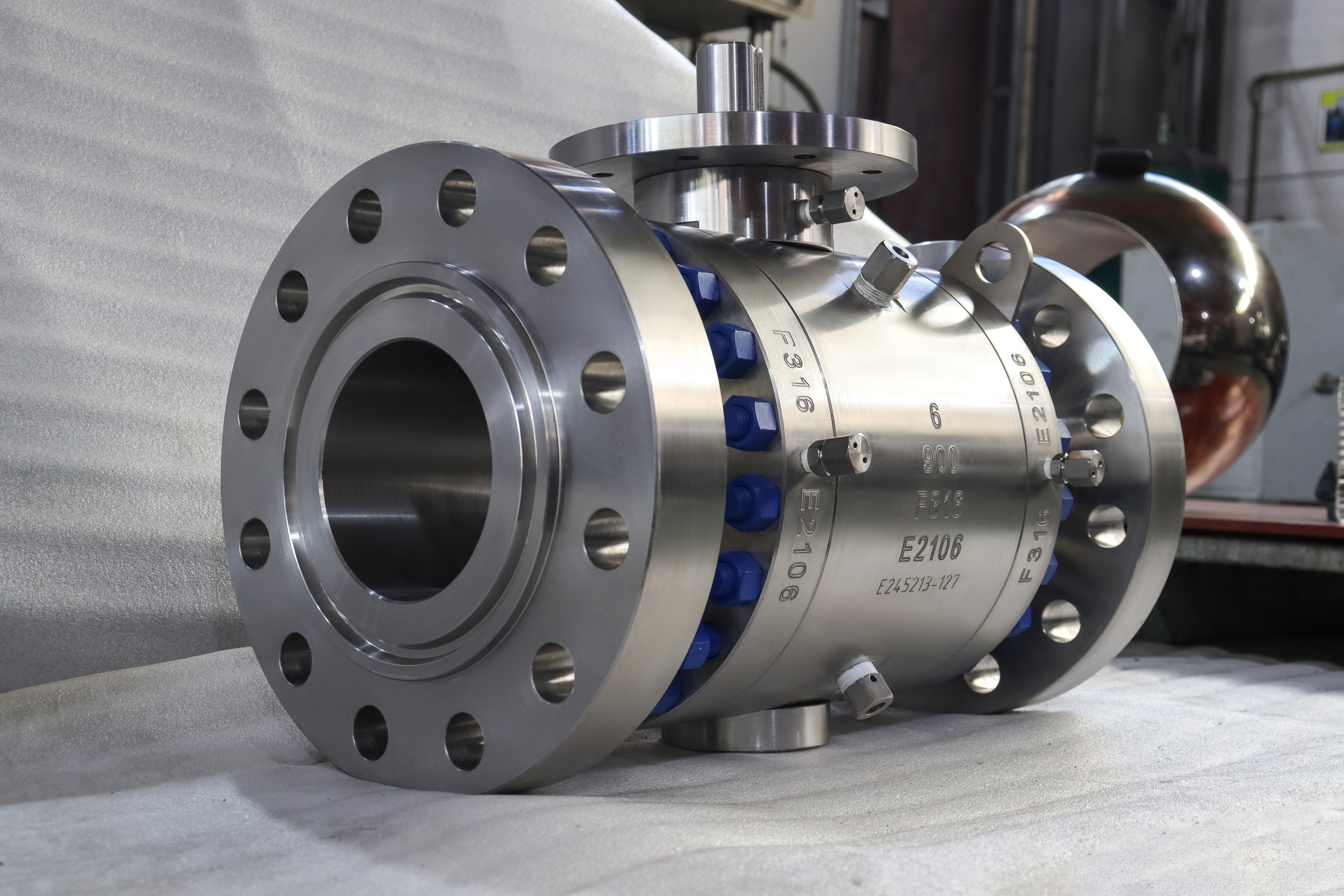
On a stainless steel valve at Class 1500 or 2500, the parts that end up causing a shutdown are rarely the body, the ball or the seat. They are the bolting and the gasket. A 316 bolt under a chloride bearing atmosphere, inside damp insulation, at a flange that is under tension, is the classic chloride stress corrosion cracking failure in a chemical plant, and it happens without warning and without visible corrosion.
The family runs from two inch to fifty six inch, Class 150 to Class 2500, with a general temperature range of minus 29 to plus 425 Celsius. The body list covers the austenitic grades, the duplex and super duplex grades, the 6Mo super austenitic grade and the Alloy 20 grade, and the ends can be raised face, ring joint or butt weld. Those are range statements, and this page uses them as the frame for one argument about which parts fail first.
The argument is that a stainless high pressure valve is a bolted assembly before it is a sealing device. Everything that holds it together, the studs, the nuts, the spiral wound gasket, the body joint faces and the threads that receive the studs, is made of a material that was probably chosen last and specified least precisely. That is where the failures are, and that is where an order should spend its attention.
Design and Construction
The body is three pieces on the flanged builds, with a centre piece carrying the ball on its trunnions and two end pieces carrying the flanges. Each end piece closes on the centre on a gasketed joint held by its own stud ring, so the valve has two pressure joints and two gaskets that see full line pressure.
The ball is trunnion mounted, which is what makes a Class 2500 stainless valve possible at all. A floating ball at that pressure would put the whole end thrust into the seat, and no soft insert survives that. On trunnions the thrust goes into bearings and the seats only have to seal, which is why the seat materials on this page can still be polymers at the bottom of the temperature range.
The stem passes through the centre piece in a gland that can be live loaded, and the packing is either PTFE based or graphite depending on temperature. Above roughly two hundred Celsius the PTFE option is gone and the choice becomes which graphite, which is a question about purity and about the emission limit rather than about sealing.
The seats are spring loaded rings in soft or metal execution, and they can be supplied as single or double piston effect. On a stainless valve in chemical service the soft seat is usually a reinforced PTFE or a PEEK insert, and the metal option is chosen when the temperature or the solids rule polymers out. The seat is the part that gets the attention, and the point of this page is that it is not the part that usually fails first.

Material Options
The body grades divide by corrosion mechanism rather than by price. The austenitic grades cover general corrosion. The stabilised grades cover elevated temperature where chromium carbide precipitation would otherwise take the chromium out of solution. The duplex grades cover chlorides where the austenitic grades pit. The 6Mo grade and the Alloy 20 grade cover the acids and the seawater duties where even duplex is not enough.
| Body Grade | What It Is | Where It Belongs |
|---|---|---|
| F316, F316L | Austenitic stainless forging | General chemical, moderate chloride |
| F321, F347 | Stabilised austenitic | Elevated temperature, welded assemblies |
| F51 | Duplex, 22Cr | Chloride service, moderate temperature |
| F53 | Super duplex, 25Cr | High chloride, seawater, higher strength |
| CK3MCuN | 6Mo super austenitic, UNS J93254 | Severe chloride, pulp and seawater |
| CN7M | Alloy 20, UNS N08020 | Sulphuric acid, mixed acids |
The 6Mo grade is where catalogues and order sheets part company most often. The alloy has a UNS number and a cast designation, and it also travels under a mill trade name that gets printed in catalogues as if it were a grade. Write the UNS number on the order. The trade name tells the buyer which mill's product was in mind and tells the works nothing about what to buy.
The duplex grades bring a limit that is easy to miss on a page that lists them as an upgrade. F51 and F53 have a temperature ceiling for sustained service because of the formation of a brittle phase, and they have a lower impact toughness at the cold end than the austenitic grades. A duplex valve chosen for a chloride duty and installed on a line that also runs hot has been specified on one property and installed against another.
The bolting belongs in the same decision as the body grade, and it is worth reading before the rest of this page. The studs on a stainless valve see the same environment as the body, and they see it in a worse geometry: a threaded section under tensile load, often inside insulation, often damp, and often the only bare steel in an otherwise painted or lagged assembly.
| Component | Usual Choice | When It Is Wrong |
|---|---|---|
| Studs | A193 B7, chrome moly | Wet chloride, coastal, insulated hot lines |
| Studs | A193 B8M, 316 | High chloride with temperature, SCC risk |
| Studs | B7M or L7M | Sour service, hardness limited |
| Nuts | A194 2H, A194 8M | Must match the stud grade and coating |
| Gasket | Spiral wound, 316 with graphite | Not for very high pressure, not reusable |
| Gasket | Ring joint, octagonal or oval | Needs the right groove, not interchangeable |
| Gasket | Lens ring | Ultra high pressure only, special faces |
The trap is the natural assumption that a stainless valve should have stainless bolting. It is the wrong way round in the situation that matters most. Austenitic stainless is the grade most susceptible to chloride stress corrosion cracking, and a B8M stud at temperature in a chloride atmosphere is the textbook case. Chrome moly studs with a suitable coating, or a nickel alloy where the environment is severe, are frequently the better answer on a stainless valve.
The second trap is galling. Stainless steel on stainless steel will cold weld under the pressure of tightening, and a 316 nut on a 316 stud can seize at the torque that the joint needs. The remedies are a molybdenum based anti seize compound, a different hardness for nut and stud, or a coated stud. None of them are on a standard valve unless they are asked for.
The gasket is the one component that is replaced every time the valve is opened, and it is also the one that is ordered by description rather than by part number. A spiral wound gasket is defined by its winding material, its filler, its dimensions and its standard, and a gasket that matches the groove diameter but not the filler will pass a cold hydrotest and fail in service at temperature.
Technical Specifications
| Item | Value |
|---|---|
| Size range | Two inch to fifty six inch, DN 50 to DN 1400 |
| Pressure class | Class 150 to Class 2500, PN 20 to PN 420 |
| Construction | Two or three piece body, trunnion mounted ball |
| Body grades | F316, F316L, F321, F347, F51, F53, CK3MCuN, CN7M |
| Seat | Soft insert or metal, single or double piston effect |
| Ends | Raised face, ring joint, butt weld |
| Face to face | ASME B16.10 where tabulated |
| Temperature | Minus 29 to plus 425 Celsius, grade dependent |
| Packing | PTFE or graphite, live loaded option |
| Anti-static | Conductivity from ball to stem to body |
| Fire test | API 607 or ISO 10497, type test |
| Test | API 598 shell and seat |
The class range is wide enough that the rating has to be read per grade rather than off the nameplate. F316 sits in one material group in ASME B16.34 and F316L sits in a lower one, so a valve built to the same class numbers with the L grade has a lower allowable pressure at every temperature. That is not a defect, it is the point of the L grade, but it means the two are not interchangeable in a line that is being uprated.
Standards and Compliance
| Requirement | Document | What It Means Here |
|---|---|---|
| Product requirements | API 6D | Design, materials, marking, documentation |
| Wall and rating | ASME B16.34 | Group by grade, rating falls with temperature |
| Product requirements | API 608 to Class 600 | Only the bottom of this range |
| Pressure test | API 598 | Shell at 1.5 times, seat at 1.1 times |
| Fire test | API 607 or ISO 10497 | Type test, scope on the certificate |
| Material certificate | EN 10204 3.1 | Heat number per pressure part |
| Flanges | ASME B16.5 up to 24 inch | B16.47 above, series stated |
| Weld ends | ASME B16.25 | The bevel is specified, not assumed |
The flange line is a reminder that a fifty six inch valve is outside the range of B16.5, and a page that offers fifty six inch ends to B16.5 is a page with an error in it. Above twenty four inch the flange standard changes and the series has to be named, because series A and series B are different flanges with different bolt circles and neither will mate with the other.
API 608 reaches only the bottom of this range. It covers ball valves to Class 600 and DN 600, so the Class 900, 1500 and 2500 valves on this page are API 6D articles and a quotation citing 608 against a Class 2500 stainless valve is citing a document that does not cover the article.
Manufacturing Process
The stainless body is forged or cast depending on size, and the choice affects the corrosion behaviour as much as the strength. A forging has no shrinkage porosity, and porosity in a stainless casting is not only a pressure risk, it is a crevice where chlorides concentrate and pitting starts. That is why the higher alloy grades are more often supplied as forgings, and why a casting in a super austenitic grade is worth a conversation before it is ordered.
Machining stainless is slower than machining carbon steel, and the reason is work hardening rather than hardness. A cut that rubs instead of shearing hardens the surface and makes the next pass harder, so the feeds and speeds are set to keep the tool cutting rather than polishing. A seat pocket that has been work hardened will not take a lapped finish, and a seat that does not have a lapped finish will not hold the leakage rate the standard asks for.
After machining, the parts are cleaned, pickled and passivated, and the passivation is what restores the chromium oxide layer that the machining and the embedded iron have disturbed. A stainless valve that has been machined, handled with carbon steel tools and shipped without passivation will show rust spots in the crate, and those spots are free iron on the surface rather than a failure of the alloy.

Quality Control and Testing
The identity check on a stainless valve is a positive material identification test on the body, the ball, the stem and the bolting, because the grades on this page look identical to the eye and several of them are separated only by molybdenum or by nitrogen. A 316 body and a 6Mo body cannot be told apart by colour or by spark.
The shell test is performed with the body assembled, and on a stainless valve the water quality matters. Chloride bearing test water left in a stainless valve is a pitting risk from the inside, so the test water is controlled and the valve is drained and dried after the test rather than shipped wet.
The seat test is done per seat and per direction, at 1.1 times the rating, with the cavity vented. On a double piston effect build the reverse direction is the one that matters, because that is the direction in which a single effect seat would lift and pass.

Applications and Industry Service
The stainless high pressure valve belongs to chemical and petrochemical service where the medium would eat a carbon steel body in a season: acid transfer, chloride bearing process water, seawater cooling on the high alloy builds, pulp and paper liquors on the 6Mo and Alloy 20 builds, and the injection packages where a small bore line runs at a pressure that would otherwise dictate a forged carbon steel valve with a corrosion allowance.
The duplex and super duplex grades carry the same valve into offshore and seawater duty, where the combination of chloride, pressure and occasional oxygen is the classic pitting environment. On those jobs the bolting question becomes as important as the body grade, because the atmospheric side of an offshore valve is wet, salty and permanent.
It is the wrong valve where the medium is dry chlorine or where the temperature is above the range of the grade, because the failure mode there is not corrosion but ignition or creep. It is also the wrong valve where a cheaper carbon steel body with a corrosion allowance would last the life of the plant, because the stainless premium buys nothing that the duty needs.

Installation, Operation and Maintenance
Support the body and do not let the flanges carry it, and check the studs before installation rather than after. A stud that has been over-tensioned once has lost its elasticity at the point where the thread meets the shank, and re-using it is the most common cause of a joint that will not stay tight on a stainless valve.
Bring the mating flanges up parallel before tensioning, use the gasket that belongs to the size, the class and the facing, and tighten in a cross pattern in stages. Apply anti seize compound to the stud threads where stainless meets stainless, and use a torque figure from the drawing rather than a feel for the wrench.
For maintenance the line is isolated, vented and drained, the body studs are released in a pattern, and the end pieces come away with their gaskets. New gaskets and new studs go back on every opening on a stainless valve in a corrosive atmosphere, because the studs are the cheapest part on the valve and the most expensive to have fail. The seat inserts are replaced as a pair, the ball is checked for its contact band, and the body joint faces are inspected for crevice corrosion before the assembly is closed.
How to Specify and Order
Six lines settle the valve, namely size, class, body grade, seat arrangement, the ends and the operator. On this article there are three more that belong on the order and are almost always left off: the stud grade and coating, the gasket type and filler, and whether the packing is to be live loaded.
Four questions belong to the line rather than to the valve: the medium and its chloride content, the design temperature, the design pressure, and the atmosphere the valve will sit in. The first three choose the body, the seat and the class. The fourth chooses the bolting and the coating, and it is the question that prevents the failure this page is about.
Documents to name in the order: the EN 10204 3.1 certificate for each pressure part with its heat number, the positive material identification report, the passivation record, the stud and nut certificates with grade stamps, the gasket certificate, the shell and seat test record with a result per seat and per direction, and the general arrangement drawing with the face to face dimension.
FAQ
Q: Should a stainless valve have stainless bolts?
A: Not always, and the exception matters. Austenitic stainless is the grade most prone to chloride stress corrosion cracking, and a B8M stud under load in a damp chloride atmosphere is the textbook case. Chrome moly studs with a suitable coating, or a nickel alloy where the atmosphere is severe, are frequently the better answer on a stainless body.
Q: Why do stainless studs seize?
A: Because stainless on stainless cold welds under the pressure of tightening. The thread surfaces gall, the torque goes into friction instead of preload, and the joint comes up short or the stud shears. Anti seize compound, a hardness difference between stud and nut, or a coated stud are the three remedies, and none are fitted unless asked for.
Q: What decides the gasket on this valve?
A: Temperature first, then the medium. A spiral wound gasket with a graphite filler covers the whole range on this page, and a PTFE filler does not. The gasket is defined by winding material, filler, dimensions and standard, and a gasket that fits the groove but has the wrong filler will pass a cold test and fail at temperature.
Q: Why is CK3MCuN written instead of a trade name?
A: Because the trade name is a mill brand and the UNS number is the alloy. CK3MCuN is UNS J93254, a 6Mo super austenitic grade used for severe chloride and seawater duty, and it travels in catalogues under at least one mill trade name that is not a grade at all. Write the UNS number and the certificate can be checked.
Q: Does this valve cover fifty six inch to B16.5?
A: No. ASME B16.5 covers flanges to twenty four inch, and above that the flange standard changes to B16.47 with series A and series B drillings that are not interchangeable. A page offering fifty six inch ends to B16.5 has an error in it, so the flange standard and the series have to be stated on the order.


Hot Products


News
Why A Ball Valve Gets Harder To Turn: Five Causes, And The Test That Tells Them Apart
A ball valve that stiffens over months points at one of five parts. Measure torque with the line pressurised and again vented, and the split becomes visible.
Read More
The Ball Valve at Four Thousand Bar: Seat Load, Erosion And Fatigue in Waterjet Circuits
At 4,000 bar a 10 mm bore puts 31 kN on the seat and a 0.1 mm leak cuts steel. What a ball valve must survive in a waterjet or intensifier circuit.
Read More
Large Diameter Ball Valves: Four Limits That Change The Design
Above a certain size a ball valve stops being a scaled one. Ball weight, operator torque, body split and the test bench each set a limit at a different size.
Read More
Cast Or Forged Ball Valve Body, And What A Radiography Acceptance Level Actually Buys You
Casting or forging is only half the decision. What RT, UT, MT and a proof test each find in a ball valve body, and where the geometry defeats all of them.
Read More