


CHINA J-VALVES Offers Various High-quality I ndustrial Ball Valves
J-VALVES, a distinguished professional ball valve manufacturer rooted in China, takes pride in its extensive product portfolio. Our offerings span a wide range, including trunnion-mounted ball valves, floating ball valves, high-temperature ball valves, high-pressure ball valves, metal-sealed ball valves, ultra-low temperature ball valves, DBB ball valves, Three-way And Four-way Ball Valve, and fully welded ball valves. Each product is a testament to our commitment to precision engineering and reliable performance. Meticulously crafted, they are designed to not only meet but exceed the most stringent industrial demands, ensuring stable operation even under extreme conditions. This enables us to provide our clients with high-value services and makes our valves widely sought-after in industries.
Product Category
Contact Us


-
J-VALVES-Q47F
-
J-VALVES
Overview of the J-VALVES 6x4 inch Class 2500 F316 reduced bore trunnion ball valve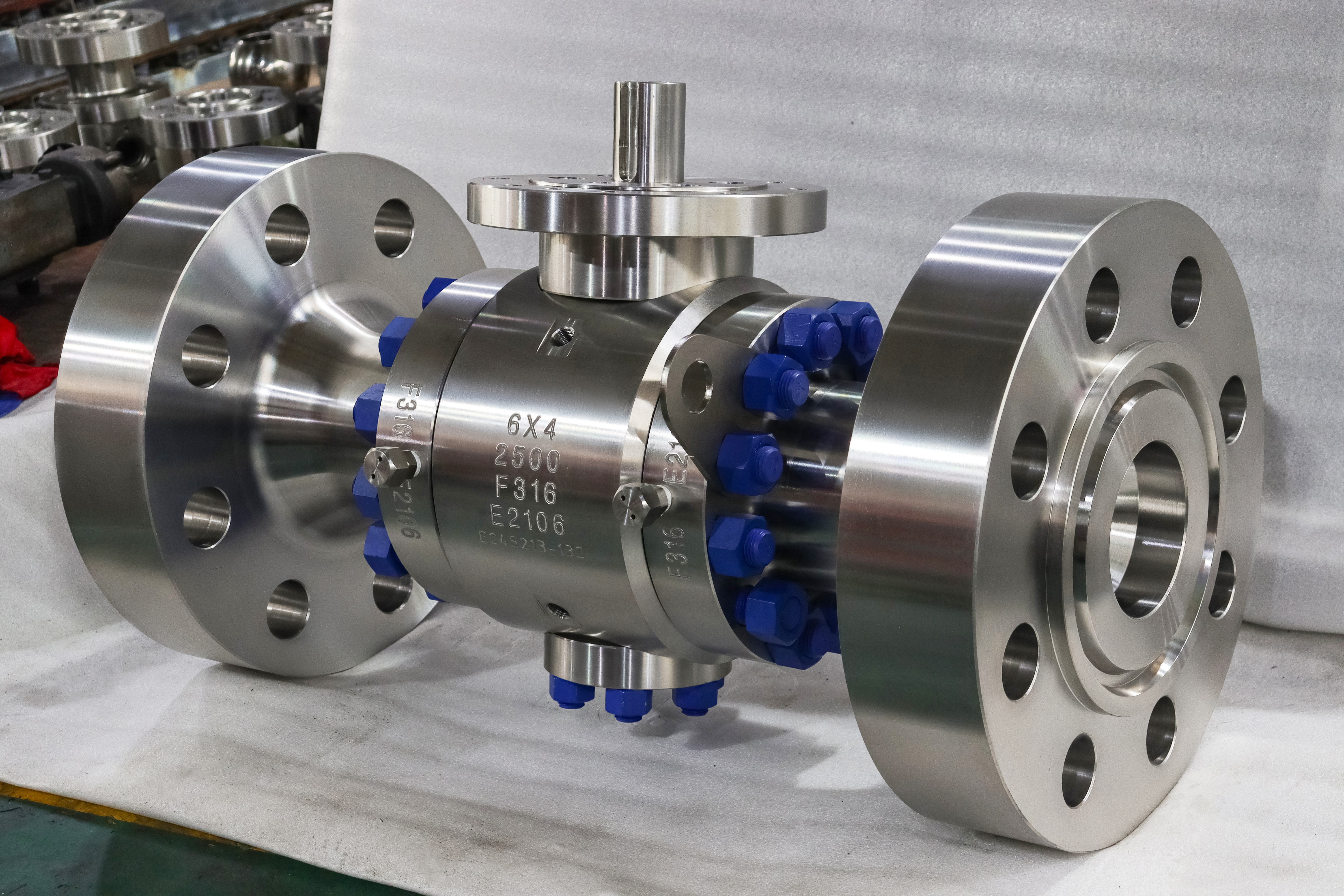
Read the heading as an engineer and it says two things that look like a contradiction. The valve is six inch and it is full bore. Both are true, and the sentence only stops being confusing once the two numbers are separated: six inch is the size of the body and its flanges, four inch is the size of the bore, and full bore describes the four inch trim rather than the six inch body.
That separation is worth a page of its own, because the phrase 6x4 full bore is read three different ways by three different people. A buyer reads it as a six inch valve with a four inch bore. A piping designer reads it as a six inch valve that will pass a four inch pig. A works order reads it as a body pattern with a four inch ball and, if nobody checks, a six inch seat. The first two are right about different things and the third is how the wrong valve gets built.
The valve itself is six inch by four inch at Class 2500, forged A182 F316, three piece, trunnion mounted, metal seated, with ring joint flanges and a gear. It is a stainless valve at the top of the pressure range, and it exists because the line is six inch and the flow only needs four.
Design and Construction
The body is three forgings: a centre piece carrying the ball, the trunnions and the stem, and two end pieces carrying the ring joint flanges. Each end piece closes on its own ring of studs with its own ring gasket, so there are two pressure joints and both are at the class pressure rather than at the bore pressure.
The bore through the ball is four inch and it is a full bore in the sense that matters: the passage is the same diameter as the inside of a four inch pipe, so the pressure drop across the valve is close to that of a four inch spool and the trim can be pigged with a four inch tool. It is not a full bore for a six inch line, and a six inch pig will not pass through it.
The reason for the gap is torque rather than economy, although the economy follows. A six inch full bore ball at Class 2500 would be a sphere large enough that the seat load on it, multiplied by the friction of a metal seat, would put the operating torque beyond what a gear of reasonable ratio can deliver by hand. Dropping the ball to four inch cuts the seat circumference and the radius at which friction acts, and the valve becomes turnable.
The ball runs on an upper and a lower shaft in bearings, so the pressure load goes into the body and the seats only have to seal. The seats are metal, ring shaped, hardfaced, spring loaded and pressure energized, and they are lapped against the ball as a pair. At this class the seat is the item that decides both the leakage rate and the torque.

Material Options
F316 is the forged austenitic grade with molybdenum, and at Class 2500 the choice of a forging rather than a casting is not economic. A cast CF8M body of this section would have to be radiographed to a level that would reject a good proportion of pours, and the wall at 2500 class is thick enough that shrinkage porosity is a real risk rather than a theoretical one.
| Component | Standard Build | Options | What It Decides |
|---|---|---|---|
| Body and end pieces | A182 F316 forged | F316L for weldability, F51 for higher strength | Soundness and corrosion resistance |
| Ball | F316 with hardfacing | Tungsten carbide coating | Wear life of the sealing surface |
| Seat | F316 with hardfacing | Nickel based overlay for erosion | Leakage rate and torque |
| Stem | F316 | 17-4PH, nickel based alloy | Stem strength at torque |
| Packing | Flexible graphite | Graphite with an anti-extrusion ring | Stem seal at temperature |
| Ring gasket | Soft iron or 316 ring | 316 for corrosive service | The two metal to metal joints |
| Bolting | A193 B8M with A194 8M | B7 with 2H where permitted | Thermal and galvanic match |
| Bearing | Reinforced PTFE | Metal or nickel based | Torque under load |
The bolting choice on a stainless Class 2500 valve is more consequential than it looks. B8M studs match the body galvanically and thermally, and they have a lower preload capability than B7 because the allowable stress is lower. On a ring joint at this pressure the preload is what makes the seal, so the stud size and the bolt pattern have to be designed for the grade that will actually be fitted.
The ring gasket is a consumable and it should be ordered as one. A soft iron ring deforms into the groove on first make up and is not reusable; a stainless ring is harder and can be reused only if the grooves and the ring are both undamaged. On a valve that will be opened for a seat change, the ring set should be in the spares box before the work starts.
Technical Specifications
Class 2500 is the top of the flanged range and the cold rating is 6000 psi at 38 C. The number that matters for the body is not that figure but the shell test at 1.5 times it, because the wall, the two body joints and the ring grooves are all sized by the test rather than by the service pressure.
| Item | Value |
|---|---|
| Body size | Six inch, DN 150 |
| Bore size | Four inch, DN 100, full bore for the four inch trim |
| Pressure class | Class 2500, recorded as PN 420 in API 6D clause 7.2 |
| Rating | 6000 psi at 38 C |
| Body style | Three piece forged body, trunnion mounted ball |
| Body material | A182 F316, ASME B16.34 group 2.2 |
| Flange | ASME B16.5 Class 2500, ring type joint |
| Ring gasket | ASME B16.20, octagonal or oval |
| Face to face | ASME B16.10 for NPS 6 Class 2500, confirmed on the drawing |
| Seat | Metal to metal, hardfaced, spring loaded |
| Temperature | Minus 29 to plus 425 C as a body figure |
| Test | API 598 shell and seat, seat accepted at the metal seat rate |
The face to face dimension is tabulated by the body size rather than by the bore, which is the point where a spool designer most often goes wrong. A 6x4 valve occupies the space of a six inch valve, so the spool has to be built to the six inch figure. A spool built to a four inch figure will be short by the difference, and the difference at this class is not small.
Standards and Compliance
Three documents do the work and one of them stops short of this valve. ASME B16.34 gives the wall and the rating for the material group; API 6D gives the product requirements; API 598 gives the test. API 608 covers only Class 150 to Class 600, so a Class 2500 valve is outside it, and a quotation that cites 608 at this class has cited a standard that does not reach.
| Requirement | Document | What It Means Here |
|---|---|---|
| Wall and rating | ASME B16.34 group 2.2 | 6000 psi at 38 C |
| Product requirements | API 6D, Class 2500 | Design, marking, documentation |
| Flange and groove | ASME B16.5 Class 2500 | Ring joint facing, six inch circle |
| Ring gasket | ASME B16.20 | Octagonal or oval, matched to the groove |
| Face to face | ASME B16.10 | Tabulated by body size, not by bore |
| Pressure test | API 598 | Shell 1.5 times, seat 1.1 times |
| Fire test | API 607 or ISO 10497 | Type test, scope to be read |
| Material certificate | EN 10204 3.1 | Heat number matched to each forging |
The group matters because F316 and F316L are not the same group. F316 is group 2.2 and F316L is group 2.3, which carries a lower rating at temperature. On a Class 2500 valve bought at the top of the range, a substitution from F316 to F316L is a rating change and not a convenience, and it is invisible to a portable analyser that cannot measure carbon.
Manufacturing Process
The three forgings are machined separately and then brought together on the centre piece, so the operation that matters is the one that cuts the seat pocket and the ring groove from the same reference. The step between the six inch flange and the four inch seat bore is machined in the end piece, and that step is where the wall carries the full class pressure.
The ball is machined with a four inch through bore and then ground on its sphere. On a metal seated valve the sphere is the sealing surface, so it is finished to a sphericity that the seat can conform to and the hardfacing on the seat is finished and lapped against it. A ball supplied without its seat, or a seat supplied without its ball, is a pair that has to be lapped again before it will hold.
The body is assembled centre piece first, with the ball on its trunnions and the stem in place, then the seats and springs, then the two end pieces on their studs in a cross pattern. The gear goes on last and the stops are set so the four inch port is fully open and fully closed at the ends of travel rather than a few degrees short.

Quality Control and Testing
The heat number is stamped on each forging and repeated on the certificate, and on a stainless valve the identity check is a check for molybdenum as much as for grade. A F304 part in a F316 valve will pass every pressure test and will pit in chloride service, and on a Class 2500 stainless valve that is the substitution that matters.
| Step | Check | Acceptance |
|---|---|---|
| 1 Incoming | Heat number against the mill certificate | A182 F316 chemistry |
| 2 Identity | Positive material identification on each forging | Molybdenum present |
| 3 Bore | Four inch bore through the ball | Drawing, full bore for the trim |
| 4 Machining | Seat pocket to ring groove reference | Drawing tolerance |
| 5 Lapping | Contact band between seat and ball | Works standard, full ring |
| 6 Shell test | Body and both ring joints at 1.5 times | API 598, no leakage |
| 7 Seat test | Each seat at 1.1 times, cavity vented | API 598 metal seat rate |
| 8 Final | Grooves greased, faces masked, marked, crated | Works standard |
The bore check is the one that catches a 6x4 built as a 6x6. A valve with a six inch bore will pass every pressure test, weigh more, cost more and be impossible to turn with the gear that was supplied for a four inch ball, and the error is discovered when someone tries to operate it rather than when it is inspected.

Applications and Industry Service
A 6x4 at Class 2500 is bought where the line is six inch and the flow only needs four, which happens more often than a catalogue suggests. Pump discharges sized for velocity rather than for pressure drop, branches where a six inch header feeds a smaller circuit, and high pressure injection lines where the pipe is sized for mechanical reasons and the flow is small.
The stainless body is chosen for the medium rather than for the pressure. Class 2500 carbon steel valves exist and are cheaper, so a buyer who pays for F316 at this class is buying corrosion resistance at the top of the pressure range, which is the combination found in chemical injection, in some refinery services and in offshore water injection.
Offshore is where the stainless 6x4 is most often seen, and for a reason that has nothing to do with the medium. A high pressure water injection or chemical line on a platform is sized by mechanical robustness rather than by flow, so a six inch pipe carrying a small flow is normal, and the valve that matches it is a six inch body with a smaller trim. The weight saved by dropping the ball from six inch to four inch is also weight saved on a structure that is priced by the tonne.
It is the wrong valve where the line has to be pigged with a six inch tool, where a full bore six inch body is required whatever the torque. It is also the wrong valve where the four inch bore would create an unacceptable pressure drop, because a reduced bore valve in a high flow line is a permanent energy cost that is paid every hour the plant runs.

Installation, Operation and Maintenance
The valve is heavy and the two ring joints are unforgiving, so the support should carry the body and the mating flanges should be brought up parallel before anything is tensioned. A ring joint will not absorb an angular misalignment the way a sheet gasket does, because the ring has to sit in both grooves at once.
For maintenance the line is isolated, drained and vented, the end piece studs are released in a pattern, and the end piece comes away with its seat and its ring. The ball and seat are a lapped pair, so a seat is replaced with a ball or relapped against the ball that is in the valve, and the ring gaskets are replaced rather than reused.
The first closing after a seat change tells you whether the lapping was right. Put the valve under pressure, crack the cavity bleed and watch the release. A properly lapped metal seat will give up the trapped volume and stop; one that was not will keep running, and extra torque on the gear will not fix a contact band that is a crescent.
How to Specify and Order
Six lines fix the valve and one of them is not a single number. Size has to be given as two numbers, six by four, because a quotation that says six inch at Class 2500 will be read as a full bore six inch valve and priced accordingly. The other five are class, body grade, seat type, flange facing and operator.
Four questions belong to the line rather than to the valve: the line size, the flow required, the design pressure and whether the line will be pigged. The first two decide the size pair, the third confirms the class, and the fourth decides whether a reduced bore is acceptable at all.
Documents to name in the order: the EN 10204 3.1 certificate for each forging with the heat number matched to the part, the group confirmation that the grade is 2.2 rather than 2.3, the shell and seat test record with a result per seat, the ring gasket certificate, and the general arrangement drawing carrying the six inch face to face dimension.
FAQ
Q: If the body is six inch, why is it called full bore?
A: Because the four inch trim is full bore for a four inch line. The passage matches the inside diameter of four inch pipe, so the pressure drop is close to that of a four inch spool and a four inch pig will pass. It is not full bore for the six inch line the flanges belong to.
Q: Why not a six inch full bore ball at this class?
A: Because the torque would no longer be turnable with a sensible gear. A six inch ball at Class 2500 has a large seat circumference and friction acting at a large radius, and reducing the ball to four inch cuts both. The reduced bore is what keeps the valve operable by hand.
Q: Which face to face dimension applies, six inch or four inch?
A: Six inch. The dimension is tabulated by the valve size and class, and the valve occupies the space of a six inch valve. A spool built to a four inch figure will be short by the difference, and at this class that difference is not small.
Q: Will a pig pass through it?
A: A four inch pig will and a six inch pig will not. If the line has to be swept with a tool sized to the pipe, this valve is an obstruction and a full bore six inch body has to be specified whatever the torque penalty.
Q: Is F316L acceptable instead of F316?
A: Only if the rating is rechecked. F316 is group 2.2 and F316L is group 2.3, which carries a lower rating at temperature, so a substitution is a rating change rather than a convenience. It is also invisible to a portable analyser, which cannot measure carbon.


Hot Products


News
Why A Ball Valve Gets Harder To Turn: Five Causes, And The Test That Tells Them Apart
A ball valve that stiffens over months points at one of five parts. Measure torque with the line pressurised and again vented, and the split becomes visible.
Read More
The Ball Valve at Four Thousand Bar: Seat Load, Erosion And Fatigue in Waterjet Circuits
At 4,000 bar a 10 mm bore puts 31 kN on the seat and a 0.1 mm leak cuts steel. What a ball valve must survive in a waterjet or intensifier circuit.
Read More
Large Diameter Ball Valves: Four Limits That Change The Design
Above a certain size a ball valve stops being a scaled one. Ball weight, operator torque, body split and the test bench each set a limit at a different size.
Read More
Cast Or Forged Ball Valve Body, And What A Radiography Acceptance Level Actually Buys You
Casting or forging is only half the decision. What RT, UT, MT and a proof test each find in a ball valve body, and where the geometry defeats all of them.
Read More