


CHINA J-VALVES Offers Various High-quality I ndustrial Ball Valves
J-VALVES, a distinguished professional ball valve manufacturer rooted in China, takes pride in its extensive product portfolio. Our offerings span a wide range, including trunnion-mounted ball valves, floating ball valves, high-temperature ball valves, high-pressure ball valves, metal-sealed ball valves, ultra-low temperature ball valves, DBB ball valves, Three-way And Four-way Ball Valve, and fully welded ball valves. Each product is a testament to our commitment to precision engineering and reliable performance. Meticulously crafted, they are designed to not only meet but exceed the most stringent industrial demands, ensuring stable operation even under extreme conditions. This enables us to provide our clients with high-value services and makes our valves widely sought-after in industries.
Product Category
Contact Us


-
J-VALVES-Q47F
-
J-VALVES
Overview of the J-VALVES 3 piece stainless steel metal seated trunnion ball valve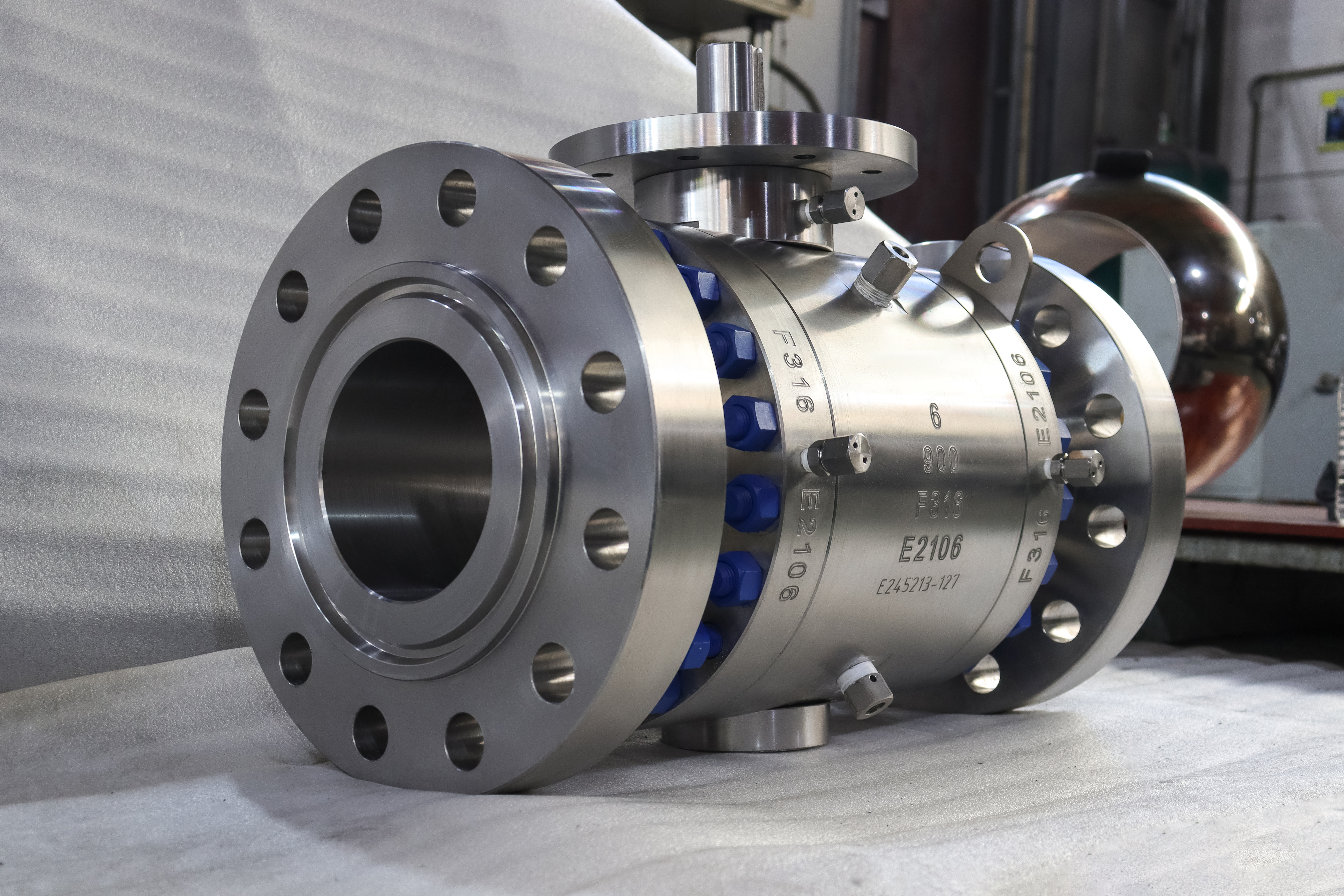
The interesting question on this valve is not the metal seat. A metal seated valve in stainless steel is a known article: hardfaced ball, hardfaced seat, no soft insert to burn, and a leakage acceptance that is a rate rather than zero. The question the page actually raises is quieter, and it sits in one line of the material list. The body can be cast CF8 or CF8M, or forged F304 or F316, and the buyer is choosing between two manufacturing routes for the same valve.
That choice is not cosmetic and it is not always visible from the outside. A cast body and a forged body of the same dimensions will both bolt into the same pipe, both pass the same pressure test, and both carry the same marking. What differs is the internal soundness, the inspection that can be applied, the sizes each route can reach, and what the certificate will say about how the part was made.
The valve is three piece, stainless, metal seated and trunnion mounted, and the range is one half inch to twenty four inch from Class 150 to Class 2500. The body is CF8 or CF8M cast, or F304 or F316 forged; the ball and seat are F304 or F316 with a hardfacing; the ends are raised face or ring joint flanges, butt weld or socket weld; and the operator is a lever, a gear or an actuator.
Design and Construction
A three piece body is a left body, a right body and a centre body, bolted together at two joints. The centre piece carries the ball, the trunnions and the stem; the two end pieces carry the flanges and one seat each. Both joints are at full line pressure, which is the price of the construction, and both are made with spiral wound or ring joint gaskets depending on the class.
The return on that price is access from both ends. Take both end pieces off and the ball, both seats and both trunnion bearings are in front of you, and the whole trim can be replaced without disturbing the pipe. On a metal seated valve that matters more than it does on a soft seated one, because a metal seat is a lapped pair that has to be replaced or relapped as a pair, and a body style that only opens from one end makes that a workshop job.
The ball is trunnion mounted, held between an upper and a lower shaft in bearings, so the pressure load goes into the body rather than into the seats. The seats are rings in pockets with springs behind them, and they move towards the ball under line pressure. On a metal seated valve the spring is doing more work than on a soft seated one, because there is no resilient insert to take up the difference between the ball and the seat when the valve is cold.
The sealing surface on each side is a hardfacing on a machined ring, and the two surfaces are lapped against each other. That is the whole of the metal seat: a narrow band of contact between two hard surfaces, held together by a spring and by pressure, with a leakage rate that the standard tabulates rather than a zero that it does not.

Material Options
CF8 and CF8M are the cast austenitic grades, equivalent in composition to 304 and 316, and they are the normal route above about four inch because a casting can be made in the shape of a valve body without machining it out of a solid block. F304 and F316 are the forged equivalents, and they are used at small sizes, at the top of the class range, and wherever the buyer's specification calls for a forging.
| Component | Standard Build | Options | What It Decides |
|---|---|---|---|
| Body and end pieces | CF8 or CF8M cast | F304 or F316 forged | Soundness route and available sizes |
| Ball | F304 or F316 with hardfacing | Tungsten carbide coating, nickel based overlay | Wear life of the sealing surface |
| Seat | F304 or F316 with hardfacing | Nickel based hardfacing, tungsten carbide | Leakage rate and erosion resistance |
| Stem | F316 | 17-4PH, nickel based alloy | Stem strength at torque |
| Packing | Flexible graphite | Braided graphite with an anti-extrusion ring | Stem seal at temperature |
| Body gasket | Spiral wound, graphite filled | Ring joint at the higher classes | The two joints at line pressure |
| Bolting | A193 B8 or B8M with A194 8 or 8M | B7 with 2H where the body is carbon steel | Corrosion and thermal match |
| Bearing | PTFE lined | Reinforced PTFE, metal | Torque and wear at the trunnion |
The cast route has one property that the forged route cannot match and one that it cannot match in the other direction. A casting can be made in a shape that puts metal where the stress is, with the trunnion pockets and the seat bores formed rather than machined out of solid, and it can be made at twenty four inch. A forging has finer, more uniform grain and no internal shrinkage, which is why it is the route at small sizes and the route a specification calls for when impact toughness or fatigue is the governing requirement.
The bolting choice follows the body rather than the medium. B8 and B8M are the stainless grades that match a stainless body thermally and galvanically; B7 and 2H are the alloy steel grades that are used on carbon bodies and are offered here as an option. Mixing them, which happens when a valve is assembled from a parts bin, gives a joint that either corrodes at the studs or loosens at temperature.
Technical Specifications
The range on this page is wide, from half inch to twenty four inch and from Class 150 to Class 2500, and that width is itself information. It says the body pattern is a family rather than a single casting, and it means the page is a specification page rather than a description of one valve on a shelf.
| Item | Value |
|---|---|
| Size range | Half inch to twenty four inch, DN 15 to DN 600 |
| Pressure class | Class 150 to Class 2500, PN 20 to PN 420 |
| Body style | Three piece bolted body, trunnion mounted ball |
| Body material | CF8 or CF8M cast, or F304 or F316 forged |
| Seat | Metal to metal, hardfaced, spring loaded |
| Flange | ASME B16.5 raised face or ring joint, Class 150 to 2500 |
| Welded ends | Butt weld to ASME B16.25, socket weld to ASME B16.11 |
| Face to face | ASME B16.10 for the size and class, confirmed on the drawing |
| Temperature | Minus 29 to plus 425 C as a body figure |
| Operator | Lever, gear or actuator |
| Test | API 598 shell and seat, seat accepted at the metal seat rate |
| Leakage | Rate per API 598 for a metal seat, not zero |
The class range is where the standards question starts, because API 608 stops at Class 600 and this page runs to 2500. A single page that covers both is not wrong, but the documents behind the two ends of it are different, and a quotation that cites 608 for a Class 1500 valve has cited a standard that does not reach it.
Standards and Compliance
Three documents apply across most of this range and one applies to part of it. ASME B16.34 gives the wall and the rating. API 6D gives the product requirements across the class range. API 598 gives the test. API 608 applies only up to Class 600, which is where the ambiguity on a page like this comes from.
| Requirement | Document | What It Means Here |
|---|---|---|
| Wall and rating | ASME B16.34 | Rating by material group and class |
| Product requirements | API 6D, all classes | Design, marking, documentation |
| Product requirements | API 608, up to Class 600 | Applies only at the lower end of the range |
| Pressure test | API 598 | Shell 1.5 times, seat 1.1 times |
| Fire test | API 607 or ISO 10497 | The current test; 6FA is no longer separate |
| Casting quality | MSS SP-55 | Visual acceptance for cast bodies |
| Material certificate | EN 10204 3.1 | Heat number matched to each part |
| Marking | API 6D | Size, class, material, heat, standard |
The fire test line on the source page names 6FA, and that is worth correcting rather than repeating. API 6FA was the fire test for valves and it has been folded into API 607, which is itself aligned with ISO 10497. A certificate that says 6FA is old rather than wrong, but a new order should be written to 607 and the certificate should be read for the sizes and classes it actually covers.
Manufacturing Process
The cast route starts with a pattern and a pour, and the part that matters is the riser and the cooling. A valve body has thick sections at the flanges and thin sections at the bore, and the shrinkage that happens as the thick sections cool is what produces the porosity that a pressure test finds. A foundry that has made the pattern properly will have the risers where the shrinkage goes, and the proof is in the radiograph rather than in the sales literature.
The forged route starts with a billet that is upset and pierced, and the grain follows the shape of the forging rather than being cut through by the machining. That is why a forging is chosen for fatigue and impact duty: the grain flow follows the contour, and a machined-from-solid part has the grain running in one direction only.
Both routes then converge on the same machining. The seat pockets in the two end pieces are cut in one setting each, the ball is ground on its sphere, and the hardfacing is applied and finished before the seat is lapped against the ball. The lapping is the operation that sets the leakage rate, and it is done as a pair, so a replacement seat is supplied with a ball or relapped against the one in the valve.

Quality Control and Testing
The identity check on a stainless valve is the one that finds the most substitutions, because 304 and 316 look the same, machine the same and pass the same pressure test. A portable analyser will separate them on molybdenum in a few seconds, and on this valve it should be applied to the body, the ball and the seat rather than to the body alone.
| Step | Check | Acceptance |
|---|---|---|
| 1 Incoming | Heat number against the mill certificate | CF8M or F316 chemistry as ordered |
| 2 Identity | Positive material identification on body, ball, seat | Molybdenum present, grade match |
| 3 Casting | Radiography where specified | Acceptance level on the order |
| 4 Hardness | Hardfacing hardness after finishing | Drawing figure, recorded |
| 5 Lapping | Contact band between seat and ball | Works standard, full ring |
| 6 Shell test | Body and both joints at 1.5 times | API 598, no leakage |
| 7 Seat test | Each seat at 1.1 times, cavity vented | API 598 metal seat rate |
| 8 Final | Faces masked, ports capped, marked, crated | Works standard |
The seat test result on a metal seated valve is a rate, and the rate has to be read against the size and the class. A rate that would be a failure on a half inch valve can be inside the acceptance on a twenty four inch one, because the standard scales the allowance with the bore. A test record that gives one number without the size beside it cannot be checked.

Applications and Industry Service
Metal seated stainless valves are bought for three kinds of duty. The first is temperature, where a soft insert would deform or burn and a metal seat will not. The second is abrasion, where the medium carries solids and a soft insert would be cut away in weeks. The third is a specification that forbids soft seats in the wetted path, which is common in oxygen, in some refinery services and in plant where a fire case governs the design.
The stainless body is chosen separately from the metal seat and for a different reason. A carbon steel body with a metal seat is a perfectly good high temperature valve, and it is cheaper. The stainless body is bought when the medium is corrosive, and on this page the two decisions are offered together because the product family is stainless rather than because metal seats need stainless.
The valve is a poor choice where tight shutoff is the only requirement and the medium is clean, because a soft seated valve is tighter, cheaper and easier to repair. It is also a poor choice at the very bottom of the size range, where a half inch metal seated three piece valve is a workshop item rather than a catalogue one, and the buyer should expect to be asked for a drawing.

Installation, Operation and Maintenance
A three piece body has two joints at line pressure, so the installation has to bring both flanges up parallel and support the body. On a horizontal run the support goes under the centre piece; on a vertical run the body should be carried so that the two joints are not holding the weight of the valve and the spool above it.
For maintenance the line is isolated, vented and drained, both end piece studs are released in a pattern, and the end pieces come away with their seats. The ball is then free on its trunnions and can be lifted out. The gaskets are replaced rather than reused, the seats go back with a ball that has been lapped to them, and the studs are brought up to the drawing figure in a cross pattern.
The first closing after a seat change is the operation that tells you whether the lapping was right. Close the valve on a pressurised line, open the cavity bleed and watch it. A metal seat that was lapped properly will show a short release of trapped volume and then stop; one that was not will keep running, and no amount of extra torque on the gear will fix a contact band that is a crescent.
How to Specify and Order
Six lines fix the valve: size, class, body route, body grade, seat hardfacing and operator. The body route is the one that is left off most often, because a quotation that says stainless steel does not say whether the body is cast or forged, and the two are not interchangeable in a specification that has been written around one of them.
Four questions belong to the line rather than to the valve: the medium and whether it carries solids, the design temperature, the design pressure, and whether the specification permits a soft seat anywhere in the wetted path. The first decides the hardfacing, the second decides whether a metal seat is needed at all, the third confirms the class, and the fourth decides whether this valve is acceptable.
Documents to name in the order: the EN 10204 3.1 certificate for the body, the ball and the seat with the heat numbers matched, the radiography report where it was specified, the hardfacing hardness record, the shell and seat test record with a rate per seat, and the general arrangement drawing carrying the face to face dimension.
FAQ
Q: How can I tell a cast body from a forged one after delivery?
A: The marking and the certificate, not the appearance. A cast body carries a foundry mark and a cast heat number; a forging carries the heat stamped or etched on a machined face. The certificate states the specification, A351 for cast and A182 for forged, and that line is the only reliable answer once the part is painted.
Q: Why is a metal seat supplied as a matched pair?
A: Because the seat is lapped against the ball it will run with. The contact band is produced by the two surfaces being ground in against each other, and a seat supplied without its ball has to be lapped again on site. That is why a replacement seat is ordered as a pair or the existing ball is sent back for relapping.
Q: Does API 6FA still apply, or is it API 607?
A: API 6FA has been folded into API 607, which is aligned with ISO 10497. A certificate that says 6FA is old rather than wrong, and a new order should be written to 607 with the certificate read for the sizes and classes it actually covers.
Q: Is a metal seated valve tight enough to replace a soft seated one?
A: It is tight enough for the duties it is bought for, and it is not zero leakage. API 598 accepts a metal seat at a rate that scales with size. If the duty needs bubble tight shutoff on a clean medium, a soft seat is the right article and a metal seat is a compromise being made for temperature or abrasion.
Q: Which is better, a cast or a forged body?
A: Neither, and the question is the wrong shape. A casting can be made large and can be shaped around the trunnion pockets; a forging has finer, more uniform grain and no shrinkage. The route is chosen by size, class and the buyer specification, and the seat is unaffected by which one was used.


Hot Products


News
Why A Ball Valve Gets Harder To Turn: Five Causes, And The Test That Tells Them Apart
A ball valve that stiffens over months points at one of five parts. Measure torque with the line pressurised and again vented, and the split becomes visible.
Read More
The Ball Valve at Four Thousand Bar: Seat Load, Erosion And Fatigue in Waterjet Circuits
At 4,000 bar a 10 mm bore puts 31 kN on the seat and a 0.1 mm leak cuts steel. What a ball valve must survive in a waterjet or intensifier circuit.
Read More
Large Diameter Ball Valves: Four Limits That Change The Design
Above a certain size a ball valve stops being a scaled one. Ball weight, operator torque, body split and the test bench each set a limit at a different size.
Read More
Cast Or Forged Ball Valve Body, And What A Radiography Acceptance Level Actually Buys You
Casting or forging is only half the decision. What RT, UT, MT and a proof test each find in a ball valve body, and where the geometry defeats all of them.
Read More