


CHINA J-VALVES Offers Various High-quality I ndustrial Ball Valves
J-VALVES, a distinguished professional ball valve manufacturer rooted in China, takes pride in its extensive product portfolio. Our offerings span a wide range, including trunnion-mounted ball valves, floating ball valves, high-temperature ball valves, high-pressure ball valves, metal-sealed ball valves, ultra-low temperature ball valves, DBB ball valves, Three-way And Four-way Ball Valve, and fully welded ball valves. Each product is a testament to our commitment to precision engineering and reliable performance. Meticulously crafted, they are designed to not only meet but exceed the most stringent industrial demands, ensuring stable operation even under extreme conditions. This enables us to provide our clients with high-value services and makes our valves widely sought-after in industries.
Product Category
Contact Us


-
J-VALVES-Q347F
-
J-VALVES
Overview of the J-VALVES API 6D flange forged steel trunnion mounted ball valve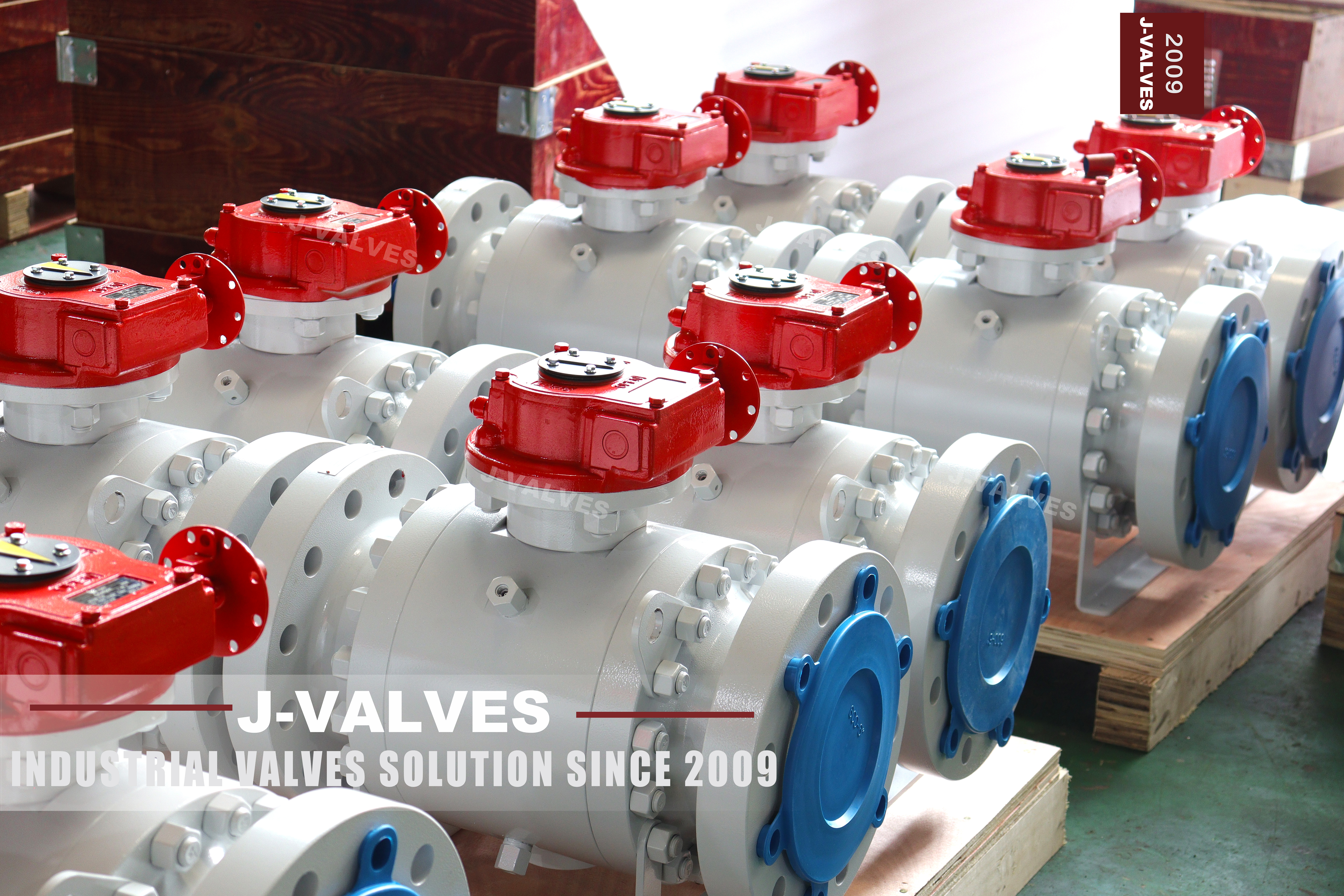
API 6D is a product specification, not a material specification, and that single sentence explains most of the confusion around this valve. The document tells a manufacturer how the valve has to be designed, assembled, tested, marked and documented. It does not tell anyone what the steel is made of. Chemistry lives in ASTM A182 for the forging, in A216 for a casting, and in A351 for a cast stainless body, and 6D simply requires that whichever of those applies has been met and can be proved.
The practical consequence is that a data sheet reading only API 6D says nothing at all about the material. Two valves can both be 6D and one can be forged carbon steel while the other is forged duplex stainless, and the standard is satisfied by both. Anyone comparing quotations on the strength of the letters 6D alone is comparing two documents that were never meant to distinguish the products.
This page covers the forged flanged trunnion mounted construction across the family range of two inch to fifty six inch at Class 150 to 2500, in the forged grades the range is built from. The body is a forged or fabricated forging assembly, the ball is trunnion mounted, the ends are flanged to ASME B16.5 or B16.47 according to size, and the operator is supplied to order.
What the photographs show is the construction that the standard is written around: a body split for assembly, a ball carried on bearings rather than on the seats, a stem on a neck with a pad, and a nameplate on the body that carries the fields the standard requires.
Design and Construction
The trunnion arrangement is what makes a large flanged ball valve possible. The ball is held on a shaft above and a shaft below, so its position does not depend on the seats and its weight does not rest on them. The seats are then free to be loaded by springs and by line pressure acting on a piston area, which is what allows the double piston effect and the combined seat arrangements that a floating ball cannot offer.
The body is forged rather than cast in the sizes and classes where forging is the right process, and the reason is soundness rather than cost. A forging has no shrinkage porosity and no mould joint, so the wall that carries the pressure is homogeneous, and on a high class body the wall is doing more work than it is on a low class one. Above a certain size the forging becomes impractical and the body is fabricated from forged sections or cast, which is a manufacturing decision the standard permits and the data sheet should state.
The stem is carried in a neck above the body with a pad machined on top, and the pad is drilled to an ISO 5211 pattern in most builds so that an operator can be bolted on without an adapter. The stem is retained against blowout by a shoulder below the gland rather than by the gland itself, which is the arrangement the standard expects on a valve that will be actuated.
The body cavity between the seats is a separate pressure space, and what the valve does with it is a design choice rather than a standard requirement. Single piston effect seats relieve the cavity upstream, double piston effect seats keep it trapped and make both seats barriers, and the combined arrangement does one of each depending on direction. All three are available in this construction and all three are 6D.

Material Options
Because 6D does not name a grade, the material table for this valve is a table of choices rather than a specification. The common builds are forged carbon steel and forged stainless, with alloy and duplex available where the medium asks for them.
| Component | Standard Build | Options | What It Decides |
|---|---|---|---|
| Body and caps | ASTM A182 F304 or F316 forging | A105N forged carbon, F6a, F51 duplex | Corrosion resistance and temperature |
| Ball | A182 F316 with hard facing | F304, F51, or carbon with nickel | Wear life and galling |
| Seat | PTFE or reinforced PTFE | PPL, or metal seat with hard facing | Temperature ceiling |
| Stem | A182 F316 | 17-4PH, F51 | Torque and stem strength |
| Packing | Flexible graphite | PTFE for low temperature | Stem seal and emission class |
| Body gasket | Spiral wound, graphite filled | Ring joint gasket | The body joint at full pressure |
| Bolting | A193 B8M with A194 8M | B7 with 2H for carbon bodies | Thermal match with the body |
| Bearings | PTFE lined | Composite or bronze | Operating torque |
The one line in this table that a 6D certificate will not settle is the seat. A soft seat and a metal seat are both compliant, and they behave completely differently in service, so the seat has to be written on the order as a material and not left to the drawing.
Technical Specifications
The family range is written as a range because this is the page that introduces the construction rather than a single size. Two inch to fifty six inch at Class 150 to 2500 covers the forged trunnion build; a single size page in this family carries its own class and its own face to face figure.
| Item | Value |
|---|---|
| Size range | Two inch to fifty six inch, DN50 to DN1400 |
| Pressure class | Class 150, 300, 600, 900, 1500, 2500 |
| Class designation | PN 20, 50, 100, 150, 250, 420 under API 6D clause 7.2 |
| Body style | Forged body, trunnion mounted ball, full or reduced bore |
| Body material | ASTM A182 F304 or F316, A105N, F6a or F51 |
| Flange | ASME B16.5 up to NPS 24, ASME B16.47 above |
| Face to face | ASME B16.10 or the API 6D table, confirmed on the drawing |
| Pressure test level | PR1 or PR2, stated on the nameplate |
| Operator | Lever, gear, or actuator mounting pad to order |
| Test | API 598 shell and seat, API 6D documentation |
| Fire test | API 607 or ISO 10497 when specified |
| Product standard | API 6D |
The class designations are worth reading carefully, because the PN numbers are not a conversion of the class number and they are not a pressure in bar. PN 250 is Class 1500 and PN 420 is Class 2500, and a document that offers a figure outside the seven listed in clause 7.2 is offering a number the standard does not contain.
Standards and Compliance
This is the section that the page exists for, because the letters API 6D get quoted far more often than they get read. The standard fixes the design method, the material documentation, the welding and non destructive examination of any joints, the assembly, the pressure test, the marking and the documentation package. It does not fix the chemistry, it does not fix the seat design, and it does not by itself entitle a manufacturer to put the API mark on the valve.
| Requirement | Where It Comes From | What It Means Here |
|---|---|---|
| Chemical composition | ASTM A182, A105, A216, A351 | 6D requires compliance, does not define it |
| Wall and rating | ASME B16.34 | 6D requires the design to be qualified |
| Flange dimensions | ASME B16.5 or B16.47 | By size, not by class |
| Face to face | ASME B16.10 or the 6D table | Confirmed on the signed drawing |
| Shell test | API 598 or 6D | 1.5 times the class rating |
| Seat test | API 598 or 6D | 1.1 times, each seat separately |
| Pressure test level | API 6D | PR1 or PR2, marked on the plate |
| Fire test | API 607 or ISO 10497 | A type test, with a scope on the certificate |
| Marking | API 6D | Size, class, material, heat, PR level |
| Documentation | API 6D plus EN 10204 | Certificate and test records |
The two pressure test levels are the part of the standard that buyers most often fail to specify. PR1 is the standard sequence: shell test and seat test at the factors above, on the assembled valve. PR2 adds a thermal cycle before the pressure test, so the valve is proved after it has been taken through a temperature excursion rather than only in the condition it left the factory in. Both are 6D. A valve marked PR1 is not a defective valve and a valve marked PR2 is not automatically the right one, and the choice belongs in the enquiry rather than in the inference.
The API mark is a separate matter from compliance. The monogram is licensed to manufacturers by the institute, and a valve can be built to 6D without carrying it, in the same way that a valve can carry a manufacturer's own mark and still be built to the standard. What a buyer should look for is the standard cited on the nameplate and the documentation that supports it, not the presence or absence of a logo.
Manufacturing Process
A forged body starts as a billet or a shaped forging, is heat treated to the grade, and is then machined. The heat treatment is the part that turns a forging into an A182 F316 part rather than a piece of stainless steel with the right analysis, and the record of it belongs with the certificate rather than in a drawer at the forge.
Machining is done with the body assembled as a set, so that the two halves are bored and faced together. That is what guarantees the seat pockets are coaxial with each other and with the flange faces, and it is why a replacement cap from another valve will not fit even when the two valves are nominally the same size.
Any welded joint, whether a fabrication seam or a weld overlay on a seat, is examined to the standard's acceptance level and the report travels with the valve. On a fully forged and machined body there are no such joints, which is one of the arguments for forging on high class valves.

Quality Control and Testing
The documentation package is the deliverable that separates a 6D valve from a lookalike, and it is worth listing what should be in it before the order is placed rather than after the valve arrives.
| Step | Check | Acceptance |
|---|---|---|
| 1 Incoming | Heat number against the mill certificate | Grade chemistry and mechanicals |
| 2 Identity | Positive material identification | Grade match, no mixed parts |
| 3 Dimensional | Flange facing, bolt circle, face to face, bore | B16.5 or B16.47 and B16.10 |
| 4 Non destructive | Radiography or ultrasonic on welds | The acceptance level stated in the order |
| 5 Shell test | Body and all joints at 1.5 times | No leakage, no permanent distortion |
| 6 Seat test | Each seat at 1.1 times, cavity vented | Per the seat type and the agreed rate |
| 7 Thermal cycle | Where PR2 is ordered, before the pressure test | No leakage after the cycle |
| 8 Marking | Nameplate fields complete and legible | Size, class, material, heat, PR level |
The seat test is the step where a buyer has to have decided something before the valve is built. A soft seat is accepted on no visible leakage. A metal seat is accepted on a rate, and the rate depends on the size, so a purchase order that says only API 598 has left the acceptance criterion half written.

Applications and Industry Service
The forged flanged trunnion valve is the default for pipeline and process isolation from two inch upward, in any class high enough that a floating ball stops being practical. It is bought for hydrocarbon transmission, for gas gathering and metering stations, for refinery and petrochemical process lines, and for utility headers where the valve has to be repairable without cutting the line.
It is also the construction that gets specified when the buyer's own standard cites 6D, which is common in pipeline and in a good deal of process work. In that case the standard is not a selling point but a gate: the valve either comes with the marking and the documentation or it does not get installed.
Above Class 600 the valve is a 6D article and only a 6D article, because the other ball valve product standard stops at Class 600. That is a scope fact rather than a quality ranking, and it is worth knowing when a quotation cites the lower standard on a high class valve.
One further scope point catches buyers at the enquiry stage. A valve built to 6D is not automatically built to the purchaser's own company specification, and a company specification that adds requirements on top of 6D describes a different article. Where a project standard exists it has to be attached to the enquiry rather than assumed to be covered by the standard number, because the additions are almost always in the examination and documentation scope, and that is where the price difference lives.

Installation, Operation and Maintenance
The valve is installed with the flanges mated to the line and the body supported where the spool is long. A trunnion valve at large size is heavy, and the weight should go to a support rather than into the pipe. Bring the mating flanges up parallel before tensioning, and use the gasket and studs that belong to the flange size and class.
Operation is a quarter turn, and the stops should be set so that the ball is fully at each end of travel rather than a few degrees short. Leaving a trunnion ball part open puts the seat edge in the flow and is the fastest way to damage a seat that would otherwise last the life of the plant.
Maintenance follows the seat arrangement. On a single piston effect build the cavity relieves upstream and the valve can be worked on with the line isolated and vented. On a double piston effect build the cavity stays trapped, and the body has to be bled before any joint is opened, which is a procedure that belongs in the plant's isolation standard rather than in the valve manual.
How to Specify and Order
Seven fields fix the article: size, class, body grade, seat type, flange facing, operator, and the pressure test level. The last of those is the one most often omitted and it is a 6D field rather than a preference, because PR1 and PR2 are two different tests and the nameplate will say which one was done.
Add the documents to the order in the same sentence as the valve: the EN 10204 3.1 certificate with heat numbers, the shell and seat test records, the non destructive examination reports where any weld exists, the fire certificate with its scope, and the general arrangement drawing with the face to face dimension. A 6D valve without that package is a valve that will cost more to qualify at site than it saved at the quotation stage.
Finally, write the standard you want cited and the standard you do not. If the duty requires 6D, say so and say which test level applies to it. If the duty would be satisfied by the lower product standard, say that too, because a supplier who is told nothing will quote the cheaper document and the buyer will discover the difference when the documentation is reviewed.
FAQ
Q: Does API 6D specify the material of the valve?
A: No. It requires the material to comply with a recognised material specification and to be documented, but the chemistry and the mechanical properties are defined in ASTM A182, A105, A216 or A351. A data sheet that names only API 6D has said nothing about what the valve is made of.
Q: What is the difference between PR1 and PR2?
A: Both are pressure test levels in API 6D. PR1 is the standard sequence of shell and seat test on the assembled valve. PR2 adds a temperature cycle before the pressure test, so the valve is proved after a thermal excursion rather than only in the condition it left the factory in. Both are 6D, and the level is marked on the plate.
Q: Does a 6D valve have to carry the API monogram?
A: No. The monogram is licensed separately, and a valve can be built and documented to API 6D without carrying it. What should be checked is the standard cited on the nameplate and the documentation behind it, not the presence of a logo.
Q: Which document covers the wall thickness?
A: ASME B16.34, not API 6D. The 6D requirement is that the design is qualified and documented; the wall, the rating at temperature and the material groups are tabulated in B16.34, and the two documents are used together rather than as alternatives.
Q: Why is the standard cited on the plate rather than in a datasheet?
A: Because the plate stays with the valve and the datasheet does not. At site the only durable record of which standard and which test level apply is the marking on the body, which is why the marking fields are part of the standard rather than a house convention.


Hot Products


News
Ball Valves on A Waterflood: Why The Pressure Is Not The Problem And The Chemistry Is
Injection pressure is steady; the damage is chemical. Oxygen maths, sour thresholds, scale torque and why a ball valve is the wrong flow control device here.
Read More
Reading A Ball Valve GA Drawing: The Five Dimensions That Decide Whether It Fits
A GA drawing is approved for its outline and lost on its section. The five dimensions that decide whether the valve fits, bolts and can be operated.
Read More
Stainless Steel Ball Valve Grades: 304, 316 And 316L, And What Actually Decides
Molybdenum is the difference that decides the duty, carbon is the difference that gets missed, and the chloride in the line matters more than the price.
Read More
Ball Valve Spare Parts for Overseas Projects: The Wear Part List, The Quantity Math, And Four Traps
Why isolation valves fail on calendar time, not cycles. Wear part lists, Poisson stock maths, seat kit traps and the clauses that decide year six.
Read More