


CHINA J-VALVES Offers Various High-quality I ndustrial Ball Valves
J-VALVES, a distinguished professional ball valve manufacturer rooted in China, takes pride in its extensive product portfolio. Our offerings span a wide range, including trunnion-mounted ball valves, floating ball valves, high-temperature ball valves, high-pressure ball valves, metal-sealed ball valves, ultra-low temperature ball valves, DBB ball valves, Three-way And Four-way Ball Valve, and fully welded ball valves. Each product is a testament to our commitment to precision engineering and reliable performance. Meticulously crafted, they are designed to not only meet but exceed the most stringent industrial demands, ensuring stable operation even under extreme conditions. This enables us to provide our clients with high-value services and makes our valves widely sought-after in industries.
Product Category
Contact Us


-
J-VALVES-Q47F
-
J-VALVES
Overview of the J-VALVES 6x4 inch 300LB WCB reduced bore trunnion ball valve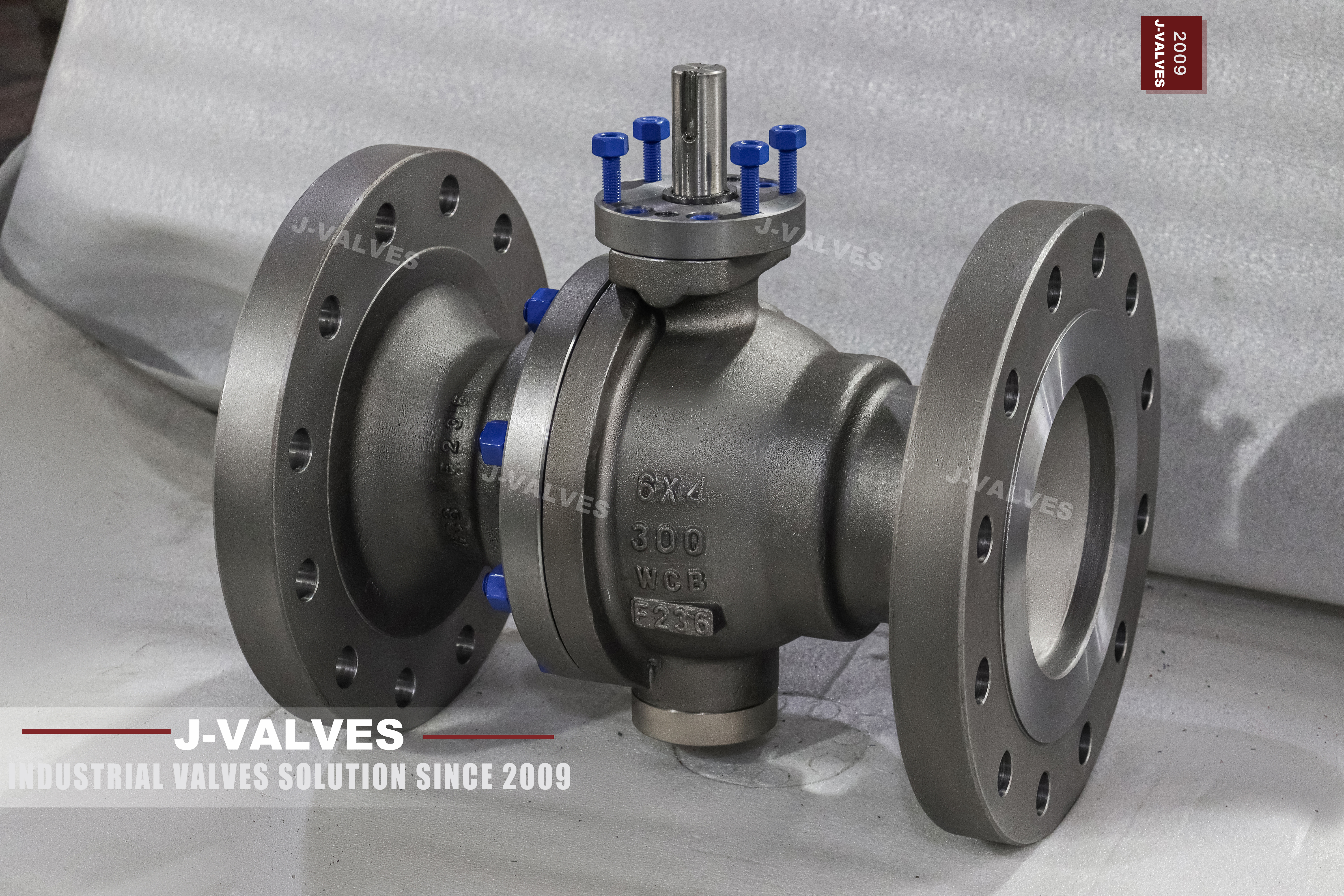
A 6x4 valve carries two nominal sizes and only one pressure boundary. Six inch is the boundary: the flanges, the gasket, the bolt circle, the wall, the shell test and the studs all belong to the larger number. Four inch is the flow path: the bore through the ball, the seat, and the velocity the medium sees. Getting those two roles the right way round is the whole of buying this valve correctly, and getting them the wrong way round is the most common mistake on the purchase order.
The reason it matters commercially is that a quotation names one size and the valve has two. A buyer who asks for a four inch valve receives a four inch valve, with four inch flanges, and it will not bolt to the six inch pipe. A buyer who asks for a six inch valve receives a 6x6 with a six inch bore, which costs more than the 6x4 that was actually wanted. The article that sits between those two errors is written as a pair, and the pair has to appear on the order as a pair.
The body is cast ASTM A216 WCB, a two piece trunnion mounted construction with one cap joint, raised face flanges to ASME B16.5 in six inch, and a bare stem on a pad above the body. At Class 300 the group 1.1 rating is 740 psi at 38 C, and API 6D records the class as PN 50.
What the photographs show is the geometry that causes all of this: a six inch flange with a body behind it that is visibly smaller, and a bore through the ball that is smaller again. The shell around the step is not thin, because it was never sized for the four inch passage. It was sized for the six inch one.
Design and Construction
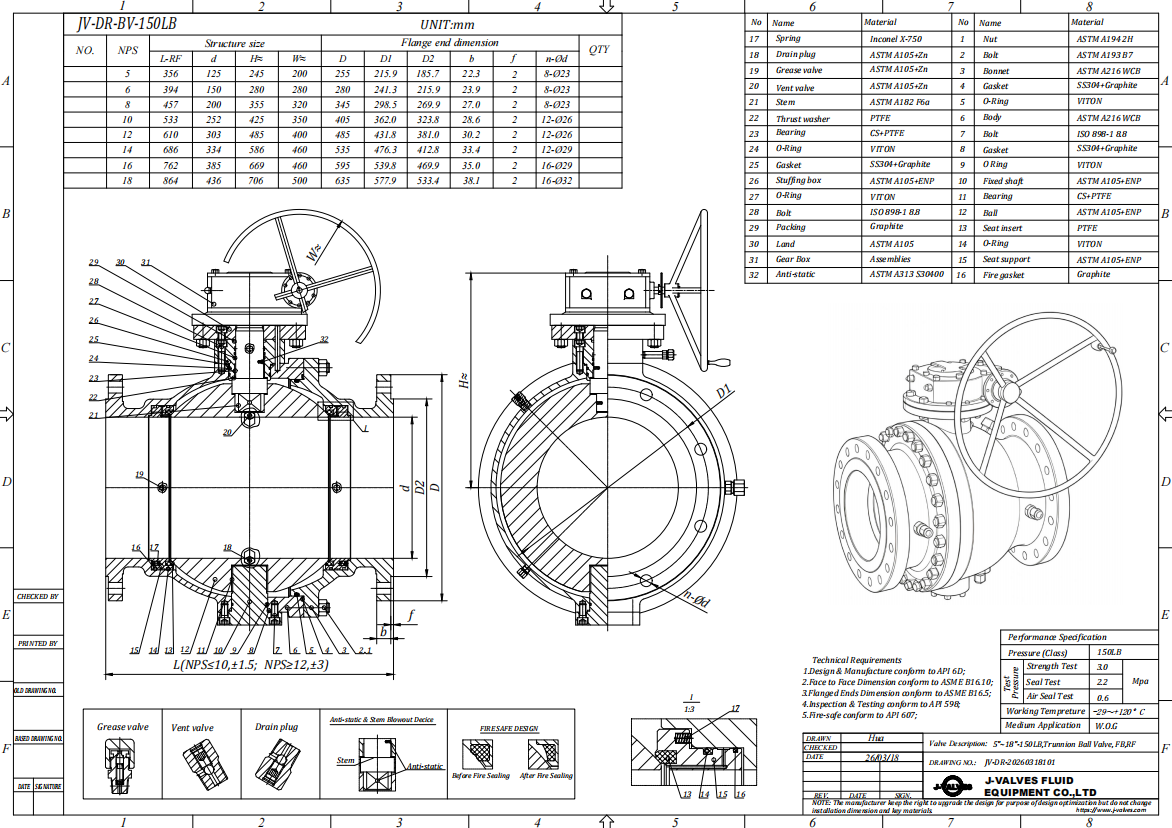
The two piece split is a main body with one cast flange and a cap with the other, and the cap carries one seat and one flange while the main body carries both trunnion bearings and the second seat. The joint between them is a single gasket at full line pressure, and it is the only joint in the valve that has to be broken for maintenance.
The step from six inch to four is machined into the body and the cap, and it sits upstream and downstream of the ball. That step is not a pressure boundary and it must not be treated as one: the pressure is contained by the shell around it, and the step only changes the velocity of the medium. A valve whose step has been machined too far is a valve whose bore is wrong, not a valve whose wall is thin.
The ball is carried on upper and lower trunnions, so it does not move with pressure the way a floating ball does. The seats are loaded by springs and then by line pressure acting on the seat piston area, and the trunnion bearings take the thrust that a four inch ball in a six inch body would otherwise put on the seats. Because the ball is four inch, the trunnions are shorter and the seat pockets smaller than they would be in a 6x6, which is where the non-interchangeability of parts comes from.
The stem runs through a neck with a pad above it, and the pad is drilled and tapped for an operator. On this build the stem is bare, so the valve ships ready for a lever, a gearbox or an actuator rather than with one bolted on.
Material Options
ASTM A216 WCB is the standard casting for a 300 lb carbon steel body, and the reduced bore construction does not change that. What changes is the ball and the seat, because a step in the flow path is a place where solids settle and where a coated carbon ball wears first.
| Component | Standard Build | Options | What It Decides |
|---|---|---|---|
| Body and cap | ASTM A216 WCB | CF8 or CF8M cast stainless | Corrosion resistance and low temperature limit |
| Ball | WCB with electroless nickel | CF8 or CF8M, or 316 with hard facing | Whether the step stays clean |
| Seat | PTFE or reinforced PTFE | Metal seat with hard facing | Temperature ceiling and solids tolerance |
| Trunnion bearing | PTFE lined or bronze | Composite bushing | Operating torque at pressure |
| Stem | 316 stainless | 17-4PH | Torque with a gear or actuator fitted |
| Packing | Flexible graphite | Braided graphite with alloy wire | Stem seal at temperature |
| Body gasket | Spiral wound, graphite filled | Ring joint gasket | The single joint at full line pressure |
| Bolting | A193 B7 with A194 2H | B8M with 8M | Thermal match with the body |
The seat choice is the one line in this table that changes the class of the valve rather than its price. A soft seat gives a tight shutoff and a temperature ceiling set by the insert. A metal seat removes the ceiling and changes the acceptance criterion, because a metal to metal seal is proved by a leakage rate rather than by the absence of visible leakage.
Technical Specifications
The data sheet for a reduced bore valve has to carry the two sizes on separate lines. When they are merged into one line, one of them is lost, and the one that is lost is usually the bore, because the body size is the one that appears on the packing list and on the flange.
| Item | Value |
|---|---|
| Body size | Six inch, DN150 |
| Bore size | Four inch, DN100 |
| Pressure class | Class 300, recorded as PN 50 in API 6D clause 7.2 |
| Body style | Two piece cast body, trunnion mounted ball, reduced bore |
| Body material | ASTM A216 WCB, ASME B16.34 group 1.1 |
| Rating | 740 psi at 38 C in group 1.1 |
| Flange | ASME B16.5 Class 300, six inch |
| Face to face | ASME B16.10 for NPS 6 Class 300, confirmed on the signed drawing |
| Temperature | Minus 29 to plus 425 C as a body figure |
| Operator | Bare stem on the pad as photographed |
| Test | API 598 shell and seat at the six inch class |
| Product standard | API 608 and API 6D both apply at this size and class |
The shell test is run at the six inch class rather than at anything derived from the bore, and that is the practical meaning of the pressure boundary argument. The body was designed, cast and proved as a six inch Class 300 shell, and the four inch bore inside it does not reduce the test the shell has to pass.
Standards and Compliance
Both API 608 and API 6D apply, and the reduced bore does not take the valve out of either. Both documents are written around the body size and the class, so a 6x4 at Class 300 is inside the DN 15 to DN 600 and Class 150 to 600 scope of 608 and inside the pipeline valve scope of 6D, exactly as a 6x6 would be.
| Requirement | Document | What It Means Here |
|---|---|---|
| Wall thickness and rating | ASME B16.34 group 1.1 | 740 psi at 38 C |
| Flange dimensions | ASME B16.5 Class 300 | Six inch bolt circle |
| Face to face | ASME B16.10 for NPS 6 | Tabulated by body size, not by bore |
| Reduced bore construction | API 6D | A tabulated construction, not a modification |
| Pressure testing | API 598 | Shell 1.5 times, seat 1.1 times |
| Fire test | API 607 or ISO 10497 | Type test, certificate scope to be read |
| Material certificate | EN 10204 3.1 | Heat number matched to the plate |
| Marking | API 6D | Size pair, class, material, heat |
The face to face dimension deserves its own note because it is where a reduced bore valve surprises people. It is tabulated against NPS 6, so a 6x4 is the same length as a 6x6 and is not the length of a four inch valve. Replacing a four inch valve with a 6x4 in an existing spool means the spool has to change, and that is a pipework decision rather than a valve decision.
Manufacturing Process
The body is cast from a pattern made for the six inch Class 300 shell, and the bore is machined down afterwards. That sequence is why the shell in the photograph looks small behind a large flange: the casting was designed around the flange and the class, and the passage is cut to the smaller nominal size later.
Machining runs in two sets of dimensions on one centreline. The flange faces, the bolt circles and the joint face are cut to six inch, and the bore, the seat pockets and the trunnion bores are cut to four inch. Everything is referenced to the same axis, which is the reason a 6x4 cannot be produced by boring out a 6x6, and also the reason a 6x6 cannot be produced by boring out a 6x4.
Assembly is gasket first, then ball and seats, then the cap, then the studs brought up in a cross pattern to the drawing figure. The cavity plug goes in before the shell test, because the test fills the body and the cavity has to be closed and then vented to prove the seats separately.

Quality Control and Testing
The dimensional check is the one that matters most on this construction, and it is the one most easily done badly. A check that measures only the flange will pass a valve whose bore was machined to the wrong nominal size, and the error will not appear until the line is commissioned and the flow is short of what the pump curve promised.
| Step | Check | Acceptance |
|---|---|---|
| 1 Incoming | Heat number against the mill certificate | A216 WCB chemistry and tensile |
| 2 Identity | Positive material identification | Grade match, no mixed parts |
| 3 Machining | Bore diameter, seat pocket position, concentricity | Drawing tolerance |
| 4 Dimensional | Six inch flange facing, bolt circle, face to face | ASME B16.5 and B16.10 |
| 5 Shell test | Body and the single joint at 1.5 times | API 598, no leakage |
| 6 Seat test | Each seat at 1.1 times with the cavity vented | API 598, zero visible on a soft seat |
| 7 Torque | Operating torque at rated pressure | Within the figure on the drawing |
| 8 Final | Cavity drained, bore dried, faces masked, marked | Works standard |
Both nominal sizes have to appear on the dimensional report, and the report has to say which is which. A report that lists a single size is not proof of anything on a valve that has two, because the number could belong to either.

Applications and Industry Service
A 6x4 at Class 300 is bought when the line was sized for something other than the valve itself. Pump discharge headers sized for velocity rather than for pressure drop, branches where a six inch header feeds a four inch circuit, and retrofits where an existing six inch spool has to take a smaller valve without being cut and rewelded.
It is also bought where the body strength of the larger size is wanted at the smaller bore, which is a class argument rather than a flow argument. At 300 lb the benefit is modest. At 900 or 1500 the same logic becomes the reason reduced bore exists, because the body size can stay fixed across a plant while the bore changes with the duty.
The valve is the wrong choice on any line that has to be pigged, because a pig will not pass a step and no pressure will make it. It is also the wrong choice where the pressure drop through the valve has been counted in the line sizing, since the step adds a loss that a 6x6 would not, and that loss is a permanent feature of the spool.

Installation and Operation
Order the gasket and the studs against the six inch flange, never against the bore. This is the mistake that happens most often in the field, because the person preparing the joint reads the valve size off the packing list and orders four inch hardware, and the hardware arrives after the line is open.
Support the body when the spool is long, and bring the two flanges up square to each other before any stud is tensioned. A two piece body has one joint and one gasket, and a flange pulled in by the studs will distort that joint face enough to weep at test pressure, at which point the gasket takes the blame for a pipework error.
Commissioning is where a reduced bore valve gets condemned unfairly. The spool is filled, the valve is closed, and a weep appears at the cap joint that was dry at the works. The cause is nearly always the pipe flange rather than the valve: a six inch flange pulled square by its studs bends the cap face, and no gasket will close a gap that changes as the torque goes on. Re-torquing to the drawing figure in a cross pattern with the line at ambient closes it in most cases, and where it does not, the joint face should be checked for flatness before the gasket is blamed a second time.
For maintenance the line is isolated and vented, the cavity plug is opened to drain, the cap studs are released in a pattern, and the cap comes away with one seat. The ball is then accessible from that side. Fit a new gasket rather than reusing the old one, and torque the studs back to the drawing figure in a cross pattern.
How to Specify and Order
Write the size as a pair and write both numbers on the same line: 6x4, or 6 by 4, or DN150 by DN100. Then add the class, the body grade, the seat material, the flange facing and the operator. Six fields in total, and the first one is the pair rather than a number.
Three quotations go wrong in predictable ways, and all three are worth checking before a purchase order is raised. The first quotes a four inch valve, which is the correct bore in the wrong body. The second quotes a 6x6, which is the correct body with a bore nobody asked for. The third quotes a 6x4 but leaves the face to face dimension to the drawing, which is how a valve arrives that is the right article and the wrong length for the spool.
Documents to name: the EN 10204 3.1 certificate with the heat number matched to the plate, the shell and seat test record at the six inch class, the dimensional report showing both the six inch flange and the four inch bore, and the general arrangement drawing with the face to face dimension. On this valve the dimensional report is the document that settles which article was bought, because it is the only one that carries both numbers.
FAQ
Q: Is the shell of a 6x4 rated as six inch or as four inch?
A: As six inch. The wall, the flanges, the bolt circle, the gasket and the shell test all belong to the six inch Class 300 body, because that is the pressure boundary. The four inch bore changes the velocity of the medium and nothing about what contains the pressure.
Q: Why does the face to face dimension not follow the bore?
A: Because ASME B16.10 tabulates it against the body size. A 6x4 is the same length as a 6x6 and is not the length of a four inch valve, so replacing a four inch valve with a 6x4 in an existing spool means the spool has to change.
Q: Can a 6x6 be turned into a 6x4 by boring it out?
A: No, and the reverse is also true. The seat pockets, the trunnion bores and the bore are cut on the same centreline to the smaller dimensions, so the internal geometry of a 6x4 is not a 6x6 with metal removed. The parts are not interchangeable across the pair.
Q: What is the commonest ordering mistake on this valve?
A: Writing a single size. A four inch line on the order buys a four inch valve with four inch flanges that will not bolt to the six inch pipe, and a six inch line buys a 6x6 with a bore nobody asked for. The article wanted is written as a pair, 6x4 or DN150 by DN100, with the class and the face to face on the same line.
Q: Will a pig pass through this valve?
A: No. The bore steps from six inch to four inside the body, and a pig will not pass a step. On a piggable line the valve has to be removed for the operation or a full bore valve used instead.


Hot Products


News
Reading A Ball Valve GA Drawing: The Five Dimensions That Decide Whether It Fits
A GA drawing is approved for its outline and lost on its section. The five dimensions that decide whether the valve fits, bolts and can be operated.
Read More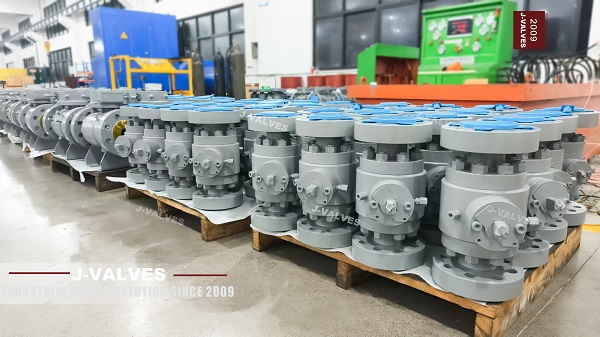
Stainless Steel Ball Valve Grades: 304, 316 And 316L, And What Actually Decides
Molybdenum is the difference that decides the duty, carbon is the difference that gets missed, and the chloride in the line matters more than the price.
Read More
Ball Valve Spare Parts for Overseas Projects: The Wear Part List, The Quantity Math, And Four Traps
Why isolation valves fail on calendar time, not cycles. Wear part lists, Poisson stock maths, seat kit traps and the clauses that decide year six.
Read More
Ball Valves On A Bottom Loading Gantry: Creep, Dry Break And The Test That Proves Neither
A loading gantry cycles a ball valve far more than it is designed for and still cannot prove shut-off. Where creep starts, and what to specify.
Read More