


CHINA J-VALVES Offers Various High-quality I ndustrial Ball Valves
J-VALVES, a distinguished professional ball valve manufacturer rooted in China, takes pride in its extensive product portfolio. Our offerings span a wide range, including trunnion-mounted ball valves, floating ball valves, high-temperature ball valves, high-pressure ball valves, metal-sealed ball valves, ultra-low temperature ball valves, DBB ball valves, Three-way And Four-way Ball Valve, and fully welded ball valves. Each product is a testament to our commitment to precision engineering and reliable performance. Meticulously crafted, they are designed to not only meet but exceed the most stringent industrial demands, ensuring stable operation even under extreme conditions. This enables us to provide our clients with high-value services and makes our valves widely sought-after in industries.
Product Category
Contact Us


-
J-VALVES-Q47F
-
J-VALVES
Overview of the J-VALVES 4x3 inch 1500LB A105N extended stem ball valve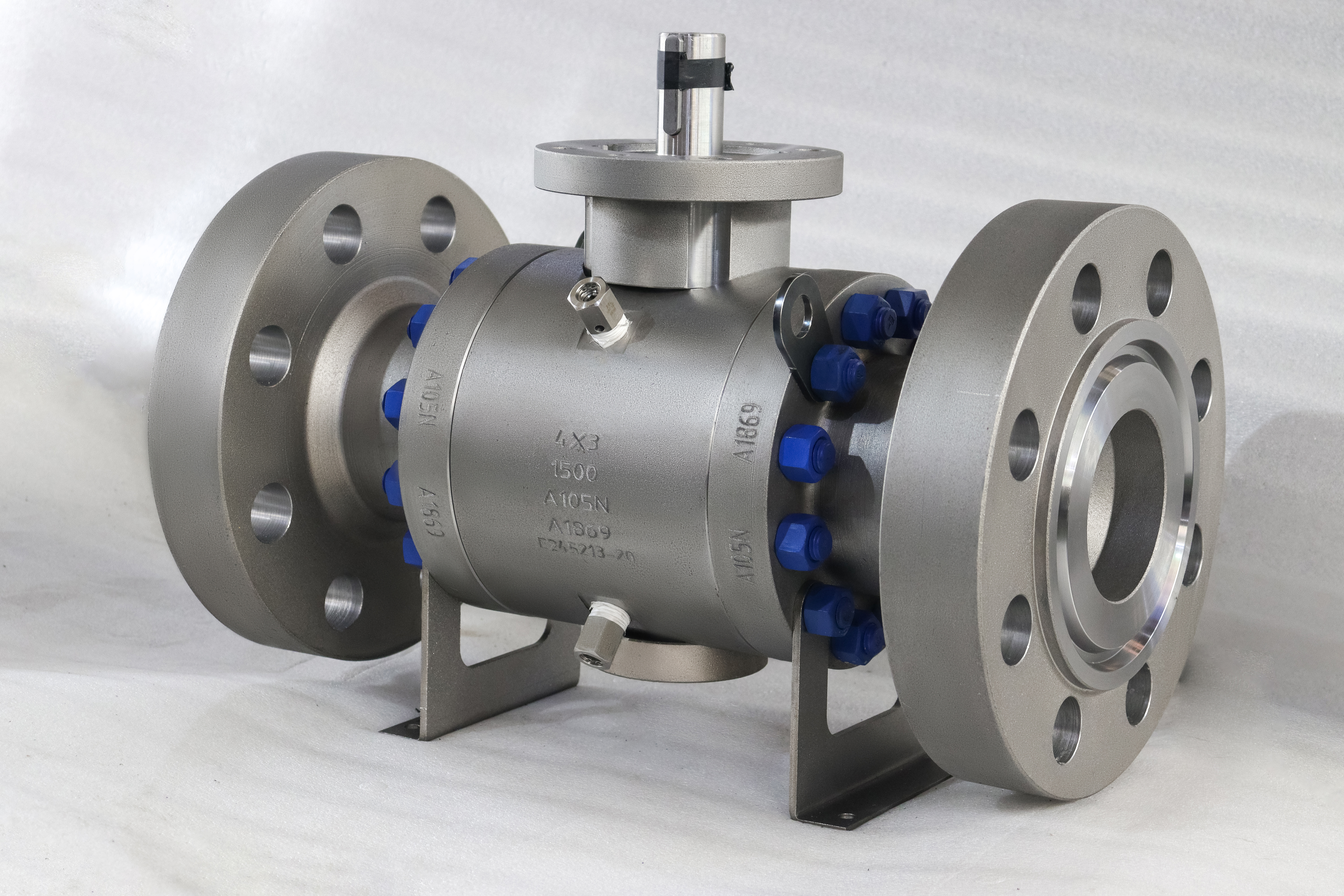 .
 .
Two things about this valve need explaining before anything else, and both of them are visible in the photographs. The plate is stamped 4X3, which means a four inch body with a three inch bore. The title calls it full bore. Those two statements are only compatible under one reading, and the reading has to be agreed before the order is placed.
The second thing is the stem. It rises out of the body on a neck, ends in a drive above a bolted pad, and on a buried valve that neck can be a metre or more long. The valve sits below ground, the operator stands at ground level, and the column between them is the part that decides whether the installation works or becomes an excavation every time the valve has to be turned.
The class is Class 1500, recorded as PN 250 in API 6D clause 7.2, and the body is forged A105N in the normalized condition. At four inch and this class the body is small and the flanges are large, which is the geometry that makes a 4x3 sensible in the first place: the line is four inch, the flow is three inch, and the body has to be strong enough for the class rather than for the bore.
This page deals with the two unusual features rather than with the routine ones. What 4x3 means, how to read full bore against it, and what an extended stem has to say on the drawing before a buried valve is made.
Design and Construction
The body is three forged pieces: a centre section carrying both trunnion bearings, and two caps that carry the flanges and their own seat rings. At Class 1500 the caps are substantial and the stud rings are long, because both joints see the full line pressure. The ball is held on upper and lower trunnions so the pressure thrust goes into bearings and not into the seats.
The bore is three inch through a four inch body, so the flow path steps down inside the valve. Where that step sits, and whether the ball port is three inch or slightly less, is a drawing item: the phrase full bore on a 4x3 normally means that the port through the ball is not reduced below the three inch nominal, not that the valve passes a four inch pig. Reading it as the second thing is how a pigging programme runs into a valve it cannot pass.
The extended stem is a mechanical riser, not a second valve. The stem is lengthened, the drive is brought up to the top of the column, and the column is protected by a tube that keeps soil, water and insulation out of the drive. Where the packing sits within that arrangement is the one thing that must be settled on the drawing, because a column that carries pressure up to ground level is a different article from a dry extension over a packed body.
At Class 1500 the seat load is high, so the trunnions are doing real work and the stem is doing very little beyond turning the ball. That is what makes an extended stem practical: the column carries torque and a little bending, not pressure thrust, and the stem inside it can be a slender shaft as long as the bearings at each end are aligned with the body bore.

Material Options
A105N is the forged carbon steel grade in the normalized condition, and at Class 1500 that condition is part of the specification rather than a finishing touch. Normalizing refines the grain and makes the toughness predictable, which matters on a buried body that nobody will inspect for twenty years.
The trim is the usual choice of stainless ball and hard faced seats, with a metal seat available for hot or abrasive service. What is specific to a buried valve is the external protection: the body, the column and the tube are all exposed to soil and groundwater, and the coating system is the only thing standing between a carbon forging and corrosion.
| Component | Standard Build | Options | What It Decides |
|---|---|---|---|
| Body and caps | ASTM A105N forging, normalized | A350 LF2 for low temperature | Toughness underground |
| Ball | A182 F304 or F316, hard faced | Carbide coated | Bore life |
| Seat | PTFE, reinforced PTFE or PPL | Metal seat | Temperature ceiling |
| Stem | A182 F316, extended | 17-4PH | Length and strength of the column |
| Column protection | Galvanised steel tube | Stainless steel tube | Corrosion life of the extension |
| Packing | Flexible graphite | Braided graphite | Stem seal at the top of the column |
| Coating | Epoxy system for buried service | Tape wrap or heat shrink sleeve | Whether the body survives the soil |
| Top configuration | Bare pad and drive | Handwheel, gear, actuator | How the valve is operated at grade |
The tube material deserves a decision rather than a default. A galvanised tube is adequate in dry soil and useless in a wet, chloride bearing one; a stainless tube costs more and lasts, and on a buried valve the difference is the difference between one excavation and two.
Technical Specifications
The valve is a four inch body with a three inch port, Class 1500, forged A105N, three piece, trunnion mounted, with an extended stem and a top configuration chosen by the buyer. Class 1500 is recorded as PN 250 in API 6D clause 7.2, and the data sheet for this valve writes PN 260, which is a figure that appears in neither API 6D nor the EN flange tables.
| Item | Value |
|---|---|
| Body size | Four inch, DN100 |
| Port size | Three inch, DN80 |
| Pressure class | Class 1500, recorded as PN 250 in API 6D clause 7.2 |
| Body style | Three piece forged body, trunnion mounted ball |
| Body material | ASTM A105N, normalized, ASME B16.34 group 1.1 |
| Rating | Group 1.1 at Class 1500 reads 3705 psi at 38 C |
| Flange | ASME B16.5 Class 1500, raised face or ring joint |
| Extension | Length quoted against the burial depth or the insulation thickness |
| Column protection | Galvanised or stainless steel tube |
| Top configuration | Bare pad, handwheel, gear or actuator mounting flange |
| Temperature | Minus 29 to plus 425 C as a body figure |
| Test | API 598 shell and seat, API 6D documentation |
The extension length is a quoted dimension rather than a catalogue one. It is set by the burial depth, by the thickness of any insulation, and by the height at which the operator has to be reachable, and it is the line most often left blank on a first enquiry. A valve ordered with the wrong column length is a valve that either cannot be reached or cannot be buried deep enough.
Standards and Compliance
The valve is governed by API 6D, with ASME B16.34 for the wall and the rating and ASME B16.5 for the flanges. API 608 does not apply at Class 1500, because its scope stops at Class 600.
The extension is where the standards run out and the drawing takes over. No product standard prescribes how long a stem extension should be, or where the packing sits within it, or whether the column is a pressure boundary. Those are design decisions that have to be recorded on the general arrangement drawing and agreed before manufacture, because two valves that look identical from above can behave very differently below grade.
Coating is the other place where a buried valve depends on a works specification rather than a product standard. Epoxy systems are quoted with a surface preparation grade and a dry film thickness, and both are recorded at application. Tape wrap and heat shrink sleeves are alternatives with their own overlap requirements, and none of them can be inspected after backfill.
| Requirement | Document | What It Means Here |
|---|---|---|
| Pipeline valve design | API 6D | Governing standard at this class |
| Wall and rating | ASME B16.34 group 1.1 | 3705 psi at 38 C, falling with temperature |
| Flange dimensions | ASME B16.5 Class 1500 | Raised face or ring joint |
| Pressure testing | API 598 | Shell 1.5 times, seat 1.1 times |
| Fire test | API 607 or ISO 10497 | Type test with a scope on the certificate |
| Buried coating | Works specification, dry film thickness recorded | The only protection below grade |
| Extension | General arrangement drawing | Length, packing position and tube material |
| Material certificate | EN 10204 3.1 | Heat number matched to the plate |
Manufacturing Process
The three forgings are machined, the seat pockets and trunnion bores cut, and the body assembled and tested before the extension is fitted. Testing the valve before the column goes on is deliberate: a leak found at that stage is a body problem, and the same leak found after the column is fitted is much harder to attribute.
The extension is made to the drawing length from bar or tube, with the stem lengthened and the drive machined at the top. The column is aligned with the body stem bore so that the drive turns freely and the packing, wherever it sits, is compressed evenly. A column that is out of line puts a side load on the stem every time the valve is operated, and the seal at the bottom of the column pays for it.
Coating comes after assembly of the extension and before the valve is packed for shipment. The body, the column and the tube are all part of the same corrosion system, and a tube that is galvanised while the body is painted is a joint between two coatings that has to be sealed rather than left to overlap.
The valve is then packed with the column protected, because a column that is bent in transit cannot be straightened without losing the alignment that the drive depends on.

Quality Control and Testing
The test sequence is the same as any Class 1500 valve, with one addition: the drive is turned through its quarter with the column fitted, and the effort is recorded as an observation rather than a figure. A column that binds at the top will bind worse in service, when the temperature difference between the buried body and the surface drive is added to it.
| Step | Check | Acceptance |
|---|---|---|
| 1 Incoming | Heat number against the mill certificate | A105N chemistry, tensile and normalizing record |
| 2 Machining | Seat pockets, trunnion bores, stem bore | Drawing tolerance |
| 3 Body test | Shell and seat test before the extension | API 598 |
| 4 Extension | Length, straightness, drive engagement | Drawing dimension |
| 5 Assembly | Packing position and compression, gland setting | Assembly instruction |
| 6 Function | Quarter turn with the column fitted, effort observed | Works standard |
| 7 Coating | Dry film thickness on body, column and tube | Works specification |
| 8 Final | Bore dried, ends capped, top protected for transport | Works standard |
The coating check is worth a record because it cannot be repeated once the valve is buried. A dry film thickness reading taken at the works is the only evidence there will ever be that the body was protected to the specification, and it should travel with the valve.

Applications and Industry Service
Underground and buried service is the reason this valve exists: fuel and product pipelines where the valve has to sit below grade for protection and where the operator must be reachable from the surface, tank farm lines under a bund, and any installation where a valve pit is cheaper than a valve chamber.
The other use of an extended stem is thermal rather than burial. Where a line is insulated, or where the body runs hot or cold, the extension lifts the packing and the operator away from the body so that the seal is not asked to work at the temperature of the medium. On a cryogenic line it is the packing that has to be kept warm; on a hot line it is the operator and the seal that have to be kept cool.

Installation, Operation and Maintenance
Set the valve at the depth the drawing states, with the column vertical and the tube clear of the surrounding structure. Backfill carefully around the column, because a tube that is loaded by settling soil will bend the stem inside it, and a bent stem in a buried valve is an excavation.
The top of the column should finish at a height where an operator can stand and turn the wheel, and it should be capped or boxed so that water does not run down the tube. A column full of water is a column that will corrode from the inside, and the stem inside it will seize long before the valve itself gives trouble.
For maintenance, the top can be dismantled without excavation where the design puts the packing at grade; where the packing is at the body, the valve has to be dug out or the whole assembly lifted. That single difference is why the packing position belongs on the drawing and why it should be settled before the order, not after the pit is dug.
How to Specify and Order
Six lines fix the valve: body size and port size as a pair, class, body grade with the normalizing requirement, seat material, the extension length with the burial depth it is based on, and the top configuration. The extension line is the one that cannot be defaulted, and the port line is the one that has to be written as a pair.
Four questions are about the installation: the medium, the temperature, the depth of burial or the insulation thickness, and how the valve will be operated at grade. The medium decides the body and the coating, the temperature decides the seat and the packing position, the depth sets the extension, and the operation decides the top.
The top configuration is worth deciding early rather than at shipment. A bare pad and drive allows any operator to be fitted later, a handwheel commits to manual operation at grade, and a gear or an actuator mounting flange commits to a footprint that has to be clear of the surface box. Changing that decision after the valve is made means changing the top of the column.
Documents worth naming: EN 10204 3.1 with the heat number matched to the plate, the normalizing record, the shell and seat test record, the general arrangement drawing with the extension length and packing position, and the coating thickness report. On a buried valve the last three are the ones that will be asked for when the pit is opened.
FAQ
Q: Can a 4x3 valve be full bore?
A: Not in the sense of passing a four inch pig. The bore through the ball is three inch inside a four inch body, so the flow path steps down. Full port on a valve like this normally means the ball is not reduced below the three inch nominal, and the drawing has to say which is meant before the order is placed.
Q: Where does the packing sit in an extended stem valve?
A: That depends on the design and it has to be on the drawing. A dry extension keeps the packing in the body and lengthens the stem through a protected column; an extended bonnet carries the pressure boundary up to grade so the packing can be serviced without excavation. The two look alike and behave differently.
Q: Is Class 1500 the same as PN 260?
A: No. API 6D clause 7.2 records Class 1500 as PN 250, and PN 260 appears in neither API 6D nor the EN flange tables. The figure looks like the class rating converted into bar and rounded, which is not the same as a designation quoted from a standard.
Q: How long should the extension be?
A: It is quoted against the burial depth, the insulation thickness and the height at which the operator has to be reachable. It is a drawing dimension rather than a catalogue one, and it is the line most often left blank on a first enquiry.
Q: Why is the body coated differently from an above ground valve?
A: Because it will never be inspected again. Epoxy systems for buried service are quoted with a surface preparation grade and a dry film thickness, and both are recorded at application, since after backfill there is no way to check either.


Hot Products


News
Reading A Ball Valve GA Drawing: The Five Dimensions That Decide Whether It Fits
A GA drawing is approved for its outline and lost on its section. The five dimensions that decide whether the valve fits, bolts and can be operated.
Read More
Stainless Steel Ball Valve Grades: 304, 316 And 316L, And What Actually Decides
Molybdenum is the difference that decides the duty, carbon is the difference that gets missed, and the chloride in the line matters more than the price.
Read More
Ball Valve Spare Parts for Overseas Projects: The Wear Part List, The Quantity Math, And Four Traps
Why isolation valves fail on calendar time, not cycles. Wear part lists, Poisson stock maths, seat kit traps and the clauses that decide year six.
Read More
Ball Valves On A Bottom Loading Gantry: Creep, Dry Break And The Test That Proves Neither
A loading gantry cycles a ball valve far more than it is designed for and still cannot prove shut-off. Where creep starts, and what to specify.
Read More