


CHINA J-VALVES Offers Various High-quality I ndustrial Ball Valves
J-VALVES, a distinguished professional ball valve manufacturer rooted in China, takes pride in its extensive product portfolio. Our offerings span a wide range, including trunnion-mounted ball valves, floating ball valves, high-temperature ball valves, high-pressure ball valves, metal-sealed ball valves, ultra-low temperature ball valves, DBB ball valves, Three-way And Four-way Ball Valve, and fully welded ball valves. Each product is a testament to our commitment to precision engineering and reliable performance. Meticulously crafted, they are designed to not only meet but exceed the most stringent industrial demands, ensuring stable operation even under extreme conditions. This enables us to provide our clients with high-value services and makes our valves widely sought-after in industries.
Product Category
Contact Us


-
J-VALVES-Q347F
-
J-VALVES
Overview of the J-VALVES 16 inch 300LB WCB two piece trunnion ball valve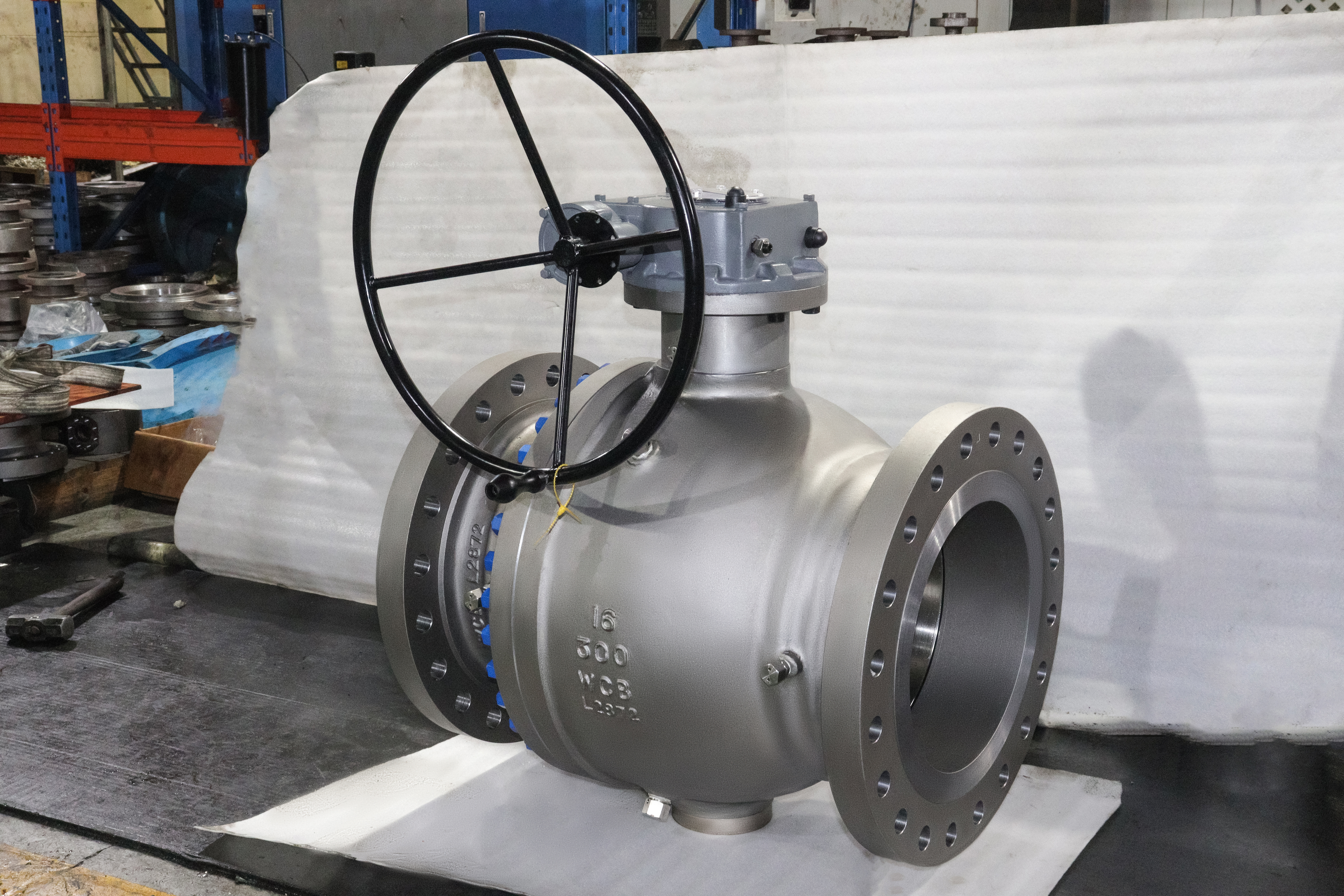
A sixteen inch valve is bought once and repaired several times, and the second part of that sentence is the one that decides whether the purchase was a good one. The body casting will outlive most of the plant around it. The gasket will not, the seats will not, and the packing will not, and every one of those is a purchased part with a lead time.
That is the practical case for a two piece body at this size. One cap, one gasket, one stud ring, and the ball and both seats are reachable without cutting the pipe. A three piece body would give the same access with one more joint and one more gasket to stock, and at sixteen inch the extra joint is a great deal of stud and a great deal of torque.
The plate on the body in the photographs reads 16, 300, WCB and then a four character code. That is size, class, grade and heat, and the heat code is the line that ties this particular casting to the certificate that came with it. It is worth photographing at commissioning, because the plate will still be legible in fifteen years and the paperwork may not be.
What follows is written from the maintenance side: which parts fail, which can be changed with the valve in the line, what to hold on the shelf, and what a repair actually involves on a body this size.
Design and Construction
The body is two castings: a main body carrying one flange, the trunnion bearings and one seat, and a cap carrying the other flange and the other seat. The joint between them is a full circle closed by a stud ring, and it sees full line pressure whenever the valve is pressurised, which is the entire time the line is live.
The ball is carried on an upper and a lower trunnion in the main body, so the bearings do not come out with the cap and their alignment does not depend on how the cap is refitted. That is the structural argument for the two piece arrangement at this size: the part that has to stay true stays in one piece, and the part that comes off carries only a flange and a seat.
The gear on top is bolted to the body, not to the cap. It turns a stem that is retained by the body cover, and the handwheel is sized so that one person can operate the valve without a lever extension. The two feet under the body let the valve stand on a foundation instead of hanging from the flanges.
Material Options
A216 WCB is the body grade and it is right for water, steam and hydrocarbon service at moderate temperature. The parts that will be replaced during the valve's life are the ones worth specifying carefully at purchase, because they are also the ones that are hardest to order later without the original data sheet.
Seats and gaskets are the two items that fail first. A soft seat in PTFE or reinforced PTFE is the normal build and it will harden with age and temperature; the gasket at the body joint is a spiral wound part that is replaced every time the joint is opened, without exception.
| Component | Standard Build | Options | Stock or Order |
|---|---|---|---|
| Body and cap | ASTM A216 WCB | CF8 or CF8M cast stainless | Neither, the body is the life of the valve |
| Ball | WCB with electroless nickel or hard chrome | CF8 or CF8M stainless | Order with the first seat change |
| Seat | PTFE, reinforced PTFE or PPL | Metal seat with hard facing | Stock one set |
| Body joint gasket | Spiral wound, graphite filled | Ring joint gasket | Stock two, they are consumed on opening |
| Packing | Flexible graphite | Braided graphite with alloy wire | Stock one set |
| Bolting | A193 B7 with A194 2H | B8M with 8M | Stock a few, they are often reused once |
| Cavity plug | Steel plug with a compound | Needle valve | Stock one |
| Gear | Worm gear with handwheel | Actuator | Order, not a shelf item |
The gasket is the part that catches people out. It is inexpensive, it is consumed every time the valve is opened, and a joint that is reassembled with the old gasket will weep. Two on the shelf at commissioning is a cheaper habit than an unplanned shutdown while one is flown in.
Technical Specifications
The valve is sixteen inch, Class 300, cast WCB, two piece body, trunnion mounted, gear operated, flanged to ASME B16.5 with a raised face or a ring joint. Class 300 is recorded as PN 50 in API 6D clause 7.2, and the rating in group 1.1 is 740 psi at 38 C.
| Item | Value |
|---|---|
| Size | Sixteen inch, DN400 |
| Pressure class | Class 300, recorded as PN 50 in API 6D clause 7.2 |
| Body style | Two piece cast body, trunnion mounted ball |
| Body material | ASTM A216 WCB, ASME B16.34 group 1.1 |
| Rating | 740 psi at 38 C in group 1.1 |
| Flange | ASME B16.5 Class 300, raised face or ring joint |
| Body joint | One gasketed joint, stud ring, full line pressure |
| Service ports | Cavity drain plug, seat injection fitting |
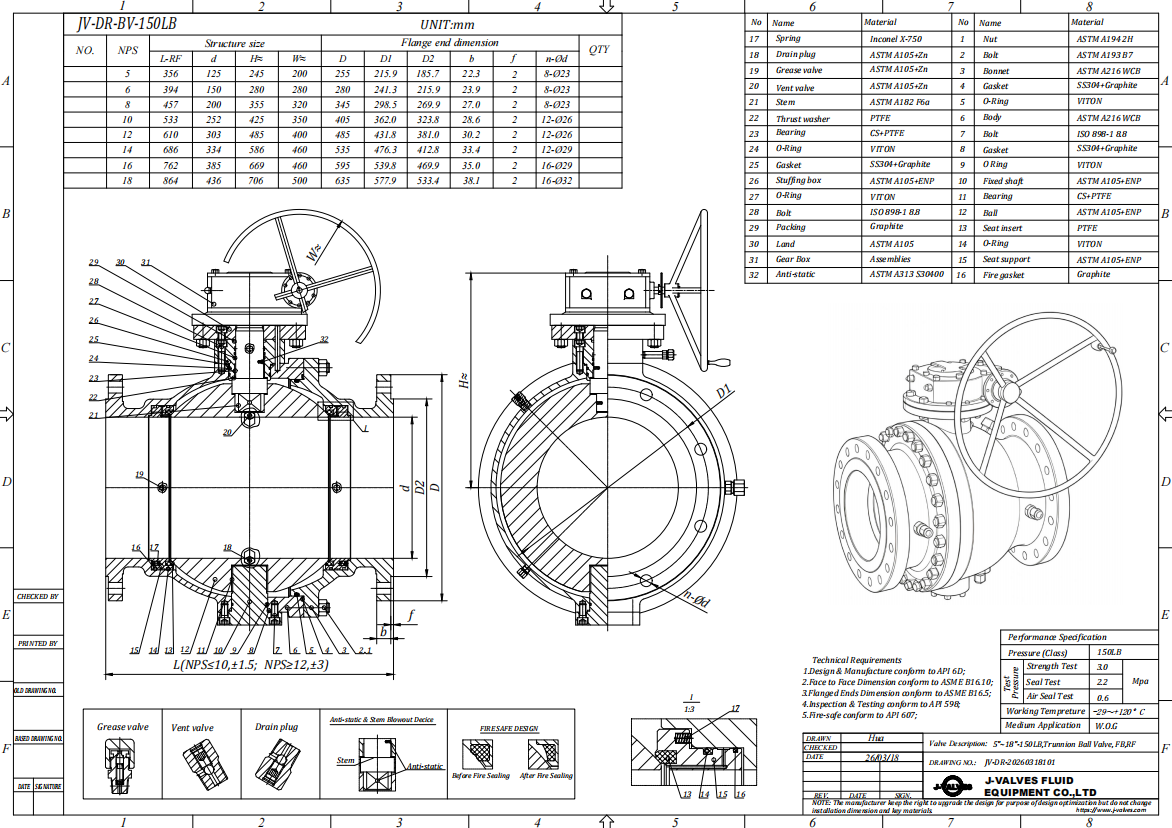
| Face to face | ASME B16.10 for NPS 16 Class 300, confirmed on the signed drawing |
| Temperature | Minus 29 to plus 425 C as a body figure |
| Operator | Worm gear with handwheel as photographed |
| Spares | Gasket, seat set, packing set, studs |
Standards and Compliance
API 608 and API 6D both cover this valve, which matters for repair as well as for purchase: a refurbishment that follows the original standard is easier to document than one that follows a workshop habit. ASME B16.34 supplies the wall and rating basis, and the body is checked against it whenever a repair involves weld repair of the casting.
The repair standard worth naming is API 6D itself, because it defines what a valve has to be after rework as well as before. A repaired valve is tested to the same shell and seat pressures as a new one, and the record should say so; a repair that is signed off on a visual check is a repair with no evidence behind it.
Documentation is the part of a repair that is most often skipped and most often needed. A refurbished valve should leave with a test record that names the pressures used, a parts list with the grade of every item replaced, and a note of any machining done to the joint face. Without those three, the next person to open the valve has no baseline, and the second repair is guesswork.
| Requirement | Document | What It Means Here |
|---|---|---|
| Wall thickness and rating | ASME B16.34 group 1.1 | 740 psi at 38 C in group 1.1 |
| Product standard | API 608 and API 6D | Both apply at this size and class |
| Pressure testing | API 598 | Shell 1.5 times, seat 1.1 times |
| Fire test | API 607 or ISO 10497 | Type test with a scope on the certificate |
| Weld repair of the body | Qualified procedure, post repair test | Documented and re-tested, not dressed |
| Material certificate | EN 10204 3.1 | Heat number matched to the plate |
| Flange dimensions | ASME B16.5 Class 300 | Checked again after any joint face re machining |
Manufacturing Process
The parts that matter in a repair are the joint face and the seat pocket, and both are re machined rather than patched when a valve comes back. A joint face that has been scored by a leaking gasket is skimmed flat, the seat pocket is checked for roundness, and the stud holes are checked for thread damage before anything is reassembled.
Refurbishment then follows the same sequence as the original build: new gasket, seats checked or replaced, ball inspected for the contact band, packing renewed, and the valve tested. The one addition is that the body is examined for corrosion or erosion in the cavity, because a sixteen inch valve that has been sitting in wet service will have lost metal where the flow turns.
Assembly on a body this size is a two person job with a torque wrench and a sequence. The studs are brought up in stages in a cross pattern, and the final pass is a torque figure rather than a feel. On a single joint body the sequence is the entire difference between a valve that holds and one that weeps at commissioning.
The refurbishment decision is worth stating plainly, because it is not always repair. A sixteen inch body with a corroded cavity, a damaged joint face that has been skimmed twice already, or a trunnion bore out of tolerance is a body at the end of its life, and the honest answer is a new valve with the old one kept for parts. What makes that judgement possible is the wall calculation and the machining history rather than a look at the paint.

Quality Control and Testing
A repaired valve is tested exactly like a new one, and there is no reason for that to be negotiable. The shell test loads the body joint at one and a half times the rating, the seat test follows at one and one tenth with the cavity vented, and the gland is watched during the shell test because that is when it is under pressure.
| Step | Check | Acceptance |
|---|---|---|
| 1 Incoming for repair | Body cavity corrosion, joint face condition | Assessed against the wall calculation |
| 2 Machining | Joint face flatness, seat pocket roundness | Drawing tolerance |
| 3 Parts | New gasket, seats and packing | Certified to the original grades |
| 4 Assembly | Stud torque sequence and figure | Drawing figure |
| 5 Shell test | Body and the single joint at 1.5 times | API 598, no leakage |
| 6 Seat test | Each seat at 1.1 times, cavity vented | API 598, zero visible on a soft seat |
| 7 Function | Gear travel, indicator, stop setting | Works standard |
| 8 Record | Test record and parts list issued | Retained with the valve history |
Keeping the test record with the valve is worth more than it costs. A sixteen inch valve may be repaired three times in its life, and each repair without a record starts the history again from nothing.
The record is also what makes a warranty claim possible. A valve that fails two years after installation and has a test sheet from the works is a valve whose failure can be discussed on facts rather than on recollection.

Applications and Industry Service
This size sits on headers and main lines: cooling water, raw water, fire protection, tank farm manifolds and plant utility distribution. In those duties the valve is often left in one position for years and operated only for isolation, which is exactly the duty that stiffens a packing and sets a seat.
The duty that damages a large valve most is not steady flow but the event: a pump trip, a check valve slam, a column of water stopped in a pipe. A two piece body with a geared operator handles that better than a smaller valve would, because the ball is held on trunnions and the seat is not carrying the transient alone, but the stud ring still sees every pressure surge the line can produce.
Because it is a capital item, the spares decision belongs at purchase. A plant that buys a sixteen inch valve and two gaskets and one seat set at the same time will service it in a planned window; a plant that buys the valve alone will service it when the gasket arrives, and by then the window has usually closed.
Installation, Operation and Maintenance
Set the valve on its feet or support the spool either side. A body this size hanging on two flanges will sag, and a joint that has sagged is a joint that leaks at the bottom of the ring where nobody looks until the insulation is wet.
Operate the handwheel through the quarter and read the indicator, and exercise the valve at least once a year even on an isolation duty. A geared valve that is never moved will still move after ten years, but the packing will have taken a set and the seat will have bonded to the ball, and the first operation will be harder than the hundredth.
For a seat change the line is isolated, drained and vented, the cavity is bled through the plug, and the cap studs are released in a pattern from the far side inwards. The cap is lifted with whatever is available, because it is heavy, and the gasket is discarded rather than inspected. The injection fitting is for a temporary stop, not for a repair, and using it as a repair is how a small weep becomes a seat that has to be cut out.
Gasket handling is the small discipline that decides whether the joint holds. The gasket is stored flat, kept dry, and fitted without grease on the sealing faces; the joint faces are wiped clean and checked for a burr left by the last opening. On a single joint body there is no second chance, and the leak that follows a dirty face is always blamed on the gasket supplier.
How to Specify and Order
Six lines fix the valve: size, class, body grade, seat material, flange facing and the operator. A seventh belongs on the same order for a valve this size, which is the spares package: one seat set, two body gaskets, one packing set and a few spare studs.
Four questions are about the line: the medium, the temperature, the pressure, and how often the valve will be operated. The medium decides the body and the ball, the temperature decides the seat, the pressure confirms the class, and the operating frequency decides whether the packing will need attention before the first planned shutdown.
Documents to keep with the valve: the certificate with the heat number, the shell and seat test record, and the parts list with the grade of every replaceable item. The parts list is what makes the next repair possible without a fresh enquiry, and it costs nothing at the time of purchase.
The spares order is worth placing with the valve rather than after the first leak. A seat set and two gaskets made at the same time as the valve are made to the same drawing and the same heat, which is not true of parts ordered five years later from a catalogue description. The cost of holding them is small compared with the cost of a shutdown waiting for a part.
FAQ
Q: Can the seats be replaced with the valve still in the line?
A: Yes, with the line isolated, drained and vented. The cap studs are released in a pattern, the cap comes away, and the seat and ball are reachable through the opening. The valve stays bolted in the pipe, but the joint that was opened needs a new gasket and fresh torque.
Q: Which parts should be ordered with the valve?
A: One seat set, two body gaskets, one packing set and a few spare studs. The gasket is the part that is consumed every time the joint is opened, and a joint reassembled on the old gasket will weep, so having two on the shelf at commissioning is cheaper than an unplanned shutdown.
Q: What fails first on a large cast carbon valve?
A: The soft parts. PTFE and PPL seats harden with age and temperature, the body gasket is consumed each time the valve is opened, and the packing takes a set if the valve is never operated. The casting and the ball usually outlast all three.
Q: Is a repaired valve as good as a new one?
A: It can be, if the repair follows the same standard as the build: joint face re-machined rather than dressed, seats replaced rather than cleaned, and the valve re-tested to API 598 with a record. A repair signed off on a visual check is a repair with no evidence behind it.
Q: Why does this page exist if the same valve is on two other URLs?
A: Because the same photographs and the same body appear on more than one product page, and the useful thing a buyer can be told is how to keep the valve running. This page covers maintenance and spares; the body joint and the casting route are covered on the pages that carry those subjects.


Hot Products


News
Reading A Ball Valve GA Drawing: The Five Dimensions That Decide Whether It Fits
A GA drawing is approved for its outline and lost on its section. The five dimensions that decide whether the valve fits, bolts and can be operated.
Read More
Stainless Steel Ball Valve Grades: 304, 316 And 316L, And What Actually Decides
Molybdenum is the difference that decides the duty, carbon is the difference that gets missed, and the chloride in the line matters more than the price.
Read More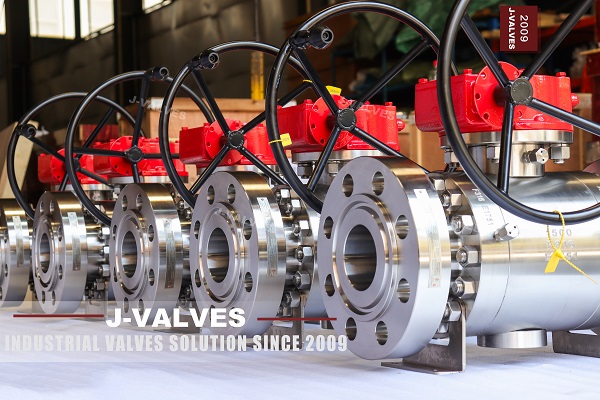
Ball Valve Spare Parts for Overseas Projects: The Wear Part List, The Quantity Math, And Four Traps
Why isolation valves fail on calendar time, not cycles. Wear part lists, Poisson stock maths, seat kit traps and the clauses that decide year six.
Read More
Ball Valves On A Bottom Loading Gantry: Creep, Dry Break And The Test That Proves Neither
A loading gantry cycles a ball valve far more than it is designed for and still cannot prove shut-off. Where creep starts, and what to specify.
Read More