


CHINA J-VALVES Offers Various High-quality I ndustrial Ball Valves
J-VALVES, a distinguished professional ball valve manufacturer rooted in China, takes pride in its extensive product portfolio. Our offerings span a wide range, including trunnion-mounted ball valves, floating ball valves, high-temperature ball valves, high-pressure ball valves, metal-sealed ball valves, ultra-low temperature ball valves, DBB ball valves, Three-way And Four-way Ball Valve, and fully welded ball valves. Each product is a testament to our commitment to precision engineering and reliable performance. Meticulously crafted, they are designed to not only meet but exceed the most stringent industrial demands, ensuring stable operation even under extreme conditions. This enables us to provide our clients with high-value services and makes our valves widely sought-after in industries.
Product Category
Contact Us


-
J-VALVES-Q47F
-
J-VALVES
Overview of the J-VALVES 6x4 inch 300LB WCB reduced bore trunnion ball valve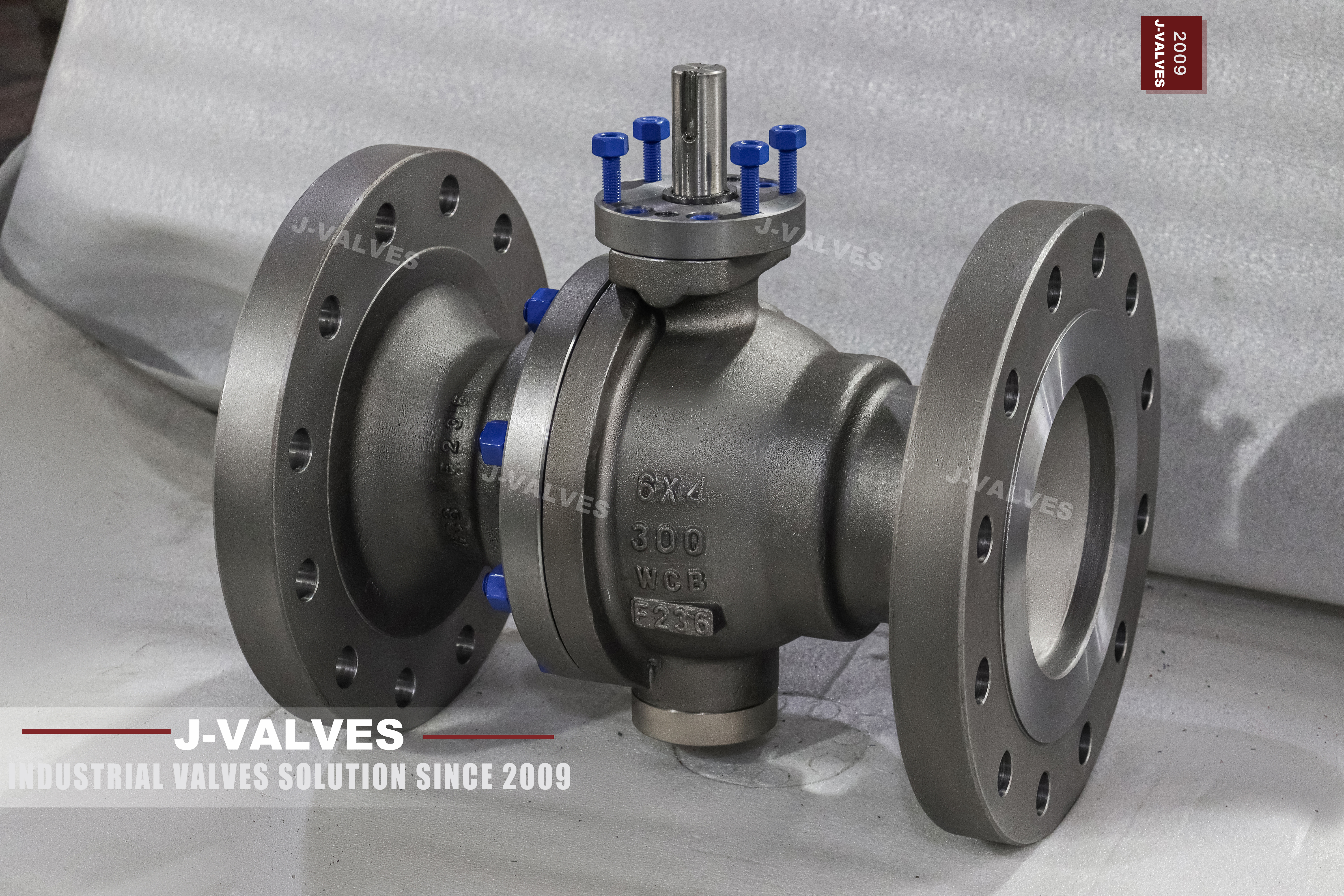
The plate on this body reads 6X4, and that is more informative than any other line on it. Not six, not four: six by four. The valve bolts into a six inch line and passes flow through a four inch bore, and everything about the hardware follows the first number while the flow path follows the second. The flanges are six inch, the gasket is six inch, the bolt circle is six inch, and the ball inside is four.
That arrangement is not a compromise or a mistake, and it is not the same as a badly sized valve. Reduced bore is a tabulated construction in API 6D, with its own face to face dimension for each body size, and it exists because there are three cases where a smaller bore in a bigger body is the right answer: a line that was sized for pressure drop rather than for the valve, a spool where the body has to be strong enough for a class the bore does not need, and a retrofit where the pipe is already there.
The cost of the arrangement sits in two places that nobody mentions in a quotation. The first is the step: the flow path falls from six inch to four inside the valve and rises again on the other side, and that is a permanent feature of the spool rather than something a larger valve would fix. The second is spares: a 6x4 valve shares its flange with a 6x6 and almost nothing else, so the seat, the ball and the gasket are specific to the size pair.
What the photographs show is a two piece cast body in ASTM A216 WCB, a single cap joint closed by a ring of studs, a trunnion mounted ball, and a bare stem on a small pad above the body. The plate is stamped 6X4, 300, WCB, and then a boxed four character code.
Design and Construction
The two piece body is a main body with one cast flange, and a cap with the other. The cap is the smaller part and it carries one seat and one flange; the main body carries the trunnion bearings and the other seat. That split is normal for a two piece trunnion valve, and it means the joint that has to be opened for maintenance is the one on the cap side, while the bearings stay in the part that never comes apart.
The bore step is machined into the body and the cap, and the ball sits behind it. Because the ball is four inch in a body sized for six, the trunnions are shorter than they would be in a 6x6 and the seat pockets are smaller, which is why the parts are not interchangeable across the pair. A six inch seat will not fit a 6x4, and a 6x4 ball will not seat in a 6x6.
The stem is carried on a short neck with a pad above it, and the pad is drilled for an operator. On this build the stem is bare, which means the valve is delivered ready for a lever, a gear or an actuator rather than with one fitted.
Material Options
ASTM A216 WCB is cast carbon steel, and on a 300 lb body at this size it is the economical and correct choice for water, steam, dry gas and hydrocarbon liquids. Its limits are corrosion and low temperature, and both are addressed by changing the casting grade rather than by adding wall.
The ball and seats are where a 6x4 valve can be built two very different ways. A WCB ball with electroless nickel is the standard build for clean service and keeps the cost in proportion to a 300 lb valve. A CF8 or CF8M stainless ball is the upgrade where the bore has to stay clean, which is common on a reduced bore valve because the step is already a place where debris collects.
| Component | Standard Build | Options | What It Decides |
|---|---|---|---|
| Body and cap | ASTM A216 WCB | CF8 or CF8M cast stainless | Corrosion and low temperature limit |
| Ball | WCB with electroless nickel or hard chrome | CF8 or CF8M stainless | Whether the step stays clean |
| Seat | PTFE, reinforced PTFE or PPL | Metal seat with hard facing | Temperature ceiling |
| Stem | 316 stainless | 17-4PH | Drive strength with an operator fitted |
| Packing | Flexible graphite | Braided graphite with alloy wire | Stem seal at temperature |
| Body joint gasket | Spiral wound, graphite filled | Ring joint gasket | The single joint at full line pressure |
| Bolting | A193 B7 with A194 2H | B8M with 8M | Thermal match with the body |
| Cavity plug | Steel plug with a sealing compound | Needle valve | Whether the cavity can be bled |
A stainless ball in a carbon body is the normal upgrade and it is worth the money on a reduced bore valve specifically. Solids that pass a six inch pipe tend to settle where the bore steps down, and a carbon ball with a nickel coating is the part that suffers first when they do.
Technical Specifications
Class 300 is recorded as PN 50 in API 6D clause 7.2, and the body grade puts the valve in group 1.1 of ASME B16.34, where Class 300 reads 740 psi at 38 C. The nominal body size is six inch and the nominal bore is four inch, which are two separate lines on the data sheet and should stay separate on any purchase order.
| Item | Value |
|---|---|
| Body size | Six inch, DN150 |
| Bore size | Four inch, DN100 |
| Pressure class | Class 300, recorded as PN 50 in API 6D clause 7.2 |
| Body style | Two piece cast body, trunnion mounted ball, reduced bore |
| Body material | ASTM A216 WCB, ASME B16.34 group 1.1 |
| Rating | 740 psi at 38 C in group 1.1 |
| Flange | ASME B16.5 Class 300, six inch |
| Face to face | ASME B16.10 for NPS 6 Class 300, confirmed on the signed drawing |
| Temperature | Minus 29 to plus 425 C as a body figure |
| Operator | Bare stem on the pad as photographed; lever, gear or actuator per order |
| Test | API 598 shell and seat, API 6D documentation |
| Product standard | API 608 and API 6D both apply at this size and class |
The fourth line of the plate, the boxed code, is a heat or batch reference rather than a grade. It is stamped inside a border to distinguish it from the material line above it, and it is the character string that ties this casting to a mill certificate. Reading it as a material design would be reading the wrong line.
Standards and Compliance
API 608 and API 6D both apply here, and the reason is the size and class rather than the bore: six inch at Class 300 is inside the DN 15 to DN 600 and Class 150 to 600 scope of 608, and inside the pipeline valve scope of 6D. A reduced bore does not take the valve out of either document, because both are written around the body size and the class.
The face to face dimension is the one place where a reduced bore buyer gets caught. It is tabulated against the body size, not the bore, so a 6x4 shares its length with a 6x6 and not with a four inch valve. Anyone replacing a four inch valve with a 6x4 in an existing spool will find the gap is wrong, and the spool has to change.
| Requirement | Document | What It Means Here |
|---|---|---|
| Wall thickness and rating | ASME B16.34 group 1.1 | 740 psi at 38 C in group 1.1 |
| Flange dimensions | ASME B16.5 Class 300 | Six inch bolt circle |
| Face to face | ASME B16.10 for NPS 6 | Tabulated by body size, not bore |
| Reduced bore construction | API 6D | A tabulated construction, not a modification |
| Pressure testing | API 598 | Shell 1.5 times, seat 1.1 times |
| Fire test | API 607 or ISO 10497 | Type test with a scope on the certificate |
| Material certificate | EN 10204 3.1 | Heat number matched to the boxed code |
| Casting examination | Radiography or ultrasonic when ordered | Report with the certificate |
Manufacturing Process
The body is cast from a pattern made for the six inch class 300 shell, and the bore is subsequently machined to four inch. That sequence is why the shell looks smaller than its flanges in the photographs: the casting was designed around a passage that is machined smaller than the flange opening, and the metal left behind at the step is what gives the body its strength.
Machining is a two stage exercise. The flange faces, the bolt circles and the joint face are cut to the six inch dimensions, and the bore, the seat pockets and the trunnion bores are cut to the four inch ones. Everything is referenced to the same centreline, which is why a 6x4 body cannot be made by taking a 6x6 and shrinking the bore without a new seat pocket geometry.
Assembly and test follow the usual pattern: gasket, stud torque in a cross pattern, cavity plug, then a shell test at one and a half times and a seat test at one and one tenth. On a two piece body the shell test is a single question about a single joint, which is the advantage of the construction and the reason it is used at this size.

Quality Control and Testing
The heat number on the boxed line is the link between the part and the certificate, and it is checked first. Identity by positive material identification follows where the order asks for it, and on a carbon body the reading is as much about excluding a mixed part as about confirming WCB.
| Step | Check | Acceptance |
|---|---|---|
| 1 Incoming | Boxed code against the mill certificate | A216 WCB chemistry and tensile |
| 2 Identity | Positive material identification | Grade match, no mixed parts |
| 3 Casting | Radiography or ultrasonic when ordered | Report to the stated acceptance level |
| 4 Machining | Bore diameter and concentricity with the seat pockets | Drawing tolerance |
| 5 Dimensional | Six inch flange facing, bolt circle, face to face | ASME B16.5 and B16.10 |
| 6 Shell test | Body and the single joint at 1.5 times | API 598, no leakage |
| 7 Seat test | Each seat at 1.1 times, cavity vented | API 598, zero visible on a soft seat |
| 8 Final | Cavity drained, bore dried, faces masked, marked | Works standard |
The dimensional check is where a reduced bore valve earns attention. The bore and the flange belong to two different nominal sizes, so a check that only measures the flange will pass a valve whose bore was machined wrong, and the error will not appear until the flow is commissioned.

Applications and Industry Service
A 6x4 at Class 300 is bought where the line was sized for something other than the valve. Pump discharge headers where the pipe is six inch for velocity and the valve is chosen for a four inch pressure drop, branch lines where a six inch header feeds a four inch circuit, and retrofits where an existing six inch spool has to take a smaller valve without being cut.
It is also used where the body strength of the larger size is wanted at the smaller bore, which is a class argument rather than a flow argument. At 300 lb that is a modest benefit; at 900 or 1500 it is the reason reduced bore exists at all, and the same body size can then be bought in different bore pairs without changing the surrounding steelwork.
Where the line has to be pigged, this valve is the wrong choice. A pig will not pass a step, and no amount of pressure will make it. Anyone specifying a reduced bore valve on a piggable line has to accept that the pig run stops at the valve or that the valve is removed for the operation.
The step also changes how the valve is inspected and cleaned. A spool that has been swept, pigged or chemically cleaned will leave material at the lowest point of the step, and that material is sitting directly on the seat. On a line that carries solids, the 6x4 valve is therefore a place where a cleaning programme has to include the valve rather than stop at it.

Installation, Operation and Maintenance
Match the gasket and the studs to the six inch flange, not to the bore. This sounds obvious and it is the mistake made most often, because the person preparing the joint reads the valve size off the packing list and orders four inch hardware. The flange is the only dimension that matters for the joint.
Support the valve if the spool is long, and bring the mating flanges up parallel before tensioning. A two piece body has one joint and one gasket, and a flange pulled in by the studs will distort that joint face enough to weep at test pressure, at which point the gasket takes the blame.
For maintenance the line is isolated and vented, the cap studs are released in a pattern, and the cap comes away with one seat. The ball is then accessible from that side. The gasket is replaced rather than reused, and the studs are brought back to the drawing figure in a cross pattern, because the single joint is the whole pressure boundary on that side.
How to Specify and Order
Six lines fix the valve: body size and bore size as a pair, class, body grade, seat material, flange facing, and the operator. The first of those is written as a pair and never as a single number, because a 6x4 and a 6x6 are different articles with different internals and different spares.
Four questions are about the line: the medium, the design temperature, the design pressure, and whether the line will ever be pigged. The medium decides the ball and body grade, the temperature decides the seat, the pressure confirms the class, and the pigging question decides whether a reduced bore valve belongs on the line at all.
Documents to name: EN 10204 3.1 with the heat number matched to the boxed code on the plate, the shell and seat test record, the dimensional report showing the bore, and the fire certificate if one is required. The dimensional report is the one that proves the reduced bore was machined as ordered, and it is the only document that will settle an argument about which size was bought if the packing list and the plate ever disagree.
FAQ
Q: What does 6x4 mean on the plate?
A: It is the body size and the bore size as a pair: a six inch body with a four inch bore. The flanges, the gasket and the bolt circle are six inch, the ball and the seats are four inch, and the two are written together because either one alone describes a different valve.
Q: Is a 6x4 the same as a four inch valve?
A: No. It shares its face to face dimension with a 6x6, not with a four inch valve, and it shares nothing with a four inch valve internally. Anyone replacing a four inch valve with a 6x4 in an existing spool will find the gap is wrong and the spool has to change.
Q: Can a pig pass a 6x4 reduced bore valve?
A: No. The bore steps from six inch to four inside the valve, and a pig will not pass a step. On a piggable line the reduced bore valve has to be removed for the operation, or a full bore valve has to be used instead.
Q: What is the boxed code on the plate?
A: A heat or batch reference rather than a material designation. It is stamped inside a border to separate it from the grade line above it, and it is what ties this casting to the mill certificate. The material is the WCB line.
Q: Why use a reduced bore at Class 300?
A: Because the line was sized for velocity rather than for the valve, because an existing six inch spool has to take a smaller valve, or because the body strength of the larger size is wanted at a smaller bore. At Class 300 the last of those is a modest benefit; at 900 and above it is the reason reduced bore exists.


Hot Products


News
Reading A Ball Valve GA Drawing: The Five Dimensions That Decide Whether It Fits
A GA drawing is approved for its outline and lost on its section. The five dimensions that decide whether the valve fits, bolts and can be operated.
Read More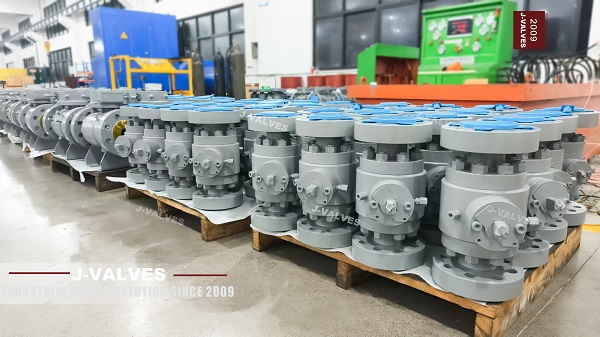
Stainless Steel Ball Valve Grades: 304, 316 And 316L, And What Actually Decides
Molybdenum is the difference that decides the duty, carbon is the difference that gets missed, and the chloride in the line matters more than the price.
Read More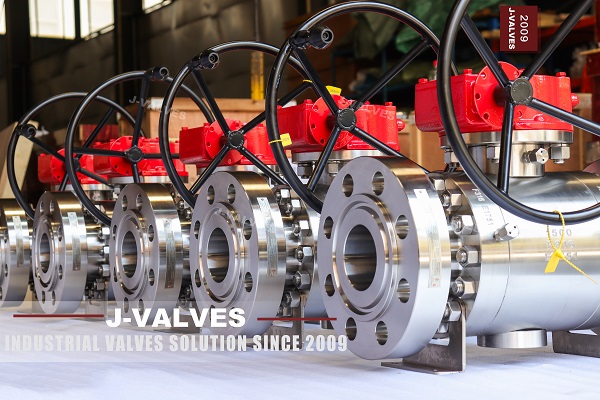
Ball Valve Spare Parts for Overseas Projects: The Wear Part List, The Quantity Math, And Four Traps
Why isolation valves fail on calendar time, not cycles. Wear part lists, Poisson stock maths, seat kit traps and the clauses that decide year six.
Read More
Ball Valves On A Bottom Loading Gantry: Creep, Dry Break And The Test That Proves Neither
A loading gantry cycles a ball valve far more than it is designed for and still cannot prove shut-off. Where creep starts, and what to specify.
Read More