


CHINA J-VALVES Offers Various High-quality I ndustrial Ball Valves
J-VALVES, a distinguished professional ball valve manufacturer rooted in China, takes pride in its extensive product portfolio. Our offerings span a wide range, including trunnion-mounted ball valves, floating ball valves, high-temperature ball valves, high-pressure ball valves, metal-sealed ball valves, ultra-low temperature ball valves, DBB ball valves, Three-way And Four-way Ball Valve, and fully welded ball valves. Each product is a testament to our commitment to precision engineering and reliable performance. Meticulously crafted, they are designed to not only meet but exceed the most stringent industrial demands, ensuring stable operation even under extreme conditions. This enables us to provide our clients with high-value services and makes our valves widely sought-after in industries.
Product Category
Contact Us


-
J-VALVES-Q47F
-
J-VALVES
Overview of the J-VALVES 2 inch 1500LB A105N trunnion ball valve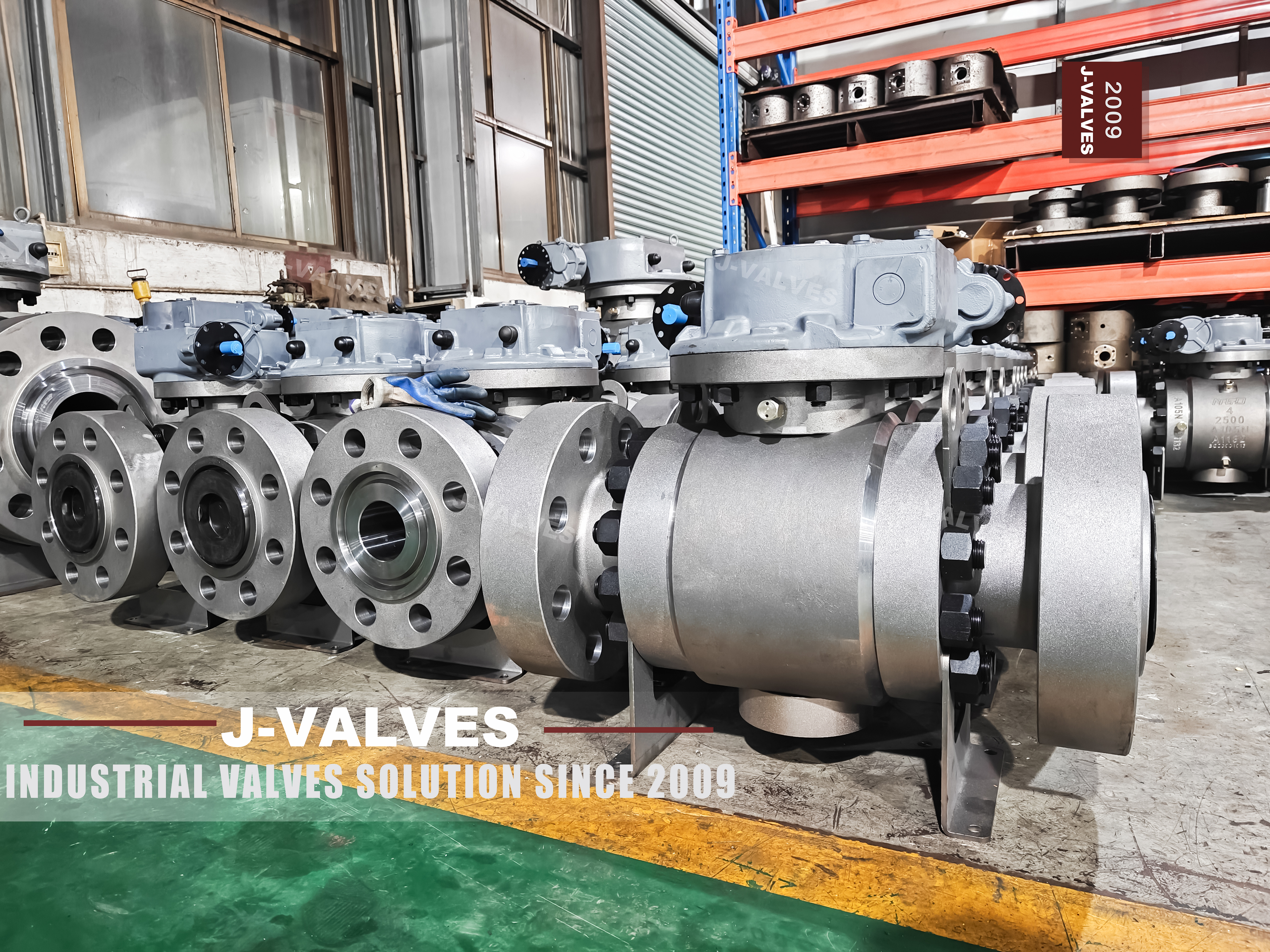
Every valve carries its own documentation, and on this one it is stamped into the body in four lines. The plate in the photographs reads 2, then 1500, then A105N, then a four digit number, and the same four lines are repeated on both caps. Nobody had to write a data sheet to produce that: it is what the foundry, the machine shop and the inspector put on the part so that it can be identified after the paperwork has been filed.
Read properly, the four lines are size, class, material and heat. Each one has a trap in it for a buyer who reads quickly. The size is nominal, not the bore. The class is not a pressure, it is a table reference that has to be converted at the design temperature. The material designation is a condition as much as a grade, because the N on the end of A105N is doing real work. And the last line is not a grade at all, it is a traceability number, which is the only one of the four that will never appear on a quotation.
The valve itself is a three piece forged body with a trunnion mounted ball, ring joint or raised face flanges, and a bare stem on a mounting pad above a short neck. At two inch and Class 1500, the flanges and the two body joints are physically larger than the ball they contain, which is the first thing a buyer notices when the valve arrives.
This page takes the four lines one at a time. It is the fastest way to explain why two valves that both say 1500 can be rated differently, and why a quotation that swaps a grade can be wrong without anybody noticing.
Design and Construction
The body is three forgings: the centre section with both trunnion bearings, and two caps that carry the flanges and their own stud rings. Both joints see full line pressure, and both are closed on spiral wound gaskets or, where a ring joint facing is specified, on metal rings in machined grooves. The ball is carried on an upper and a lower trunnion, so the pressure thrust goes into the bearings rather than into the seats, and the stem only turns the ball.
The neck is the detail that distinguishes this build. The stem runs up through a short extension and ends in a plain drive above a bolted pad plate, which raises the operator clear of the body and gives an actuator something flat to mount to. It is not a tall extension and it is not a bonnet: the packing stays at the body end, and the neck exists to put the drive where a hand or a bracket can reach it.

Material Options
A105 is the standard forged carbon steel for valve bodies, and A105N is the same grade in the normalized condition. That is the whole difference and it is not cosmetic. Normalizing refines the grain and makes the impact behaviour more predictable, which is why a specification that cares about toughness at low temperature writes the N. A certificate that says A105 without the N is not wrong, it is simply not the same promise.
The alternatives are driven by the medium rather than the class. A350 LF2 for low temperature carbon service, A182 F304 or F316 where the medium is corrosive, and the alloy grades where the temperature climbs. At Class 1500 the body is doing real work, so the substitution of one grade for another is a design change and not a purchasing convenience.
| Component | Standard Build | Options | What It Decides |
|---|---|---|---|
| Body and caps | ASTM A105N forging, normalized | A350 LF2, A182 F304 or F316 | Toughness and corrosion resistance |
| Ball | A105N with electroless nickel or hard chrome | CF8 or CF8M stainless | Bore cleanliness and wear |
| Seat | PTFE, reinforced PTFE or PPL | Metal seat with hard facing | Temperature ceiling |
| Stem | 316 stainless | 17-4PH | Drive strength for an actuator |
| Packing | Flexible graphite | Braided graphite with alloy wire | Stem seal at temperature |
| Body joint gasket | Spiral wound, graphite filled | Ring joint gasket | The two joints at full line pressure |
| Bolting | A193 B7 with A194 2H | B8M with 8M | Thermal match with the body |
| Cavity plug | Steel plug with a sealing compound | Needle valve for venting | Whether the cavity can be bled safely |
A carbon ball in a carbon body with a nickel coating is a legitimate build at this size and it is cheaper than stainless. What it will not do is stay bright in a wet line, and a bore that has rusted is a bore that will wear the seat faster than a stainless one would.
Technical Specifications
Class 1500 is recorded as PN 250 in API 6D clause 7.2, and that pairing is the one to hold on to. The data sheet for this valve writes the class as PN 260, which is a figure that appears in neither API 6D nor the EN flange tables, and which looks like the class rating converted into bar and rounded up rather than a designation quoted from a standard.
| Item | Value |
|---|---|
| Size | Two inch, DN50 |
| Pressure class | Class 1500, recorded as PN 250 in API 6D clause 7.2 |
| Body style | Three piece forged body, trunnion mounted ball |
| Body material | ASTM A105N, normalized, ASME B16.34 group 1.1 |
| Rating | Group 1.1 at Class 1500 reads 3705 psi at 38 C |
| Flange | ASME B16.5 Class 1500, raised face or ring joint |
| Bore | Full port as photographed |
| Face to face | ASME B16.10 for NPS 2 Class 1500, confirmed on the signed drawing |
| Temperature | Minus 29 to plus 425 C as a body figure; the seat sets the working ceiling |
| Operator | Bare stem on the pad as photographed; lever, gear or actuator on request |
| Test | API 598 shell and seat, API 6D documentation |
| Product standard | API 6D; API 608 does not reach this class |
The rating is worth one more sentence because it is the number that gets quoted in conversation. Group 1.1 at Class 1500 is 3705 psi at 38 C, and the table falls away as the temperature rises, so the same valve in a hot line is rated lower than the figure on the front of the catalogue. The class does not change; the rating does.
Standards and Compliance
API 6D governs the design, the marking and the documentation. API 608 does not apply at this class: its scope stops at Class 600, so a 1500 class valve citing 608 is citing a document whose scope excludes it. ASME B16.34 sits behind both as the wall and rating standard, and ASME B16.5 fixes the flange.
The nameplate is part of the compliance story rather than decoration. API 6D requires the body to be marked with the size, the class, the material and a heat or serial reference, and the marking has to survive the paint. On this valve the four lines are stamped into the forging before painting, which is why they are still legible in a photograph taken in daylight.
| Requirement | Document | What It Means Here |
|---|---|---|
| Pipeline valve design and marking | API 6D | Governing standard at this class |
| Wall thickness and rating | ASME B16.34 group 1.1 | 3705 psi at 38 C, falling with temperature |
| Flange dimensions | ASME B16.5 Class 1500 | Raised face or ring joint |
| Face to face | ASME B16.10 | Confirmed on the signed drawing |
| Pressure testing | API 598 | Shell 1.5 times, seat 1.1 times |
| Fire test | API 607 or ISO 10497 | Type test with a scope on the certificate |
| Material certificate | EN 10204 3.1 | Heat number matched to the stamped figure |
| Sour service | NACE MR0175 on request | Hardness limits on body, trim and bolting |
Manufacturing Process
The forging is cut from bar or billet, heated and worked into a blank close to the finished shape, then normalized: heated above the critical temperature and cooled in air so that the grain refines uniformly through the section. That treatment is what the N on the plate records, and it is done before machining because the part moves when it is normalized and not after.
Machining establishes the bore, the two joint faces, the seat pockets and the stem bore. On a three piece body the centre section is machined in one setting so that the trunnion bores and the stem bore stay coaxial, and the caps are then machined to fit it. The joint faces are the surfaces that decide whether the valve passes its shell test, and they are checked for flatness rather than for appearance.
Assembly is a gasket and torque job, then a test. The studs are brought up in a cross pattern in stages, the cavity plug is fitted with a compound that suits the service, and the valve is set with the ball fully open or fully closed rather than left part way. A trunnion valve parked at half travel for shipping is a valve whose seat has been asked to do something it was not designed for.
Marking is the last operation and it is controlled rather than casual. The four lines are stamped into the forging with a rounded-nose tool so that no sharp notch is left in a pressure-containing wall, and the same four lines are repeated on each cap so that a part separated from the body can still be identified. The paint goes on afterwards, thin enough that the stamping stays legible, which is why the characters in the photographs still read after finishing.

Quality Control and Testing
The heat number is the thread that ties the test record to the part. A positive material identification reading on the finished body confirms the grade, and on a carbon forging it will also show whether the part is A105 or something else that was in the rack. Where the order asks for hardness testing, as it would for a sour service order under NACE, that reading is taken on the body and on the trim.
| Step | Check | Acceptance |
|---|---|---|
| 1 Incoming | Heat number against the mill certificate | A105N chemistry, tensile and normalizing record |
| 2 Identity | Positive material identification | Grade match, no mixed parts |
| 3 Hardness | Body and trim when specified | NACE MR0175 limits where applicable |
| 4 Machining | Joint face flatness, seat pocket concentricity | Drawing tolerance |
| 5 Shell test | Body and both joints at 1.5 times | API 598, no leakage |
| 6 Seat test | Each seat at 1.1 times, cavity vented | API 598, zero visible on a soft seat |
| 7 Function | Quarter turn, stop position, pad squareness | Works standard |
| 8 Final | Cavity drained, bore dried, faces protected, marked | API 6D marking |
The normalizing record is the document people forget to ask for. A certificate can state A105N while the heat treatment sheet shows a different cycle, and the two together are what prove the N. On a valve that will sit in a cold line or see pressure cycling, that sheet is the difference between a grade and a claim.

Applications and Industry Service
Two inch at Class 1500 is a high pressure small bore duty: instrument and injection lines, hydraulic power circuits, wellhead and manifold work, gas letdown and metering runs. The valve is small enough to be handled by two people and heavy enough that the flanges are the biggest thing on it, which is why the body joint studs and the flange bolts dominate the appearance.
In these duties the valve is often closed for long periods and opened on demand, which puts the emphasis on the seat and the stem seal rather than on the bore. A soft seat is the right answer for clean dry gas and a metal seat for anything hot or abrasive, and the class does not decide which one is correct.
One consequence of the small bore and high class is that the valve is mostly made of flange. The two B16.5 flanges at this class are thick, the bolt circle is wide, and the studs are large for the pipe they serve, which is why the body looks compressed between its ends. That is normal at 1500 and it is worth remembering when the valve is being installed in a tight space: the clearance needed is set by the flange diameter and the stud length, not by the body.

Installation, Operation and Maintenance
Check the flange facing and the class marking before the joint is made. A 1500 class flange has a specific bolt pattern and, where a ring joint is specified, a specific groove; a gasket or ring of the wrong number will sit on the face and leak at pressure. Studs go in with lubricated threads and come up in a cross pattern in stages.
Operate through the quarter turn and stop at the stop. Where the stem is bare, an operator has to be fitted before the valve is put into automatic service, and the actuator bracket has to sit square on the pad so that the stem is not side loaded. A stem bent by a badly fitted bracket is a stem seal that will weep for the rest of the valve's life.
For maintenance the line is isolated, drained and vented, then both caps come off and the ball and seats come out. The pipe stays in place. The gaskets are replaced rather than reused, the studs are re-torqued to the drawing figure, and the cavity plug is refitted with a compound that will survive the service temperature.
How to Specify and Order
Six lines fix the valve: size, class, body grade with the normalizing requirement, seat material, flange facing with the ring number where a ring joint is used, and the operator. On this size the grade line matters more than usual, because A105 and A105N are often quoted as if they were the same thing and only one of them carries the toughness promise.
Four questions are about the line: the medium, the design temperature, the design pressure, and whether the service is sour. The medium decides the body and the ball, the temperature decides the seat and the packing, the pressure confirms the class, and a sour service answer changes the hardness limits on everything.
Ask for the documents you will need at handover: EN 10204 3.1 with the heat number matched to the plate, the normalizing record, the shell and seat test record, and the fire certificate with its scope. All four exist for this valve; only the first is in the default delivery.
FAQ
Q: What is the difference between A105 and A105N?
A: The N is the normalized condition. A105N is the same forged carbon steel grade, heated above the critical temperature and cooled in air so that the grain refines and the impact behaviour becomes predictable. A certificate that says A105 without the N is not the same promise, and the heat treatment sheet is what proves the difference.
Q: Is Class 1500 the same as PN 260?
A: No. API 6D clause 7.2 records Class 1500 as PN 250, and PN 260 appears in neither API 6D nor the EN flange tables. The figure looks like the class rating converted into bar and rounded, which is not the same thing as a designation quoted from a standard.
Q: What pressure does Class 1500 hold in A105N?
A: In group 1.1 of ASME B16.34, Class 1500 reads 3705 psi at 38 C. The figure falls as the design temperature rises, so the rating has to be read at temperature rather than at ambient, and the class itself never changes.
Q: Is the four digit number on the plate a material?
A: No, it is a heat or batch reference. It is stamped so that the body can be traced back to the mill certificate that came with the forging. The material is the third line, A105N, and the heat number is what connects the two.
Q: Is API 608 applicable at Class 1500?
A: No. API 608 covers flanged ball valves at classes 150 to 600, so a 1500 class valve citing it is citing a document whose scope excludes it. The governing standard is API 6D, with ASME B16.34 for the wall and the rating.


Hot Products


News
Reading A Ball Valve GA Drawing: The Five Dimensions That Decide Whether It Fits
A GA drawing is approved for its outline and lost on its section. The five dimensions that decide whether the valve fits, bolts and can be operated.
Read More
Stainless Steel Ball Valve Grades: 304, 316 And 316L, And What Actually Decides
Molybdenum is the difference that decides the duty, carbon is the difference that gets missed, and the chloride in the line matters more than the price.
Read More
Ball Valve Spare Parts for Overseas Projects: The Wear Part List, The Quantity Math, And Four Traps
Why isolation valves fail on calendar time, not cycles. Wear part lists, Poisson stock maths, seat kit traps and the clauses that decide year six.
Read More
Ball Valves On A Bottom Loading Gantry: Creep, Dry Break And The Test That Proves Neither
A loading gantry cycles a ball valve far more than it is designed for and still cannot prove shut-off. Where creep starts, and what to specify.
Read More