


CHINA J-VALVES Offers Various High-quality I ndustrial Ball Valves
J-VALVES, a distinguished professional ball valve manufacturer rooted in China, takes pride in its extensive product portfolio. Our offerings span a wide range, including trunnion-mounted ball valves, floating ball valves, high-temperature ball valves, high-pressure ball valves, metal-sealed ball valves, ultra-low temperature ball valves, DBB ball valves, Three-way And Four-way Ball Valve, and fully welded ball valves. Each product is a testament to our commitment to precision engineering and reliable performance. Meticulously crafted, they are designed to not only meet but exceed the most stringent industrial demands, ensuring stable operation even under extreme conditions. This enables us to provide our clients with high-value services and makes our valves widely sought-after in industries.
Product Category
Contact Us


-
J-VALVES-Q347F
-
J-VALVES
Overview of the J-VALVES 16 inch 300LB WCB trunnion ball valve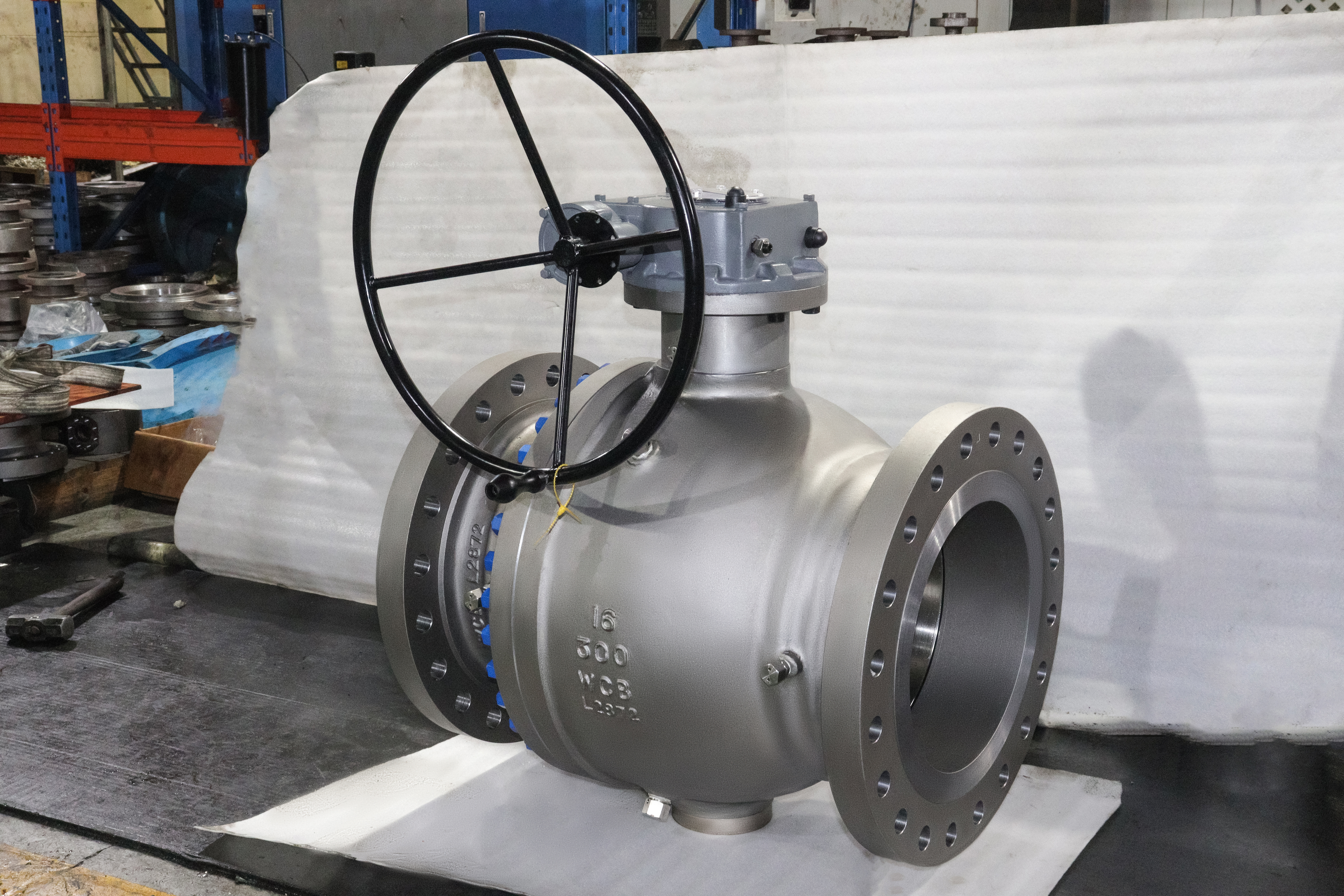
Nobody forges a sixteen inch Class 300 ball valve body in production. The blank would be enormous, the press tonnage would be punishing, and the machining that followed would remove more metal than the forging saved. So the body is cast, in ASTM A216 WCB, and the interesting questions are not whether casting is acceptable but which casting, made how, examined how, and machined to what.
That is what this page is about. Sixteen inch at Class 300 is a modest pressure duty, 740 psi at 38 C in group 1.1 of ASME B16.34, which means the wall is driven by stiffness, flange geometry and handling rather than by hoop stress. The casting is therefore not working hard, and the risk in it is not strength but soundness: a shrinkage void in a fillet, a gas hole behind a flange, a repair that was welded and dressed and painted over.
The valve in the photographs is a two piece body, a main body and one cap, cast and painted, with a worm gear under a large spoked handwheel. The casting skin is visible on the shell and gone from every machined face, which is exactly what a foundry and a machine shop are supposed to leave behind. The nameplate is cast in relief and stamped afterwards.
A buyer of this size is usually not choosing between cast and forged at all. They are choosing between foundries, and the specification that separates them is the examination clause, not the grade.
Design and Construction
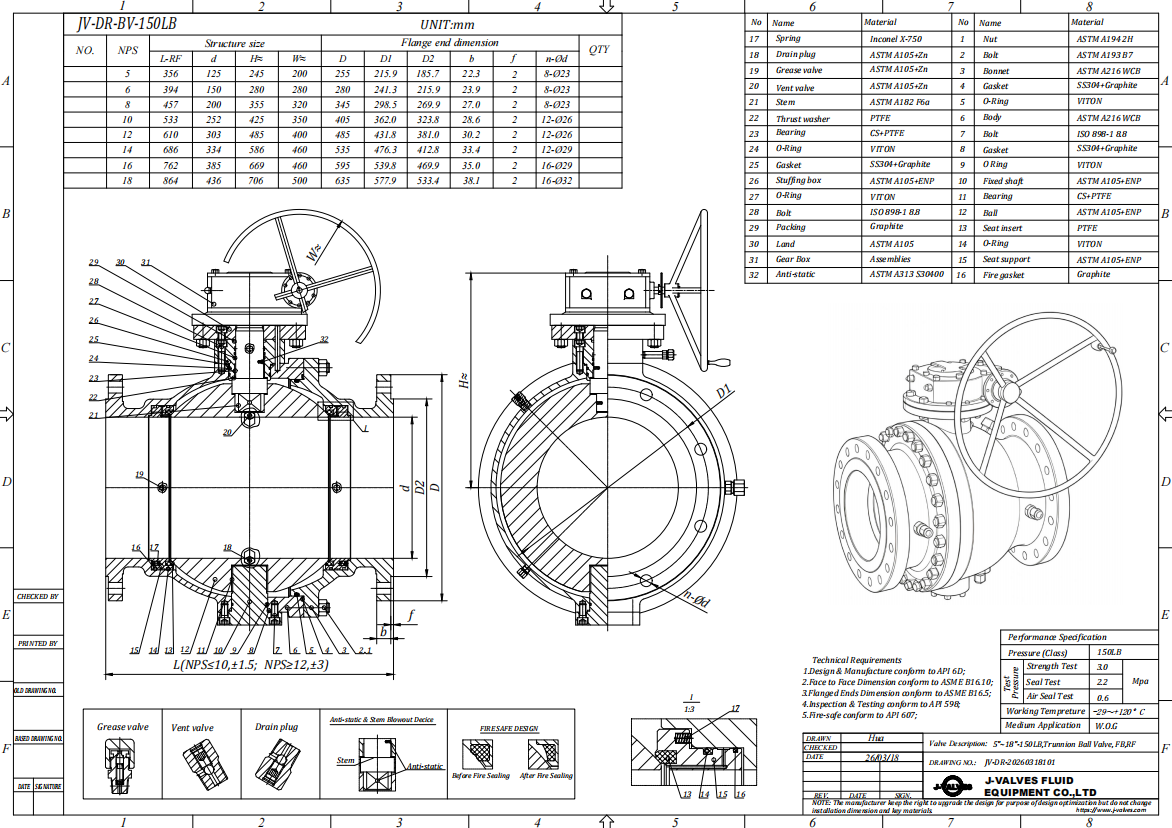
The body is a shell around a ball with two flanges cast into it, one on the main body and one on the cap. The wall between the bore and the outside is a casting dimension, so it has to be controlled by the pattern and checked by measurement rather than assumed from a plate thickness. Fillets at the flange-to-shell transition are where a casting either works or does not, because that is where the section changes fastest and where shrinkage porosity likes to sit.
One cap joint runs around the full circle on the cap side, with its own gasket and its own stud ring, and it holds full line pressure whenever the valve is pressurised. Sixteen inch is too large for a lever to be honest about: the hand force needed to seat a ball this size is beyond what a person should apply, which is why the photographs show a geared handwheel with a wheel large enough to be gripped with both hands.
Inside, the ball is carried on an upper and a lower trunnion so that the pressure thrust goes into the bearings and not into the seat. The seats are spring energised and pressure assisted, and the cavity between them is reachable from outside through a plug, which is the port a maintenance team uses to confirm the valve is holding before the line is opened.
Material Options
ASTM A216 WCB is cast carbon steel with a carbon and manganese specification and no alloy addition worth the name. Its virtues are strength, weldability, machinability and price, and its limits are corrosion resistance and low temperature toughness. It is the correct body for water, steam, dry gas, hydrocarbon liquids and neutral process streams, and the wrong body for anything wet, chlorinated or acidic.
The ball and seats are a separate decision from the body. A WCB ball with electroless nickel or hard chrome is the economical build for clean service, and a CF8 or CF8M stainless ball is the normal upgrade where the bore has to stay clean or the medium is mildly aggressive. Seat material then sets the temperature, because the body can take far more heat than any soft insert can.
| Component | Standard Build | Options | What It Decides |
|---|---|---|---|
| Body and cap | ASTM A216 WCB cast carbon steel | CF8 or CF8M cast stainless | Corrosion resistance and low temperature limit |
| Ball | WCB with electroless nickel or hard chrome | CF8 or CF8M stainless | Bore cleanliness and erosion |
| Seat | PTFE, reinforced PTFE or PPL | Metal seat with cobalt based facing | The real temperature ceiling |
| Stem | 316 stainless | 17-4PH | Strength at the drive end |
| Packing | Flexible graphite | Braided graphite with alloy wire | Stem sealing at temperature |
| Body joint gasket | Spiral wound, graphite filled | Ring joint gasket | The single joint at full line pressure |
| Bolting | A193 B7 with A194 2H | B8M with 8M for a stainless body | Thermal match with the body |
| Coating | Shop primer over a prepared surface | Epoxy system for buried or coastal service | Whether the casting skin survives ten years |
A cast carbon body and a stainless ball is the most common combination in this size, and it is not a compromise. The body carries pressure and does not see the flow; the ball does both, so the money goes on the ball.
Technical Specifications
The range statement for this valve is narrow: sixteen inch, Class 300, flanged to ASME B16.5 with a raised face or a ring joint, two piece cast body, trunnion mounted ball, gear operated. Everything else on the data sheet is either a standard reference or an option.
Class 300 is recorded as PN 50 in API 6D clause 7.2, which is the cross reference that lets a metric piping specification order the same valve. Getting that line right saves a surprising amount of correspondence, because a buyer who reads PN 50 as a different pressure from 300 lb will ask for a re-quote that changes nothing.
| Item | Value |
|---|---|
| Size | Sixteen inch, DN400 |
| Pressure class | Class 300, recorded as PN 50 in API 6D clause 7.2 |
| Body style | Two piece cast body, trunnion mounted ball |
| Body material | ASTM A216 WCB, ASME B16.34 group 1.1 |
| Rating | 740 psi at 38 C in group 1.1 |
| Flange | ASME B16.5 Class 300, raised face or ring joint |
| Bore | Full port as photographed |
| Face to face | ASME B16.10 for NPS 16 Class 300, confirmed on the signed drawing |
| Temperature | Minus 29 to plus 425 C, the carbon steel ceiling |
| Operator | Worm gear under a spoked handwheel as photographed |
| Test | API 598 shell and seat, API 6D documentation |
| Product standard | API 608 and API 6D both apply at this size and class |
Face to face is worth a sentence because it is the number that decides whether the valve fits the gap that is already in the pipe. It comes from the ASME B16.10 table for the size and class, and the finished valve is checked against the signed drawing rather than against the catalogue, because at sixteen inch a millimetre of mismatch is a spool that has to be cut.
Standards and Compliance
API 608 and API 6D both cover this valve, and the two are not alternatives. API 608 sets requirements for flanged ball valves from DN 15 to DN 600 at classes 150 to 600, which includes a sixteen inch Class 300 valve, and API 6D sets the pipeline valve requirements that most buyers actually test against. A certificate may cite either or both; a buyer should ask which one the design was checked to.
ASME B16.34 supplies the wall calculation and the rating. In group 1.1, Class 300 reads 740 psi at 38 C, and the same table falls away as the temperature climbs, so a valve ordered for a hot line has to be checked at the design temperature and not at ambient. NPS 16 is still inside ASME B16.5, which is the reason this valve has a standard bolt circle at all; one size class up, and the flange table changes.
| Requirement | Document | What It Means Here |
|---|---|---|
| Wall thickness and rating | ASME B16.34 group 1.1 | 740 psi at 38 C, falling with temperature |
| Flange dimensions | ASME B16.5 Class 300 | Standard bolt circle at NPS 16 |
| Face to face | ASME B16.10 | Checked against the signed drawing |
| Product standard | API 608 and API 6D | Both apply at this size and class |
| Pressure testing | API 598 | Shell 1.5 times, seat 1.1 times |
| Fire test | API 607 or ISO 10497 | Type test with the scope stated |
| Casting examination | Radiography or ultrasonic, when ordered | Report issued with the certificate |
| Material certificate | EN 10204 3.1 | Heat number matched to the casting stamp |
Manufacturing Process
A cast body begins with a pattern, and at sixteen inch the pattern is a piece of tooling in its own right. Sand is packed around it, the pattern is drawn, cores are set for the bore and the seat pockets, the mould is closed and the metal is poured. The gating and the feeders are designed so that the thick sections feed the thin ones as the casting solidifies, because the alternative is shrinkage porosity in exactly the places that matter.
After casting the body is cleaned, the gates are cut off, and the part is heat treated to the condition the specification asks for. Only then is it machined: flange faces, the joint face, the seat pockets, the stem bore and the trunnion bores. Machining a casting before it has been stress relieved is how a body ends up with a joint face that is flat on the bench and not flat in service.
Assembly, gasket fit and stud torque then decide whether the single body joint holds at test pressure. That is the step where a foundry and a machine shop either combine into a valve or do not, and it is the reason a buyer who has had one bad experience with a large cast body tends to add an examination clause to every order afterwards.

Quality Control and Testing
The examination clause is the whole conversation on a casting. Radiography of the body and the joint region, ultrasonic examination of the wall, or dye penetrant on the machined faces are all available and none is in the default delivery. A buyer who needs soundness demonstrated has to name the method and the acceptance level, and the report will then be specific to that casting rather than to a batch.
Dimensional control at this size is mostly about the flange. The facing, the bolt circle, the number of holes and their positions are checked against ASME B16.5, and the face to face length is checked against the drawing. A sixteen inch valve that is not square to its flanges will pull a spool out of alignment when the studs are tensioned, and the leak that follows is usually blamed on the gasket.
| Step | Check | Acceptance |
|---|---|---|
| 1 Incoming | Heat number against the mill certificate | A216 WCB chemistry and tensile |
| 2 Casting | Radiography or ultrasonic when ordered | Report to the stated acceptance level |
| 3 Machining | Flange facing, bolt circle, joint face flatness | ASME B16.5 and the drawing |
| 4 Dimensional | Face to face, bore, flange squareness | ASME B16.10 and the signed drawing |
| 5 Shell test | Body and the single joint at 1.5 times | API 598, no leakage |
| 6 Seat test | Each seat at 1.1 times, cavity vented | API 598, zero visible on a soft seat |
| 7 Function | Gear travel, indicator position, stop setting | Works standard |
| 8 Final | Cavity drained, bore dried, faces masked, coating | Works standard |

Applications and Industry Service
Sixteen inch Class 300 is a water and utility size. Cooling water headers in power and process plants, raw and treated water in municipal and industrial supply, fire protection headers where a large isolation valve is required, and terminal and tank farm lines where the medium is liquid and the pressure is modest.
It is also a size that appears in hydrocarbon service where the line is large and the pressure is low, such as tank farm manifolds and pump suction headers. In those duties the cast body is the right answer and a forged one would be a needless expense, provided the examination clause is written to match the consequence of a leak.
Where the medium turns corrosive, the answer is not a heavier carbon wall but a change of material, and at this size a cast stainless body in CF8 or CF8M is the usual substitution. Where the temperature falls below the carbon steel limit, the answer is a low temperature cast grade rather than a carbon body with a thicker wall.

Installation, Operation and Maintenance
Plan the lift before the valve arrives. A sixteen inch cast body with a gear on top is not a two person item, and the lifting points are the forged eye or the sling around the body, never the handwheel or the gear housing. Set the valve so that its weight is carried by the pipe supports either side rather than by the flanges.
Bring the mating flanges up parallel before any stud is tensioned, use a new gasket, and torque in a cross pattern in stages. On a single joint body there is no second joint to share the load, so the sequence matters more than it does on a three piece body. Check that the valve is in the position the indicator claims before the line is filled, because a geared valve turned by hand can be left between positions.
For maintenance the line is isolated, drained and vented, the cap studs are released in a pattern, and the cap comes away with the ball and seats reachable through the opening. The gear stays on the body. The joint that was opened needs a new gasket and fresh torque, and the cavity plug needs to be refitted with a sealing compound that suits the service.
How to Specify and Order
Seven lines fix this valve: size and class, body material and whether stainless is required, the casting examination method and acceptance level, flange facing, seat material, the operator, and the coating system. The examination line is the one that separates two suppliers quoting the same grade, and it is the line most often left out of a first enquiry.
Four questions are about the line rather than the valve: the medium, the design temperature, the design pressure, and the consequence of a leak. The medium decides whether carbon is acceptable, the temperature decides the seat, the pressure confirms the class, and the consequence decides how much examination the casting has to survive before it ships.
Ask for the documents by name: EN 10204 3.1 for body and trim, the radiography or ultrasonic report if examination was specified, the shell and seat test record, the dimensional report, and the fire certificate with its scope. Everything listed is available at this size; the default delivery contains the certificate and the test record and nothing else.
FAQ
Q: Why is a sixteen inch body cast rather than forged?
A: Because the blank would be enormous, the press tonnage punishing, and the machining that followed would remove more metal than the forging saved. At Class 300 and this size the wall is driven by stiffness and flange geometry rather than by hoop stress, so a sound casting does the job without the cost of a forging.
Q: What examination should be ordered on the casting?
A: Radiography of the body and the joint region, ultrasonic examination of the wall, or penetrant on the machined faces. None of them is in the default delivery, and each has to be ordered with an acceptance level, so the report describes this casting rather than a batch.
Q: Is API 608 applicable at this size?
A: Yes. API 608 covers flanged ball valves from DN 15 to DN 600 at classes 150 to 600, which includes sixteen inch at Class 300. API 6D also applies, and most buyers test against 6D, so a certificate may cite either or both.
Q: What is 300 lb in bar?
A: The class is recorded as PN 50 in API 6D clause 7.2, and in group 1.1 of ASME B16.34 the rating is 740 psi at 38 C. The two designations describe the same class, and the rating falls as the temperature rises, so it has to be read at the design temperature.
Q: Can a lever be fitted instead of the gear?
A: At sixteen inch a lever would need a hand force beyond what one person should apply, which is why the geared handwheel is the standard configuration. Where the valve has to be automated, the same pad takes an actuator and the gear is omitted.


Hot Products


News
Reading A Ball Valve GA Drawing: The Five Dimensions That Decide Whether It Fits
A GA drawing is approved for its outline and lost on its section. The five dimensions that decide whether the valve fits, bolts and can be operated.
Read More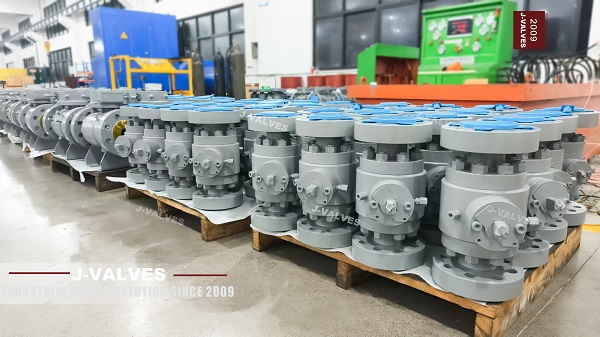
Stainless Steel Ball Valve Grades: 304, 316 And 316L, And What Actually Decides
Molybdenum is the difference that decides the duty, carbon is the difference that gets missed, and the chloride in the line matters more than the price.
Read More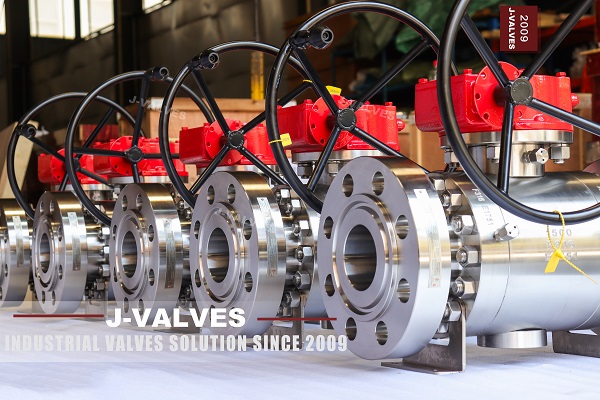
Ball Valve Spare Parts for Overseas Projects: The Wear Part List, The Quantity Math, And Four Traps
Why isolation valves fail on calendar time, not cycles. Wear part lists, Poisson stock maths, seat kit traps and the clauses that decide year six.
Read More
Ball Valves On A Bottom Loading Gantry: Creep, Dry Break And The Test That Proves Neither
A loading gantry cycles a ball valve far more than it is designed for and still cannot prove shut-off. Where creep starts, and what to specify.
Read More