


CHINA J-VALVES Offers Various High-quality I ndustrial Ball Valves
J-VALVES, a distinguished professional ball valve manufacturer rooted in China, takes pride in its extensive product portfolio. Our offerings span a wide range, including trunnion-mounted ball valves, floating ball valves, high-temperature ball valves, high-pressure ball valves, metal-sealed ball valves, ultra-low temperature ball valves, DBB ball valves, Three-way And Four-way Ball Valve, and fully welded ball valves. Each product is a testament to our commitment to precision engineering and reliable performance. Meticulously crafted, they are designed to not only meet but exceed the most stringent industrial demands, ensuring stable operation even under extreme conditions. This enables us to provide our clients with high-value services and makes our valves widely sought-after in industries.
Product Category
Contact Us


-
J-VALVES-Q347F
-
J-VALVES
Overview of the J-VALVES three piece forged steel flange trunnion ball valve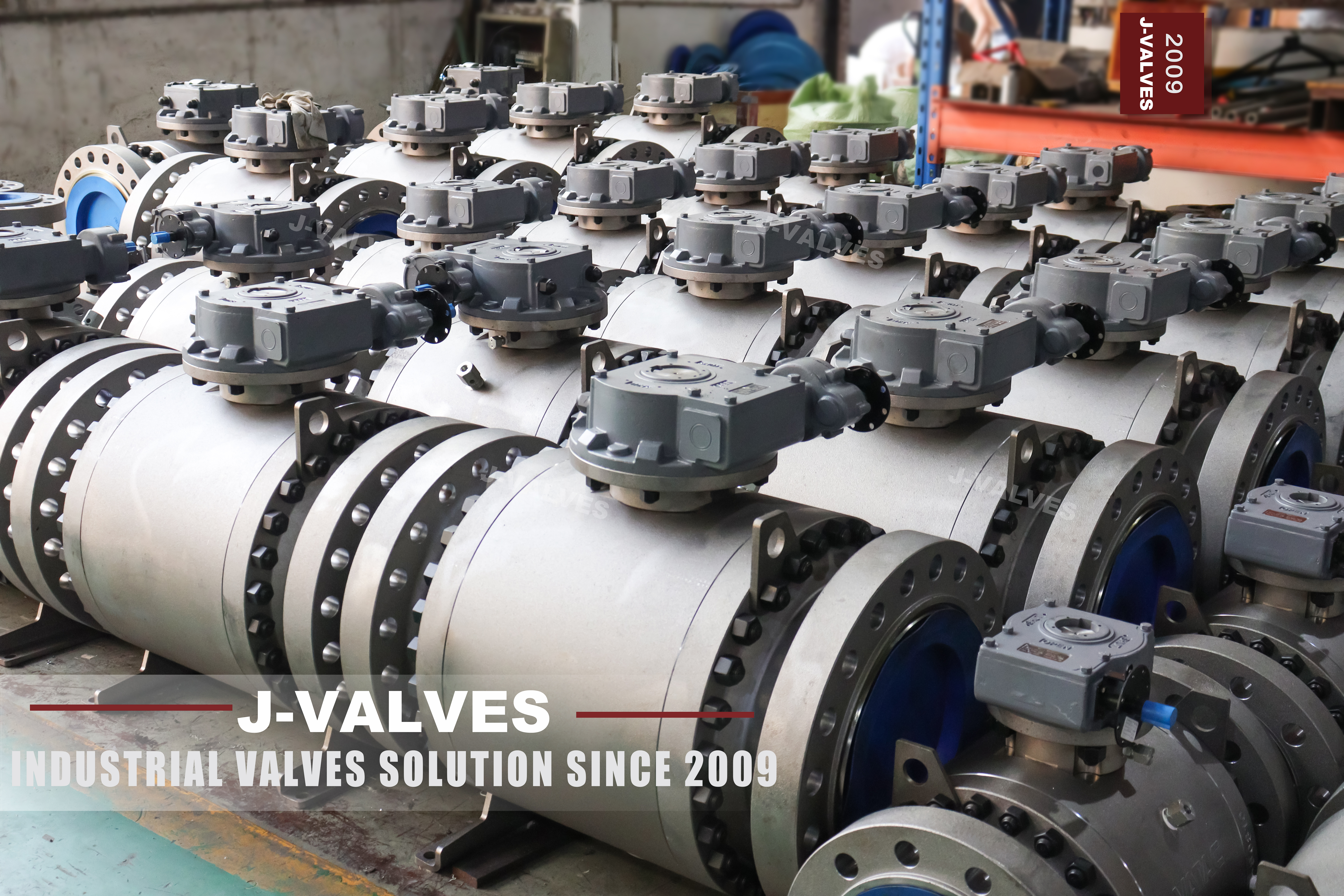
One drawing family covers this valve from two inch to fifty six inch, at Class 150 through Class 2500, which makes the range look like a single article with a size list bolted on. It is not. Two things change inside the range, and both of them change at the small end rather than the large one: the way the ball is held, and the number of service ports the body carries.
Up to four inch the ball is carried on an upper and a lower trunnion machined into the primary body. From six inch the bearings move out into two separate bearing blocks, and the ball is held between them. Up to four inch the drain and the vent share one port; from six inch they are separate. Up to four inch the emergency seat injection fittings are an option; from six inch they are standard. A four inch valve and a six inch valve from this family do not come apart the same way, and the drawing that covers both is telling you less than it appears to.
What the photographs show is the large end of that range: a forged body machined all over, two caps each closed by its own ring of studs, a worm gear with a handwheel on the mounting pad, and two flat feet under the body that let the valve sit on a base rather than hang on the pipe. The nameplate is stamped into the centre section, not attached to it.
The specification that governs the purchase is therefore not the size. It is which of the two builds the size buys you, and whether the trim in that build has the ports you need for the way the line will be maintained.
Design and Construction
The body is three forgings: the centre section, and one cap on each side. Both trunnion bearing blocks sit in the centre, which is the part that never comes apart, so the stem axis and the lower bearing axis stay where they were set the day the body was machined. Each cap carries its own spiral wound gasket and its own stud ring, and each joint sees full line pressure around the whole circle, which is why neither may be broken with the line live.
At six inch and above the bearing blocks are separate parts bolted into the centre section, so the ball is supported by two blocks rather than by two bores in the body. That costs two more parts and one more machining operation, and it buys a lower trunnion that can be replaced without scrapping the body. On the small build the trunnion bore is in the body itself and a worn bore is a body problem.
The ports follow the same logic. One combined drain and vent port on the small build means the cavity can be relieved but not separately checked at both ends; two ports on the large build mean the top and the bottom of the cavity can be treated as two places. For a valve that will be opened for inspection, that difference decides whether a cavity check is a two minute job or a lift.

Material Options
The body is a forging in one of six grades: A105N carbon steel, A350 LF2 for low temperature, A182 F304 or F316 and their low carbon versions, and the alloy grades F11 and F22. Forging is chosen here for soundness rather than for strength alone. A rolled ring or an upset forging has grain that follows the shape, no mould to leave sand in, and no shrinkage porosity at the section changes, which is exactly where a cast body is hardest to inspect.
The trim is a separate decision and it is where most of the cost sits. The ball and the seats are stainless with a hard facing on the sealing band, and the facing is a cobalt based alloy for general service or a tungsten carbide coating where abrasion is the problem. The stem is 316 for ordinary duty, 17-4PH where the stem has to be harder, or a nickel based alloy for hot and corrosive work.
Sealing material closes the temperature question. A PTFE seat stops around 200 C, a reinforced PTFE a little higher, PPL around 280 C, and past that the seat has to be metal. The body can take far more heat than any of them, so the seat, not the body grade, is what the data sheet temperature really describes.
| Component | Standard Build | Options | What It Decides |
|---|---|---|---|
| Body and caps | ASTM A105N forging | A350 LF2, A182 F304 or F316, F11, F22 | Corrosion allowance and temperature |
| Ball | A182 F304 or F316, hard faced band | Tungsten carbide coating | Erosion at the sealing line |
| Seat | A182 F304 or F316, hard faced | Cobalt based facing, carbide facing | Temperature and abrasion |
| Stem | A182 F316 | 17-4PH, nickel based alloy | Strength at the drive end |
| Seat insert | PTFE, reinforced PTFE, PPL | Metal to metal | The real temperature ceiling |
| Packing | Flexible graphite | Braided graphite with alloy wire | Stem leakage and fire survival |
| Body joint gasket | Spiral wound, graphite filled | Ring joint gasket | Whether the joint survives thermal cycling |
| Bolting | A193 B7 with A194 2H | B16 with A194 7, B8M with 8M | The temperature the joint can hold |
Technical Specifications
The published range is two inch to fifty six inch, Class 150 to Class 2500, minus 29 to plus 425 C, flanged to ASME B16.5 with raised face or ring joint, with a choice of lever, gear, pneumatic, electric or hydraulic operation. That is a family description, and every line of it is fixed by a standard rather than by a drawing.
What is not published is the part that varies with the order: the wall thickness at a given class, the face to face length, the bore, and the weight. Wall comes from a calculation against ASME B16.34 and lives on the design record. Face to face comes from ASME B16.10 and is confirmed on the signed general arrangement drawing. The bore is measured on that drawing too. A page that prints any of them from memory is printing a number nobody has checked against the valve that will ship.
| Item | Value |
|---|---|
| Size range | Two inch to fifty six inch, DN50 to DN1400 |
| Pressure class | Class 150, 300, 600, 900, 1500, 2500 |
| Body style | Three piece forged body, trunnion mounted ball |
| Body grades | A105N, A350 LF2, A182 F304 or F316, F11, F22 |
| Ball retention | Trunnion in the primary body to four inch; bearing blocks from six inch |
| Service ports | One combined drain and vent to four inch; separate from six inch |
| Seat injection | Option from two to four inch; standard from six inch |
| Flange | ASME B16.5, raised face or ring joint |
| Face to face | ASME B16.10, confirmed on the signed drawing |
| Temperature | Minus 29 to plus 425 C as a body figure; the seat sets the working ceiling |
| Operation | Lever, worm gear, pneumatic, electric or hydraulic |
| Product standard | API 6D; ASME B16.34 for wall and rating |
The one dimensional consequence worth knowing before the enquiry is that the two builds look identical on a data sheet. Same class, same flange, same face to face for a given size, and different internals. That is why the drawing has to be read with the size in mind rather than the class alone.
Standards and Compliance
API 6D is the governing product standard, and ASME B16.34 supplies the wall calculation and the rating table behind the class marking. Above NPS 24 the flange is no longer in ASME B16.5 and moves to ASME B16.47, which is a separate table and a separate purchase decision at the top of the range.
Fire testing is a type test, not a per valve test. API 607 is the standard, ISO 10497 is its international equivalent, and API 6FA no longer exists as a separate document because it was folded into 607. The certificate carries the size and class it was witnessed at, and a buyer should read that line rather than the logo on the front page.
| Requirement | Document | What It Means Here |
|---|---|---|
| Pipeline valve design | API 6D | Governing standard for this family |
| Wall and rating | ASME B16.34 | Class converted to pressure at design temperature |
| Flanges to NPS 24 | ASME B16.5 | Raised face or ring joint |
| Flanges above NPS 24 | ASME B16.47 | Different bolt circle, different gasket |
| Fire test | API 607 or ISO 10497 | Type test with a size and class scope |
| Pressure test | API 598 | Shell and seat test procedure |
| Material certificate | EN 10204 3.1 | Heat number matched to the stamp |
| Sour service | NACE MR0175 on request | Hardness limits on body, trim and bolting |
Manufacturing Process
A forging starts as a cut billet that is heated, upset, punched and rolled until the grain has been pushed around the shape rather than cut across it. The result is a blank with no mould, no sand and no gating system, and the material that ends up in the wall is the material that was tested at the mill. Where the order asks for it, the blank is examined ultrasonically to ASTM A388 before a single chip is taken.
Machining is where a three piece body earns its price. Two joint faces have to be flat and parallel to each other, two seat pockets have to be concentric with the ball axis, and the stem bore has to be square to both. Because the bearings live in the centre section, that part can be machined in one setting, which is the reason the axes survive every cap removal afterwards. The caps are machined to the centre, not the other way round.
Assembly is a torque procedure more than a fitting job. The gaskets go in dry and new, the studs are lubricated and brought up in a cross pattern in stages, and the gear is set so that the indicator reads what the ball is actually doing. The valve is then tested as an assembly, because the joints that were made on the bench are the joints that will see the line pressure.

Quality Control and Testing
Identity comes first. The heat number raised on the body is matched against the mill certificate, and a positive material identification reading confirms the grade on the finished part where the order calls for it. On an alloy body such as F11 or F22 this check matters more than on carbon, because the two look the same under a coat of paint.
The shell test is run at one and a half times the rating with the ball part open, which loads both body joints and the stem seal at the same time. The seat test is run at one and one tenth with the cavity vented, so that the reading describes the seat and not trapped pressure. Both are API 598 procedures, and both are recorded per valve rather than per batch.
| Step | Check | Acceptance |
|---|---|---|
| 1 Incoming | Heat number against mill certificate | EN 10204 3.1, chemistry and tensile |
| 2 Forging | Ultrasonic examination when ordered | ASTM A388, no reportable indication |
| 3 Identity | Positive material identification | Grade match, no mixed parts |
| 4 Machining | Joint face flatness, seat pocket concentricity | Drawing tolerance |
| 5 Shell test | Body, both joints and stem at 1.5 times | API 598, no leakage |
| 6 Seat test | Each seat at 1.1 times, cavity vented | API 598, soft seat zero visible |
| 7 Function | Quarter turn, indicator position, gear backlash | Works standard |
| 8 Final | Cavity drained, bore dried, faces masked, caps fitted | Works standard |
The joint test deserves one sentence of its own. Two gasketed joints at one and a half times the rating is twice the chance of a weep and twice the chance of finding a machining fault before the valve leaves, which is the trade a three piece body makes against a welded one.

Applications and Industry Service
This family is bought where the class is high, the medium is not friendly, or the valve will be opened more than once. Hydrocarbon lines with sour traces, produced water, amine and glycol systems, offshore topsides where a hot work permit for a cut spool is expensive, and high temperature steam headers where a cast body would need a heavier wall than a forging.
The six inch build and above is what most of those duties actually order, because the separate drain and vent ports and the standard injection fittings are what a maintenance team uses. The small build is bought where space is tight and the valve is small enough that a bearing block would be a luxury.
It is the wrong valve where the class is low and the size is large. At Class 150 in a big size a casting is cheaper, and the arguments that make a forging worth its price, soundness at section changes and no pattern cost, stop paying for themselves.

Installation, Operation and Maintenance
Set the valve on its feet where it has them, or support the spool either side, and do not let the body carry the weight of the pipe. Bring the mating flanges up square before the studs are tensioned, because a flange pulled in with the bolts is a flange that will leak at the first thermal cycle. Ring joint grooves need a new ring every time the joint is broken; a raised face needs a new gasket and a clean, dry, flat face.
Operate through the quarter turn and read the indicator rather than the handwheel. A gear multiplies force, which means a valve that will not turn can be forced past its stop by a strong arm, and the damage lands on the stem and the seat rather than on the gear. The stem is retained by the body, so the packing can be adjusted while the valve is in service, and the upper stem seal can be renewed once the cavity has been vented.
For a seat change the line is isolated, drained and vented, then both caps come off and the ball and seats come out. The pipe stays where it is. What has to be replaced afterwards is two gaskets and the stud torque, and that is the whole reason this body exists. Seat injection is a way to finish a shift, not a repair: the sealant buys time and the seat still has to be changed.
How to Specify and Order
Six things fix the valve: size and class, body grade with the certificate requirement, flange facing and whether a ring joint ring ships with it, seat type with or without injection ports, the operator, and the face to face standard. On this family a seventh belongs on the list, which is the build: whether the size ordered falls into the four inch and under arrangement or the six inch and over one, because that decides the spare parts.
Four questions are about the line rather than the valve: the medium and its concentration, the design temperature, the design pressure, and how often the valve will be operated. The medium decides whether a forging is needed at all, the temperature decides the seat, the pressure decides the class, and the duty decides whether a gear is enough or an actuator is required.
Name the documents on the order. EN 10204 3.1 for body and trim, the hydrostatic record, the dimensional report, the fire certificate with its scope, and ultrasonic examination of the forging where soundness has to be demonstrated. Every one of them is available, and none of them arrives unless it was asked for in writing.
FAQ
Q: What changes between the four inch and the six inch build in this family?
A: Ball retention and service access. Up to four inch the ball runs on trunnions machined into the primary body and the drain and vent share one port. From six inch the bearings sit in two separate blocks, the drain and vent are separate, and emergency seat injection is standard rather than optional. Ask for the drawing at the size you are buying.
Q: Is this valve double block and bleed?
A: Not in the standard build. A single piston effect seat holds from one side and lets the cavity relieve to the other, so only the downstream seat is a barrier at any moment. Double block and bleed needs the double piston effect arrangement and a bleed valve at the cavity, and it has to be ordered as such.
Q: Why buy a forged body instead of a casting?
A: For soundness. A forging has grain that follows the shape, no mould and no shrinkage porosity at the section changes, and it can be examined ultrasonically to ASTM A388 before machining. At low class and large size a casting is cheaper and is the right answer; at high class a forging removes a class of defect that examination may not find.
Q: Can the seats be changed without cutting the pipe?
A: Yes, with the line isolated, drained and vented. Both caps come off their own stud rings and the ball and seats come out through the openings, so the valve stays bolted in the line. The two gaskets have to be replaced and both stud rings re-torqued afterwards.
Q: What does the 425 C on the data sheet refer to?
A: The body. It is the ceiling carbon steel carries in process piping codes and it is not a seat rating: a PTFE seat stops around 200 C, a PPL seat around 280 C, and above that the seat has to be metal. The lowest limit in the valve is the one that governs the service.


Hot Products


News
Reading A Ball Valve GA Drawing: The Five Dimensions That Decide Whether It Fits
A GA drawing is approved for its outline and lost on its section. The five dimensions that decide whether the valve fits, bolts and can be operated.
Read More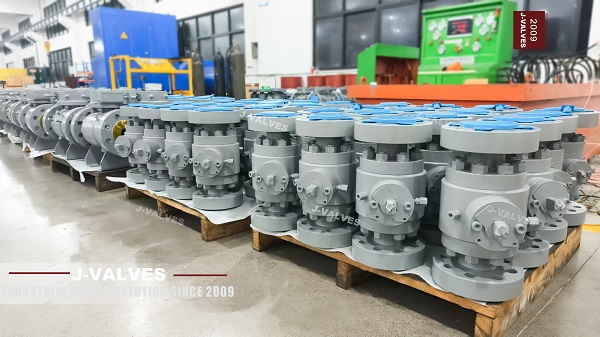
Stainless Steel Ball Valve Grades: 304, 316 And 316L, And What Actually Decides
Molybdenum is the difference that decides the duty, carbon is the difference that gets missed, and the chloride in the line matters more than the price.
Read More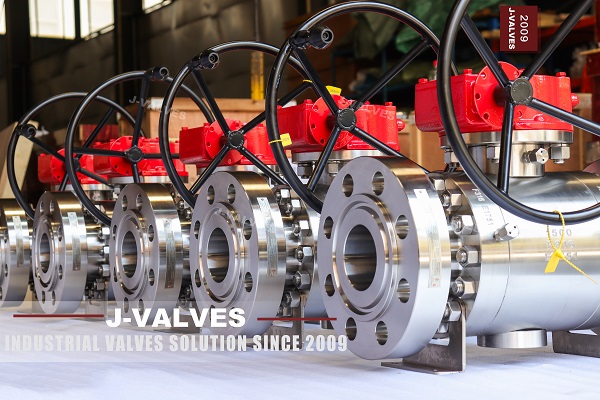
Ball Valve Spare Parts for Overseas Projects: The Wear Part List, The Quantity Math, And Four Traps
Why isolation valves fail on calendar time, not cycles. Wear part lists, Poisson stock maths, seat kit traps and the clauses that decide year six.
Read More
Ball Valves On A Bottom Loading Gantry: Creep, Dry Break And The Test That Proves Neither
A loading gantry cycles a ball valve far more than it is designed for and still cannot prove shut-off. Where creep starts, and what to specify.
Read More