


CHINA J-VALVES Offers Various High-quality I ndustrial Ball Valves
J-VALVES, a distinguished professional ball valve manufacturer rooted in China, takes pride in its extensive product portfolio. Our offerings span a wide range, including trunnion-mounted ball valves, floating ball valves, high-temperature ball valves, high-pressure ball valves, metal-sealed ball valves, ultra-low temperature ball valves, DBB ball valves, Three-way And Four-way Ball Valve, and fully welded ball valves. Each product is a testament to our commitment to precision engineering and reliable performance. Meticulously crafted, they are designed to not only meet but exceed the most stringent industrial demands, ensuring stable operation even under extreme conditions. This enables us to provide our clients with high-value services and makes our valves widely sought-after in industries.
Product Category
Contact Us


-
J-VALVES-Q47F
-
J-VALVES
Overview of the J-VALVES 3 piece high pressure stainless steel trunnion ball valve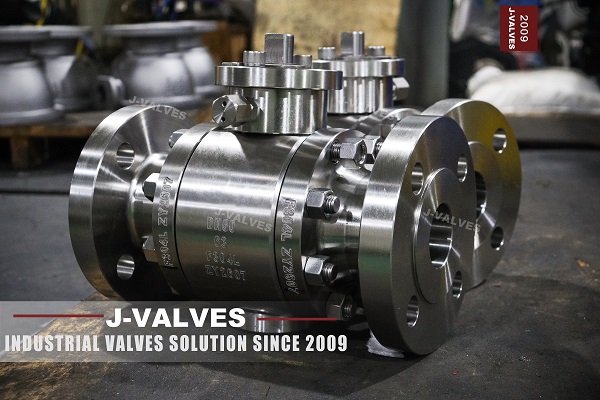
Somewhere between Class 600 and Class 900 the stainless steel body stops being a casting. Below that line a two piece cast CF8M body is normal and it is a good valve. Above it the body becomes a three piece forging, and the reason is not that a forging is nicer. It is that a casting of the section needed at Class 2500 has to be radiographed to a level that a working foundry will struggle to meet on a routine basis, so the forging becomes the only route that delivers the same valve every time.
That is the structural story of this page. The range runs from Class 600 to Class 2500 in half inch to twenty four inch, and the top of that range is a different manufacturing article from the bottom of it, even though the drawings look similar and the marking is the same.
The second story is the material list, which is where the stainless steel part of the name is earned. CF8M, CF3M, F51, F53 and F55 are austenitic and duplex grades, and a sixth entry appears under a trade shorthand that is not a grade at all. Which of those is chosen decides whether the valve survives a chloride duty or fails at the seat in eighteen months.
Design and Construction
The body is three forgings: a centre piece carrying the ball, the trunnions and the stem, and two end pieces carrying the flanges. Both end pieces are identical, so one forging serves both ends, and each closes on its own stud ring with its own gasket at full class pressure.
The ball is trunnion mounted and both seats are double piston effect on most builds at this class. That is more than a nicety. Double piston effect means pressure from either side pushes the seat towards the ball, so both seats are barriers and the cavity between them can be bled, which is what double block and bleed requires. A single piston effect seat relieves the cavity but is only a barrier in one direction.
The valve is full bore, so the ball passage matches the pipeline bore and the pressure drop across it is close to that of a spool. At these classes that is a deliberate choice rather than a default, because a full bore ball at Class 2500 is a large sphere and the torque that comes with it decides the operator.
The threaded end option stops at two inch, and that is a pressure decision rather than a catalogue limit. A taper thread is a joint whose strength comes from the engaged length, and the engaged length is a fixed number of threads regardless of size, so the ratio of thread to wall gets worse as the bore grows. Above two inch the class pressure belongs on a flange or a weld, and a threaded connection at Class 2500 in four inch is not something a serious works will offer.
Sealant injection points are provided at the seat and at the stem on most builds. They are an emergency provision for a valve that has started to pass in a line that cannot be stopped, and on a high pressure stainless valve they are worth having because the alternative is a shutdown of a line that may not be able to be stopped at all.

Material Options
The grade list is the part of the page that decides whether the valve is right, and it is worth separating the austenitic grades from the duplex ones because they are bought for different reasons. The trade shorthand that appears at the end of the list is not a grade and should not be ordered as one.
| Grade | Family | What It Is For | Where It Stops |
|---|---|---|---|
| CF8M | Austenitic cast | General corrosion, 316 equivalent | Chloride stress cracking under load |
| CF3M | Austenitic cast, low carbon | Welded bodies, 316L equivalent | Lower strength, lower rating |
| F51 | Duplex | Chloride service under pressure | Temperature limit of the duplex family |
| F53 | Super duplex | Higher chloride and higher pressure | Cost, and the same temperature limit |
| F55 | Super duplex | Similar to F53 with a different balance | Cost and availability |
| Nickel based | Nickel alloy | Severe acid and chloride | Cost |
| CK3MCuN | Super austenitic | High molybdenum chloride duty | Not a trade name, a UNS designation |
The specification code in front of the grade is the part that is most often dropped, and dropping it is what allows an impossible combination to be ordered. A351 is a casting specification and A182 is a forging specification, so CF8M belongs to a casting and F316 belongs to a forging, and there is no such article as a CF8M forging. That is not a technicality: the two are made by different processes, tested differently and certified differently, and a drawing that asks for one while the schedule assumes the other will be quoted by one supplier and refused by the next.
On this page the CF8M and CF3M entries are the cast pieces that appear at the Class 600 bottom of the range, and the F316, F51, F53 and F55 entries are the forgings that carry Class 900 upward. Reading which form a grade belongs to is the first check on any quotation for this valve.
The trade shorthand that appears on the source page is a six percent molybdenum label. It describes a family of super austenitic stainless steels rather than a grade, and it is used because it is short. The designation that belongs on an order is the UNS number or the cast or wrought equivalent, because two mills will supply two different alloys under the same shorthand and only one of them will meet the corrosion requirement the buyer had in mind.
Duplex is not a universal upgrade over austenitic stainless. It is stronger and it resists chloride stress corrosion cracking, which is the failure mode that kills 316 in warm chloride service. It also has a temperature ceiling above which it loses toughness, and it is not the right choice for a hot chloride duty, which is where the nickel alloys come in.
Technical Specifications
Class 600 is the bottom of this range and Class 2500 is the top, and both are recorded in API 6D clause 7.2 as PN 100 and PN 420. The rating at temperature depends on which group the grade sits in, and that is why the grade cannot be separated from the class on a page that runs this far.
| Item | Value |
|---|---|
| Size range | Half inch to twenty four inch, DN 15 to DN 600 |
| Pressure class | Class 600 to Class 2500, PN 100 to PN 420 |
| Body style | Three piece body, forged from Class 900 up, trunnion mounted ball |
| Body grades | CF8M, CF3M, F51, F53, F55, nickel alloys |
| Seats | Double piston effect as standard at this class |
| Ball | CF8M with hard chrome or nickel plating, or duplex |
| Ends | Flanged raised face or ring joint, butt weld, threaded up to two inch |
| Face to face | ASME B16.10 for the size and class, confirmed on the drawing |
| Temperature | Minus 29 to plus 425 C as a general figure, grade dependent |
| Operator | Lever at the small sizes, gear above |
| Sealant | Injection points at the seat and the stem |
| Test | API 598 shell and seat, a result per seat |
The body grade column is not a menu in which the top item is best. CF8M is the right answer for a great many duties and it is the cheapest of the stainless options. The duplex grades are bought when the chloride content and the temperature together would crack an austenitic body, and that is a corrosion assessment rather than a preference.
Standards and Compliance
API 608 covers Class 150 to Class 600, which means it applies only to the very bottom of this range and does not apply to the rest of it. API 6D covers the whole range. A page that runs from 600 to 2500 and cites 608 without qualification has cited a standard that stops at the first entry.
| Requirement | Document | What It Means Here |
|---|---|---|
| Wall and rating | ASME B16.34, group by grade | Rating by group and class |
| Product requirements | API 6D, Class 600 to 2500 | Design, marking, documentation |
| Product requirements | API 608, Class 600 only | Applies at the bottom of the range |
| Pressure test | API 598 | Shell 1.5 times, seat 1.1 times |
| Duplex metallurgy | Ferrite balance and heat treatment | Checked on the certificate |
| Fire test | API 607 or ISO 10497 | Type test, scope to be read |
| Material certificate | EN 10204 3.1 | Heat number matched to each forging |
| Marking | API 6D | Size, class, grade, heat, standard |
The rating also depends on the group, and the groups are not ordered the way a buyer expects. An austenitic stainless body and a duplex body at the same class can have different ratings at the same temperature, and the difference widens as the temperature rises. That is why the class on the nameplate is a starting point rather than an answer, and why a valve bought at the top of its temperature range should be checked against the group table rather than against the class number.
The duplex line is the one that has no equivalent on an austenitic valve. A duplex steel is a two phase material and its properties depend on the balance between the phases, which is set by the composition and by the solution annealing treatment. A duplex part that has been heated into the wrong range loses that balance and with it both toughness and corrosion resistance, and the damage does not show on a hardness test.
Manufacturing Process
The forgings are produced from billets that are upset and pierced, and the grain flow follows the shape of the forging rather than being cut through by machining. On a body that has to hold Class 2500 pressure that is the point of the route: the material is continuous where the pressure is, and there is no shrinkage to find.
Duplex forgings are solution annealed after forging and quenched, and the quench is the operation that preserves the balance between the two phases. A duplex part that has been cooled slowly will have the wrong balance and will not be corrected by any later operation short of a full re-treatment.
Machining is done with the flange face, the bolt circle, the joint face and the seat pocket referenced to one centreline per part. On the high classes the wall is thick and the machining removes a large amount of material, which is why the forging envelope is checked before the first cut rather than after the last one.

Quality Control and Testing
The identity check on a duplex valve is a real analysis rather than a comparison, because duplex and austenitic stainless look the same and machine the same. A portable analyser will separate them on chromium and nickel, and on a super duplex it will also show the molybdenum that puts the grade in its family.
| Step | Check | Acceptance |
|---|---|---|
| 1 Incoming | Heat number against the mill certificate | Grade chemistry as ordered |
| 2 Identity | Positive material identification on each forging | Family and grade match |
| 3 Metallurgy | Ferrite balance on duplex parts | Certificate figure |
| 4 Heat treatment | Solution anneal record for duplex | Recorded per heat |
| 5 Machining | Seat pocket to ring groove reference | Drawing tolerance |
| 6 Shell test | Body and both joints at 1.5 times | API 598, no leakage |
| 7 Seat test | Each seat at 1.1 times, cavity vented | API 598, no visible leakage |
| 8 Final | Faces masked, ports capped, marked, crated | Works standard |
The ferrite balance line is not a formality on a duplex valve. A balance outside the accepted range means the part will not have the toughness or the corrosion resistance the grade was bought for, and it is the one property that a buyer cannot check on site and cannot see.

Applications and Industry Service
High pressure stainless trunnion valves belong to the duties where both the pressure and the corrosion are present at once. Seawater injection, chloride bearing process streams, chemical injection at pressure, and the small bore high pressure lines around a membrane or an injection skid.
Class 2500 in stainless is a narrow market and it is bought for a reason that is usually a combination rather than a single requirement. The pressure rules out the cheaper body, the medium rules out carbon steel, and the temperature or the chloride rules out the austenitic grades, so the answer comes out as a duplex or a nickel alloy body at the top of the class range.
It is the wrong valve where the medium is dry and clean and the pressure is the only issue, because a carbon steel or a low alloy body would do the same job for less. It is also the wrong valve where the temperature is high enough to take a duplex body out of its range, because the corrosion resistance that justified the grade is not available at that temperature.

Installation, Operation and Maintenance
The valve is heavy at the top of the size range and the two body joints have to be brought up true, so the body is supported and the mating flanges are brought parallel before anything is tensioned. A body that is carrying pipe load will close its joints unevenly and will weep on one side.
For maintenance the line is isolated, drained and vented, both end piece stud rings are released in a pattern, and the end pieces come away with their seats. The ball is then free on its trunnions. The gaskets are replaced rather than reused, the seats go back with a ball that has been checked, and the studs are brought to the drawing figure in a cross pattern.
The sealant injection points should be capped and left alone unless they are needed. They are an emergency provision, and a valve that has been topped up with sealant as routine maintenance has a seat problem that the sealant is hiding until the next time the valve is cycled.
How to Specify and Order
Six lines fix the valve: size, class, body grade, seat pattern, end connection and operator. Two more belong on the order at this class and are often left off: whether the valve has to block twice, which is the difference between single and double piston effect seats, and whether the body grade is duplex or austenitic, which the word stainless does not settle.
Four questions belong to the line rather than to the valve: the chloride content, the design temperature, the design pressure and whether the valve will be welded in. The first two decide the grade family, the third confirms the class, and the fourth decides whether the ends are flanged or welded and whether the body has to be supplied in a weldable condition.
Documents to name in the order: the EN 10204 3.1 certificate for each forging with the heat number matched, the solution anneal and ferrite balance record where duplex is supplied, the shell and seat test record with a result per seat, and the general arrangement drawing carrying the face to face dimension and the end connection.
FAQ
Q: Can CF8M be supplied as a forging?
A: No, and the code says why. CF8M is a designation in A351, which is a casting specification, and F316 is the corresponding designation in A182, which is a forging specification. A drawing that asks for a CF8M forging is asking for an article that no mill makes, and the two suppliers who quote it will deliver different things, one a casting and one a forging, under the same line of text.
Q: Why does the threaded end stop at two inch?
A: Because a taper thread carries its strength in the engaged length, and the engaged length is a fixed number of threads whatever the size. As the bore grows the wall gets thinner and the thread stays the same, so the ratio of thread to wall falls away. Above two inch the class pressure belongs on a flange or a weld, and a threaded Class 2500 connection in four inch is not something a serious works will offer.
Q: Why are both end pieces the same?
A: Because one forging then serves both ends, which halves the tooling and simplifies the spares. Each end piece carries one seat and one flange, and each closes on its own stud ring with its own gasket at full class pressure, so the symmetry costs nothing in pressure integrity. It does mean the two seat bores have to be machined to the same reference, because the ball sits between them.
Q: What does double piston effect change?
A: It makes both seats barriers. A single piston effect seat is pushed towards the ball by upstream pressure and relieves cavity pressure, so it blocks in one direction only. A double piston effect seat is pushed towards the ball by pressure from either side, so both seats are barriers and the cavity between them can be bled, which is exactly what double block and bleed requires.
Q: Is a duplex body better than CF8M here?
A: Only for a chloride duty under load. Duplex is stronger and it resists chloride stress corrosion cracking, which is the failure mode that takes out an austenitic body in warm chloride service. It also has a temperature ceiling above which it loses toughness, so a hot chloride duty goes to a nickel alloy rather than to duplex. Above that ceiling duplex is not an upgrade at all.


Hot Products


News
Why A Ball Valve Gets Harder To Turn: Five Causes, And The Test That Tells Them Apart
A ball valve that stiffens over months points at one of five parts. Measure torque with the line pressurised and again vented, and the split becomes visible.
Read More
The Ball Valve at Four Thousand Bar: Seat Load, Erosion And Fatigue in Waterjet Circuits
At 4,000 bar a 10 mm bore puts 31 kN on the seat and a 0.1 mm leak cuts steel. What a ball valve must survive in a waterjet or intensifier circuit.
Read More
Large Diameter Ball Valves: Four Limits That Change The Design
Above a certain size a ball valve stops being a scaled one. Ball weight, operator torque, body split and the test bench each set a limit at a different size.
Read More
Cast Or Forged Ball Valve Body, And What A Radiography Acceptance Level Actually Buys You
Casting or forging is only half the decision. What RT, UT, MT and a proof test each find in a ball valve body, and where the geometry defeats all of them.
Read More