


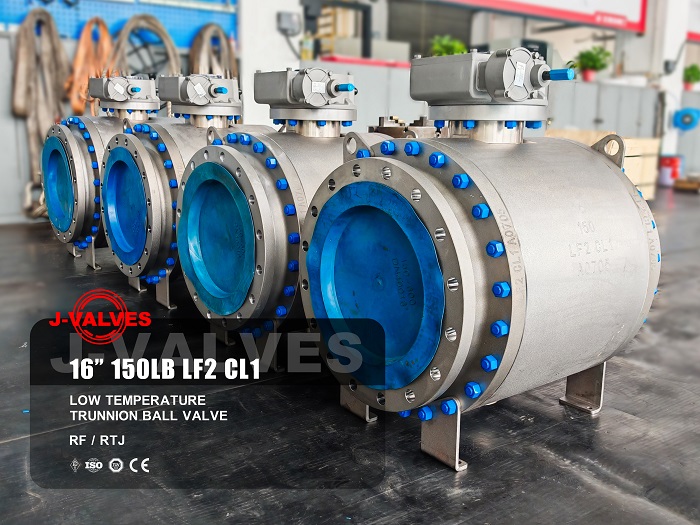
1. Core Specification of LF2 CL1 Trunnion Ball Valve
LF2 refers to cryogenic forged steel complying with ASTM A350 specification, while CL1 stands for matching specification of product pressure class. The 16” Class150 LF2 CL1 trunnion ball valve is a mainstream valve type for cryogenic petrochemical plants, LNG receiving terminals and cryogenic liquefied gas transmission pipelines. Designed with trunnion-mounted ball structure differing from floating ball valves, this 16-inch large-bore valve features outstanding resistance to torque and pipeline stress deformation under high-pressure service. Flange options include RF (Raised Face) and RTJ (Ring Joint Face) for customization, and the valve shown in attached picture adopts RF flange standard. It is rated for Class150 nominal pressure with minimum operating temperature down to -46℃.
LF2 forged steel is widely adopted for valve bodies in global cryogenic pipeline systems owing to its superior low-temperature impact toughness compared with WCB carbon steel, effectively preventing brittle fracture under sub-zero working conditions. It is the designated body material for cryogenic service per ASME and API6D standards in European and American markets.
2. J-VALVES Competitive Advantages on LF2 Cryogenic Ball Valve
(1) Full-chain Raw Material Control with Full Traceability of Original LF2 Forgings
All LF2 valve body blanks of J-VALVES are sourced from certified foundries producing A350 LF2 CL1 forgings. Each incoming batch is attached with material heat number certificate and cryogenic impact test report with actual measured Charpy V-notch impact value at -46℃. Substandard substitute carbon steel is strictly forbidden to eliminate hidden risks of body cracking in low-temperature service. Some peer manufacturers cut costs by replacing LF2 with ordinary WCB material, which easily causes body leakage or rupture after commissioning under cryogenic environment; J-VALVES implements rigorous incoming material inspection to avoid such defects.
(2) Optimized Custom Cryogenic Sealing System
Targeted at thermal shrinkage characteristics of LF2 valves under low temperature, the valve seat adopts composite sealing structure combining flexible metal and PTFE. An extended bonnet stem is configured to avoid frost condensation. All products have passed API6FA fire safety certification and cyclic cryogenic pressure testing. Every 16” Class150 unit undergoes full hydrostatic and pneumatic tightness inspection before delivery under zero-leakage standard, perfectly adapting to alternating temperature conditions caused by intermittent start-stop of LNG pipelines.
(3) High-precision Machining Technology for Large-bore Valves
Spheres of 16-inch large-size trunnion ball valves are processed via CNC lapping with sphericity tolerance controlled within ≤0.005mm. Low-temperature self-lubricating alloy is used for trunnion bushings to reduce jamming failures at cold ambient. The valve body features three-piece bolted forged construction (split bolted flange design as shown on photo) for convenient on-site disassembly and maintenance, with RF or RTJ flanges machined per customer requirements.
(4) Complete Set of Authoritative Certifications
Our products are certified with ISO, CE, API6D and API6FA approvals, conforming to ASME B16.5 flange standard and ASME B16.34 valve design specification, enabling direct export to cryogenic oil & gas projects across Europe, America and the Middle East.
3. Global Successful Project References
Shandong China LNG Peak Shaving Terminal: 32pcs 16”150LB LF2 CL1 trunnion ball valves for LNG export pipeline, continuous -38℃ operation over 5 years without leakage, cost reduced 27% vs original European imported valves.
Malaysia Propane Cryogenic Chemical Plant: 48 sets RTJ type LF2 Class150 large bore ball valves for cryogenic distillation unit, fully approved by local third-party inspection authority.
Inner Mongolia China Coal-to-Olefin Low-Temp Tail Gas Project: Bulk LF2 fixed ball valve supply for harsh -42℃ frigid winter site with stable long-term performance.
4. Application Range
Service fluid: LNG, liquid ammonia, propane, butane, cryogenic petrochemical off-gas;
Industry: LNG receiving terminal, refinery cold unit, fine chemical cryogenic plant, cross-country cryogenic pipeline. Custom sizes 8”~24”, Class150~Class600 LF2 ball valve available from J-VALVES factory.


