


Introduction
In modern energy transportation and industrial pipeline systems, valve reliability directly affects operational safety, maintenance costs, and production efficiency. For critical applications such as natural gas transmission, district heating networks, LNG facilities, and underground pipeline systems, long-term zero leakage performance has become one of the most important requirements for valve selection.
Fully Welded Ball Valves are designed with a welded valve body structure that eliminates traditional bolted body connections, providing enhanced sealing reliability and improved resistance against external leakage. Through advanced structural design, precision manufacturing, and strict quality control, fully welded ball valves offer exceptional durability for long-term pipeline service.
As a professional industrial valve manufacturer, J-VALVES focuses on the development and manufacturing of high-performance fully welded ball valves, providing reliable solutions for demanding applications that require secure isolation, low maintenance, and extended service life.
1. Understanding Fully Welded Ball Valve Structure
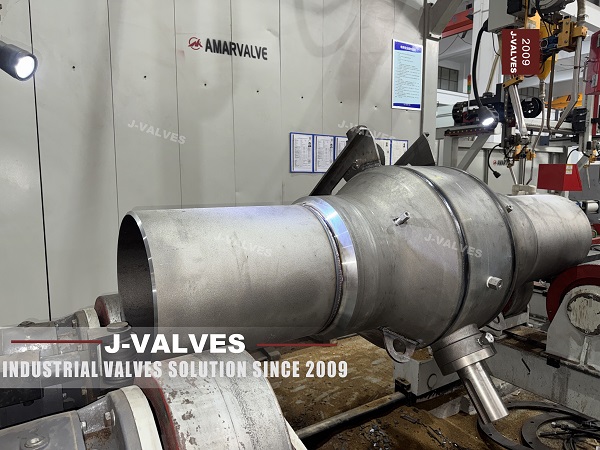
A fully welded ball valve is a type of ball valve where the valve body is permanently welded instead of using traditional bolted connections. This design creates a compact and integrated pressure boundary, reducing potential leakage points.
The main components include:
Fully welded valve body
Ball and stem assembly
Seat sealing system
Anti-blowout stem structure
Extended stem design (optional)
Injection and maintenance ports
Compared with conventional two-piece or three-piece ball valves, the fully welded design provides improved structural integrity and better protection against external environmental factors.
2. How Fully Welded Ball Valves Achieve Long-Term Zero Leakage Performance
2.1 Eliminating External Leakage Paths
One of the major advantages of fully welded ball valves is the elimination of body flange connections.
Traditional ball valves usually rely on:
Body bolts
Spiral gaskets
Flange sealing surfaces
Over long-term operation, these connections may be affected by:
Thermal expansion and contraction
Pipeline vibration
Pressure fluctuations
Environmental corrosion
The fully welded structure removes these potential leakage points by creating a continuous metal pressure boundary.
This significantly improves:
External sealing reliability
Pipeline safety
Long-term operational stability
2.2 Advanced Seat Sealing Technology
The seat sealing system plays a critical role in achieving zero leakage performance.
Fully welded ball valves commonly use advanced seat designs such as:
Floating seat structure
Double piston effect seats
Self-relieving seat systems
These designs allow the valve to maintain reliable sealing under different pressure conditions.
Key benefits include:
Low leakage shut-off
Stable sealing force
Reduced operating torque
Extended service life
For natural gas and high-pressure pipeline applications, reliable seat performance is essential for preventing internal leakage.
2.3 Precision Machined Ball and Seat Components
The sealing performance of a ball valve depends heavily on the accuracy of the ball and seat contact surfaces.
J-VALVES fully welded ball valves use precision machining processes to achieve:
Accurate spherical surface geometry
Smooth sealing contact
Reduced friction
Improved wear resistance
The optimized machining process helps maintain consistent sealing performance throughout repeated opening and closing cycles.
3. Structural Advantages of Fully Welded Ball Valves
3.1 High Mechanical Strength
The welded body design provides excellent resistance against external loads and pipeline stress.
Advantages include:
Higher structural rigidity
Improved pressure containment
Reduced deformation risk
Better resistance to vibration
This makes fully welded ball valves especially suitable for buried pipelines and long-distance transmission systems.
3.2 Reduced Maintenance Requirements
Because the valve body does not require regular bolt tightening or gasket replacement, fully welded ball valves significantly reduce maintenance requirements.
Benefits include:
Lower lifecycle costs
Reduced downtime
Easier pipeline management
Longer service intervals
For remote pipeline locations, this maintenance advantage is extremely valuable.
3.3 Excellent Environmental Adaptability
Fully welded ball valves are widely used in outdoor and underground installations due to their strong environmental resistance.
They can perform reliably under conditions such as:
Extreme temperatures
High humidity environments
Underground pipeline installation
Offshore applications
Proper material selection allows the valve to adapt to various operating environments.
4. Applications of Fully Welded Ball Valves
4.1 Natural Gas Transmission Pipelines
Natural gas pipelines require valves with excellent sealing performance because even minor leakage can affect safety and efficiency.
Fully welded ball valves are commonly installed in:
Main transmission pipelines
Gas distribution systems
Compressor stations
Pipeline terminals
Their welded structure provides reliable isolation for long-term operation.
4.2 District Heating Systems
District heating networks operate under high temperature and pressure conditions.
Fully welded ball valves provide advantages including:
Thermal cycling resistance
Reliable shut-off performance
Low maintenance requirements
They are widely used in underground heating pipelines.
4.3 LNG and Energy Infrastructure
LNG facilities require valves capable of maintaining reliable performance under demanding conditions.
Fully welded ball valves offer:
Strong pressure resistance
Stable sealing performance
Long service life
They are suitable for energy transportation and storage systems.
5. Manufacturing Advantages of J-VALVES Fully Welded Ball Valves
5.1 Professional Welding Technology
The quality of the welded body directly affects valve reliability.
J-VALVES applies professional welding processes, including:
Controlled welding procedures
Welding quality inspection
Non-destructive testing
Dimensional verification
These processes ensure the welded body maintains structural integrity.
5.2 High-Performance Material Selection
Different applications require different materials.
J-VALVES provides fully welded ball valves manufactured from various materials, including:
Carbon steel
Stainless steel
Low-temperature carbon steel
Alloy steel
Material selection is optimized according to:
Operating temperature
Pressure rating
Medium characteristics
Environmental conditions
5.3 Comprehensive Testing Procedures
To ensure long-term sealing reliability, J-VALVES performs strict inspection procedures, including:
Shell pressure testing
Seat leakage testing
Welding inspection
Operation torque testing
Final dimensional inspection
These tests ensure every valve meets industrial project requirements.
6. Fully Welded Ball Valve Compared with Traditional Ball Valves
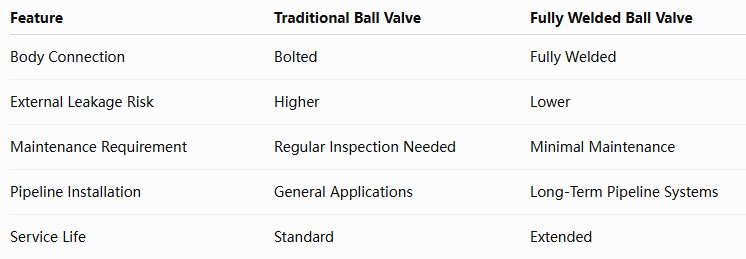
The fully welded design provides a more reliable solution for applications where continuous operation and long-term sealing performance are required.
7. Key Factors for Selecting Fully Welded Ball Valves
When selecting a fully welded ball valve, engineers should consider:
Pressure Rating
Valve pressure class should match the pipeline operating conditions to ensure safe performance.
Temperature Range
Material selection should consider both normal and extreme operating temperatures.
Medium Characteristics
Gas, liquid, corrosive fluids, and special media require appropriate sealing materials.
Installation Environment
Buried, offshore, or outdoor applications may require additional protection features.
Conclusion
Fully Welded Ball Valves achieve long-term zero leakage performance through integrated welded body construction, advanced seat sealing technology, precision machining, and strict manufacturing control.
Compared with traditional valve designs, fully welded ball valves provide improved structural strength, reduced leakage risks, lower maintenance requirements, and extended service life.
With professional engineering capabilities, advanced production technology, and comprehensive quality inspection, J-VALVES delivers reliable fully welded ball valve solutions for natural gas pipelines, LNG systems, district heating networks, and industrial applications worldwide.


