


CHINA J-VALVES Offers Various High-quality I ndustrial Ball Valves
J-VALVES, a distinguished professional ball valve manufacturer rooted in China, takes pride in its extensive product portfolio. Our offerings span a wide range, including trunnion-mounted ball valves, floating ball valves, high-temperature ball valves, high-pressure ball valves, metal-sealed ball valves, ultra-low temperature ball valves, DBB ball valves, Three-way And Four-way Ball Valve, and fully welded ball valves. Each product is a testament to our commitment to precision engineering and reliable performance. Meticulously crafted, they are designed to not only meet but exceed the most stringent industrial demands, ensuring stable operation even under extreme conditions. This enables us to provide our clients with high-value services and makes our valves widely sought-after in industries.
Product Category
Contact Us

-
J-VALVES-Q367F
-
J-VALVES
Overview of the J-VALVES pneumatic trunnion mounted fully welded ball valve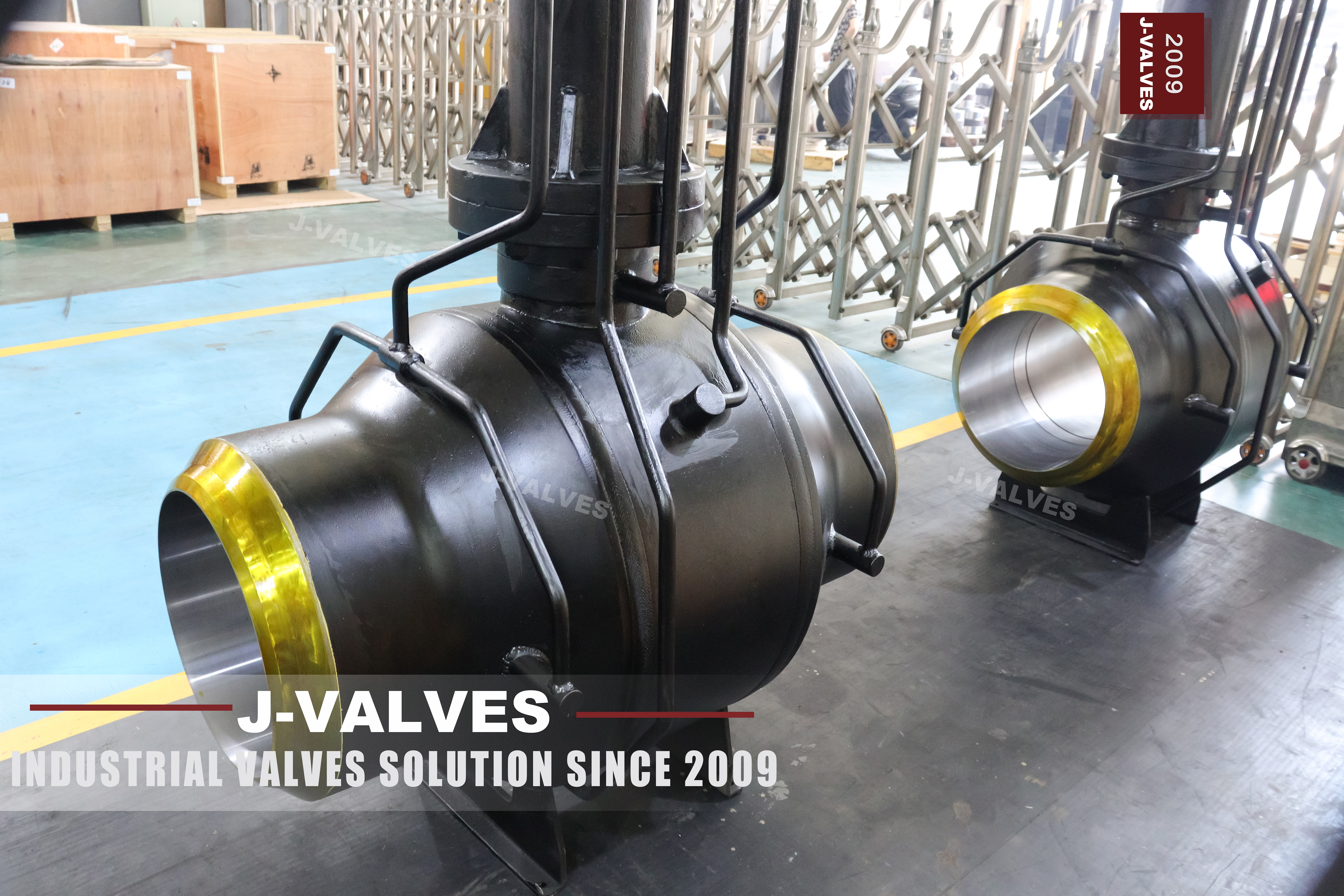
This page describes a seat in two parts, which is unusual and correct. The primary seal is metal to metal and the secondary seal is a polymer that sits behind it, and the polymer is listed as PTFE, RPTFE, PEEK or nylon. Read as a sentence, that is a proper description of how a metal seated trunnion valve is built for a hard service: the metal carries the pressure and the wear, and the polymer fills the last few microns so the valve is tight at low pressure before the metal has bedded in.
Now put that seat inside a welded body. The polymer is the part that a fire test consumes, the part that ages fastest, and the part that a seat injection fitting is designed to compensate for, and none of it can be replaced without cutting the valve out of the line. The valve is therefore designed around a component with a shorter life than the shell, installed where it cannot be changed.
This page follows that one component. It separates the two seals, says what each of them is for, follows what a fire test does to the pair, and puts the injection port in its real place: not an emergency accessory, but the only second chance this seat will get.
Design and Construction
The body is one welded shell: a forged pipe section closed by two forged ends, with no flange across the middle and no bolted cover. The ball is carried on an upper and a lower trunnion, so the thrust from line pressure goes into the trunnion bearings and the seats only have to seal. Above four inch the trunnions run in bearing blocks that are fitted before the second end is welded on, which is the detail that makes a welded trunnion valve buildable at all.
The stem passes out through the top of the shell, sealed with graphite packing and held by a shoulder below it so that it cannot be blown out with the gland removed. The operator pad above is machined square to the stem axis and drilled to the actuator pattern; the pneumatic cylinder is bolted there and can be removed and replaced without touching the pressure boundary.
The seat assembly is the part that differs from the pages around it. A metal seat ring is lapped to the ball and backed by a spring or by line pressure, and behind it sits a polymer ring that is pressed against the ball by the same spring. At low pressure the polymer is what makes the seal; as pressure rises the metal takes over. Both rings are in the same pocket, and the pocket is inside the welded body.

Two Seals, One of Them Sacrificial
The page's own wording is the right way round, and it is worth taking it literally. A primary seal and a secondary seal are not two options and they are not a first choice and a fallback; they are two parts doing two jobs in series, and only one of them survives a fire.
| Element | What It Does | What Limits It | What Can Be Done About It |
|---|---|---|---|
| Metal primary seat | Carries pressure and wear, laps to the ball | Finish, hardness pair, thermal growth | Relap at overhaul, which needs the body open |
| Polymer secondary seat | Seals at low pressure before the metal beds in | Temperature, and the medium if it attacks it | Nothing in service, except injection |
| Spring preload | Holds both rings to the ball with no line pressure | Set at build, relaxes with cycling | Nothing in service |
| Injection port | Puts sealant into the seat pocket | Fitting type, and whether it is reachable | The only in service remedy |
| Ball surface | The face both rings seal against | Coating wear, scratches, particles | Repolish at overhaul |
Nylon is the lowest of the four polymers in that list and it is the one that is hardest to justify on a page that also quotes a range to 425 Celsius. It has its place where the medium would swell or attack PTFE, and it has no place near the top of the temperature range. A range printed as a single figure over four different polymers is a statement about the family, not about the seat that will be fitted.
The fire test is where the two seals separate completely. A fire test destroys the polymer on purpose and then measures what the metal seat still holds. That is not a defect of the design, it is the design: the polymer is there to make the valve tight in normal service, and it is expected to be consumed in a fire. The consequence for a welded valve is that the part which is designed to be consumed cannot be replaced afterwards.
That is what the injection port is really for. The page calls it an emergency fitting, which is honest, but on a welded body it is more than that: it is the only way to put anything into the seat pocket for the whole life of the valve. Sealant does not restore a worn seat, it fills the gap between a worn seat and the ball for a while, and the page says as much when it warns that the seats have to be repaired at the first opportunity. On a welded valve the first opportunity is a shutdown with the valve cut out.
Technical Specifications
The table is the build as the page states it. One line on the page does not survive being read against the standard, and it is corrected below rather than repeated.
| Item | Value |
|---|---|
| Size range | 2 inch to 56 inch, DN 50 to DN 1400 |
| Pressure class | Class 150 to Class 2500, PN 20 to PN 420 |
| Temperature | Minus 29 to plus 425 Celsius, per the seat fitted |
| Body | Forged A105, A350 LF2, A694 F52 or F65, A182 F304, F316, F51 |
| Ball | Matching the body, chrome plated or nitrided |
| Trunnion | On bearing shafts, 440C or a lined type |
| Stem | 17-4PH, 316 or F51 |
| Primary Seat | Metal to metal, hardfaced |
| Secondary Seat | PTFE, RPTFE, PEEK or nylon |
| Packing | Flexible graphite |
| Ends | Butt weld to ASME B16.25 or EN 12627 |
| Actuation | Pneumatic, double acting or spring return |
| Air Supply | 0.4 to 0.7 MPa |
| Actuator Type | Rack and pinion, scotch yoke, or a combination |
| Design and Test | API 6D and ASME B16.34, tested to API 6D |
The pressure class line reads PN 16 to PN 420 on the page, and PN 16 is not a row in the class table that API 6D publishes. Class 150 is PN 20, and the classes above it run 50, 64, 100, 150, 250 and 420. A range that starts at PN 16 starts below Class 150, which for a steel trunnion valve is not a class at all; PN 16 belongs to the flange standard, not to this one.
Standards and Compliance
API 6D governs the valve and ASME B16.34 supplies the wall and the ratings. The ends are offered to ASME B16.25 or to EN 12627, and those two are not interchangeable: they are two weld end profiles, and a valve machined to one does not fit a pipe prepared to the other without grinding. The actuator brings its own documents, which are separate from the valve's.
| Document | What It Fixes | What It Leaves Open |
|---|---|---|
| API 6D | Classes, test, marking, fire test | The seat arrangement |
| ASME B16.34 | Wall, material groups, ratings | The seat and the drive |
| ASME B16.25 | Weld end profile, US practice | The European profile |
| EN 12627 | Weld end profile, European practice | The US profile |
| API 598 | Shell and seat test | The acceptance rate |
| API 607 and 6FA | Fire test of the design | Whether this unit was tested |
| ISO 5211 | The mounting pad and coupling | The actuator bolted to it |
The two weld end profiles deserve a sentence because they are a recurring field problem. A valve ordered with B16.25 ends and a pipe prepared to EN 12627 will be ground to fit on site, and the root gap that results is not the one the welding procedure was written for. The fit is made to work, and the weld is then radiographed to a standard that assumes a different preparation.
Manufacturing Process
The body is welded, radiographed and machined, and the seat pockets are cut after the body is closed. That last point is what makes a welded trunnion valve difficult: the pockets are reached through the ends, bored from each end face, and the two have to end up coaxial with each other and with the trunnion bores. Any error shows as one seat carrying more load than the other, which is invisible until the leakage test.
The metal seat rings are machined, hardfaced and lapped against the ball they will run with, because a lapped pair is matched rather than interchangeable. The polymer rings are moulded or machined to a size that gives a defined interference when the seat is assembled, and the spring that loads both rings is set at build so that the preload is the same on both seats.
The actuator is fitted after the valve is tested, and the open and closed positions are set on the mechanical stops rather than on the cylinder travel. On a spring return unit the spring is compressed at the closed position, so the spring is doing work for the whole life of the valve and its free length is a service item.

Quality Control and Testing
The shell test is applied to the welded body with the ball open, at the multiple of the class that API 6D names. With no body joint, a weep at this stage is a weld or a plug, and the plugs are the more common finding: a seat injection fitting that is not correctly seated will weep at test pressure and be tight at line pressure.
The seat test is run from each side and the leakage collected and compared with the acceptance on the order. On a metal primary seat the acceptance is a rate rather than zero, and the polymer secondary seat is what makes a low pressure test pass. That combination means the test has to be run at more than one pressure: a valve that holds at low pressure on the polymer and leaks at the class pressure has a metal seat problem that the low pressure test cannot see.
The pneumatic actuator is stroked against the valve at the minimum supply pressure, not the nominal one, because a double acting cylinder at the bottom of its band produces less torque and a spring return unit at the bottom of its band may not fully compress the spring. A unit set up at 0.7 MPa and run at 0.4 arrives with the wrong switch positions.

Applications and Industry Service
Gas gathering and transmission is the first use, where the valve is a section isolator and the pneumatic cylinder is driven from an instrument air header at the station. The metal primary seat is chosen for dry gas, where a polymer seat on its own would be damaged by particles carried through the line at start up.
The second use is any service where the medium is abrasive enough to destroy a lapped band but where a bubble tight shut off is still required at low pressure. That is exactly the case the two seal arrangement was invented for, and it is also the case where the polymer will need replacing first.
The valve is the wrong choice where the seat has to be renewed on a schedule, because on a welded body that means cutting the valve out. It is also the wrong choice where the air supply cannot be guaranteed at the minimum pressure, because a spring return unit that cannot fully compress its spring will not fully open, and a double acting unit with low air will not close.

Installation, Operation and Maintenance
The valve is welded into the line and the field weld is made to whichever profile the valve was machined to. The injection fittings are left accessible and labelled, because a fitting buried under insulation has been bought for the drawing rather than for the valve. The air supply is filtered and lubricated to the actuator's requirement, and a regulator at the valve is better than a long header that sags in pressure at the end of the line.
Operation is a quarter turn and the air supply is the thing to watch. A cylinder that is slow is usually a filter or a regulator, and a cylinder that is weak is usually a supply pressure problem rather than a piston seal. On a spring return unit the spring is compressed in one position for years, and the first sign of a tired spring is a valve that does not quite reach its stop.
Maintenance is the packing, the injection fittings and the actuator. The packing is renewable with the line live. The injection fittings are proved by injecting and holding, not by looking at them. The seat itself is not a maintenance item on this valve: it is a renewal at a shutdown, and the decision to renew it is taken from the leakage trend rather than from the calendar.
How to Specify and Order
The order lines below are the ones the page leaves open, and the first two are the ones that decide whether the seat can be kept alive between shutdowns.
| Line on the Order | What to Write | Why It Matters |
|---|---|---|
| Secondary seat material | Which polymer, with the temperature it allows | The range on the page is the family, not the seat |
| Injection fittings | Fitted on both seats, with the fitting and check type | The only in service route into the pocket |
| Class | Class 150 to API 6D, not PN 16 | PN 16 is a flange rating, not a class |
| Weld ends | B16.25 or EN 12627, and which one the pipe is cut to | The two profiles are not interchangeable |
| Actuator | Double acting or spring return, and the fail position | Only a spring defines where it fails |
| Air supply | Minimum and normal pressure at the valve | The unit is set at the minimum |
| Bearing | 440C or lined, with the temperature limit | It sets the torque and the life |
| Test | Seat acceptance as a rate, at both low and class pressure | A low pressure pass hides a metal seat fault |
Read as a whole, the page describes a valve whose seat is a designed compromise: a metal ring for the pressure and a polymer ring for the tightness, in a body that cannot be opened. The shell and the trunnion are settled. What decides whether the valve is still tight in its tenth year is which polymer was chosen for the temperature it actually sees, and whether anyone proved the injection fittings while they were still reachable.
FAQ
Q: What is the difference between the primary and the secondary seat?
A: The primary is metal to metal and carries the pressure and the wear; it is lapped to the ball so the two surfaces match. The secondary is a polymer ring behind the metal ring, held against the ball by the same spring, and it is what makes the valve tight at low pressure before the metal has bedded in. They work in series, not as alternatives.
Q: Why does a fire test consume the secondary seat?
A: Because that is what the test is for. The polymer is destroyed on purpose and the valve is then checked for what the metal seat still holds. The design expects the polymer to be gone after a fire, so the metal ring has to be able to seal on its own, which is why the metal seat is lapped rather than merely machined.
Q: Can the secondary seat be replaced?
A: Not on a welded body. Replacing it means opening the cavity, and the cavity of a welded valve is closed for its life. The only in service action is injecting sealant through the port, which fills the gap for a time rather than renewing the part. A real replacement means cutting the valve out of the line.
Q: Is PN 16 a pressure class for this valve?
A: No. The class table in API 6D runs from Class 150, which is PN 20, through 50, 64, 100, 150, 250 and 420. PN 16 is a flange rating from the European flange standard and has no row in the valve class table, so a range written as PN 16 to PN 420 has borrowed a number from another document.
Q: What happens to a spring return actuator at low air pressure?
A: It may not fully compress the spring, which means the valve does not fully reach the position the spring is fighting. The unit should be stroked and the switches set at the minimum supply pressure rather than the nominal one, because the minimum is the pressure the plant will actually deliver at the end of a long header.


Hot Products


News
Urea Plant Ball Valves: The Wetted Path Survives Only While Oxygen Is Being Fed To It
Carbamate at 150 bar and 185 C eats stainless 50 times faster once the passive film starves. The valve cavity is where the oxygen runs out first.
Read More
Stiction: What A Ball Valve Becomes When Nobody Turns It
A valve that stood closed for years has not worn out. The seat has bonded to the ball, and the first stroke is a step, not a ramp. What the trace shows.
Read More
Molten Salt Ball Valves: The Valve Works at 565 C And Dies at 219 C
Salt freezes at 220 C and decomposes at 565 C. Everything a molten salt ball valve does happens in that 345 kelvin gap, and the gap is not generous.
Read More
Direct Air Capture Ball Valves The Vacuum Side Runs The Seal Backwards, And Three Hundred Thousand Strokes Decide The Design
A solid sorbent DAC plant moves 1.3 million cubic metres of air per tonne of CO2, then asks a DN50 ball valve to hold 0.9 bar from the wrong side.
Read More