


CHINA J-VALVES Offers Various High-quality I ndustrial Ball Valves
J-VALVES, a distinguished professional ball valve manufacturer rooted in China, takes pride in its extensive product portfolio. Our offerings span a wide range, including trunnion-mounted ball valves, floating ball valves, high-temperature ball valves, high-pressure ball valves, metal-sealed ball valves, ultra-low temperature ball valves, DBB ball valves, Three-way And Four-way Ball Valve, and fully welded ball valves. Each product is a testament to our commitment to precision engineering and reliable performance. Meticulously crafted, they are designed to not only meet but exceed the most stringent industrial demands, ensuring stable operation even under extreme conditions. This enables us to provide our clients with high-value services and makes our valves widely sought-after in industries.
Product Category
Contact Us


-
J-VALVES-Q41F
-
J-VALVES
Overview of the J-VALVES 3 inch Class 600 WCB two piece floating ball valve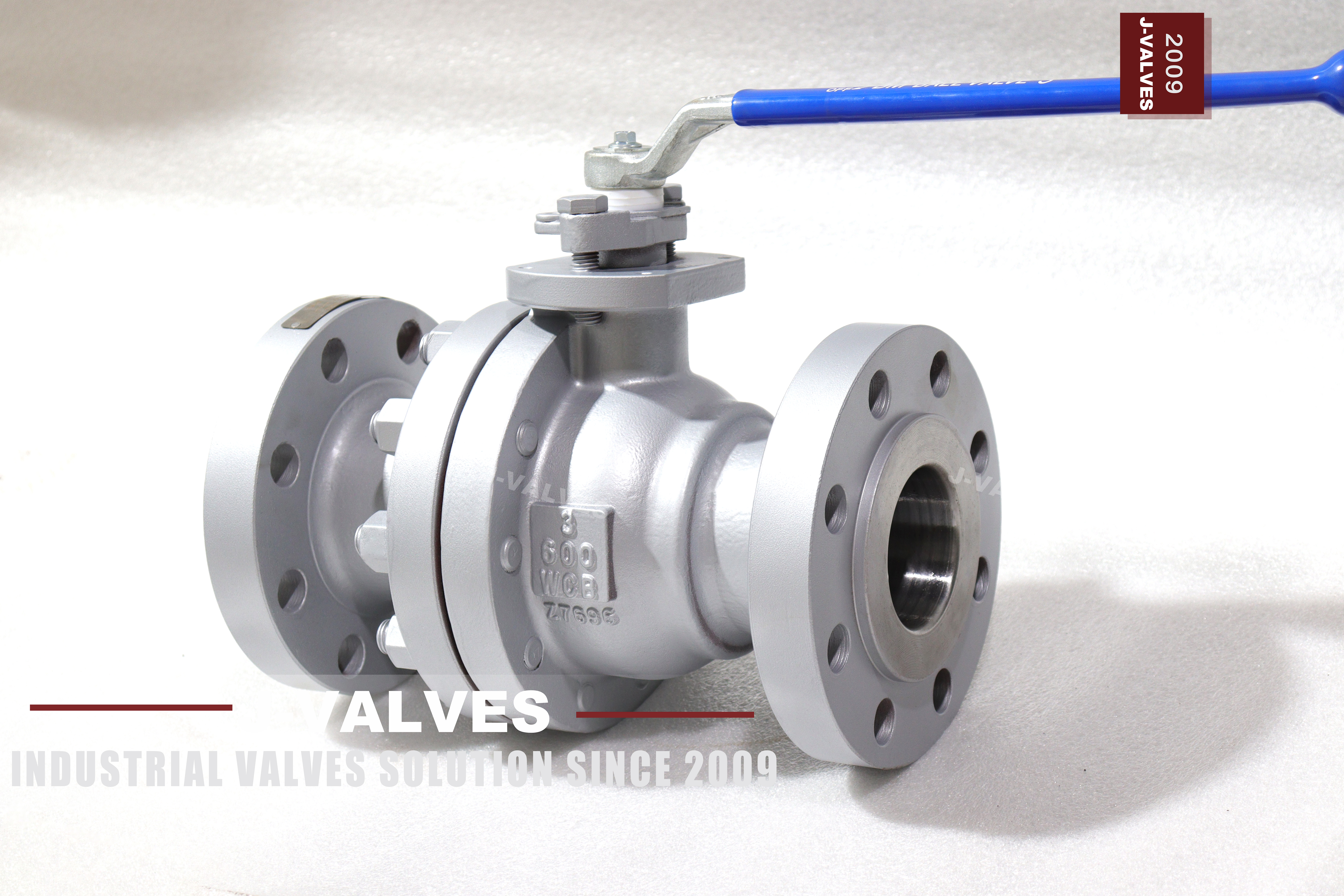
Every soft seated ball valve is sold as bubble tight, and almost none of them are sold with a number that means anything. Bubble tight is not a rate and it is not a class. It is a phrase that came out of a test bench where a soap film was watched for bubbles, and a valve that passes that test on water at ambient will not necessarily pass it on air at the same pressure, because the two fluids find leaks differently.
The valve on this page is three inch, Class 600, cast carbon steel, two piece, floating ball, with a lever. It is a utility valve and it is bought by the thousand. What makes the difference between one that is tight in service and one that weeps after a month is not the body and not the ball. It is the seat insert, and behind the insert, the test that was run to prove it.
So this page is about the two numbers that never appear together on a data sheet: the seat test pressure the valve was proved at, and the medium the test was run with. Get those two right and the word bubble tight stops being a promise and becomes a result.
Design and Construction
The body is two pieces, a main body and one end cap, closed on a single ring of studs with one gasket. At three inch that is one joint at full line pressure, and it is the reason this style is cheap to make: one joint instead of two, one gasket instead of two, one set of studs.
The ball is not held. It sits in the cavity with the stem above it and the two seats on either side, and line pressure pushes it into the downstream seat. The upstream seat is loaded by its spring and by whatever preload was set at assembly, and while the downstream seat holds, the upstream seat is not a barrier. That is the mechanism, and it is why a floating valve is a one barrier valve however many seats it has.
The seat is a ring in a pocket with a spring behind it and an insert in its face. The insert is the part that actually touches the ball, and it is a polymer rather than a metal, which is what makes the valve tight and what limits its temperature. The spring is only there to hold the insert against the ball when there is no pressure, because above a few bar the pressure behind the seat does the work.
The stem enters through the body and is retained from inside, so pressure cannot eject it. The gland above it compresses the packing, and on a carbon steel valve at this class the packing is normally PTFE chevrons or graphite. Above the gland is the lever, keyed to a flatted stem, with a stop plate that limits travel to a quarter turn.

Material Options
The insert is the choice that matters on this page, and the parameter list offers four of them. They are not a ladder of quality. They are four different polymers with four different sets of properties, and the right one is decided by the medium and the temperature rather than by the price.
| Insert | What It Is Good At | Where It Stops | What It Costs |
|---|---|---|---|
| PTFE | Lowest friction, tightest seal, widest chemical resistance | The first to deform under load at temperature | The standard, and the cheapest |
| Reinforced PTFE | Same seal with less creep under load | Higher than plain PTFE, still a polymer limit | The default upgrade |
| PPL | Holds shape higher up the temperature range | Below a metal seat, above the reinforced grades | The middle option |
| Metal | No polymer to deform or burn | Needs a lapped pair and a rate acceptance | The expensive one |
The difference between plain and reinforced PTFE is glass or another filler, and its effect is on creep rather than on chemical resistance. A plain PTFE insert under a loaded seat at temperature takes a permanent set, and a seat that has taken a set will not seal again at ambient until the valve has been cycled and the insert has been pushed back into contact.
PPL is the option that gets specified when the temperature is above what reinforced PTFE will hold and the buyer does not want to go to a metal seat. It keeps its shape better, and it is harder, which means it conforms less well to a ball that is not perfectly round. On a valve whose ball has been ground properly that is not a problem, and on one that has not it is the difference between tight and weeping.
A metal seat on a floating valve is possible and it changes the acceptance. A metal seat is a lapped pair that is proved at a leakage rate rather than at zero, so a buyer who specifies a metal seat to solve a temperature problem has also bought a different definition of tight. That trade should be made deliberately rather than discovered at the witness test.
Technical Specifications
Class 600 in group 1.1 of ASME B16.34 is 1480 psi at 38 C, and API 6D clause 7.2 records the same class as PN 100. The seat test is run at 1.1 times the rating, which means a valve that will spend its life at a few bar is proved on its seats at a pressure well above anything it will see in service.
| Item | Value |
|---|---|
| Size | Three inch, DN 80 |
| Pressure class | Class 600, recorded as PN 100 in API 6D clause 7.2 |
| Rating | 1480 psi at 38 C in group 1.1 |
| Body style | Two piece bolted body, floating ball |
| Body material | ASTM A216 WCB, group 1.1 |
| Flange | ASME B16.5 Class 600, raised face |
| Face to face | ASME B16.10 for NPS 3 Class 600, confirmed on the drawing |
| Seat insert | PTFE, reinforced PTFE, PPL or metal |
| Shell test | 1.5 times the rating, API 598 |
| Seat test | 1.1 times the rating, each seat, cavity vented |
| Temperature | Minus 29 to plus 425 C as a body figure, insert limited |
| Operator | Lever as photographed, gear or actuator per order |
The two test pressures are the numbers to carry into a conversation about tightness, because they are the only ones that were actually applied to the valve. A certificate that says the valve is bubble tight without saying what pressure and what medium it was proved at has told you that someone watched a joint, and nothing more.
Standards and Compliance
At three inch Class 600 both product standards apply, and this is one of the sizes where the overlap is real rather than nominal. API 608 covers DN 15 to DN 600 in Class 150 to Class 600 and API 6D covers pipeline valves over a wider class range. A valve at this size and class is inside both, and a data sheet that names only one of them is incomplete.
| Requirement | Document | What It Means Here |
|---|---|---|
| Wall and rating | ASME B16.34 group 1.1 | 1480 psi at 38 C |
| Product requirements | API 608 and API 6D | Both apply at this class |
| Flange dimensions | ASME B16.5 Class 600 | Raised face, three inch circle |
| Face to face | ASME B16.10 | The dimension the spool is built to |
| Pressure test | API 598 | Shell 1.5 times, seat 1.1 times |
| Test medium | API 598 permits water, air or gas | The medium has to be recorded |
| Fire test | API 607 or ISO 10497 | Type test, scope to be read |
| Material certificate | EN 10204 3.1 | Heat number matched to the plate |
The test medium is the clause that is most often skipped when a certificate is copied into a project file. API 598 allows the shell test to be run with water or with air or another gas, and the seat test to be run with water, air or gas, and the acceptance differs with the medium because the leak path behaves differently. A test on water at ambient is the normal workshop practice and it is a weaker proof than a test on air, because water does not pass a leak path that air will.
That is not an argument for testing everything on air, which is dangerous at these pressures and needs different equipment. It is an argument for reading the certificate rather than the word bubble tight, and for asking for a gas seat test when the service is gas, because a valve that holds water may not hold gas and the buyer is the only person who knows which one the service is.
Manufacturing Process
The body and cap are cast, normalized and shot blasted, then machined with the flange face, the bolt circle, the joint face and the seat pocket referenced to one centreline per part. That reference is what makes the two halves close with the seat pockets in line, and it is the operation that separates a body that seals from one that weeps at the joint however the studs are tensioned.
The ball is machined, coated if the order calls for a coating, and ground on its sphere. The coating is a hard chrome or a nickel plating on a carbon steel ball, and it is there to stop the ball corroding in the closed position rather than to make it harder, because the insert is softer than either coating.
The insert is machined and fitted into the seat ring, and the ring is then assembled with its spring into the pocket. The insert sits slightly proud of the ring face, and the amount it stands proud is what sets the preload on the ball when the body is closed. Too little and the valve is loose at low pressure; too much and the insert is over compressed before the valve ever sees line pressure.

Quality Control and Testing
The heat number is cast into the body and repeated on the certificate, and the check that matters on a carbon steel valve is that the body and the cap are from the same heat or from heats of the same grade. A mixed cap is not a service defect, but it is a documentation defect, and on a valve that will be one of fifty in a plant it is the kind of thing that stops a file being closed.
| Step | Check | Acceptance |
|---|---|---|
| 1 Incoming | Heat number against the mill certificate | A216 WCB chemistry and tensile |
| 2 Machining | Seat pocket alignment across the joint | Drawing tolerance |
| 3 Insert | Insert stand proud of the seat face | Drawing figure, recorded |
| 4 Shell test | Body and joint at 1.5 times, medium recorded | API 598, no leakage |
| 5 Seat test | 1.1 times on each seat with the cavity vented | API 598, no visible leakage |
| 6 Medium | Water, air or gas recorded against each test | Certificate states the medium |
| 7 Torque | Lever torque at rated pressure | Within the drawing figure |
| 8 Final | Cavity drained, faces masked, marked, crated | Works standard |
Step six is not a physical check, and it is the one that makes the certificate usable. A record that says the seat test passed without saying whether it was water or air cannot be compared with the specification, and it cannot be compared with a test on the same valve at a different works.
The insert stand proud is the check that predicts how the valve behaves on the bench at the customer's site. A valve that has been assembled with too much preload will feel stiff on the lever before it is installed, and a valve with too little will pass its seat test at pressure and leak at the first low pressure check.

Applications and Industry Service
Three inch Class 600 carbon steel floating valves are the utility and process valve of a plant: water and steam headers, plant air, nitrogen, fuel gas, and hydrocarbon liquids that are clean enough not to attack a carbon body. In all of those the requirement is a tight shutoff that can be restored by changing an insert, and the floating construction delivers that with the fewest parts of any body style.
Steam is where the insert choice is decided rather than the body. Saturated steam at this class is not a pressure problem for a WCB body, and it is a temperature problem for a PTFE insert, so a valve bought for steam should be bought with the insert that suits the steam temperature rather than with the standard insert and a hope.
The valve is the wrong choice for a duty that needs two barriers, and the reason is the mechanism rather than the paperwork. A floating ball seals on one seat, so a double block and bleed duty has to go to a trunnion valve with double piston effect seats. It is also the wrong choice for a line that will be pigged, where a full port helps with the flow but the cavity is still a trap.

Installation, Operation and Maintenance
The valve can go in either way round, because the ball moves to whichever seat the pressure is behind. What changes with orientation is the cavity plug, and on a line that will be drained for maintenance the plug should end up at the lowest point rather than at the top where it was convenient to reach during installation.
Bring the mating flanges up parallel before tensioning, and use the gasket and studs that belong to the three inch Class 600 flange rather than hardware sized to the bore. Draw them up out of parallel and the studs bend the cap instead of seating it, the joint weeps at test, and the gasket carries the blame for the pipework.
For maintenance the line is isolated, vented and drained, the cap studs are released in a pattern, and the cap comes away with one seat. Both inserts should be replaced as a pair even when only one is leaking, because they have seen the same number of cycles and the second is halfway through its life. Nothing on that joint is reused: the gasket goes back new and the studs are brought to the stated figure in a cross pattern.
How to Specify and Order
The order is decided by six entries: bore, class, body grade, insert, facing and operator. Two more belong on the order and are almost always left off: the test medium, and whether the seat test is to be witnessed. Those two decide whether the certificate that arrives at the end is worth the paper it is printed on for the service the valve is going into.
What the line has to supply is the medium, the design temperature and pressure, and whether a pig ever has to pass; the valve cannot supply any of them. The medium decides the insert and the body grade, the temperature decides the insert, the pressure confirms the class, and the pigging question decides whether a full port is needed.
Documents to name in the order: the EN 10204 3.1 certificate with the heat number matched to the plate, the shell and seat test record with the test medium stated against each, the insert material certificate, the fire certificate if one is required with its scope read, and the general arrangement drawing carrying the face to face dimension.
FAQ
Q: What does bubble tight actually mean?
A: It means a technician watched a joint and saw no bubbles. It is not a rate and it is not a class, and it says nothing about the pressure or the fluid the observation was made with. API 598 acceptance for a soft seat is no visible leakage, judged over a defined observation period, and that is the criterion the certificate should quote.
Q: Why does the test medium matter?
A: Because water and air find leaks differently. A path that will not pass water at ambient will pass air, so a gas service valve proved on water has been proved to a lower standard than the service requires. API 598 permits either medium, which is exactly why the certificate has to say which one was used.
Q: What pressure is the seat tested at?
A: 1.1 times the Class 600 rating, which is well above what most of these valves see in service. The shell test is at 1.5 times. Both figures come from the rating and not from the line, and they are the reason a small valve can be proved harder than it will ever work.
Q: Which seat insert should I order?
A: Reinforced PTFE for most water, air and steam duties, PPL where the temperature is above what reinforced PTFE will hold, and metal only where a polymer cannot survive at all. The insert sets the temperature limit of the whole valve, so this is the line that decides the service range.
Q: Can this valve be used for double block and bleed?
A: No. The ball floats, so pressure pushes it into the downstream seat and only that seat is a barrier. A double block and bleed duty needs a trunnion valve with double piston effect seats, where both seats are barriers and the cavity between them can be bled.


Hot Products


News
Why A Ball Valve Gets Harder To Turn: Five Causes, And The Test That Tells Them Apart
A ball valve that stiffens over months points at one of five parts. Measure torque with the line pressurised and again vented, and the split becomes visible.
Read More
The Ball Valve at Four Thousand Bar: Seat Load, Erosion And Fatigue in Waterjet Circuits
At 4,000 bar a 10 mm bore puts 31 kN on the seat and a 0.1 mm leak cuts steel. What a ball valve must survive in a waterjet or intensifier circuit.
Read More
Large Diameter Ball Valves: Four Limits That Change The Design
Above a certain size a ball valve stops being a scaled one. Ball weight, operator torque, body split and the test bench each set a limit at a different size.
Read More
Cast Or Forged Ball Valve Body, And What A Radiography Acceptance Level Actually Buys You
Casting or forging is only half the decision. What RT, UT, MT and a proof test each find in a ball valve body, and where the geometry defeats all of them.
Read More