


CHINA J-VALVES Offers Various High-quality I ndustrial Ball Valves
J-VALVES, a distinguished professional ball valve manufacturer rooted in China, takes pride in its extensive product portfolio. Our offerings span a wide range, including trunnion-mounted ball valves, floating ball valves, high-temperature ball valves, high-pressure ball valves, metal-sealed ball valves, ultra-low temperature ball valves, DBB ball valves, Three-way And Four-way Ball Valve, and fully welded ball valves. Each product is a testament to our commitment to precision engineering and reliable performance. Meticulously crafted, they are designed to not only meet but exceed the most stringent industrial demands, ensuring stable operation even under extreme conditions. This enables us to provide our clients with high-value services and makes our valves widely sought-after in industries.
Product Category
Contact Us


-
J-VALVES-Q647F
-
J-VALVES
Overview of the J-VALVES 12x10 A105 hydraulic three piece flanged ball valve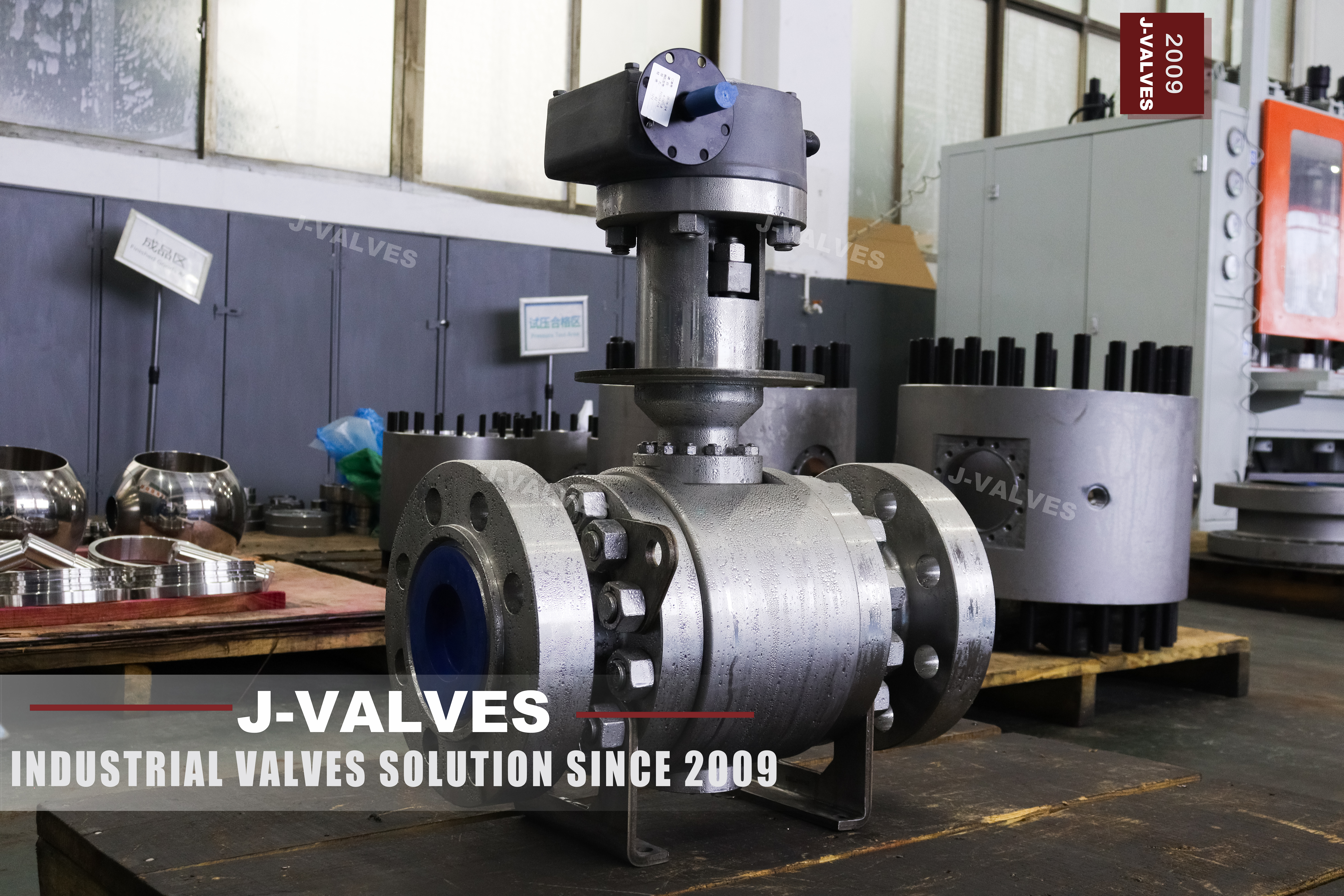
The reason to buy a three piece body is access, and access has a price that is easy to state: two joints, two gaskets, four sealing faces and a set of studs, every time the valve is opened. The reason to buy a welded body is that the price is never paid, because the valve is never opened. Both are correct answers to different questions, and this batch contains six of each, which makes the comparison unusually direct.
The page sells the three piece version on the sentence that the middle body can be disassembled online for inspection and seat replacement without removing the valve from the pipeline. Every word of that is defensible and the sentence still misleads, because online here means the valve stays in the pipe. It does not mean the line stays in service. Before a single stud is loosened the section has to be isolated, drained and proved, which is a permit, a procedure and a shift rather than an adjustment.
This page is about what the teardown actually involves. It counts the parts that are consumed each time, says what has to be true before the joint is broken, and sets the count against the welded alternative that the rest of this family offers. The valve itself, a 12x10 A105 body with a hydraulic actuator, is the same one the neighbouring page describes.
Design and Construction
The body is three forged pieces: a left body, a right body and a centre section that carries the ball and both seats. Each outer piece carries one flange and one half of a body joint. The centre section carries the other half of each joint, which is why there are two joints rather than one, and why the centre section is the only part that has to be removed to reach the seats.
Each joint is a pair of machined faces with a gasket between them, held by a ring of studs with nuts. That means four sealing faces on the valve, two per joint, and each of them has to be clean, flat and free of a scratch before the joint is closed. A scratch across a face on a 2500 class valve is not a leak, it is a new body half, because no gasket will seal a raised burr and no amount of torque will flatten one.
The ball is carried on trunnions rather than floating, which the page's feature block states and its description does not. That matters for the teardown: on a trunnion valve the seats can be inspected and replaced with the ball left in place once the centre section is out, because the ball is held by its shafts and not by the seats. On a floating valve the ball would come out with the seat.
Handling the centre section is its own problem. It carries the ball, both seats and both joint faces, so it is the heaviest of the three pieces and the one with the least to grip. It has to come out square rather than be dragged, a sling passed through the bore will mark a seat pocket, and a pocket with a burr in it damages the new seat before the valve is closed again. A stand that holds the section face up is worth more than a second pair of hands, and it is the difference between an inspection and a repair.

What a Teardown Costs
The useful comparison with the welded pages in this family is not a matter of opinion, it is a count of parts that are consumed. The table below is what one opening of this body costs, and it is the same list whether the opening is for an inspection or for a seat replacement.
| Item | Consumed per Opening | Why It Cannot Be Reused |
|---|---|---|
| Body gaskets | Two, one per joint | Compressed to a set thickness, and taken past its elastic limit |
| Studs and nuts | A full set per joint, where the maker requires it | Torque cycles and thread stretch, and a stud has a stated life |
| Sealing faces | Four, two per joint | Each has to be dressed and inspected, and a defect condemns the half |
| Seat rings | Two, replaced as a pair | A new seat against a worn one loads unevenly |
| Joint sealant or dressing | Per the procedure | The joint is a pressure boundary, not a dust cover |
| Cavity fluid | Drained and disposed of | The cavity has to be empty before the joint opens |
Two gaskets per opening is the number that surprises people who are used to two piece bodies, where there is one joint and one gasket. It is also the number that makes the welded body attractive: six of the pages in this batch describe valves with no body joint at all, and their cost per opening is zero because there is no opening.
The counter argument is equally concrete. A welded body cannot be inspected, so a seat that starts to weep can only be injected or waited on. A three piece body can be opened, looked at and put back together with new gaskets for a fraction of the cost of a new valve, provided the line can be taken out of service. The choice is between a maintenance cost that is paid only when the valve is opened and an access that does not exist at all.
Technical Specifications
The table is the build as the page states it, with the joint written as two joints rather than as a feature.
| Item | Value |
|---|---|
| Nominal bore | 12 inch by 10 inch, DN 300 by DN 250 |
| Pressure class | Class 150 to Class 2500, PN 20 to PN 420 |
| Temperature | Minus 29 to plus 425 Celsius |
| Body | ASTM A105 forged carbon steel, normalized, three pieces |
| Body Joints | Two, each with a gasket and a stud set |
| Ball | A105 with hard chrome, or 304 or 316 stainless |
| Ball Support | Upper and lower trunnion |
| Stem | 410 or 420 stainless, or 17-4PH |
| Seat | PTFE, RPTFE or PPL, to be named on the order |
| Packing | Flexible graphite |
| Ends | Raised face flange to ASME B16.5, twelve inch |
| Face to Face | ASME B16.10, looked up at twelve inch |
| Actuation | Hydraulic, double acting or spring return |
| Supply | 10 to 21 MPa hydraulic |
| Design | ASME B16.34, and API 608 only to Class 600 |
| Test | API 598 |
The class row is a family statement and the seat row is a build statement, and at the top of the range they disagree. A 2500 class valve at this size is not built with a polymer seat, because the seat would be extruded out of its pocket long before the body reached the class pressure. The range says what the family can be built to; the seat line says what this particular valve is.
Standards and Compliance
ASME B16.34 fixes the wall and the ratings, and on a three piece body it also implies where the material has to be sound, because the joint faces are part of the pressure boundary. API 598 governs the test, and on a body with two joints the test is as much about the joints as about the seats. API 608 is named as a design standard on the page and covers only the lower part of the pressure range.
| Document | What It Fixes | What It Does Not Cover |
|---|---|---|
| ASME B16.34 | Wall, material groups, ratings | The joint form and its fasteners |
| API 598 | Shell and seat test procedure | The acceptance rate |
| API 608 | Steel ball valves to DN 600 and Class 600 | Anything above Class 600 |
| API 6D | Pipeline valves, classes to 2500 | The three piece bolted form in refinery practice |
| ASME B16.5 | The flange at each end | The body joint |
| ASME B16.10 | Face to face at twelve inch | The bore |
| ASME B1.1 | Threads on the studs and nuts | The torque sequence |
The fastener line is the one that gets left out of specifications. A stud is not a bolt that can be torqued until it strips; it has a stated number of make ups, and past that number it is replaced whether it looks sound or not. On a valve that is opened every few years that number is never reached. On one that is opened every outage it is reached in a decade, and it is not written anywhere on the valve.
Manufacturing Process
The three pieces are forged, normalized and machined. The centre section is machined first, because both seat pockets and both joint faces are cut there and the pockets have to be coaxial with each other and square to the faces. If the two joint faces are not parallel, the two outer bodies sit at an angle and the whole valve is bent before it is bolted.
The joint faces are then lapped or ground as a pair, and the gasket groove or the raised face is cut to the profile the gasket needs. On a spiral wound gasket the joint needs a flat land and a controlled bolt load; on a sheet gasket it needs a surface finish that will not cut the sheet. The two are not interchangeable, and the finish on the face is decided by the gasket rather than by the machining convenience.
Assembly is two joints, each closed on a gasket and torqued in a crossing sequence in stages rather than in one pass. The ball and both seats are set in the centre section before the second joint is closed, and the stem is fitted from the top afterwards. The hydraulic unit goes on last, on a pad machined square to the stem.

Quality Control and Testing
The shell test is applied to the assembled body with the ball open, at the multiple of the class that the standard names. Both joints are under observation, and a weep is a gasket, a face or a sequence problem. On a 2500 class build the joints are the highest stressed seals on the valve, which is why the test pressure is applied slowly and held rather than taken up in one step.
The seat test is run from each side. On a trunnion valve with double piston seats both seats are barriers in both directions, which makes the test meaningful as a double block and bleed check; on a single piston build the upstream seat is not a barrier against the cavity and the test has to be read accordingly.
The gasket compression is checked by measuring the gap at the joint rather than by trusting the torque wrench. A joint that has been torqued to the specified value but has a gasket of the wrong thickness is either under compressed or over compressed, and both conditions leak at pressure rather than at the bench.

Applications and Industry Service
Continuous process plant is the first use, and the page's own argument is right for it: a valve that can be opened in place is worth more than a valve that cannot, where the line runs for years and a shutdown is planned rather than forced. The three piece form exists because a plant would rather change two gaskets than cut a body out.
The second use is a line that carries a medium that attacks the seat slowly, so that the seat is a planned replacement rather than a surprise. Being able to look at the seat, measure the wear and put the valve back with a new seat is the whole value of the bolted body, and it is only realised if the gaskets and studs are on the shelf before the outage rather than ordered during it.
The valve is the wrong choice where the line cannot be isolated for the length of a teardown, and where the medium is hazardous enough that two more joints are two more chances. Those are the cases the welded pages in this family were written for.

Installation, Operation and Maintenance
Installation is a raised face flange at each end and two body joints that arrived closed at the works. The body joints are not re-torqued on site as a matter of course; if a joint has to be re-torqued, the reason is a gasket that has taken a set, and the answer is a new gasket rather than more torque. The hydraulic unit is connected after the body is in place, and the accumulator, where fitted, is charged to the specified precharge.
Operation is a quarter turn, and the two things worth recording are the supply pressure and the stroke time. A hydraulic unit that is slow at the specified pressure is usually a filter or a valve in the supply line rather than the actuator, and a unit that is fast and weak is usually a bypassing cylinder seal.
Maintenance is the joints. Before anything is loosened the line is isolated, the cavity is drained through the drain fitting and the drain is proved by watching it, and only then is the first stud broken. Gaskets are replaced, faces are cleaned and inspected, studs are replaced if they are past their make up limit, and the joints are closed in stages with the torque recorded. Seats are replaced as a pair and the ball is inspected for a scratched band at the same time, because a new seat against a damaged ball will not last.
How to Specify and Order
The order lines below are the ones the page leaves open, and the first three are the ones that decide whether a teardown is a shift or a week.
| Line on the Order | What to Write | Why It Matters |
|---|---|---|
| Joint form and gasket | Spiral wound or sheet, with the face finish it needs | Two joints and four faces per teardown |
| Studs | Grade, and the number of make ups permitted | A stud has a life that is not on the valve |
| Spares | Two gaskets and a stud set held on site | The teardown starts when the parts arrive |
| Seat | PTFE, RPTFE, PPL or metal, with the temperature | The class range is not the seat range |
| Class and standard | The class, and API 6D above Class 600 | 608 stops at 600 |
| Ends | Flange standard and facing at twelve inch | The joint to the pipe is separate |
| Actuator | Double acting or spring return, with the fail position | Only a spring defines a fail position |
| Drain | Size and accessibility after insulation | The cavity has to be proved before the joint opens |
Read as a whole, the page describes a valve that is bought for the day it is opened. Three pieces give access to the seats, and the price of that access is two gaskets, four faces and a stud set per opening. Whether that is a good trade depends on one question: will the line be available for the teardown, or will the valve have to sit and wait because it cannot be taken out of service.
FAQ
Q: How many gaskets does one teardown need?
A: Two, one per body joint, plus a full stud set where the maker's make up limit has been reached. A two piece body needs one; a welded body needs none and gives no access. That count is the honest way to compare the three constructions.
Q: Can the centre section really be removed with the line in service?
A: No. The valve can stay bolted in the pipeline, which is what online means here, but the section has to be isolated, drained and proved before a stud is loosened. The saving is the cut and re weld, not the shutdown.
Q: Why replace both seats when only one is worn?
A: Because a new seat against a worn one does not share the load. The new ring takes the whole preload, wears faster, and the pair ends up further apart than when they were installed. Seats are a matched pair, and the ball has to be inspected at the same time because a scratched band will destroy the new seat.
Q: Does a stud need replacing at every opening?
A: Only when it has reached the number of make ups the maker permits, which is a figure that belongs on the drawing rather than in a fitter's memory. Past that number the stud is replaced whether it looks sound or not, because the failure mode is stretch rather than corrosion.
Q: Is API 608 valid for this valve?
A: Only up to Class 600. The page prints a range that runs to 2500 and names 608 as the design standard, and 608 stops at Class 600. Below that line it is the right document; above it the governing standard is API 6D.


Hot Products


News
Urea Plant Ball Valves: The Wetted Path Survives Only While Oxygen Is Being Fed To It
Carbamate at 150 bar and 185 C eats stainless 50 times faster once the passive film starves. The valve cavity is where the oxygen runs out first.
Read More
Stiction: What A Ball Valve Becomes When Nobody Turns It
A valve that stood closed for years has not worn out. The seat has bonded to the ball, and the first stroke is a step, not a ramp. What the trace shows.
Read More
Molten Salt Ball Valves: The Valve Works at 565 C And Dies at 219 C
Salt freezes at 220 C and decomposes at 565 C. Everything a molten salt ball valve does happens in that 345 kelvin gap, and the gap is not generous.
Read More
Direct Air Capture Ball Valves The Vacuum Side Runs The Seal Backwards, And Three Hundred Thousand Strokes Decide The Design
A solid sorbent DAC plant moves 1.3 million cubic metres of air per tonne of CO2, then asks a DN50 ball valve to hold 0.9 bar from the wrong side.
Read More