


CHINA J-VALVES Offers Various High-quality I ndustrial Ball Valves
J-VALVES, a distinguished professional ball valve manufacturer rooted in China, takes pride in its extensive product portfolio. Our offerings span a wide range, including trunnion-mounted ball valves, floating ball valves, high-temperature ball valves, high-pressure ball valves, metal-sealed ball valves, ultra-low temperature ball valves, DBB ball valves, Three-way And Four-way Ball Valve, and fully welded ball valves. Each product is a testament to our commitment to precision engineering and reliable performance. Meticulously crafted, they are designed to not only meet but exceed the most stringent industrial demands, ensuring stable operation even under extreme conditions. This enables us to provide our clients with high-value services and makes our valves widely sought-after in industries.
Product Category
Contact Us


-
J-VALVES-Q41F
-
J-VALVES
Overview of the J-VALVES three by two Class 600 F316 double block and bleed valve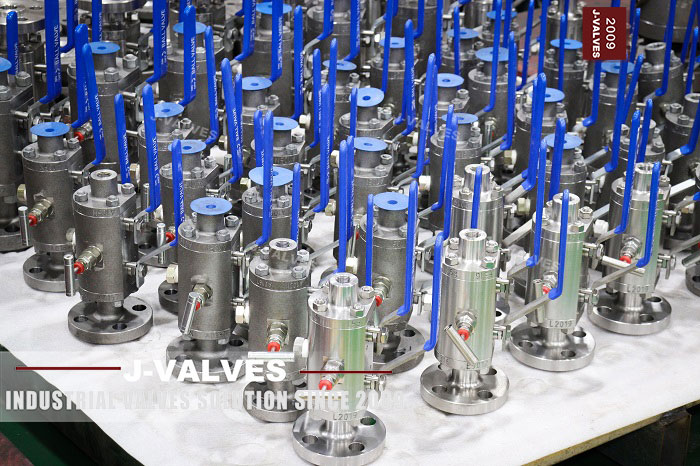
Two balls, two stems, two levers, one forged stainless body with a three inch flange at each end. That is what the photograph on this page shows, and it changes what the article is. A single ball with two seats and a bleed is block and bleed. Two balls with a bleed between them is double block and bleed, and the difference is not a matter of wording.
The build is three inch by two inch, Class 600, from minus 29 to plus 425 Celsius, in a forged A182 F316 body with an austenitic ball and stem. The ends are raised face, ring joint or butt weld. The bore through both balls is two inch, so the line steps down at each end and runs two inch through the pair.
The argument here is about how many sealed spaces actually exist inside this body. The answer is three, and only one of them has a proving point. That count is what makes the drawing, the seat option and the bleed arrangement into one decision rather than three.
Design and Construction
Take the two balls in turn. Each ball sits between two seat rings, and when it is turned closed the ball surface seals both of them, so the annular space around that ball is a sealed volume. Two balls give two of those. Between the first ball's downstream seat and the second ball's upstream seat there is a third space, bounded by the body bore, and that is the one the centre port reaches.
The three spaces behave differently. The middle one is the one that proves the pair: with both balls closed, opening the centre port tells you whether the upstream ball is passing. The two annular spaces around the balls are seat cavities, and whether they relieve into the line or stay sealed is decided by the seat design rather than by the body.
The seat table on this valve offers single piston effect, double piston effect, and two combination arrangements. The difference that matters is stated in the same table: a single effect seat lets the body cavity relieve into the line, and a double effect seat does not. On a valve with a centre bleed either can be used, because the bleed is there to empty the space. On a valve without one, the double effect seat creates a sealed volume with no way out.
Around it there are four further plugs at the corners of the body and one at the bottom. On a build of this kind those serve the seat and sealant passages, and the drawing is the only document that says which plug does what. An operator who assumes every port on the body is a bleed point will open the wrong one, and on a pressurised line that is how a seat sealant port becomes an escape route.
The two levers are separate because the two stems are separate. There is no linkage in the photograph and no common drive, so the valve has two operating positions and no interlock other than what is fitted to it. On an isolation duty that means both levers belong in the lockout and the closing sequence belongs in the procedure.
The bore is two inch through both balls inside three inch ends. The step at each end is a change of section where a dirty medium will deposit and where an abrasive one will cut, so a reduced bore valve on a dirty line is a valve with two wear points that a full bore valve does not have. That is the honest cost of the smaller ball, and it is not the cost the earlier version of this page described.

Material Options
The body is forged A182 F316, and on this valve the grade is doing two jobs at once. The molybdenum content gives resistance to chloride pitting and crevice attack, and the austenitic structure gives toughness at low temperature. Both are wanted on a stainless double block and bleed valve in process gas, and neither is available in a carbon steel body.
| Part | Grade | Why It Is There |
|---|---|---|
| Body | A182 F316 forging | Chlorides, process gas, low temperature toughness |
| Ball | F316, polished or coated | Same grade as the body, one corrosion behaviour |
| Stem | F316 or 17-4PH | F316 for corrosion, 17-4PH where hardness is wanted |
| Seat | Reinforced PTFE, polyimide, or metal | Temperature and pressure decide which |
| Studs | B8M class 2, strain hardened | Strength at temperature without a ferritic stud |
| Packing | PTFE V rings or graphite | Graphite above the polymer limit |
The stem grade is a choice between corrosion and hardness and it is not visible from outside. A 17-4PH stem is harder and takes the wear of frequent operation better; an F316 stem has the same corrosion behaviour as the body and the ball. On a valve with two stems that choice is made twice and it can be made differently on each, which is a question worth putting on the order rather than leaving to the works.
Stainless fasteners are the right default here and they are also the part that seizes. B8M class 2 is strain hardened austenitic, which gives it the strength the class needs without a ferritic stud in a stainless body, and it galls if it is assembled dry. The thread lubricant and the torque figure are part of the assembly specification on a stainless valve, not an afterthought.
The seat is where the temperature ceiling is set, and the list on this valve runs from a polymer to a metal seat. A polymer seat on a two ball valve has to hold its shape at the seat load on both balls, and the ball closest to the pressure sees the higher load. That is one more reason to read the seat option and the class together rather than separately.
Technical Specifications
The reduced bore on this build is worth stating precisely because the earlier version of the page sold it as an economy. Three inch ends around a two inch bore does mean a smaller ball, and a smaller ball is cheaper to make, but the second ball and the longer body that carries it are both additions. On this article the reduced bore saves on the trim and spends on the body.
| Item | Value |
|---|---|
| Size | Three inch by two inch, DN 80 by DN 50 |
| Pressure class | Class 600, PN 100 in the API 6D table |
| Temperature | Minus 29 to plus 425 Celsius |
| Body | Forged A182 F316 |
| Ball | F316, polished or surface treated |
| Stem | F316 or 17-4PH |
| Seat | Reinforced PTFE, polyimide, or metal |
| Seat effect | Single, double, or a combination arrangement |
| Studs | B8M class 2, nickel alloy on request |
| Ends | Raised face, ring joint, or butt weld |
| Face to face | Per drawing, ASME B16.10 has no two ball entry |
| Bleed | Needle valve on the centre port |
| Operator | One lever per stem, gear or actuator on request |
| Design | API 6D, ASME B16.34, API 608 |
| Test | API 598 shell and seat, plus a cavity test |
The face to face line is not a formality. ASME B16.10 tabulates lengths for valves, and a body carrying two balls and three cavities has no entry in that table. The dimension therefore comes from the drawing, and a buyer who writes the tabulated length for a three inch Class 600 single valve into a spool drawing will find the valve does not fit the gap.
The seat effect row is the one that decides whether the centre bleed is a convenience or a necessity. With double effect seats the middle cavity cannot relieve into the line in either direction, so the bleed is the only way to empty it. With single effect seats it relieves, and the bleed becomes a proving point rather than a pressure relief path.
Standards and Compliance
| Requirement | Document | What It Means Here |
|---|---|---|
| Product requirements | API 6D | Design, materials, marking |
| Product requirements | API 608 | Ball valves DN 15 to DN 600, Class 150 to 600 |
| Wall and rating | ASME B16.34 | Group 2.2 for F316 |
| Pressure test | API 598 | Shell at 1.5 times, seat at 1.1 times |
| Fire test | API 607 or ISO 10497 | Type test with a stated scope |
| Material certificate | EN 10204 3.1 | Heat number for each pressure part |
| Flange drilling | ASME B16.5 | To twenty four inch |
| Marking | API 6D | Size, class, grade, standard |
This valve is inside the scope of both product standards, and the overlap is worth using. API 608 covers ball valves from DN 15 to DN 600 in Class 150 to Class 600, so a three by two Class 600 valve sits inside it, and API 6D covers the same article from the oil and gas side. Quoting one and testing to the other is a common way to buy a valve with no stated acceptance.
The fire test row deserves a note because the scope is often wider than the test. API 607 and ISO 10497 are type tests carried out on a sample, and what the buyer gets is a qualification that covers a range of sizes and a design. A certificate for a type test is not a statement that the particular valve was tested, and the two should not be confused in a specification.
Manufacturing Process
The body is forged from a stainless billet, which for a two ball article means a longer shape than a single ball body with the same bore. The two ball bores and the three cavities are machined in line, and the seat pockets for each ball are machined as a pair so that the two seats of one ball face each other at the correct distance.
The stainless route adds steps that a carbon steel body does not have. The forging is solution annealed, the machined surfaces are passivated after welding and after any repair, and the passivation is recorded because it is the step that restores the oxide layer the machining removed. A stainless body that has been machined and not passivated is a body with a surface that will pit in the first wet season.
Assembly is bench work with the two ball and seat assemblies set in turn, and each ball is checked for seat contact before the next is fitted. The two stems are set for packing compression separately, because the two packings are separate items and one being correct says nothing about the other.

Quality Control and Testing
The cavity test is the one that distinguishes this article from a valve with two seats. With both balls closed and the centre needle valve open, nothing should appear at the outlet of the bleed. Then the test is repeated from the other side, because the second ball is proved by pressure from the outlet direction and the first by pressure from the inlet direction.
| Step | Check | Acceptance |
|---|---|---|
| 1 Incoming | Heat number against the mill certificate | Chemistry and mechanicals |
| 2 Identity | Positive material identification on body and both balls | Grade match |
| 3 Passivation | Record after machining and after weld repair | By procedure |
| 4 Shell test | Body and both body joints at 1.5 times | API 598, no leakage |
| 5 Seat test | Each of the four seats, each direction | API 598 rate |
| 6 Cavity test | Both balls closed, bleed open, both directions | No flow at the bleed |
| 7 Continuity | Electrical continuity from each stem to body | Figure recorded |
| 8 Marking | Size, class, grade, standard | API 6D marking |
Four seats is the number to hold on to. Two balls carry four seat rings, and the seat test on this valve has four results rather than two, one for each seat in each direction. A test record that reports two results for a two ball valve has tested the article as though it were a single ball valve, and the two remaining seats are exactly the ones nobody will look at again.
The continuity row is a small thing with a large consequence on a gas line. Each stem needs its own path from the ball to the body, and the check is per stem. On a valve with two independent stems, one path tested and reported as the valve result leaves the other ball without a verified discharge route.

Applications and Industry Service
The duty is process gas and chemical service where a positive isolation has to be proved before a line is opened. Metering runs, analyser systems, chemical injection, hydrogen service and the isolation points around a reactor are the usual places, and the medium is the reason the body is stainless rather than the pressure.
The second duty is where the space between two barriers has to be emptied rather than merely isolated. That is what the centre needle valve is for, and it is why the build in the photograph is the right one for a line that will be opened for maintenance rather than a line that will only ever be shut.
It is the wrong article where the line needs one operating action or where the pressure drop matters. Two levers are two operations, and two balls in series at a reduced bore put two restrictions into a line that a single full bore valve would not have. On a low pressure, high flow duty, that is a cost paid for a function nobody asked for.

Installation, Operation and Maintenance
Install with both levers accessible, because a valve that needs two operations and offers one accessible handle will be operated in the wrong order. The bleed should be reachable without standing under the valve, and on a liquid line it belongs at the low point so that the cavity drains rather than holds.
For routine proving, close both balls, open the centre needle valve, and watch. Close the needle valve again before either ball is opened, because an open bleed with a ball being turned is a path from the line to atmosphere through the cavity.
For maintenance the line is isolated and vented, the end pieces are removed, and both ball and seat assemblies come out. The four seat rings are replaced as two pairs, the body gaskets are renewed, both packings are replaced, and the studs are brought up in a cross pattern. The seat pockets are checked for damage before the new rings go in, because a damaged pocket will destroy a new ring in a short time.
How to Specify and Order
Six things have to be written down before this valve exists: size, class, body grade, seat material, end connection and operator. On this article the size line needs both figures, because three by two and two by three are different valves and only one of them has the flange the line needs. The operator line needs a count, because there are two stems.
The seat line carries the most weight. Single effect, double effect and the combination arrangements are not variations on a theme: they decide whether the cavity relieves, and on this body they decide what the centre bleed is for. Writing the seat effect on the order is the difference between a valve that can be proved and a valve that has to be trusted.
Documents to name: the EN 10204 3.1 certificate with a heat number for the body, both balls and both stems, the passivation record, the shell and seat test record with four seat results, the cavity test result in both directions, the continuity result for each stem, and the general arrangement drawing carrying the face to face and the assignment of every plug on the body.
FAQ
Q: How many sealed spaces does a two ball valve have?
A: Three. Each ball sits between two seat rings, so each ball has an annular space around it which is sealed when that ball is closed, and between the first ball and the second there is a third space bounded by the body bore. The centre bleed reaches only the third one.
Q: Which space does the bleed prove?
A: The one between the balls. With both balls closed, anything that appears at the centre port has passed the upstream ball, so that is the barrier being proved. The downstream ball is proved the same way with pressure applied from the other side, which is why the test is run twice.
Q: What changes if the seats are double piston effect?
A: The seat cavities stop relieving into the line. With single effect seats the cavity pressure pushes the seat off the ball and relieves; with double effect it pushes the seat onto the ball from both sides, so the cavity is sealed in both directions and the bleed becomes the only way to empty it.
Q: Does reduced bore make this valve lighter?
A: Not on this build. The smaller ball saves on the trim, and the second ball plus the longer body that carries it are both additions, so the body is longer than a single ball valve of the same size. The reduced bore here is a choice about the line, not a weight saving.
Q: Why is there no face to face figure in ASME B16.10 for this valve?
A: Because B16.10 tabulates lengths for valves, and a body carrying two balls and three cavities is not one of them. The dimension comes from the drawing, and a spool built to the tabulated length for a single three inch Class 600 valve will not fit this article.


Hot Products


News
Why A Ball Valve Gets Harder To Turn: Five Causes, And The Test That Tells Them Apart
A ball valve that stiffens over months points at one of five parts. Measure torque with the line pressurised and again vented, and the split becomes visible.
Read More
The Ball Valve at Four Thousand Bar: Seat Load, Erosion And Fatigue in Waterjet Circuits
At 4,000 bar a 10 mm bore puts 31 kN on the seat and a 0.1 mm leak cuts steel. What a ball valve must survive in a waterjet or intensifier circuit.
Read More
Large Diameter Ball Valves: Four Limits That Change The Design
Above a certain size a ball valve stops being a scaled one. Ball weight, operator torque, body split and the test bench each set a limit at a different size.
Read More
Cast Or Forged Ball Valve Body, And What A Radiography Acceptance Level Actually Buys You
Casting or forging is only half the decision. What RT, UT, MT and a proof test each find in a ball valve body, and where the geometry defeats all of them.
Read More