


CHINA J-VALVES Offers Various High-quality I ndustrial Ball Valves
J-VALVES, a distinguished professional ball valve manufacturer rooted in China, takes pride in its extensive product portfolio. Our offerings span a wide range, including trunnion-mounted ball valves, floating ball valves, high-temperature ball valves, high-pressure ball valves, metal-sealed ball valves, ultra-low temperature ball valves, DBB ball valves, Three-way And Four-way Ball Valve, and fully welded ball valves. Each product is a testament to our commitment to precision engineering and reliable performance. Meticulously crafted, they are designed to not only meet but exceed the most stringent industrial demands, ensuring stable operation even under extreme conditions. This enables us to provide our clients with high-value services and makes our valves widely sought-after in industries.
Product Category
Contact Us


-
J-VALVES-Q41F
-
J-VALVES
Overview of the J-VALVES double ball DBB ball valve, Class 600 to 2500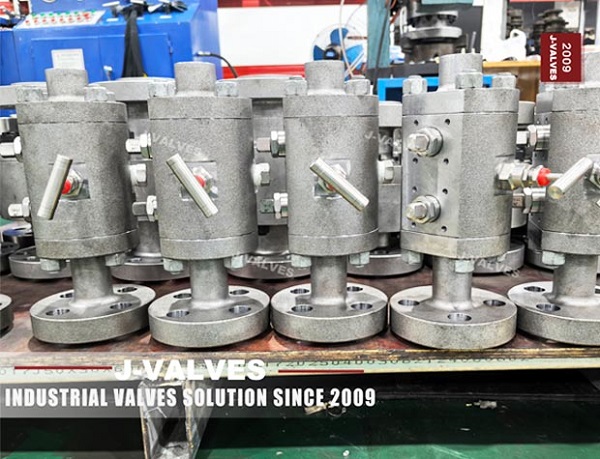
Two balls sit in series inside a single body, with a short cavity between them and a bleed connection drilled into that cavity from the outside. That is the whole of the idea, and everything else on this page follows from it: why two balls cost more than one, what the bleed point is actually for, and which sentences on a purchase order turn the idea into a valve that can be proved.
The family runs from two inch to forty eight inch, Class 600 to Class 2500, with a temperature range of minus 29 to plus 425 Celsius as a general figure. Body options run from carbon steel through the austenitic grades to duplex, and the ends can be raised face, ring joint or butt weld. Those are range statements rather than the description of one valve, and this page treats them that way.
The judgment this page is built around is a narrow one. Double block and bleed is not a synonym for two balls. The requirement is two independent isolating elements plus an intermediate cavity that can be separately pressurised and bled. Two balls in one body is the easiest way to satisfy that requirement, and it is the way this valve does it, but the requirement is what the buyer is paying for, not the part count.
Design and Construction
The body carries two seat assemblies facing each other across the cavity, and each ball is held on an upper and a lower trunnion in its own bearings. The two balls turn together on a common operating train, so the valve is operated as one element rather than as two valves bolted together.
Because the two balls turn together, the assembly is not a redundant second gate that stays open until the first one fails. It is an instrument for proving tightness online. Close the valve, open the bleed on the cavity, and watch. If pressure appears at the bleed, one of the two seats is passing and the direction of the leak tells you which one. That test is the reason the construction exists in metering, storage and custody transfer duty.
Two separate valves in series would give the same sealing logic and would be worse in three ways. Each valve carries its own body joints and its own stem seal, so the number of leak paths doubles. The spool between them has to be supported and drained. And the operating train has to be interlocked, because two independent handles can be left in a state where nobody knows what is isolated. Folding both balls into one body removes all three problems at the cost of a body that is longer and heavier than either single valve.
The bleed connection is a small part with a large job. It has to hold full cavity pressure, it has to close dead tight, and it has to be operable by a person in gloves. On most builds it is a needle valve or a plugged port on the body. A buyer who intends to use the valve for online proving should specify the bleed fitting rather than accept whatever is on the standard build, because a plugged hole is not a proving point.
The seats can be supplied as single piston effect or double piston effect, and this is the option that decides whether the article is genuinely double block and bleed. A single piston effect seat only seals against pressure from one side, which is enough for a single ball valve and is not enough here. Double piston effect seats seal from both sides, so each ball becomes a barrier in both directions and the cavity can be bled without the upstream seat lifting.

Material Options
The body list crosses four material families, and the order in which they are considered is medium, then temperature, then strength. Carbon steel covers water, gas, steam and the general hydrocarbon duties. The low temperature grade covers cold service where impact toughness at the design temperature is the governing property. The austenitic grades cover corrosion, and the duplex grades cover chlorides where the austenitic grades pit or crack.
Duplex is not a free upgrade. F51 and F53 raise the pitting resistance substantially and they also bring their own limits, including a lower ceiling on sustained temperature and a toughness behaviour that has to be checked at the cold end. A duplex valve bought because the medium is aggressive, and then installed in a line that also runs hot, is a valve that has been specified on one property and installed against another.
The ball and the seat are where an order usually loses precision. The ball is normally specified one grade above or equal to the body, and the seating face is either a soft insert or a hardfacing applied by thermal spray or weld overlay. The source page names a cobalt based alloy and a tungsten carbide coating, and both belong on the order as processes with a specification rather than as trade names, because a trade name tells the works which shop to use and tells the buyer nothing about hardness or thickness.
| Part | Options on This Build | What Decides It |
|---|---|---|
| Body | A105, LF2, F304, F316, F51, F53, nickel alloy | Medium, then design temperature |
| Ball | F304, F316, F51, F53 | Same family as the body or above it |
| Ball coating | Tungsten carbide by thermal spray, or cobalt based overlay | Abrasion, cycling, allowable clearance |
| Stem | F6a, F304, F316, 17-4PH | Strength at the top flange and gland temperature |
| Seat | Reinforced PTFE, PEEK, polyimide, or metal | Temperature and allowable leakage |
| Packing | Graphite, graphite and PTFE composite | Temperature and emission requirement |
| Bleed fitting | Needle valve or plugged port | Whether the valve is used for online proving |
Technical Specifications
The numbers below hold across the family. They are not a single valve's data sheet, and the dimension that matters for installation, the face to face length, is taken from the general arrangement drawing for the size and class that is actually ordered rather than from this table.
| Item | Value |
|---|---|
| Size range | Two inch to forty eight inch, DN 50 to DN 1200 |
| Pressure class | Class 600, 900, 1500 and 2500 |
| Class designation | PN 100, PN 150, PN 250 and PN 420 to API 6D |
| Construction | Two balls in series in one body, trunnion mounted |
| Cavity | Intermediate cavity with a bleed connection |
| Seats | Single or double piston effect, soft or metal |
| Ends | Raised face, ring joint, or butt weld |
| Face to face | ASME B16.10 where tabulated, drawing above |
| Operator | Gearbox, pneumatic, electric, hydraulic, ESD |
| Temperature | Minus 29 to plus 425 Celsius, grade dependent |
| Test | API 598 shell and seat, plus a cavity test |
The class designation row is worth reading twice, because it is where catalogues drift. API 6D sets out seven pressure class designations and their PN equivalents, and the pairing for this valve is Class 600 with PN 100, Class 900 with PN 150, Class 1500 with PN 250 and Class 2500 with PN 420. A page that prints PN 260 against Class 1500 is printing a number that appears in neither API 6D nor the European flange standard, and the mistake usually comes from converting the bar rating and rounding.
Standards and Compliance
Three documents do three different jobs here and mixing them up is the most common source of a valve that is certified and still wrong. API 6D is the product specification: it governs design, materials, welding, non destructive examination, testing, marking and documentation. ASME B16.34 supplies the wall thickness method and the pressure temperature ratings that the class number refers to. API 598 supplies the test procedure and the acceptance criteria for the shell and seat tests.
| Requirement | Document | What It Means Here |
|---|---|---|
| Product requirements | API 6D | Design, marking, documentation, cavity provision |
| Double block and bleed | API 6D, annex on DBB | The functional requirement, not a marketing term |
| Wall and rating | ASME B16.34 | Rating falls with temperature by material group |
| Pressure test | API 598 | Shell at 1.5 times, seat at 1.1 times |
| Fire test | API 607 or ISO 10497 | Type test on a representative size |
| Material certificate | EN 10204 3.1 | Heat number on each pressure part |
| Anti-static | API 6D | Continuity from ball to body |
API 608 does not reach this valve except at its bottom edge. That standard covers floating and trunnion ball valves from DN 15 to DN 600 in Class 150 to Class 600, so only the Class 600 end of this range can be quoted against it, and every 900, 1500 and 2500 valve on this page is an API 6D article. A quotation that cites API 608 for a Class 2500 valve is citing a document that does not apply to the article being sold.
Fire testing deserves a line of its own because it is quoted more confidently than it is understood. API 607 and ISO 10497 are type tests performed on a representative valve, and a certificate covers a range of sizes and classes only within the scope stated on it. A buyer who needs fire safe performance on a twenty four inch Class 2500 valve should ask whether that size is inside the scope of the certificate in hand, and should not assume that a certificate for a small valve extends upward.
Manufacturing Process
The body starts as a single piece, forged or cast depending on size and grade, and the cavity is the feature that makes the machining programme unusual. Two seat pockets have to be bored from opposite ends and meet the cavity square to a common centreline, and the bleed passage has to be drilled from the outside so that it breaks into the cavity at a point that can be cleaned and plugged.
Four seat pockets in one body, two per ball, all on one centreline, is the tolerance chain that decides whether this valve works. A pair of pockets that are each inside their own tolerance but not coaxial will give a seat contact band that is a crescent, and a crescent seat will pass a bench test and weep in service. That is why the drawing for this valve carries a coaxiality requirement across the whole bore and not just a per pocket diameter.
The two balls are matched to their own seats, and on a metal seated build the ball and seat are lapped as a pair. That pairing has to survive assembly, shipping and the first maintenance, which is why the pair carries an identifier and why the spare parts list for this valve is per position rather than per size.
Assembly is sequential rather than simultaneous. The first ball and its seats go in from one end, the second from the other, and the operating train is coupled afterwards. The whole valve is then cycled and its torque recorded before the paint goes on, because a double ball valve that binds will bind at the coupling between the two balls and no amount of force at the gearbox will fix it.

Quality Control and Testing
The shell test is one test and the seat test is two, because each ball has its own seat pair and each has to be proved in both directions. A test record for this valve that shows a single seat result is a record for a single ball valve.
| Step | Check | Acceptance |
|---|---|---|
| 1 Incoming | Heat number against the mill certificate | Chemistry and mechanicals |
| 2 Identity | Positive material identification on body parts | Grade match |
| 3 Machining | Coaxiality of the four seat pockets | Drawing tolerance |
| 4 Shell test | Body and both body joints at 1.5 times | API 598, no leakage |
| 5 Seat test | Each seat at 1.1 times, direction by direction | API 598 rate |
| 6 Cavity test | Cavity pressurised, both seats checked in reverse | No leakage past either seat |
| 7 Function | Cycles and operating torque recorded | Works limit |
| 8 Final | Cavity drained, bleed fitted and capped, marked | Works standard |
The cavity test is the one that is specific to this construction. Pressurise the cavity through the bleed connection with both balls closed and both ends open to atmosphere, and any leakage past a seat appears at the corresponding end. That is the only test that proves both barriers at once, and it is the test a buyer should ask to witness if the valve is going into a custody transfer or storage application.
Anti-static continuity and the fire test sit outside the routine. Continuity is checked on every valve because it is a resistance measurement between the ball, the stem and the body. The fire test is a type test and is not repeated on each unit, so its evidence is a certificate and a scope rather than a test sheet in the box.

Applications and Industry Service
This valve belongs where a single barrier is not considered enough and where the barrier has to be proved while the plant runs. Metering and custody transfer stations, the upstream and downstream sides of pig traps, tank farm roots, and paired systems where one train is maintained while the other carries the load are the four places it earns its price.
The second group of duties is where the medium is dangerous enough that the space between two valves would otherwise have to be drained and purged for every intervention. Folding that space into the valve body removes a drain, a vent and a length of small bore pipe that would have been the most corrosion prone part of the assembly.
It is the wrong choice where the medium is abrasive enough to destroy a soft seat in a few months, because the cost of this body only pays back if the seats last. It is also the wrong choice where the line is small, cheap and lightly stressed, because a single ball valve with a double piston effect seat will do the same job for less money at the sizes where a cavity is easy to drain.

Installation, Operation and Maintenance
The valve has no preferred flow direction as a sealing matter, but the bleed connection gives it one as a practical matter. Install it so that the bleed is reachable from the walkway and so that anything released from it goes somewhere safe, which on hydrocarbon service means a closed connection rather than an open bleed into the area.
Support the body on its own feet or on a saddle, and do not let the two flanges carry the mass of a valve this long. Bring the mating flanges up parallel before tensioning, and check that the pipe is not pulling the body out of line, because a body that is being used as a pipe support will close one joint and open the other.
Operate the valve through its full travel in one movement and do not leave it part open to throttle, because a ball valve used as a throttle erodes its own seat and the cavity between two balls would then be a trap for whatever the flow carries. After closing, bleed the cavity before opening any flange, and confirm the bleed is closed again before the valve is returned to service.
For maintenance the line is isolated and drained, the body is opened at the end that carries the seats, and the ball and its seat pair come out as a matched set. Both balls should be dealt with in the same intervention even if only one is passing, because they have seen the same number of cycles. The bleed fitting, the body gaskets and the seat inserts are the parts that get replaced, and the balls are inspected for the contact band before anything goes back in.
How to Specify and Order
Six lines fix the valve: size, class, body grade, the seat arrangement, the ends and the operator. The seat type line is the one that must not be left to the works, because single piston effect and double piston effect look identical from outside and behave in opposite ways in a cavity. The bleed line is the second: write the fitting type and where it discharges, since a plugged hole is not a proving point and a bleed that discharges into a walkway will be left open by the first operator who needs it in a hurry. The end line matters most at the top of the range, where ring joint is the normal facing, and the operator line decides the top flange and the torque figure the actuator has to deliver.
Four questions belong to the line rather than to the valve: the medium, the design temperature, the design pressure and whether the cavity will be used for proving. The first three set the materials and the class, and the fourth decides whether the bleed fitting and the seat type are worth specifying properly or whether a plain valve would have done.
Documents to name in the order: the EN 10204 3.1 certificate for each pressure part with its heat number, the seat test record with a result per seat and per direction, the cavity test record, the general arrangement drawing with the face to face dimension and the bleed position, and the fire test certificate with its scope if fire safe performance is required.
FAQ
Q: Does double block and bleed need two balls?
A: No, but two balls is the cleanest way to get there. The requirement is two independent isolating elements and a cavity between them that can be pressurised and bled. One ball with two double piston effect seats can also block twice and bleed, and the difference is that both barriers then depend on one ball, so a single seat failure removes both.
Q: What does single piston effect change on this valve?
A: It cancels the function. A single effect seat only holds pressure from one side, and it is designed to let cavity pressure push it away from the ball, which is what makes a single ball valve self relieving. On a two ball body that behaviour means the cavity cannot be proved at pressure, so the article becomes a double block valve without the bleed.
Q: Why is the cavity test separate from the seat test?
A: Because it proves something the seat test cannot. The seat test presses each seat from the line side with the cavity vented. The cavity test presses the cavity with both ends open, so any leakage appears at the end that is passing, and both barriers are checked at once in the direction they will actually work.
Q: Is a two ball valve the same as two valves in series?
A: No. Two separate valves give the same sealing logic and four body joints, two stem seals, a spool to drain and an interlock to keep the handles in step. The two ball body folds all of that into one article: one body, one operating train, one bleed point. The saving is in joints and in space rather than in sealing principle.
Q: Is this valve an API 608 article?
A: Only at the Class 600 bottom of its range. API 608 covers ball valves from DN 15 to DN 600 in Class 150 to Class 600, so every 900, 1500 and 2500 valve here is an API 6D article. A quotation citing 608 for a Class 2500 valve is citing a document outside its scope.


Hot Products


News
Why A Ball Valve Gets Harder To Turn: Five Causes, And The Test That Tells Them Apart
A ball valve that stiffens over months points at one of five parts. Measure torque with the line pressurised and again vented, and the split becomes visible.
Read More
The Ball Valve at Four Thousand Bar: Seat Load, Erosion And Fatigue in Waterjet Circuits
At 4,000 bar a 10 mm bore puts 31 kN on the seat and a 0.1 mm leak cuts steel. What a ball valve must survive in a waterjet or intensifier circuit.
Read More
Large Diameter Ball Valves: Four Limits That Change The Design
Above a certain size a ball valve stops being a scaled one. Ball weight, operator torque, body split and the test bench each set a limit at a different size.
Read More
Cast Or Forged Ball Valve Body, And What A Radiography Acceptance Level Actually Buys You
Casting or forging is only half the decision. What RT, UT, MT and a proof test each find in a ball valve body, and where the geometry defeats all of them.
Read More