


CHINA J-VALVES Offers Various High-quality I ndustrial Ball Valves
J-VALVES, a distinguished professional ball valve manufacturer rooted in China, takes pride in its extensive product portfolio. Our offerings span a wide range, including trunnion-mounted ball valves, floating ball valves, high-temperature ball valves, high-pressure ball valves, metal-sealed ball valves, ultra-low temperature ball valves, DBB ball valves, Three-way And Four-way Ball Valve, and fully welded ball valves. Each product is a testament to our commitment to precision engineering and reliable performance. Meticulously crafted, they are designed to not only meet but exceed the most stringent industrial demands, ensuring stable operation even under extreme conditions. This enables us to provide our clients with high-value services and makes our valves widely sought-after in industries.
Product Category
Contact Us


-
J-VALVES-Q41F
-
J-VALVES
Overview of the J-VALVES A105N 0.75 x 0.5 inch Class 900 DBB ball valve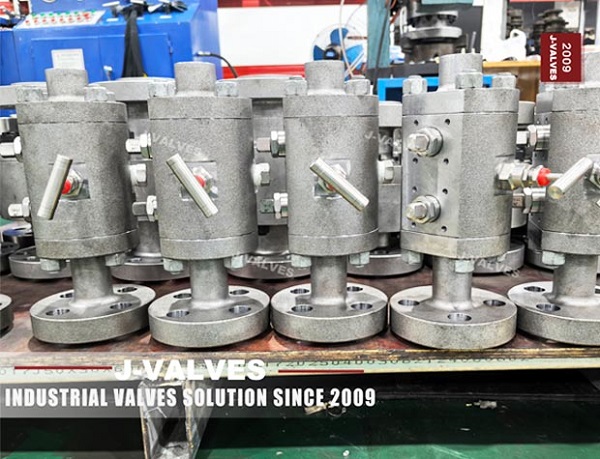
On a small bore high pressure valve there is no flange, no ring groove and no body gasket to argue about. The pressure is held by a taper thread at each end and by a bleed connection that most buyers never look at, and if the valve fails it will fail at one of those three places rather than at the seat.
That is the whole reason this page exists. A three quarter inch by half inch Class 900 valve is a small object with a large pressure behind it, and the engineering that matters is not in the ball. It is in how the thread engages, how much of it engages, what seals the engagement, and whether the bleed port on the cavity is rated for the same class as the body it is screwed into.
The valve is forged A105N, normalized, Class 900, with a nominal three quarter inch connection and a half inch bore, and it is a double block and bleed valve with a trunnion mounted ball and two seats. It is found on instrument roots, injection points, sample connections and small bore isolation, which is to say everywhere a plant needs to prove a line dead before opening it.
Design and Construction
The body is a single forging with two connections and a bleed tapping. The ball is trunnion mounted, held between an upper and a lower shaft, and both seats are double piston effect, which means pressure from either side pushes the seat towards the ball. That is what makes the valve a genuine double block and bleed rather than a valve with two seats and an assumption.
The bleed is a small port into the cavity between the seats, fitted with a plug or a needle valve. With both seats closed it should be possible to open the bleed, release whatever volume was trapped, and then see nothing. If it keeps running, one seat is passing and the valve is blocking once rather than twice, which is the condition the whole valve was bought to avoid.
The trunnion looks like an overbuild at this size, and it is there for the double block and bleed requirement rather than for the torque. A double piston effect seat needs a seat ring with a piston area behind it, and the piston area only works if the ball does not move when pressure pushes it. A floating ball at three quarter inch would drift downstream under pressure and the upstream seat would stop being a barrier, so the construction and the function are tied together: a DBB valve at this size is trunnion mounted because it has to be.
The bore is reduced from three quarter to half inch, which at this size is a decision about the pipe rather than about the flow. A half inch bore in a three quarter inch body is the normal arrangement on an instrument root, where the connection has to match the fitting and the flow is negligible.
The stem is a one piece T head retained from inside the body, so pressure cannot eject it. Above it sits a gland and packing, and above that a lever or a mini gearbox. At this size the lever is normal and a gearbox is bought only where the valve is out of reach or where the differential pressure across the seats is high enough to make the quarter turn hard.

Material Options
A105N is not a different grade from A105. The N is a condition, not a composition: it means the forging has been normalized, which is a heat treatment that refines the grain and relieves the forging stress. The chemistry is the same carbon steel, and the certificate has to show the heat treatment as well as the chemistry for the N to mean anything.
| Component | Standard Build | Options | What It Decides |
|---|---|---|---|
| Body | A105N forged, normalized | A105 as rolled, F304 or F316 for corrosive service | Toughness and weldability |
| Ball | A105N with nickel plating | F304 or F316 stainless | Corrosion resistance at the seal |
| Stem | F6a stainless | F304, F316 | Stem strength and corrosion |
| Seat | Reinforced PTFE | PEEK for temperature, metal for abrasion | Temperature ceiling of the valve |
| Packing | PTFE chevrons | Flexible graphite, low emission packing | Stem seal and emission limit |
| Bolting | B7M or L7M | B7 where sour service is not a consideration | Hardness limit and preload |
| Bleed | Plug | Needle valve with a bonnet | Whether the cavity can be vented controllably |
| Body joint | None, one piece forging | Two piece body where offered | Whether the trim can be changed in line |
The bolting row is the one that carries a hidden requirement. The M suffix on B7M and L7M means the grade has been hardness limited, which is what makes it acceptable in sour service where a hard stud can crack under hydrogen. A B7 stud is stronger and is the wrong choice where the specification says NACE, and the two are indistinguishable from the outside once they are in the holes.
The seat insert list on the source page includes a brand name for a high temperature thermoplastic. That name has been left out here and the insert described by its class instead, because a brand in a material specification tells a buyer which company's compound to buy rather than what the part has to do.
Technical Specifications
Class 900 in group 1.1 of ASME B16.34 is 153 bar at 38 C, and API 6D clause 7.2 records the same class as PN 150. The small bore size does not change either figure, which is the point that is most often missed: a half inch valve at Class 900 is holding the same pressure as an eight inch valve at Class 900, and the wall is thinner only because the diameter is smaller.
| Item | Value |
|---|---|
| Nominal size | 0.75 inch by 0.5 inch, DN 20 by DN 15 |
| Pressure class | Class 900, recorded as PN 150 in API 6D clause 7.2 |
| Rating | 153 bar at 38 C in group 1.1 |
| Body style | One piece forged body, trunnion mounted ball, reduced bore |
| Body material | ASTM A105N, normalized carbon steel forging |
| Seats | Two, double piston effect, spring loaded, both barriers |
| Bleed | Plug or needle valve into the cavity, rated to Class 900 |
| Ends | NPT to ASME B1.20.1, socket weld to B16.11, butt weld to B16.25 |
| Face to face | Works dimension confirmed on the drawing, not a tabulated figure |
| Temperature | Minus 29 to plus 425 C as a body figure, insert limited |
| Bolting | B7M or L7M, hardness limited |
| Test | API 598 shell and seat, each seat proved with the cavity vented |
The face to face line is a correction rather than a quotation. ASME B16.10 tabulates face to face and end to end dimensions for flanged and welding end valves, and a three quarter inch threaded valve is not in those tables in the way a six inch flanged valve is. The dimension that matters is on the drawing, and a spool built to a figure taken from a table for a different end type will be wrong by the length of the thread engagement.
Standards and Compliance
One product standard applies here and the other one does not. API 608 stops at Class 600, so a Class 900 valve is an API 6D article and only a 6D article. The thread standards are separate documents and they are the ones that decide whether the joint holds.
| Requirement | Document | What It Means Here |
|---|---|---|
| Wall and rating | ASME B16.34 group 1.1 | 153 bar at 38 C |
| Product requirements | API 6D, Class 900 | Design, marking, documentation |
| Threaded ends | ASME B1.20.1 | NPT taper, engagement length |
| Socket weld ends | ASME B16.11 | Socket depth and expansion gap |
| Butt weld ends | ASME B16.25 | Bevel and bore match |
| Pressure test | API 598 | Shell 1.5 times, seat 1.1 times |
| Fire test | API 607 or ISO 10497 | Type test, scope to be read |
| Material certificate | EN 10204 3.1 | Heat and heat treatment recorded |
The fire test remark on the source page is a scope point rather than a criticism. A certificate covers the sizes and classes that were tested, and on a small bore valve the tested article may be a different size from the one being bought. That is normal, and it is why the certificate number should be read for scope rather than counted as a pass for everything the works makes.
Manufacturing Process
The body starts as a forging and is machined all over, with the two connections, the ball bore, the seat pockets and the stem bore all cut from one reference. On a one piece body the seat pockets are reached through the connections, which is why the port threads and the seat bores have to be concentric: a seat cut off centre will load on one side and leak on the other.
The threads are cut rather than rolled on most small valve bodies, and they are gauged with ring and plug gauges rather than measured. A taper thread has no single diameter to measure, so the gauge check is the only check that means anything, and it should be recorded per connection rather than per batch.
The ball is machined and ground, plated if the order calls for a plated carbon steel ball, and assembled with its seats and springs. The bleed is fitted last and it is the component that is most often bought in rather than made, which is why its rating has to be confirmed against the body rating rather than assumed from the fact that it screws in.

Quality Control and Testing
The heat number is stamped on the forging and repeated on the certificate, and on an A105N valve the certificate has to show the normalizing as well as the chemistry. A certificate that gives chemistry and tensile but not heat treatment does not prove the N, and the N is the whole reason the grade was specified.
| Step | Check | Acceptance |
|---|---|---|
| 1 Incoming | Heat number and heat treatment on the certificate | A105 chemistry, normalized condition |
| 2 Hardness | Body hardness after normalizing | Drawing figure, recorded |
| 3 Threads | Ring and plug gauge on every connection | ASME B1.20.1 |
| 4 Seats | Seat pocket concentricity with the thread | Drawing tolerance |
| 5 Shell test | Body and both connections at 1.5 times | API 598, no leakage |
| 6 Seat test | Each seat at 1.1 times, cavity vented | API 598, no visible leakage |
| 7 Bleed | Bleed opened with one side pressurised | Cavity proves isolated |
| 8 Final | Threads capped, lever tied, marked, packed | Works standard |
Step seven is the test that proves the double block and bleed function rather than the seats. With one side pressurised and the valve closed, the bleed should release the trapped volume and then stop. A valve that passes a seat test and fails this one has two seats that leak in the same direction, which is a valve that blocks once.

Applications and Industry Service
The duty this valve is built for is the small bore high pressure connection that has to be proved dead. Instrument roots on a high pressure separator, chemical injection points, sample points on a hydrocarbon line, and isolation on a small bore gas connection all need two barriers and a vent, and one body does the work of two valves and a nipple.
Class 900 at three quarter inch is the class that appears on high pressure gas and on offshore instrument systems, where the small bore piping is rated to the same class as the main line because the fittings are. The valve follows the fitting rather than the flow, which is why a half inch bore appears on a connection that will never carry half an inch of flow.
It is the wrong valve where the medium will solidify in the cavity, because the cavity is a dead space by design and a dead space is where solids collect. It is also the wrong valve where the thread is not acceptable at all, which is increasingly the case offshore, where a welded connection is preferred and a socket weld or butt weld body should be ordered instead.

Installation, Operation and Maintenance
Threaded joints fail for two reasons and both are installation errors. The first is insufficient engagement, where the valve is run on by three or four threads and the pressure is carried by a fraction of the thread. The second is sealant in the wrong place, where tape or compound enters the bore and either blocks it or sits on the seat.
Tape goes on the male thread only and the first two threads are left bare, so that nothing is pushed into the bore when the joint is made. The valve is held on the body flats with a second wrench while the joint is tightened, because a small forged body will take a bend at the stem bore if it is turned by the handle.
For maintenance the packing gland is the only part that is normally touched. It is tightened a fraction at a time with the line depressurised, and a gland that has been over tightened will make the stem stiff for the rest of its life and will wear the packing unevenly. On a one piece body the seats are reached through the connections, which is a bench job rather than a line job.
How to Specify and Order
Six lines fix the valve: size pair, class, body grade, seat insert, end type and operator. Three more belong on the order at this size and are usually left off: the bolting grade, the bleed type, and whether the bleed is to be supplied rated and certified to the class.
Four questions belong to the installation rather than to the valve: the medium, the design pressure, whether the service is sour, and whether the connection will be made with a thread or a weld. The medium decides the body and seat, the pressure confirms the class, the sour question decides the bolting, and the connection type decides which standard the ends are made to.
Documents to name in the order: the EN 10204 3.1 certificate with the heat number and the heat treatment recorded, the thread gauge record, the shell and seat test record with a result per seat, the bleed valve certificate, and the drawing carrying the face to face dimension for the end type ordered.
FAQ
Q: Is A105N a different grade from A105?
A: No. The N is a condition, not a composition: it means the forging was normalized, which refines the grain and relieves forging stress. The chemistry is the same carbon steel, and the certificate has to show the heat treatment as well as the chemistry for the N to mean anything.
Q: Why does a three quarter inch valve need a trunnion?
A: Because of the double block and bleed function rather than the torque. A double piston effect seat needs a piston area behind it, and the piston only works if the ball does not drift downstream under pressure. A floating ball would move and the upstream seat would stop being a barrier.
Q: What is the difference between B7 and B7M bolting?
A: The M suffix means the grade has been hardness limited, which is what makes it acceptable in sour service where a hard stud can crack under hydrogen. B7 is stronger and is the wrong choice where the specification calls for a sour service grade, and the two are indistinguishable once they are in the holes.
Q: Why is the bleed port a pressure boundary issue?
A: Because it opens into the cavity and sees full line pressure as soon as either seat passes. A bleed valve bought from a bin without a class rating is the weakest connection on the valve, and it is the one nobody inspects. It should be ordered with the body rating.
Q: Does ASME B16.10 give the face to face dimension for a threaded valve?
A: Not in the way it does for a flanged one. The tables are built around flanged and welding end valves, and a threaded small valve has a works dimension. The figure that matters is on the drawing, and a spool built to a table figure will be wrong by the thread engagement.


Hot Products


News
Why A Ball Valve Gets Harder To Turn: Five Causes, And The Test That Tells Them Apart
A ball valve that stiffens over months points at one of five parts. Measure torque with the line pressurised and again vented, and the split becomes visible.
Read More
The Ball Valve at Four Thousand Bar: Seat Load, Erosion And Fatigue in Waterjet Circuits
At 4,000 bar a 10 mm bore puts 31 kN on the seat and a 0.1 mm leak cuts steel. What a ball valve must survive in a waterjet or intensifier circuit.
Read More
Large Diameter Ball Valves: Four Limits That Change The Design
Above a certain size a ball valve stops being a scaled one. Ball weight, operator torque, body split and the test bench each set a limit at a different size.
Read More
Cast Or Forged Ball Valve Body, And What A Radiography Acceptance Level Actually Buys You
Casting or forging is only half the decision. What RT, UT, MT and a proof test each find in a ball valve body, and where the geometry defeats all of them.
Read More