


I. Authoritative API Standards Set Quality Benchmark for 2PC Trunnion Ball Valves
API 6D: Governing Specification for Pipeline Ball Valves
API 6D is the globally‑recognized standard for pipeline ball valves in oil and gas industries. It defines mandatory requirements covering valve structure, dimensional tolerance, material traceability, hydro‑pneumatic pressure testing and performance validation.
For 2‑piece trunnion‑mounted ball valves, API 6D enforces strict controls on body joint alignment, ball concentricity, blow‑out‑proof stem structure and anti‑static continuity. Every assembly step shall comply with API 6D clauses. Excessive assembly tolerance may result in seat leakage and premature valve failure in field service.
API 607 Fire‑Safe Certification: Safety Protection Under Emergency Fire Condition
API 607 specifies fire test procedures for quarter‑turn valves with non‑metallic seats. In fire scenarios where soft seat material is burned out, the secondary metal‑to‑metal seal shall still maintain pressure integrity and stop flammable media leakage to avoid fire escalation.
Obtaining API 607 certification relies not only on raw material selection, but highly depends on assembly workmanship. Seat pre‑compression, graphite seal alignment and uniform bolt torque are critical details. Minor assembly mis‑alignment can cause complete failure during fire‑safe testing. An API 607 certificate is solid proof of stable assembly capability.
II. Complete Assembly Workflow of 2‑Piece Trunnion Mounted Ball Valves
The two‑piece split body design delivers compact structure, yet imposes higher requirements on precision assembly. Coaxial alignment between body, ball, seats, stem and actuator, plus controlled pre‑load force determine long‑term sealing performance and service life.
Incoming Component Inspection: First Quality Gate Before Assembly
Before assembly starts, all cast or forged valve bodies, balls, seat inserts, gaskets and fasteners go through thorough incoming quality check. Material test reports are verified, flange sealing faces are inspected for scratches, ball sphericity is measured. Only qualified parts are released to assembly station to eliminate inherent defects.
Precision Internal Component Assembly: Ball, Seat & Stem Installation
Assembly is completed in clean workshop area. Technicians carefully align ball and seats to achieve bubble‑tight bi‑directional shut‑off. Blow‑out‑proof stem and anti‑static components are installed to guarantee electrical continuity. Graphite packing is filled into stuffing box following engineering specification. All fasteners are tightened in diagonal sequence with controlled torque to prevent body distortion and seat offset.
Body Closing & Actuator Mounting
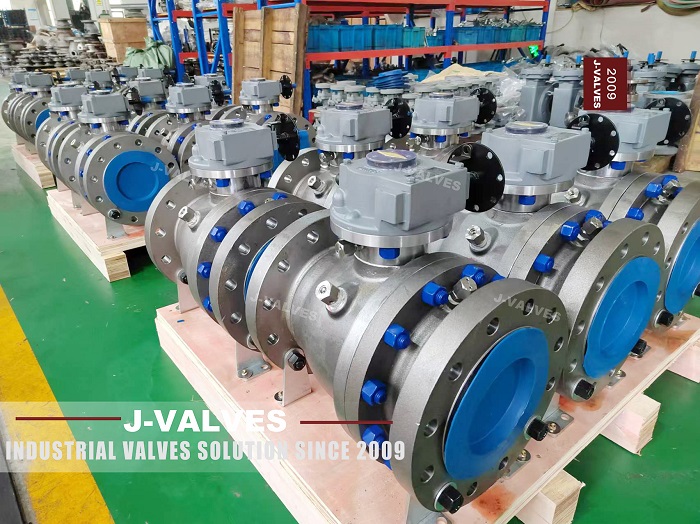
Two valve body halves are aligned and closed with mid‑gasket. Bolts are torqued step‑by‑step diagonally for even compression of body joint. Electric, gear or pneumatic actuators are mounted complying with ISO 5211 mounting standard. Perfect coaxiality between actuator output shaft and valve stem helps reduce operating torque and prevents valve jamming. The photo shows finished assembled 2‑PC trunnion ball valves waiting for pressure test before shipment.
API 598 Pressure Test: Final Validation of Assembly Quality
After full assembly, every valve shall complete API 598 hydrostatic shell test and pneumatic seat sealing test, including shell strength test and bi‑directional zero‑bubble seat tightness test. Passing pressure tests is mandatory requirement under API 6D specification, proving assembly workmanship is reliable.
III. Why Oil & Gas Projects Prefer 2PC Trunnion Ball Valves Certified to API 6D & API 607
For crude oil, natural gas, refinery and chemical process pipelines, conveyed media are often flammable and hazardous. Valves need reliable shut‑off under normal operating conditions as well as emergency fire‑safe backup protection.
1. API 6D guarantees structural integrity, traceability and test compliance for heavy‑duty pipeline service.
2. API 607 fire‑safe qualification provides emergency safety redundancy, mitigating risk of media leakage and fire spread.
3. High‑precision assembly translates written standards into real‑world reliable hardware. Same drawing specifications can perform very differently due to poor assembly practice, resulting in internal leakage, stem jamming and short service life.
Many buyers only focus on material grade and certification documents, while overlooking assembly workmanship. It is worth noting that API certification itself demands consistent, traceable assembly processes within manufacturing facilities.
IV. Customization & Delivery for Industrial Project Solutions
Our 2‑piece trunnion mounted ball valves are available in WCB carbon steel, A105 forged steel, CF8M stainless steel and other material options. Flanged ends conform to ASME B16.5, pressure rating ranges from Class150 up to Class 2500. Actuation options include electric, pneumatic and manual gearbox. SIL capable versions can be supplied upon project requirements.


