


1. Why packing is part of quality control
A valve that passes its pressure test in the factory can still arrive at site as a rejected item. For EPC projects, packing, marking and documentation are the last stage of quality control, and the purchase order usually specifies all three. Shell tests are performed at 1.5 times the rated pressure and seat tests at 1.1 times, but none of that matters if the flange faces arrive rusted or the trim is buried under loose scale.
Transit damage produces three recurring claims: corroded flange faces, internal contamination from humid sea air, and broken traceability when a nameplate or tag is lost. Each of these failures is avoidable with standard export practice, and each is checked at the receiving inspection.
J-VALVES operates from two plants in Zhejiang, in Wenzhou and Lishui, and holds ISO 9001 quality system certification with CE marking. Third-party witnessed inspection can be arranged through SGS or TUV when the project requires it.
2. Nameplate and marking requirements
Every valve should carry a permanently attached stainless steel nameplate. The content is defined by the applicable standard, and for API 6D it includes the manufacturer, the standard reference, the size, the pressure class, the body and trim material, the temperature rating, the heat numbers and the unique serial number.
Body marking is applied in addition to the nameplate on many projects. Cast or forged bodies typically carry the size, class, material designation and the heat number, so that the mark survives even if the plate is removed.
On orders to API 6D, API 600, API 602 or API 608, the marking set must match the certificate package exactly. A mismatch between the nameplate class and the test certificate is one of the most common causes of rejection at site receiving.
Line tag numbers, paint colour codes and customer references are project specific and should be confirmed on the approved drawing before production releases the order to the shop floor.
3. End protection and seaworthy packing
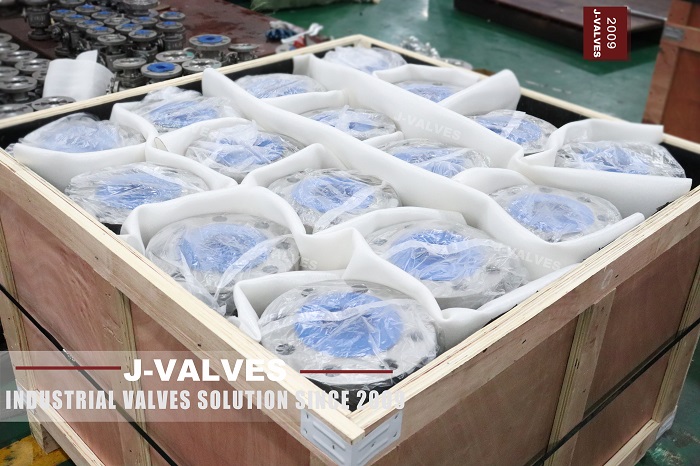
Flange faces, weld ends and threaded ends are the surfaces most exposed to sea freight conditions. Standard protection combines a rust preventive applied to the machined face with a bolted-on cover, either plastic or wooden, sized to the flange drilling.
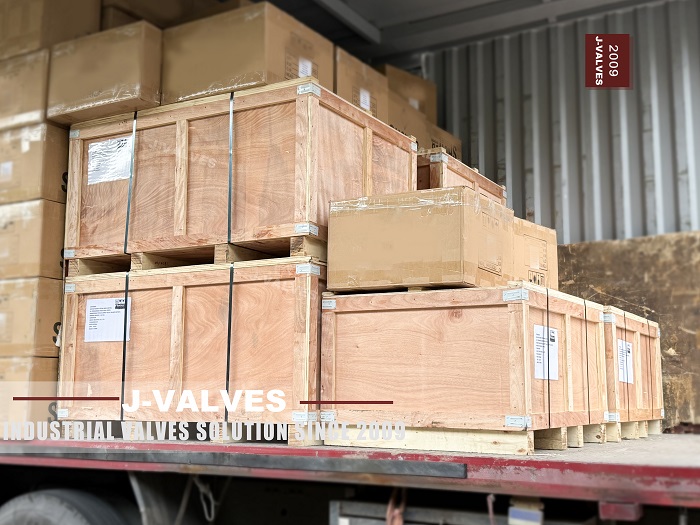
Seaworthy packing has three requirements: the crate must carry the weight without racking, the valve must be fixed so that it cannot move inside, and the internal atmosphere must stay dry. Desiccant bags and a sealed barrier film handle the humidity.
Large valves are usually shipped in a wooden crate or on a steel frame skid with the stem protected. Small valves can be packed in cartons on a pallet, but only when the end protection and the desiccant are still specified.
Valves from 1/2 to 56 inch (DN15 to DN1400) run on the same packing line, with the crate design scaled to the size and the weight of the unit.
4. Documentation package checklist
| Mark or document | Where it appears | Content |
|---|---|---|
| Nameplate | Fixed to the valve body | Manufacturer, standard, size, class, materials, serial number |
| Body marking | Cast or forged into the body | Size, class, material, heat number |
| Test certificate | Documentation package | Shell test at 1.5 times rated pressure, seat test at 1.1 times |
| Material certificate | Documentation package | EN 10204 2.2, 3.1 or 3.2 depending on the order |
| Packing list | Crate exterior and paper file | Item, serial number, size, class, net and gross weight |
| Certificate of origin | Paper file | Origin declaration for customs clearance |
The documentation package travels with the goods and is also sent electronically, so that the site team can start its receiving inspection before the crate is opened.
5. Receiving and storage at site
At receiving, check the crate for impact damage, then open it and verify the nameplate against the packing list and the certificate. Confirm that the valve is in the position in which it was shipped and that the ball port orientation matches the drawing.
Store valves in a dry, covered area, on the skid where possible. Keep the end covers fitted until installation, and leave the valve in the open or closed position that the instructions specify rather than part open.
Valves rated for service down to -196 C and up to 650 C follow the same documentation rules, and the in-house cryogenic laboratory uses liquid nitrogen to reach the lower limit before shipment is released.
6. Frequently Asked Questions
What must appear on an API 6D nameplate?
An API 6D nameplate must show the manufacturer, the standard reference, the size, the pressure class, the body and trim materials, the temperature rating, the heat numbers and the unique serial number. The plate is stainless steel and permanently attached to the body. Its content must match the test and material certificates exactly, because receiving inspection compares those documents before accepting the valve.
How should valves be packed for sea freight?
For sea freight, protect every machined end with a rust preventive and a bolted cover, then fix the valve inside a crate so that it cannot move. Use desiccant bags and a sealed barrier film to keep the internal atmosphere dry. Large units ship in wooden crates or on steel skids with the stem protected, while smaller valves may ship in cartons on pallets with the same end protection.
What causes flange face corrosion in transit?
Flange face corrosion in transit is caused by humid sea air reaching unprotected machined carbon steel. Without a rust preventive and a bolted cover, condensation forms on the face and pitting begins within days. Mixed materials make it worse, because a stainless flange face touching a carbon steel cover can corrode by galvanic action. Desiccant and barrier film control the humidity.


