


CHINA J-VALVES Offers Various High-quality I ndustrial Ball Valves
J-VALVES, a distinguished professional ball valve manufacturer rooted in China, takes pride in its extensive product portfolio. Our offerings span a wide range, including trunnion-mounted ball valves, floating ball valves, high-temperature ball valves, high-pressure ball valves, metal-sealed ball valves, ultra-low temperature ball valves, DBB ball valves, Three-way And Four-way Ball Valve, and fully welded ball valves. Each product is a testament to our commitment to precision engineering and reliable performance. Meticulously crafted, they are designed to not only meet but exceed the most stringent industrial demands, ensuring stable operation even under extreme conditions. This enables us to provide our clients with high-value services and makes our valves widely sought-after in industries.
Product Category
Contact Us

-
J-VALVES-Q347F
-
J-VALVES
Overview of the J-VALVES 8 Inch 900LB F304 Three Piece Cryogenic Trunnion Mounted Flange Ball Valve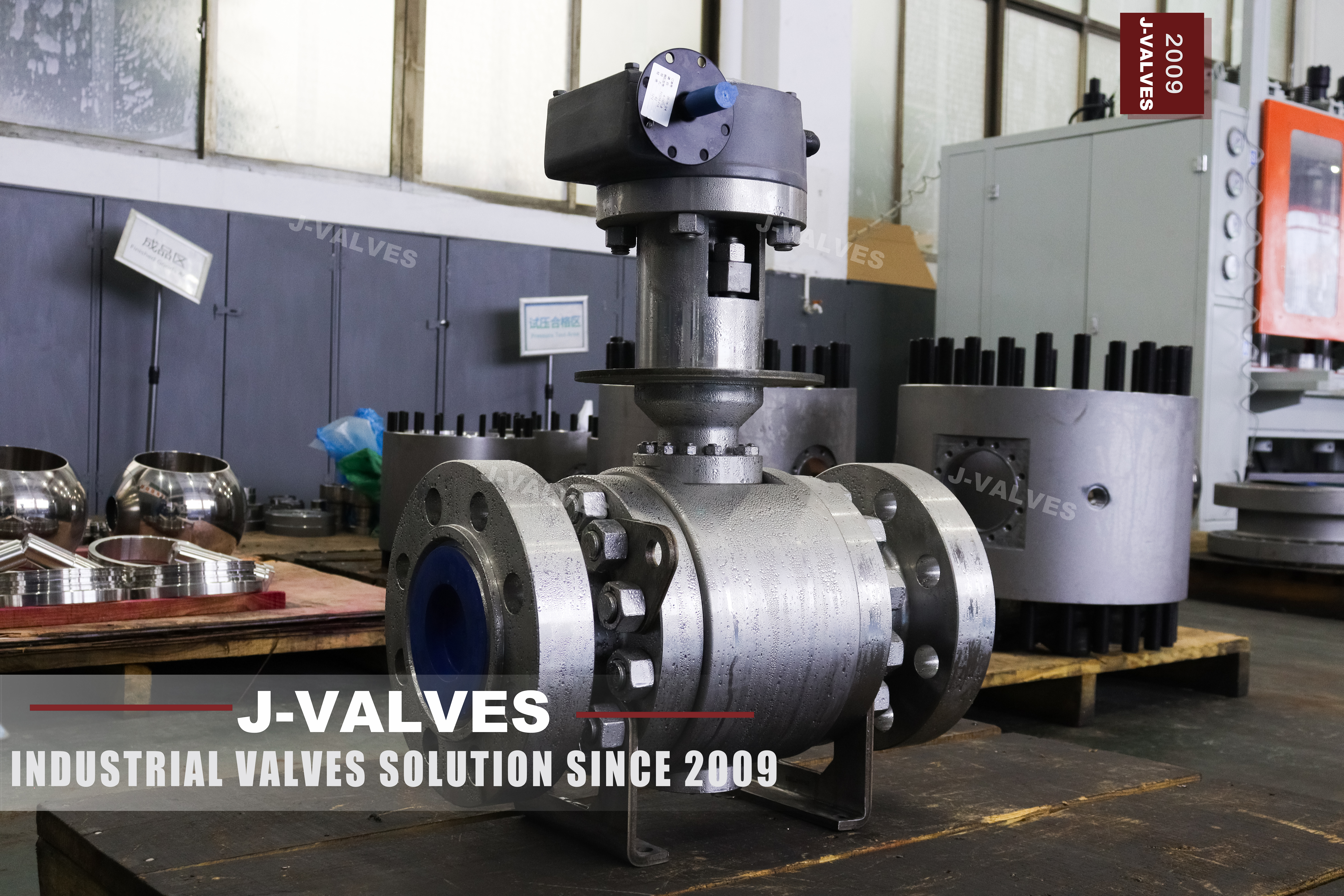
A cryogenic valve is recognisable by its long neck, and the neck is usually described as an extended stem. That description is wrong in a way that matters. A stem extension moves the operator away from the valve and leaves the packing where it was, which is fine for a buried line but useless in the cold: the packing is the part that has to leave. What a cryogenic valve has is an extended bonnet, a lengthened pressure-containing neck that carries the stuffing box up and out of the cold zone.
The two look similar from a distance and behave completely differently. The bonnet is part of the pressure boundary, so its joints have to be proved by the shell test, and it is the part that gets cold enough to matter. The stem extension carries no pressure and only transmits torque. Reading one as the other is how a valve ends up with its packing freezing while the drawing says the extension was specified.
Design and Construction
Three sections with two bolted joints in the flow path, and an extended bonnet on top carrying the gland. The ball and the seats come out through the middle section as on any three piece valve, but the trim is reached from underneath a neck that is deliberately long, which is a handling consideration rather than a design one. The bonnet joint is the third pressure boundary and the one that sees the steepest temperature gradient.
The ball is carried on trunnions, which at eight inch and Class 900 is a necessity rather than a choice. The seats are pushed against the ball and the cavity between them is closed when the valve is shut, which in cryogenic service creates a problem of its own: a trapped volume of cold liquid warms up and expands, and the pressure it reaches is not limited by the line. The cavity has to have a relief path, and that path is a design feature rather than an accessory.
Material Options
The body code is F304, a forged austenitic stainless steel, and the reason for the austenitic family in cryogenic service is that it stays ductile where carbon steels become brittle. The code is what the certificate is written against, and this page does not read it forward into a mill designation. Where more corrosion resistance is needed the code changes to a molybdenum-bearing grade, which is a different order rather than an upgrade.
The seat is the part that sets the usable temperature on most cryogenic valves, because the polymer has its own floor. The order names the seat material and the temperature, and the two are checked against the seat supplier rather than against the valve class. The bolting is specified to a low temperature standard as well, because the fasteners are a different alloy from the body and contract by a different amount.
| Component | Standard Material | Optional Upgrade | Service Notes |
|---|---|---|---|
| Body | F304 forged stainless steel, code as stamped | molybdenum-bearing grade on order | austenitic for ductility at low temperature |
| Bonnet | extended, pressure containing | not an extended stem | holds the packing outside the cold zone |
| Ball | F304 with a hard surface | named on the order | carried on trunnions |
| Trunnion | surface hardened F304 or 17-4PH | named on the order | takes the seat load |
| Seat ring | cryogenic seat, material named on the order | chosen against the low temperature limit | sets the usable temperature floor |
| Cavity relief | a relief path for a trapped volume | a design feature, not an accessory | cold liquid warms and expands |
| Bolting | low temperature alloy or stainless, per the order | a separate alloy decision | contracts differently from the body |
| Operator | worm gear | actuator on request | gland sits at the top of the neck |
Technical Specifications
The flange is an ASME B16.5 Class 900 pattern at eight inch, raised face or ring joint, with butt weld ends available as an option. Face to face follows ASME B16.10, and the dimensions of a build are on the signed general arrangement drawing. Class 900 is PN 150 in the API 6D pressure code. The two end facings are different products with different groove details, so the choice is made before the flange is machined.
The dimension that is unique to this valve is the bonnet height, and it is not a catalogue dimension. It is set by how much insulation the line carries and how far the cold zone extends, because the purpose of the height is to put the gland outside that zone. A valve ordered without that dimension is a valve whose neck is either too short to clear the cladding or longer than the headroom allows.
| Item | Value |
|---|---|
| Nominal size | 8 inch (DN200) |
| Pressure class | Class 900 (PN 150, the API 6D pressure code) |
| Temperature range | minus 196 to plus 100 Celsius, metal temperature |
| Body style | three piece, two gasketed body joints |
| Bonnet | extended, pressure containing, holds the packing outside the cold zone |
| Ball support | trunnion mounted |
| Bore | full bore |
| Body material | F304 forged stainless steel, code as stamped |
| Trunnion material | surface hardened F304 or 17-4PH |
| Seat material | cryogenic seat, named on the order with its low temperature limit |
| Cavity relief | a relief path for the trapped volume |
| Bolting | low temperature alloy or stainless, per the order |
| End connection | raised face or ring joint flange, ASME B16.5 Class 900, butt weld optional |
| Face to face | dimension on the signed GA drawing, held to ASME B16.10 |
| Bonnet height | set by the insulation, stated on the order with its datum |
| Insulation limit | shown on the drawing, cladding stops below the gland |
| Design standard | ASME B16.34 and API 6D |
| Test standard | API 598 shell and seat test |
| Test pressure | shell 1.5 times and seat 1.1 times the class rating |
| Cold re-torque | stated on the drawing for the bolted joints |
| Operation | worm gear |
| Marking | size, class, body code, heat number |
| Documentation | EN 10204 3.1 on request |
| Weight | quoted with the drawing for the bonnet height ordered |
Standards and Compliance
ASME B16.34 gives the wall and the rating at temperature, and at cryogenic temperature the rating is much lower than the class label suggests because the table falls steeply at the bottom of its range. API 6D adds the pipeline requirements, including the marking and the documentation. API 598 sets the shell and seat acceptance, which for a cryogenic valve is only the first of the two tests it will face.
The second test is the one the standard does not require: a check at the service temperature, because a seat that seals with water at ambient may not seal when the parts have contracted by different amounts. Where the project requires it, the test temperature and the medium are written on the order. The standard proves the valve at ambient; the cold test proves the clearances.
| Requirement | Standard | What J-VALVES Supplies |
|---|---|---|
| Pressure boundary | ASME B16.34 | minimum wall and the rating, which falls steeply at low temperature |
| Pipeline valve | API 6D | design, testing, marking and documentation |
| Shell and seat test | API 598 | 1.5 times the rating for the shell, 1.1 times for the seat |
| Flange pattern | ASME B16.5 Class 900 | eight inch, raised face or ring joint |
| Face to face | ASME B16.10 | flanged valve length for the size and class |
| Pressure code | API 6D clause 7.2 | Class 900 is written PN 150 |
| Bolting | low temperature specification | named on the order, separate from the body code |
| Cold test | not required by API 598 | asked for on the order when needed |
| Marking | API 6D | size, class, body code, heat number |
Manufacturing Process
The sections are forged, machined and cleaned, and on a cryogenic valve the cleaning is a process step rather than a housekeeping habit: residue in the bore or in the cavity becomes a contaminant in the medium and can block a small passage at low temperature. The bonnet is machined as a separate pressure part and its bore is finished to guide the stem without play.
Assembly brings the three sections together over new gaskets and then fits the bonnet over its own gasket, which means three pressure seals to make in one assembly. The stem is fitted through the bonnet so that the gland sits at the top of the neck, and the assembly is checked for free rotation through the full travel at that height before the operator goes on. A stem that binds in a long bonnet binds at the guide rather than at the gland.

Quality Control and Testing
The shell test covers the body wall, both body joints and the bonnet joint, at one and a half times the rating. On a cryogenic valve that is three seals rather than two, and the bonnet joint is the one most likely to be marginal because it is at the end of a long casting-prone section. The seat test follows at one and one tenth times in both directions with the cavity open.
Beyond that, the records that matter are the material ones at temperature: the impact data behind the body code, the seat material data at the low end, and the bolting specification. Where the order asks for a cold test or for a cleanliness check, both are reported rather than implied. None of those is required by API 598, which is why they have to be asked for.
| Step | What Is Checked | Standard or Acceptance |
|---|---|---|
| Forged sections | code, heat number, impact data | checked against the stamped code |
| Cleaning | bore and cavity free of residue | a process step on a cryogenic valve |
| Bonnet bore | finished to guide the stem without play | a bind shows at the guide, not the gland |
| Three pressure seals | two body joints and the bonnet joint | all three in the shell test |
| Shell test | wall and all three joints | API 598 at 1.5 times the rating |
| Seat test | no visible leakage, both directions | API 598 at 1.1 times, cavity open |
| Stem rotation | free through the full travel at height | checked with the bonnet fitted |
| Cold records | seat data, bolting specification, any cold test | reported rather than implied |

Applications and Industry Service
This valve is for liquefied gas: LNG loading and receiving, air separation, nitrogen and oxygen distribution, and the cold box piping inside those plants. The medium is at its boiling point and the valve is expected to isolate a section without transferring cold into the gland, which is exactly what the extended bonnet is for. In those plants the valve is often the only thing standing between a section of line and a warm atmosphere.
It is the wrong choice in three places. Where the temperature is low but not cryogenic, a low temperature carbon steel does the same job at lower cost, and the stainless is paying for a margin nobody needs. Where the line is insulated and the headroom is fixed, the bonnet height has to be checked before the order rather than after. And where the valve will be operated frequently, the gland at the top of a long neck is a maintenance point with poor access.

Installation, Operation and Maintenance
The bonnet height is set so that the gland sits outside the insulation, and the insulation is detailed around the neck rather than over it. Installing a cryogenic valve with the cladding running up to the gland defeats the whole arrangement, and it is a common mistake because the cladding is done by a different trade after the valve is in. The drawing should show the insulation limit.
Bolting needs attention at commissioning rather than only at assembly. The fasteners and the body contract by different amounts as the valve comes down to temperature, so the preload that was correct when the valve was built is not the preload it has when it is cold. The drawing states whether the joint is to be re-torqued cold, and on a valve this size that instruction is worth more than the torque value itself.
How to Specify and Order
The order needs size, class, body style, body code, seat material with its low temperature limit, bonnet height with its datum, end facing, bolting specification, operator and test standard. Two of those are unusual and both are essential: the bonnet height, because it is set by the insulation rather than by the valve, and the bolting, because the fasteners are a separate alloy decision at low temperature.
Read the plate, the certificate and the drawing together. The plate carries size, class, body code and heat number; the certificate carries what that heat was and what it will do at temperature; the drawing carries the bonnet height, the insulation limit, the face to face and the cold re-torque instruction. On a cryogenic valve the drawing is the document that decides whether the installation works.
FAQ
Q: Is the long neck on a cryogenic valve an extended stem?
A: No, and the difference is not cosmetic. An extended bonnet is a lengthened pressure-containing neck that carries the stuffing box out of the cold zone, and its joint is one of the pressure boundaries proved by the shell test. An extended stem moves only the operator and leaves the packing where it was. A cryogenic valve that has a stem extension and a standard bonnet has its packing in the cold, which is the one thing the neck was supposed to prevent.
Q: Why does the bonnet height have to be specified?
A: Because it is set by the installation rather than by the valve. The height has to clear the insulation and the cold zone so that the gland sits outside them, and that depends on the cladding thickness and on how the line is laid out. A valve ordered without that dimension is either too short to clear the cladding or too tall for the headroom, and neither is fixable on site.
Q: What happens to a trapped cavity at cryogenic temperature?
A: It becomes a pressure vessel. When the valve is closed the cavity between the two seats holds a volume of cold liquid, and when that liquid warms it expands and its pressure rises without any connection to the line. The cavity therefore needs a relief path, which is a design feature of the valve rather than something added later, and the same applies to the space between a double block and bleed arrangement.
Q: Why does the bolting matter more here than on a normal valve?
A: Because the fasteners and the body are different alloys and contract by different amounts as the valve comes down to temperature. The preload that was correct at assembly is not the preload the joint has when it is cold, and on a large valve the difference is enough to matter. The bolting is specified to a low temperature standard and the drawing states whether the joint is to be re-torqued cold.
Q: Does API 598 prove a cryogenic valve?
A: It proves it at ambient temperature, which is where the shell and seat tests are run. A seat that seals with water at ambient may not seal when the parts have contracted, so a cold test is a separate exercise that the standard does not require. Where the project needs one, the test temperature and the medium are written on the order and reported.
Q: Can a low temperature carbon steel be used instead?
A: Below the range of that steel, no. An austenitic stainless stays ductile at temperatures where a carbon steel becomes brittle, and that is the reason for the alloy rather than corrosion resistance. Where the service is merely cold rather than cryogenic, a low temperature carbon steel does the same job at lower cost, and the stainless would be paying for margin nobody needs.


Hot Products


News
Ball Valves in Amine CO2 Capture: Heat Stable Salts, Rich Amine, And The Three Places The Body Thins
Rich amine at 110 C with heat stable salts is where capture plant ball valves fail. Materials, velocity limits, cavity gas and seat choice, with numbers.
Read More
Fail-Safe Ball Valve Actuators: Spring Return, Stored Air, And The Torque Nobody Checks
Spring return or stored air? The answer is a torque curve, not a datasheet box. Sizing, receiver volume, closing time and four silent failures.
Read More
Ball Valve Stem Leak: The Gland, The Backseat And The Repair That Cannot Be Done Live
A stem leak on a quarter turn valve is four different failures. What gland tightening buys you, why the backseat is usually absent, and what needs a shutdown.
Read More
Ball Valves in A Kraft Pulp Mill: Black Liquor, Green Liquor And The Cost of Choosing The Alloy by Habit
White liquor at pH 14 cracks carbon steel welds, black liquor sets solid below 100 C, green liquor dregs grind seats: alloy choice and torque in a kraft mill.
Read More